Bricco, bric: origins of the word and why literature is so important to understanding Italian wine

bricco boschis

Above: A vineyard that produces one of my favorite wines, the Barolo Bricco Boschis by Cavallotto (photo taken in February on our honeymoon). Bricco Boschis means literally the “crag in/of the woods.” Note how the snow has melted at the very top of the crag. As the old (and young) folks in Langa will tell you, the best places to grow Nebbiolo for Barolo and Barbaresco are where the “snow melts first,” an indicator of ideal exposure to sun light.

While I haven’t had much time to work on my Italian Winery Designation Glossary, I did want to post my research on the vineyard designation term bricco and its origins (since so many people have written me asking me about its meaning and usage).

The best translation for the term bricco or bric is crag (“a steep or precipitous rugged rock,” Oxford English Dictionary, online edition), equivalent to the Italian dirupo.
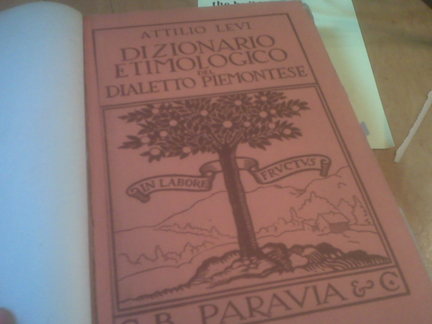
Above: I found this wonderful book at the New York Public Library.

Most etymologic dictionaries point to an unknown origin of the word but, while in NYC, I did find a wonderful (yet forgotten) fascist-era dictionary of Piedmontese dialect that reported the Provençal brich as the etymon.

But my most fascinating discovery was the eureka moment when I found one of the earliest known appearances of the term in print.

According to the Grande Dizionario della Lingua Italiana (the unabridged dictionary of the Italian language), the great 20th-century Piedmontese novelist and poet Cesare Pavese was probably the first to use it in a narrative, his masterwork no less, La luna e i falò (The Moon and the Bonfires), written in 1949 and first published a few months before his suicide in 1950.
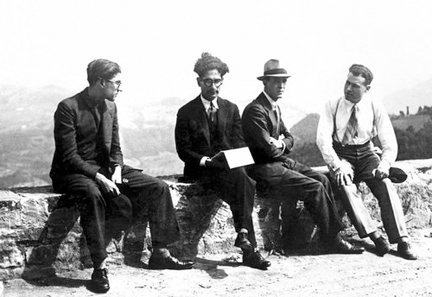
Above, from left: Cesare Pavese, Leone Ginzburg, Franco Antonicelli, and Augusto Frassinelli “in the 40s in the Langa hills.” (Source: Panorama.)

Here’s the passage (p. 30):

    fa un sole su questi bricchi, un riverbero di grillaia e di tufi che mi ero dimenticato.

As translated and published by R.W. Flint (a translator I admire greatly) in 2002:

    There’s a sun on these hills, a reflection from the dry soil and volcanic stone, that I’d forgotten.

It’s difficult for me to convey just how pregnant with signficance this line is, especially within the context of Pavese’s masterpiece. (See this synopsis of the novel and translation and profile of Pavese in The New York Review of Books.)

Flint renders an excellent translation of the line, perfectly aligned with the tone of the original and the translation as a whole. I like the way he has delivered grillaia into English: a grillaia is an ironic term that means literally a place where you’ll find only crickets (grilli), in other words, a barren or infertile place.

When the main character of the novel, Anguilla, returns from America after Italy’s Liberation from Fascism (but before the end of the Second World War), he is reminded of the barren nature of these hills — these infertile crags.

Let me offer an alternative, annotated translation:

    A sun beats down on these crags, reflecting off rocks fit only for crickets and the [nutrient-poor] volcanic soil — something I’d forgotten [while I was away in America, an Italian immigrant who fled fascism].

Is it not all the more remarkable that those very crags (bricchi) would ultimately deliver one of the greatest winemaking traditions of post-war Europe — Barolo and Barbaresco?

Post script: When I visited Langa in March 2010 with the Barbera 7, one of the wines that impressed me the most was the Lurëi by Il Falchetto in Santo Stefano Belbo, where Pavese was born in 1908.

Scenes from an East Texas 4th of July

Watermelon lady Maria gets her melons from Pitkin, Louisiana, where the sandy subsoil and high potassium content are ideal for the cultivation of tasty watermelons, she said.

This sweet lady made her patriotic vest herself.

We saw this license plate on our way over to Port Arthur. Translation: “Oklahoma University girl.”

Tracie P and I went bowling with nephew Brady to celebrate his birthday (4th of July).

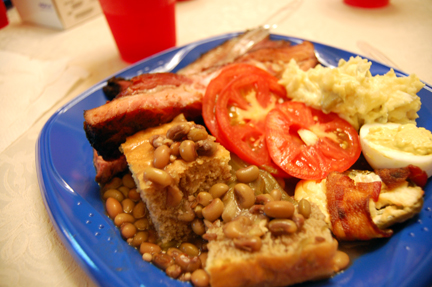
Purple hull peas, cooked with okra and served over crumbled cast-iron-skillet-fired corn bread was the highlight of dinner at Uncle Tim and aunt Ida Jean’s house on Cow Bayou. I had two servings of Tim’s award-winning potato salad.

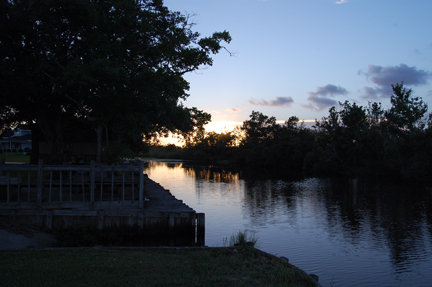
Sunset on Cow Bayou. I hope everyone had a fun and safe 4th!

On deck for tomorrow: the origins of the word “bric” and “bricco.” Stay tuned…

Rev. B’s birthday and the BEST chocolate cake

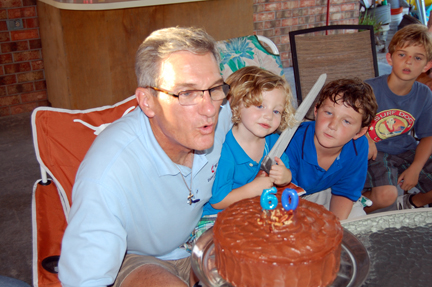
Yesterday, we celebrated Rev. B’s 60th birthday in Orange, Texas, where Tracie P grew up, on the Lusiana [sic] border. All the Johnson and Branch families were there, all the children, the Croakers and even the Manascos were there, too.

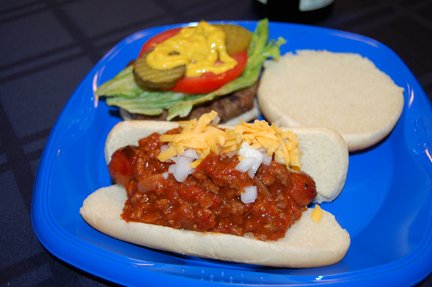
Mrs. B made homemade chili for DELICIOUS chili dogs and all the fixings for perfectly sized hamburger patties.

Tracie P made what everyone said was the BEST chocolate cake ever (and it was), now our official family chocolate cake recipe (if you’re real nice, maybe I could be convinced to share the recipe).

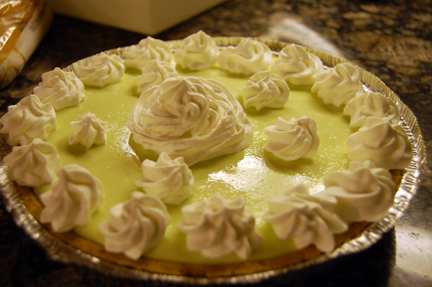
Jason M’s key lime pie — made with 20 key limes — was pretty spectacular, too. He made it fresh, just for us. It was rich in flavor but wonderfully light in mouthfeel. If you saw all those tattoos on Jason, the thought of him holding a pastry syringe doesn’t immediately come to mind. But man, that dude has a way with whipped cream!

Happy, happy birthday Rev. B! Know that we love you a lot and that I couldn’t have asked for a better father-in-law… :-)

Did you know that Rev. B is a blogger, too?

Happy fourth of July, ya’ll!

My Nudie boots, phase 2 of my TexMexamorphosis

You may remember the story about how I got my cowboy hat. Well, yesterday I received another sartorial gift from a Texan, equally cherished and most definitely destined for good use.

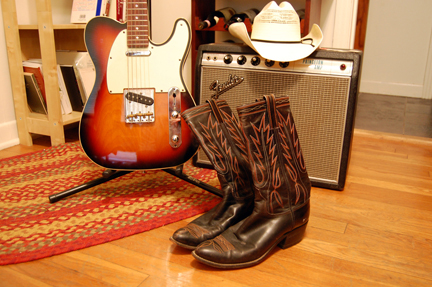
Yessiree, you got that right, those are genuine, original, vintage Nudie Cohn boots in that thar photeau above.

In case you don’t know Nudie, he was one of the great designers of the 20th century: he designed “Elvis Presley’s $10,000 gold lamé suit, worn by the singer on the cover of his ‘50,000,000 Elvis Fans Can’t Be Wrong album'” (see the Wiki) and he also created Gram Parsons’s “Gilded Palace of Sin” suit, now in the Country Music Hall of Fame in Nashville.

They were given to me by one of the most beloved folks in the Texas wine biz, Joe Pat Clayton (do you remember how Tracie P and I met Joe Pat, thanks to Cousin Marty, at a James Burton show in Austin?).

He bought them on Ebay but they didn’t fit him. “I just wanted to make sure they’d go to someone who’d know what they were and would appreciate ’em,” he said when he surprised me yesterday. Well, I’m here to tell you that he found the right guy!

Man, Joe Pat, I cannot thank you enough. I’ll wear them for sure next week at my show with The Grapes.

In other news…

I am hoping that the Prince of Puns, Thor, will appreciate a paranomasia I concocted yesterday for a new client in Austin:

Corn porn: the best kind of smut (huitlacoche)

fonda san miguel

Above: The huitlacoche (corn smut tamales) at Fonda San Miguel are UNBELIEVABLY good. Pair that with 1998 Tondonia Rosado by López de Heredia (at a more than reasonable price) and you’ll see why I love living in Austin, Texas.

Tracie P and I love eating at the bar. We love talking to bartenders and sharing wines with our neighbors.

Lately, our guilty pleasure has been the bar at one of our favorite restaurants in the world: Fonda San Miguel in Austin. Especially because they’ve recently added López de Heredia to their wine list (at more-than reasonable prices, one of the weird anomalies of living in Texas where most wine is more expensive than elsewhere but certain otherwise-unknown-to-Texans wines are sold for less).

Believe me when I tell you that the huitlacoche corn smut tamales alone would be worth the trip to Austin.

fonda san miguel

Above: To our palate, López de Heredia wines are among the greatest food-friendly wines on the planet. They’re not for everyone (with their highly oxidative style and to-some off-putting nose). To us, they are near perfection in a glass. Paired above with the excellent tortilla soup at Fonda.

Thanks again, bartender James (below) and wine director Brad for keeping those wines in stock! WE LOVE IT!

fonda san miguel

In other news…

I had a really crummy day yesterday but my Facebook friends and family got me through it with a flood of thoughtful messages. I can’t say how much I appreciate it. THANKS SO MUCH TO EVERYONE FOR YOUR SUPPORT. IT MEANS THE WORLD TO ME.

Jason, you know what’s playing on my jukebox today as I type away? Yep, you got it: DOUG SAHM.

I really cannot begin to explain how addicted I’ve become to the music of Doug Sahm. At first listen, the music may seem a little rough around the edges but once you scratch through its surface, you’ll find some real Texas soul and groove (“where the Cosmic Cowgirls play”).

My band The Grapes will be performing his ode to Austin, “Groover’s Paradise,” next Wednesday in La Jolla.

A “must read” for the true lover of Barolo

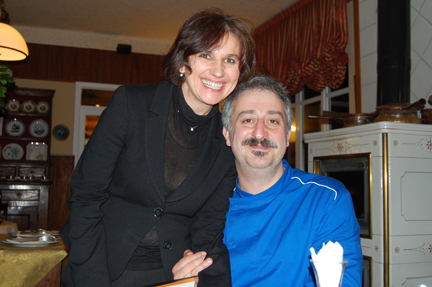
Above: Silvia and Nino Rocca preside over the kitchen and dining room of one of Piedmont’s most important wine destinations, Da Felicin in Monforte d’Alba. I took this photo in March when I dined there with the Barbera 7.

It was Charles Scicolone who, many years ago, first told me about Da Felicin, one of the great restaurants of Piedmont’s Langa hills and one of the world’s most important wine destinations — especially for those of us who worship in the temple of Nebbiolo.

Today, over at VinoWire, I’ve posted a translation of a post by my colleague and co-editor of the blog, Mr. Franco Ziliani (Italy’s A-number-1 wine blogger), about a very special bottle of wine that Felicin’s owner Nino Rocca shared with him. I hope that you’ll find Mr. Ziliani’s notes on this wine as moving as I did.

But, more importantly, this post — in part because of Mr. Ziliani’s interview of Armando Cordero, who made the wine in question — should be required reading for anyone trying to wrap their mind around what great Nebbiolo truly is and the modernist-vs.-traditionalist dialectic that is taking place on the ground in Langa. The information contained therein is subtle but fundamental. So please have a look

Buona lettura, as they say in Italian…

Ed McCarthy’s insights into Valentini, one of the absolutely best wines I’ve had in 2010

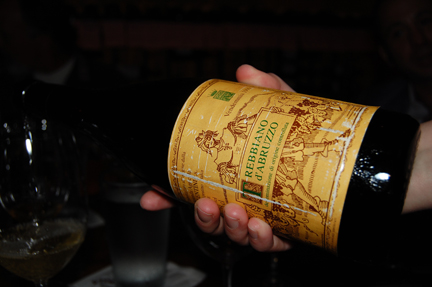
Above: One of the absolutely best wines I had this year was the 1999 Valentini Trebbiano d’Abruzzo, which I drank at the Orange Wine dinner we held at Vino Vino in Austin in April.

Ever since my friend and ex-boss Nicola Marzovilla became an importer of Edoardo Valentini wines earlier this year, this legendary winery has entered into a renaissance in the consciousness of American lovers of fine wine.

Eric did this excellent post on a portfolio tasting of the wines that took place a few weeks ago in NYC and last week, another of the wine writers whom I admire greatly, the inimitable Ed McCarthy, wrote this fantastic profile and remembrance of Valentini, his wines, and the winery (his notes on the different clones of Trebbiano are a must read for anyone interested in Italian wine).

Also worth checking out: this round-up, by my blogging colleague and friend James Taylor, of past literature on Valentini.

When I had dinner with Nicola in NYC last month, I grilled him about his recent visit to the property in Abruzzo. He was reluctant to give up the goods but he ultimately revealed some of the winery’s secrets. But you’ll have to pour me a glass to get them out of me!

1982 Taurasi: monosyllabic tasting note “wow” (and notes on the origin of the name)

From the department of “it’s not always easy to be an Italian wine professional, is it?”…

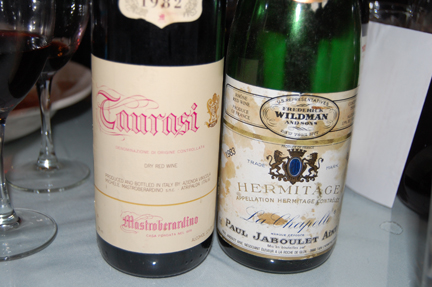
Above: I’ve tasted 1982 Taurasi by Mastroberardino before, but this bottle was special.

Alfonso will tell you: Dallas is a tough BYOB town. It’s not like Austin, where an abundance of trailer-park dining destinations and barbecue joints make it an ideal city for the BYOB-lover.

But on any given night you’ll find nearly half of the Dallas wine scene at Urbano Cafe, a relatively anonymous eatery in an otherwise gritty part of this otherwise ostentatious city, sandwiched between Jimmy’s Food Store (a great Italian wine and food destination, btw) and Spiceman F[arm to] M[arket] 1410, an amazing source for farm-to-table produce and heirloom and otherwise unusual cultivars.

I found myself there not too long ago with the cats from Grailey’s, a private wine club for high-rolling Dallasites. (Don’t look at their blog because you might end up with an acute case of Pinot envy.)

The price of admission to Grailey’s is a little steep for me but whenever I’m in town, the generously natured lads there invite me over for a taste of something old and Italian. You see, this private wine club was founded on the site of ol’ Mr. Grailey Lee Jaynes’s abandoned cellar. And while they might be selling Bordeaux-this or California-cult-that on any given day, there are lots of “onesies” and “twosies” of old Italian bottlings lying around from the old man’s collection. In most cases, those wines have been sitting there since Grailey purchased them.

Such was the case of the amazingly vibrant bottle of 1982 Taurasi by Mastroberardino. I’d tasted this wine on a few occasions in NYC but this bottling was by far the best expression of the appellation and vintage I’ve ever had. The fruit was bright and the acidity brilliant. When vinified in a tradtional style (as this wine was), Aglianico achieves a nobility rivaled by few other grapes varieties (Nebbiolo and Pinot Noir, I’d hazard to say). A bygone wine preserved in an anomaly in the space-time continuum.

Above: Michael Byington is one of the Dallas wine scene regulars who was there that night. Nearly every table in the restaurant was passing glasses to the next in a glorious and collegial exchange of vinosity.

I attribute the excellent condition of the wine to the fact that it had not been removed from old man Grailey’s cellar until the day we drank it.

The 1983 Hermitage La Chapelle by Jaboulet? Monosyllabic tasting note: “slurp.”

Thanks again, AJ, Dave, and Simon! You guys ROCK!

Btw, the toponym Taurasi is believed to be derived from the pre-Roman (probably Etruscan) taur[o] meaning mountain. One of the earliest documents mentioning the ancient village of Taurasi dates back to the 14th-century and there is also a mention inscribed in the sarcophagus of Scipio Barbatus (died 280 B.C.E.). The village sits above the valley of the Calore river at 398 meters a.s.l., hence the name.

Sounds like a great place to raise wine, no? (The hydronym Calore is a bit more problematic so I’ll have to go into that on another occasion.)

Thanks for reading!

Posts from the Gulf coasts and dispatches on the spill

Above: Guitar legend Jimmie Vaughan is a master of the “Gulf Coast” guitar style. I snapped the above photo last year at Antone’s in Austin.

Just a quick end-of-the-day post to point your attention to a couple of Gulf Coast blogs where you can read about the local impact of the BP oil spill. The author is Ms. Ashley, who reps Kermit’s wines in the South Eastern U.S. (we met when I accompanied Kermit on his record party tour last year).

Check out her posts on the oil spill and how it’s affected gulf coast beaches and the local food and wine economy, here and here (with photos).

Thanks for reading: please don’t forget the victims of the BP oil spill!

Pairing Japanese with Italian, naturally, and June Rodil’s faboosh new list

uchi austin

Above: We paired 2008 Santa Chiara by Paolo Bea Saturday night with our sashimi et alia at the new Uchiko in Austin (friends and family soft opening). Not to be down with the dogma, but few would argue with the street cred of this natural wine. (Are you following the 32 Days of Natural Wine?)

Tracie P and me paired some Italian with Japanese on Saturday night during the soft opening (ongoing) at Austin’s new Uchiko, offshoot of the wildly successful and popular Uchi. The 2008 Santa Chiara by Paolo Bea — with its saltiness, crunchiness, and acidic nervousness (to borrow a phrase minted by Scott) — was brilliant with the myriad flavors that flowed like a red tide over our tongues.

Do you need me to tell you that the food at Uchiko was great? Nah… everyone knows why the Austinite Uchi brand has enjoyed such favor in this city on a river. In fact, the Uchi (now) family of restaurants stands apart as one of the few truly world-class dining destinations in Central Texas (beyond the apotheosis of barbecue in the form of a small Texas town known as Lockhart).

uchiko

Above: Tracie P and me with the reigning “best sommelier in Texas” June Rodil (center).

What I am here to tell you is that the truly amazing June Rodil has put together a simply faboosh list there, with wines from the Jura, from the Loire, from Italy, and even some interesting Californians that might surprise the Cabernet-loving patron who thinks that Silver Oak goes with just about everything.

Chapeau bas and mazel tov and muchísimas gracias, June!

We had a fantastic time and awesome food and wine Saturday night, with great service (despite the kinks yet to be worked out in this newly christened kitchen).

But the best part of the evening was listening to 80s hits when we got home and Tracie P’s karaoke performance of Whitney Houston’s “How Will I Know,” complete with television remote control microphone and air guitar solo…