Best BBQ on 290: City Meat Market, Giddings, TX

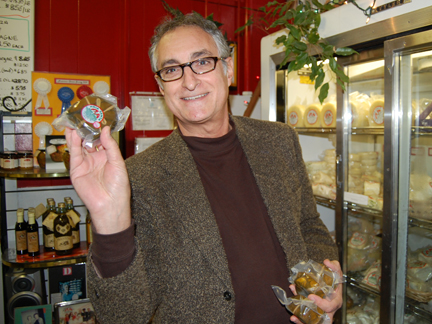
Posting hastily this morning from the road. Currently in Houston to speak at a wine event last night and meetings this morning but here are some images from my new fav bbq joint, where I stopped for lunch yesterday: City Meat Market in Giddings, TX (Giddings is a small town on highway 290 that leads from Austin eastward). I haven’t tried every place on 290 yet but so far this is the best.

BrooklynGuy would love this place. It’s the real deal. You’re served your meal on butcher paper (it’s also a butcher) and everything else is served in styrofoam.

What are old bottles of Gallo cooking vermouth good for? Yes, you guessed it: homemade hot sauce. I asked the owner how he likes to use the sauce: “I just pour it on a piece of bread and eat it,” he said. I tried it and it was great.

I’m glad I didn’t step in it! Locally produced spicy seasonings and rubs.

Highly recommended.

On deck for tomorrow: a new Barbaresco cru? I finally got to the bottom of the Vicenziana designation…

Waiter, waiter: I’ll have what Eric’s having…

Above: Last night, Tracie B and I opened Puffeney’s 2006 Trousseau, one of those “original” wines that we couldn’t stop talking about. Photos by Tracie B.

The wines from the Jura first came to my attention at one of my favorite restaurants in the world, L’Utopie in Québec City when my band Nous Non Plus was on tour there a few years back. Thirty-something owner and sommelier Frédéric Gauthier has an amazing palate and his list has always delivered something unusual and exciting to my table.

So when I read Eric’s preview of his column on the “Unusually Good” wines from the Jura at the end of a long workday for both me and Tracie B, I decided to cork a bottle of Puffeney 2006 Arbois Trousseau that we had picked up here in town at The Austin Wine Merchant.

At a talk on modern vs. traditional wines he gave in New York a number of years ago, Angelo Gaja discussed what he called “original” wines: wines that “surprise” you, he said.

The Trousseau, like nearly everything I’ve tasted from the Jura, was one of those “original” wines: it’s one of those wines that could only be made in that place, by those people, using the grapes, the techniques, and the terroir that belong uniquely to them. It was light in body but with some confident tannin, with berry fruit and brilliant acidity. Tracie B and I couldn’t stop talking about it: one of those wines that surprises you and speaks of a little mountainous utopia in France along the Swiss border where they make truly wonderful wines.

We loved it and I also highly recommend Eric’s column today in the times. Wine Digger digs these wines, too, as does McDuff. And here’s a little background on Puffeney’s methods.

Get it at The Austin Wine Merchant. Enjoy!

A post dedicated to mama Judy

From the di mamma ce n’è una sola department…

judy parzen

Above: That’s mama Judy visiting Christo’s Gates in Central Park in 2005.

Today is my mom’s birthday and so this post is dedicated to her. Last year, we held a special party for her in the La Jolla Cove Park but now that I’m living in Texas I can’t be there on her actual birthday and so I wrote a special arrangement of Happy Birthday and recorded it on my Mac using GarageBand and made a little slide show movie, with all of her children and grandchildren, including the newest arrival, little Oscar.

Mama Judy likes to drink wine when she throws her famous dinner parties. Like BrooklynGuy does for his parents, I keep her cellar (well, her closet actually) well stocked with good wine. Most recently, she’s been liking the Lini Lambrusco (the rosé in particular), Borgogno Barbera 2007, and her all-time favorite is probably the Chablisienne village Chablis.

Happy birthday, mom!

Banfi 2004 Brunello, I cannot tell a lie (and other notes and posts on 04 Brunello)

Tracie B snapped the above pic of me using my Blackberry the other night, when she came home with an open bottle of Banfi 2004 Brunello di Montalcino in her wine bag (when not otherwise occupied being knock-out gorgeous, Tracie B works as a sale representative for a behemoth mid-west and southeastern U.S. wine and spirits distributor).

The moment of truth had arrived: it was time for me to taste the wine with my dinner of Central Market rotisserie chicken, salad, and potatoes that Tracie B had roasted in her grandmother’s iron skillet.

The wine was clear and bright in the glass and had bright acidity and honest fruit flavor. The tannin, while present, was not out of balance and the wine had a slightly herbaceous note in the finish that might not please lovers of modern-style wines but that I enjoy. If ever there were a wine made with 100% Sangiovese grapes, I would say this were one — tasted covertly or overtly.

According to WineSearcher.com, the average retail price for this wine in the U.S. is $65. I can’t honestly say that I recommend the wine: it’s not a wine that I personally look for at that price point. I did not find this to be a great or original or terroir-driven wine but I will say that it is an honest expression of Sangiovese from Montalcino.

Anyone who reads my blog (or follows news from the world of Italian wine), knows that Banfi has been the subject of much controversy over the last year and a half. But fair is fair and rules are rules and I cannot conceal that I enjoyed the 04 Brunello by Banfi. (Btw, Italian Wine Guy, who is Glazer’s Italian Wine Director, recently posted on 04 Brunello, including a YouTube of Banfi media director Lars Leight speaking on the winery’s current releases at a wine dinner in Dallas.)

Above: Facing south from Il Poggione’s vineyards below Sant’Angelo in Colle, looking toward Mt. Amiata.

Despite the will of some marketers to make us think otherwise, 2004 was not an across-the-board great vintage in Montalcino. In my experience with the wines so far, only those with the best growing sites were able to make great wines in the classic style of Montalcino and wines that really taste like Montalcino.

Btw, in all fairness, it’s important to note that the Banfi vineyards lie — to my knowledge — primarily in the southwest subzone of the appellation, one of the historic growing areas for great Sangiovese. When you drive south from Sant’Angelo in Colle, you see signs for the Banfi vineyards on the right. Earlier this year, my friend Ale over at Montalcino Report posted this excellent series on understanding the terroir of Montalcino using Google Earth. It’s one of the best illustrations of why the wines from that part of the appellation are always among the best, even in difficult years. (Ale’s killer Il Poggione 04 Brunello, which I tasted for the first time at Vinitaly in April, received such glowing praise from one of the world’s greatest wine writers that it caused near pandemonium in the market, prompting wine sales guru Jon Rimmerman to write that it “may be the most offered/reacted to wine I’ve ever witnessed post-Wine Advocate review.”)

Above: Facing north in Il Poggione’s vineyards, looking at the village of Sant’Angelo in Colle (literally, Sant’Angelo “on the hill”).

Franco recently tasted 93 bottlings of 04 Brunello at the offices of The World of Fine Wine in London and wrote of his disappointment with the wines delivered by even some of the top producers. Here are Franco’s top picks and straight-from-the-hip notes, posted at VinoWire.

In other news…

One of the greatest moments of personal fulfillment in my life was when my band NN+’s debut album reached #6 in the college radio charts so I guess that stranger things have happened: a colleague in Italy emailed me last week to let me know that my blog Do Bianchi was ranked #9 in the official (?) list of “top wine blogs.” Who knew?

Thanks, everyone, for taking the time to read Do Bianchi. The blog has been such a rewarding experience for me and it means so much to me that there are people out there who enjoy it.

This is why wine blogging is so cool…

From the “it’s Friday” department (more on Sir Robert’s blogging to come next week)…

Above: Friend John Rikkers brought me and Tracie B this bottle of 1996 Fleury to celebrate our engagement. He knew that I liked it so much because he had read my post on drinking it with BrooklynGuy, who had turned me on to this killer wine. We opened it last month at Jaynes.

Today is a special day. Money is tight, times are tough, and I’m struggling, just like a lot of friends of mine in the food and wine biz. But today is a special day. I woke up today and was reminded of all the good things and goodness I have to be thankful for.

Thinking about the events of the summer, I remembered that a friend I made through blogging brought me and Tracie B a bottle of 1996 Champagne by Fleury to celebrate our engagement when she and I visited San Diego last month. I had first tasted that wine when another friend I made through blogging brought a bottle of it to our first (and only) in-person meeting a year ago last August. (The wine was fantastic both times, btw, toasty and nutty, with white fruit and caramel flavors, a great vintage and a great value from a great producer, a “grower producer” of Champagne, or so I’ve been told; but don’t quote me to the Grower Champagne police!)

Above: Me and Tracie B earlier this year at one of our favorite spots to watch the sunset in Austin. We both have a lot to be thankful for: the love and support of our family and friends and a good, happy, and healthy life here in Texas. And who would have ever dreamed that a beauty like her would fall for a schlub like me? We met through wine blogging, too!

Tonight is the first night of Rosh Hashanah, the Jewish new year. The Jewish calendar follows a lunar cycle and the new year begins at the time of harvest. Just as in the cycle of life, this is a time for new beginnings and starting anew. May your names be inscribed in the tablets of heaven and may your new year taste as sweet as apples and honey.

L’shanah tovah ya’ll!

Check out this really cool story I read this morning with my coffee about a soldier turned cantor on the battlefield in WWII.

The origins of Zibibbo (closer reading part 2)

pant1

Photos of Pantelleria by Alfonso Cevola.

In response to my post on Sir Robert the other day, both Charles (friend, mentor, venerated palate, and husband to Italian cookery authority Michele Scicolone) and Tracie B (my soon-to-be better and definitely better looking half) asked about the origins of the grape name Zibibbo.

In 1605, Sir Robert writes of white Tuscan grape “Zibibbo,” which is “dried for Lent.” It is highly likely that he is referring to the Tuscan tradition of Vin Santo. One of the unique things about Vin Santo, beyond the winemaker’s intentional oxidation of the wine, is that it often undergoes a second fermentation in the spring when temperatures begin to rise and my hunch is that the reference to Lent has something to do with vinification practices (but that’s another story for another post).

Today, we know Zibibbo as the white Moscato used to make the famed wine of Sicily, Passito di Pantelleria. But in antiquity, the word meant simply “dried grape,” from the Arabic zabib, akin to the Egyptian zibib. As it turns out, it was only recently that the term began to denote specifically the grapes used for the famous wine of Pantelleria. It’s not clear which variety Sir Robert is referring to but he’s clearing referring to a dried grape wine (especially in the light of his reference to Lent).

pant2

When I was a grad student, my dissertation adviser used to call me the segugio, the blood hound or sleuth: this morning I did some snooping around and found and translated the following passage by one of Italy’s greatest philologists, Alberto Varvaro, professor at the University of Naples (o what a joy to be reunited, finally, with my library!). I love what professor Varvaro has to say in his conclusion, i.e., that part of the reason why we’ve come to know Moscato d’Alessandria as Zibibbo is because Palermitan shopkeepers adopted the term as a designation of higher quality in order to charge higher prices.* I also love Varvaro’s Sicilian style and humor in describing this linguistic phenomenon — all the while in a highly erudite and scientific context. Varvaro was born in Palermo in 1934 and is one of Italy’s leading experts in dialectology.

    Everyone knows Zibibbo, the excellent white table grape variety, grown for the most part in Pantelleria (hence the name)… Many are quick to say that this has always been its name and that the connection between the name, meaning, and referent-object has ancient and undisputed origins.** But this is not the case: the Arabic zabib, which with all likelihood gave the name to our grape, was a dried grape and was probably the meaning of the term when it began to be used in Sicily (according to [anthropologist] Alberto Cirese, its meaning remained unchanged in outlying areas and as far away as Central Italy). Even if this were not true, there is no disputing the fact that dictionaries in the 1700s and 1800s unhesitatingly define the term zibbibbu as a red grape and therefore, there is no doubt that the word’s meaning has changed only recently. Lastly, it is worth noting that the grape’s history in Pantelleria is proof of this recent change. Apart from its past history, it is useful to consider the present state of things: as if to play a trick on Linnaeus [the father of modern taxonomy] and surely motivated by profit and self-promotion, most of the shopkeepers in Palermo make a clear-cut distinction between zibbibbu and uva: if you use the word uva [i.e., grape] when you ask for zibibbo, the shopkeepers will correct you, perhaps because they suspect you wish to pay less. Thus, we have a case in which the solidarity of the name, meaning, and referent object has been broken in relation to a change in the referent-object as well as in relation to the linguistic articulation of the meaning.

pantelleria3

If I keep up this scholarly Sicilian sleuthing, ya’ll might have to start calling me Dr. Montalbano!

Thanks for reading…

* In Grape Varieties of Italy, Calò, Scienza, and Costacurta list these synonyms for Zibibbo: Zibibbo Bianco, Moscatellone, Moscato di Pantelleria, Salamonica, Salamanna, Seralamanna, Moscato di Alessandria [Muscat d’Alexandrie, Muscat from Alexandria, a reference to its Egyptian origins], Muscat [in French].

** Referent or referent-object is a term used in linguistics to denote “The entity referred to or signified by a word or expression; a thing or person alluded to” (OED). In this case, Varvaro is using a classic triangular model of linguistics, articulating the word itself (the name or signifier), its meaning (the signified), and the actual object to which it refers.

A closer reading: “The vine is the greatest commodity of Tuscany, if not of Italy.”

This just in: taste old Australian Semillon with me at Jaynes Gastropub in San Diego on Saturday, September 26… yes, Australian wine, can you believe it?

Above: At the time of Dallington’s visit to Italy (1596), Bacchus was often depicted with Ariadne, his wife, as in this painting by Guido Reni (1557-1642). Today, we think of Bacchus (or Dionysus) as the god of wine. In fact, he was the god of luxuriant fertility, which was symbolized by the vine in antiquity, and so by association he became the god of wine. In ancient Italy, he was associated with the indigenous god Liber, who was celebrated with joyous abandon during the time of the grape harvest.

My post the other day on an “earlier Tuscan sun” and the description of grape growing and viticulture in late 16th-century Tuscany elicited some interesting comments and questions. Thanks, everyone, for taking the time to read and comment.

Simona, author of Briciole, brought up an important point: in the first line of the passage, Dallington uses the term Italy.

    The Vine.. without comparison is the greatest commodity of Tuscany, if not of Italy

Italy, as we know it today, was unified for the first time for a brief period in the modern era under Napoleon (1805-1814). Only in 1861 did Italy — as a nation — achieve independence from foreign domination. Until that time, the Italic peninsula was divided among its principalities or microstates, which often aligned themselves in league with foreign powers but never achieved a confederation defined by Italy’s natural geographical boundaries.

According to the OED, the toponym Italy begins to appear in the English language toward the end of the sixteenth-century, the same time that Dallington made his trip to Tuscany. (The terms Italy, Italian, and Italo, derive ultimately from the Latin Italia, in turn from the Latin Vitalia from vitulus, meaning calf; the ancient name Vitalia was owed to Italy’s abundant cattle.)

Even though the notion of the Italian nation and the term Italia had distinctly emerged by the 14th century (think of Petrarch’s song 126, Italia mia, ben che’l parlar sia indarno [My Italy, although speech does not aid]), the citizens of the Duke State of Tuscany encountered by Dallington would hardly have called themselves “Italians.”

Simona was right on: it’s truly remarkable that Dallington uses the term Italy and implicitly refers to an Italian nation. But what I find even more remarkable is the fact that he calls the vine the “greatest commodity of Tuscany, if not of Italy.”

More than two centuries had passed since Petrarch reproached the gluttonous cardinals of Avignon for their immovable love of Burgundian wine, asking them, “Is it not a puerile ambition to malign the many types of wines, so plentiful, found in all parts of Italy?” (See my post on this famous letter by Petrarch to Pope Urban V here.) The papacy was returned to Italy in 1378.

More than two centuries later, a foreigner arrived from Elizabethan England, and called the vine “Italy’s greatest commodity” — a preview of how viticulture would become a sine qua non of the Italian nation and Italian national identity.

This is the first in a series of “closer readings” of the Dallington text inspired by visitors’s comments. Next up: the origins of the term zibibbo. Stay tuned…

Yeaster me, yeaster you, yeaster day

Above: In some parts of the world, the “yeasting” of wines is common practice and is considered a genuinely positive aspect of human intervention, as evidenced in this post by Vinogirl. I don’t know much about Vinogirl but I love reading her blog and her posts about harvest in Napa are wonderful.

Ever the Solomon of wine bloggers, Eric posted Friday on the sometimes “strident” tones tossed about in the debate over natural wine and its definition.

I greatly appreciated Eric’s observation:

    I think that too much effort is spent coming up with a precise definition. Making wines “naturally,’’ after all, does not mean the wines are any good. All things considered, I prefer wine that would fit a rough definition of natural. But I don’t think the dividing line between natural and — what, unnatural? — is always that clear. Certainly, it is not if you are trying to characterize a winemaker.

Above: I tasted with Produttori del Barbaresco winemaker Aldo Vacca this year at Vinitaly. He is one of the most earnest and forthright winemakers I’ve ever met and I love his wines.

It does seem that the one thing that all natural wine lovers — from enthusiast to dogmatist — agree on is that “ambient” or “native” yeasts (i.e., naturally occurring yeasts) are a key if not the key element necessary to be allowed into the natural wine pantheon.

The delicate issue of yeast was illustrated Eric’s account of winemaker Roumier who “tries to make wine as naturally as he can, but he told a story once of having a batch of wine that had gotten stuck in mid-fermentation. The only way he could get it going again was to add yeast, a cardinal sin among many natural wine devotees.”

It made me think of what Produttori del Barbaresco winemaker Aldo Vacca recently told me when I called him to transact some other business but couldn’t resist asking him about the practice of “yeasting” at the winery.

“In a great vintage, we do not add yeast,” he said, “because the fermentation does not need any help. But in many vintages, we use a yeast called ‘Barolo strain’ that was developed based on yeasts that occur naturally in our terroir.”

According to the results of a quick Google search, the Barolo strain was “selected from 4 year study by University of Torino from over 600 isolates taken from 31 wineries of the Barolo region. The selection goal was to find a dominant natural yeast from Nebbiolo that is able to retain and enhance color.”

I never have and never would call Produttori del Barbaresco a “natural wine,” even though I believe the style of the wine jives with the wines of producers who subscribe to the natural wine movement. And I wonder if any of those winemakers have ever used a cultured yeast in a challenging vintage (like Roumier).

Throughout the debate, many have asked rhetorically, would the coinage of an expression other than natural wine offer an umbrella for those wines that aspire to the ideals of natural winemaking but don’t quite achieve its sanctity?

Founder Teobaldo Cappellano dubbed the Italian natural wine movement Vini Veri or Real Wines and added the epigram, wines as natural intended them.

Perhaps we should call these wines “humanist” wines. After all, all wine is made by humankind for consumption by humankind. In the end, I find that the wines I like the best are the ones that take into account not nature but rather “human scale,” as Guilhaume Gerard put it (in his remarks at the Symposium).

We can discuss natural wines and their definition until we’re blue in the face, but in the end, we are human — all too human.

Forget natural wine: the Texas weather will put the fear of G-d in you. I snapped this photo yesterday as Tracie B and I were strolling across the Colorado River. Click the photo for the full-sized image.

Super Texans: tasting Texas with the Austin Dream Team

Above: The Austin Dream Team. From left, Craig Collins (Central Texas Sales Manager for Prestige Cellars), Devon Broglie (Southwest Regional Wine Buyer for Whole Foods Markets, which was founded in Austin), and June Rodil (recently crowned “best sommelier in Texas,” sommelier at Uchi in Austin, a world-class and cutting-edge Japanese restaurant in land-locked central Texas).

This was no run-of-the-mill focus group. It was an Austin Texas USA dream-team of young sommeliers gathered by the PR firm that reps the Texas Department of Agriculture to taste some Texan wines blind.

Folks in Texas are serious about their wine (Texans love to drink locally) and when it comes to marketing of local products, they don’t kid around: these top young somms had been asked to give their honest no-holds-barred opinions of the wines (each flight included a ringer, not from Texas) to help gauge which wines to present to food and wine writers and pundits etc.

Frankly, I haven’t taken Texan wines very seriously since I moved here nearly 10 months ago but — as Franco rightly reminds me — rules are rules: when you taste blind and you taste something you like, you have to admit it (even when you weren’t expecting to like it) and frankly, I tasted more than one wine I liked in yesterday’s degustation.

And there was another surprise as well.

I had never heard the term Super Texan before and when I wondered out loud why so many Texan wineries are Italophilic as opposed to Francophilic (like their Californian counterparts), one of the more interesting theories was proposed by June, who noted that Texas is a predominantly Republican state and has a historic distaste for Francomania.

Above: Also in attendance was wine writer David Furer who came to town especially for the tasting and who was lucky enough to taste Tracie B’s farro salad the other day at our impromptu Labor Day picnic.

In the first flight of red, we tasted a number of wines made with Sangiovese (monovarietal or blended) and varietal expression was clearly evident. The wine that impressed me the most was the Llano Estate Newsome Vineyards High Plains Viviano, a “Super Texan” blend of Cabernet Sauvignon and Sangiovese. The wine was real, it was elegant, it had natural acidity, honest fruit, and genuine freshness (although I’m not sure I would reach for it at $40 a bottle).

In the same flight, however, was a wine that the panel didn’t seem to like because of a green, herbaceous quality. When asked my opinion (and frankly, I was out-classed by these top somms in their superior ability to taste and describe blind, ubi major minor cessat), I asked the other participants “to cut it some slack,” as it was also one of my favorites in the flight. Anyone who knows me wouldn’t be surprised at the laughter in the room (Devon and Craig and I have tasted a bunch of times together) when it was revealed that my ugly duckling was Italian.

But to my great surprise, it was a wine that I never would have thought I’d like, 2006 Chianti Classico by Badia a Coltibuono, a high-volume winery that has enjoyed wide success in the U.S. thanks to aggressive, intelligent marketing. According to the website, 170,000 bottles of this wine are produced every year, but, frankly, I could really taste place in this wine: it had that characteristic Sangiovese plum note and I liked its food-friendly herbaceousness. For $25, I like it. There you go: rules are rules and there’s a lot to be said for tasting locally.

In other news, another taste of Texas…

Tracie B snapped this slice of Texan life last night outside the Broken Spoke where I played a gig. I gotta say that I love living in Austin… not that the lovely Tracie B has anything to do with it… ;-)

Italy: Birth of a Wine Nation

From the “a Ph.D. has got to be good for something, doesn’t it?” department…

Jeremy Parzen

I am thrilled to announce that I’ll be teaching a six-part seminar on Italian wine starting a month from today, every Tuesday at 7 p.m., at The Austin Wine Merchant. The title of series, “Italy: Birth of a Wine Nation,” was inspired by the vision of Italy’s first two prime ministers, Camillo Cavour and Bettino Ricasoli, both winemakers in their own right. As Italian independence and the Italian monarchy began to take shape in the second half of the nineteenth century, Cavour (in Piedmont) and Ricasoli (in Tuscany) envisioned the production of fine wine as a loadstone of the nascent Italian economy, identity, and nation. If only they were alive today to experience the renaissance of Italian wine!

Please join me in October and November for one or more of my classes and tastings (6 wines will be tasted during each session in one-ounce pours). Participants may reserve for individual or multiple sessions.

ITALY: BIRTH OF A WINE NATION

A 6-class series on Italian wine, past, present, and future with Jeremy Parzen, Ph.D.

Tuesdays in October and early November, staring at 7 p.m.

The Austin Wine Merchant
512 W 6th St.
Austin, TX 78701-2806

To reserve, please call: (512) 499-0512.

Italian Wine 101 — October 6 — $25

Introduction to Italian wines, an overview of Italy’s most important grapes and major wine production zones, and the secret to unlocking the mysteries of Italian wine labels. Taste 6 wines from 6 different regions.

Jeremy Parzen

Tuscany — October 13 — $37.50

Learn what makes Super Tuscans so super (you might be surprised at the answer), experience Italy’s quintessential red grape Sangiovese in its greatest expressions (modern and traditional). Taste six wines including Brunello di Montalcino and Chianti Classico.

The “Other” Piedmont — October 20 — $25

This is the Piedmont your mother didn’t tell you about: Moscato d’Asti, Gavi, Freisa, Dolcetto, Barbera, and “outer borough” Nebbiolo. Taste 6 wines that the Piedmontese produce and drink regularly.

Jeremy Parzen

Piedmont’s De Facto Cru System — October 27 — $37.50
(recommended for wine professionals and collectors)

Learn the difference between the east and west sides of the Barolo to Alba road and explore the nuanced distinctions between Tortonian and Helvetian subsoils. Debunk the feminine vs. masculine myth in the Barbaresco and Barolo debate. Taste 6 noble expressions of Nebbiolo.

Jeremy Parzen

The Enigmatic Wines of the Veneto — November 3 — $37.50

Unlock the mysteries of Valpolicella, Amarone, and Recioto della Valpolicella, taste one of Italy’s most ancient noble wines, Soave, and learn why Venetians love their Prosecco so much. When in Venice: taste 6 ombre as the Venetians say!

Jeremy Parzen

Italian Wine and Civilization — November 10 — $25

Read 6 passages from Italian literature and history and taste 6 related wine selections. Readings include Dante, Machiavelli, Vice Admiral Horatio Lord Nelson, Camillo Cavour (above, far left, 19th-century Piedmontese winemaker and Italy’s first prime minister), and Bettino “Iron Baron” Ricasoli (above, far right, 19th-century Tuscan winemaker and Italy’s second prime minister).

To reserve, please call: (512) 499-0512