Do Bianchi live at Austin360.com today

Above: Sunday evening found me and Tracie B tattered by the rain and mud at the Austin City Limits musical festival but warm and happy at the dinner table of the inimitable Bill Head — Austinite bon vivant and all-around good fellow. Bill made a wonderful ragù alla bolognese and so I brought along a bottle of Lini Lambrusco (in this case, Lambrusco di Sorbara). As restaurateur Danny Meyer likes to say, “if it grows with it, it goes with it.”

If you happen to find yourself near a computer this afternoon at 3 p.m. (Texas time), please check out a live chat that I will be doing today with Austin American-Statesman social columnist Michael Barnes at Out and About (Austin360.com).

Above: We were also joined Sunday night by Austin natural treasure Mary Gordon Spence (to Bill’s left), writer, humorist, and radio personality, who had many wonderful tales to tell of her recent trip to Italy, and University of Texas professor of government David Edwards.

We’ll be chatting about the series of classes on Italian wine I’m teaching every Tuesday at The Austin Wine Merchant beginning this evening.

Tonight’s class is sold out and the others are filling up quickly but there is still some space available. My favorite session is Italian Wine and Civilization (Tuesday, November 10), where we read a passage from Italian literature or history, and then taste a wine in some way pertinent to the text. Did you know that Niccolò Machiavelli was a winemaker, for example?

In other news…

Tracie B and I braved the rain and mud at this year’s Austin City Limits festival on Sunday. We didn’t stay long but did get to catch the B52s’s set, which couldn’t be anything other than super fun, and we also enjoyed super-shiny sisters-and-brother bluegrass/country act Jypsi (below). Jypsi was a little slick for my taste but man can they play!

Just over a year ago, I came to Austin for the second time to visit with Tracie B. Do you remember? Here’s a little post from the archive. We recreated the Austin City Limits photo op this year, except for this time sans mustache! ;-)

Unforgettable: James Burton at the Continental Club, Austin, TX

From the “Nebbiolo meets the Hag” department…

james

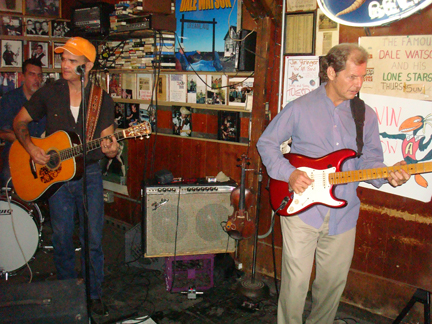
Above: THE LEGENDARY JAMES BURTON has played on more of my favorite albums and tracks than I can count. Check out his discography here. Last night’s show at the Continental Club in Austin was one of the most amazing experiences of my life… literally… We had a blast. Photo by Tracie B.

It’s all thanks to my cousin Marty, who gave my number to Joe Pat, who used to be the wine director at Tony’s in Houston, where Marty is a regular (“John Kerry could be in the house,” said Joe Pat, “and if something was wrong with Marty’s salad, Tony would drop everything to take care of it.”) After taking a glance at my blog, Joe Pat knew what kind of music I liked: “The Hag and Barbaresco are two great things,” he once wrote me in an email (before we met last night), referring to Merle Haggard, “and why are there more references about wine in country music than all genres combined.” Friday, Joe Pat called me to tell me that James Burton was playing at the Continental Club in Austin, one of the greatest American honky tonks (in my humble opinion).

chicken_pickin

Above: James Burton is the father of a style of guitar playing called “chicken pickin.” A special gauge (thickness) of strings is used to allow the player to bend the strings easily with the middle, ring, and little fingers, while s/he holds a pick in between the thumb and index finger.

He opened his set with “Las Vegas” by Gram Parsons — the opening notes are one of his most famous riffs. What followed was a string of “hits”: he played everything from Ricky Nelson to Elvis and Merle Haggard, and everything in between, all the unforgettable riffs and solos that took some of the greatest songwriting and performances from A to A+. The number that moved me the most was “I am a Lonesome Fugitive” by Merle Haggard: if you’ve never heard it, check it out and you’ll see/hear why his guitar playing is so important in terms of how it shaped popular music in this country.

jar_tra

Above: Isn’t she gorgeous? I am simply the luckiest guy in the world to have found her. I mean, she is the sweetest girl in the world and she LOVES her some James! And she can cook… AND she can speak Italian! ;-)

Man, I love this town and I love that girl for bringing me here!

We’re heading out to a day at the Austin City Limits music festival…

Happy Sunday ya’ll!

I love this town: Gary Clark Jr. at Antone’s

gary clark jr

It’s ACL weekend here in Austin and there are so many major cats playing at all the great clubs here in town.

Last night Tracie B and me caught Gary Clark Jr.’s set at Antone’s. He lives here and MAN CAN THAT DUDE PLAY GUITAR. The below YouTube is a taste (from another show) of what we heard.

I love this town…

Eating crow: Australian wine that I truly loved

jaynes_burger

Above: No trip to San Diego is complete without a Jaynes Burger at Jaynes Gastropub.

It was the white wine that first intrigued me and lured me in. And then it was the red — gritty and tannic but just old and wise enough — that seduced me.

For many years it seemed inconceivable to me that I would even approach Australian wine, let alone like it. When my band Nous Non Plus played in Germany last year at a Green party conference, I even tried to talk some young attendees out of drinking the famed critter wine, telling them that its consumption was diametrically opposed to their ideals.

But as some of the exchanges of the last few months have taught me, the extremes of extremism go the way of the historical avant-garde and Yale school deconstruction: after you kill the author (or the winemaker), you ultimately are left with nothing, n’est-ce pas?

lovedale

Above: Chef Daniel made a wonderful yellow tomato coulis vinaigrette with his seared scallops. The pairing with the 1986 Semillon was off-the-charts good.

Well, it’s time for me to come clean: on Saturday night I hosted a wine dinner in San Diego at Jaynes Gastropub where I poured 6 Australian wines that I truly loved. Three bottlings of older Semillon, including Mt. Pleasant 1986 Lovedale Semillon, and three bottles of older Shiraz, including Hardy’s Eileen Hardy 1998.

The whites — including the 23-year-old — showed beautiful acidity and white fruit and all were at about 11% alcohol. The Tyrell 95 and 96 were still babies in the glass but opened up beautifully as they arrived at room temperature and aerated: they drink more like red wines than white.

The reds were gritty and tannic, with integrated wood, but with approachable berry fruit and woodsy flavors. The only wine that seemed a little bit “slutty,” as we sometimes say in the business, was the crowd-pleasing 2001 Tower Barossa Shiraz. But I have to say that I liked it. It wasn’t overly jammy and although it lacked the structure of the Hardy, it was fun and easy to drink and not offensive in the way that some of the commercially produced wine that I’ve seen from Australia.

So, there! Do I have to write a recipe for eating crow? What would you pair with crow anyway?

All I do know is that the 1999 Hardy’s that I discreetly opened and paired with the Jaynes burger the night before was decadently brilliant.

One crazy ass psychedelic wine shirt

Casual was the call for attire at the wine dinner I hosted on Saturday night at Jaynes Gastropub and so I decided to don the above psychedelic vintage 70s disco shirt (recently unearthed in a box that arrived with my library from my Manhattan storage). I’ve never really been able to figure out what it means. On the back, a bunch of grapes transforms into silver balls. On the front, silver balls reveal a convex image of a wine bottle and one of the balls falls to the ground and bursts. There is an upside down dessert sunset that lines the bottom of the shirt (from the wearer’s POV, it looks like a sunset).

I’ll post more on the dinner tomorrow so stay tuned: Australian wines I like! Yes, I actually found some!

In other news…

Tom, I thought you’d never ask! Tom over at Fermentation posted my BloggerView interview yesterday. Tom’s blog is currently the number 1 most-visited wine blog in the world and I was thrilled that he asked me to do an interview. I had a lot of fun with it and was flattered by Tom’s generous words. Click here to read.

Even more thrilling was the revelation of what will become my new tag line: “Guitar slingin’ somm and scholarly scribe of vinous humanism Jeremy Parzen.” Thanks, McDuff, for the new epigram and thanks for the generous shout out.

Lastly, due to an editing error on my part, one of my favorite wine blogs ended up on the cutting room floor of Tom’s interview: Wayne Young’s blog The Buzz is most definitely one of my daily reads. Sorry about that, Wayne!

In other other news…

Check out this way cool Austin slide show and profile in The New York Times Travel mag. It features the Broken Spoke where I’ve been playing some gigs lately.

Who knew that Austin was such a great place to live? ;-)

I moved here for LOVE. :-)

Best definition of “orange wine” out there?

There really is no exact nor canonical definition of “orange wine” out there. But the best attempt to define the often murky and cloudy stuff was scribed by the inimitable Thor Iverson here.

Eric was at the same dinner described by Thor, as was Alice.

One thing you can say for certain about orange wine is that even though there is no succinct, clear cut definition of what it is, you definitely know when you’re drinking it!

Vin Santo: an overlooked “orange” wine? (and a more likely explanation of its name)

vin santo

Above: Ale posted photos of grapes (Trebbiano and Malvasia) being laid out to dry on reed mats for the Vin Santo that he and his father are making this year.

Scanning my Google Reader feed this morning, I came across these posts by my friend Ale in Sant’Angelo in Colle. He and his father grow Sangiovese and make Brunello di Montalcino for one of the oldest — and one of my favorite — producers in the appellation, Il Poggione.

vin santo

Above: The mats are then hung in the vinsantaia, an attic used especially for the drying of the grapes. Windows on either side of the space allow for ventilation that helps to limit humidity during drying.

Reading his descriptions of harvesting and drying grapes for the production of Vin Santo, it occurred to me that Vin Santo is an “orange” wine. There is no canonical definition of “orange wine,” even though a new “orange wine” movement has clearly emerged among European winemakers, mainstream wine writers, fringe wine bloggers (like me), enthusiasts, and lovers. Vin Santo is generally not made using skin contact during fermentation (one of the fundamental techniques employed in the production of orange wine). But there is no denying that Vin Santo is orange in color.

The rich orange color of Vin Santo is created by the drying of the grapes and by intentional oxidation of the wine.

vin santo

Above: Specially sized caratelli (literally, “small casks”) are used for aging. Many believe that the size of the barrels is one of the keys to the unique flavors and aromas of Vin Santo.

The earliest documented printed reference to Vin Santo is found in Giovanni Cosimo Villifranchi’s Oenologia Toscana (1773). In 1605, Sir Robert Dallington mentions a wine called Zibibbo, which was “dried for Lent” and could possibly be a reference to Vin Santo (see his entire description of grape growing and winemaking in Tuscany here).

Many claim that the name Vin Santo (literally, “holy wine”) was coined in the 15th century when Greek humanist Basilios Bessarion tasted the wine and compared it to the wines of Xantos (see also this entry on Bessarion in the New Advent Catholic Encyclopedia). Supporters of the theory maintain that he liked it so much, he exclaimed “Xantos!” and those present understood him to say “Santo!” But I doubt this is the case.

I’ve heard some say that the name is inspired by the fact that Vin Santo can go through a second fermentation in the spring when temperatures rise in the vinsantaia. Like Christ, the wine “rises again.” I doubt this is the case but Dallington’s reference to Lent leads me to believe that dried grape wines were associated directly or indirectly with Easter in his time.

In 1773, Villifranchi writes: “The name that is given by us today to this ‘Vino di Santo’ is believed by some to be owed to Ancoret saints* and the Monks of Soria [Spain] who originally made wine in this manner.” He adds that “others believe that this name derives from the fact that the grapes are typically pressed during the period of the Christmas holidays.”

Whether you call Vin Santo an orange wine or not, it would seem to pass muster with the natural wine dogmatists. Using a “mother” yeast to start fermentation is a sine qua non of Vin Santo production: after pressing, sediment is scraped from a cask from a previous vintage and then added to the newly pressed juice to initiate fermentation. That’s how they’ve been making Vin Santo for centuries (or at least since Villifranchi first described methods of vinification employed in his day).

The only difference is that in Italy, they don’t call it “natural wine.” They just call it wine.

Look for more on Sir Robert in upcoming posts and check out this cool video posted by Ale on his blog today:

* “The recluses of the East in the early Christian centuries” (OED).

The idioblog and the inner light (a food and wine blog for one)

Above: This photo of super-sized okra in Arkansas is just one of the many idioblog posts I receive every week.

One of the notions that intrigued me the most when I studied language was that of idiolect: “The linguistic system of one person, differing in some details from that of all other speakers of the same dialect or language,” from the Greek idios, meaning own, personal, private, peculiar, separate, distinct (OED).

In linguistics, the term idiolect is often used to denote a language spoken by only one person. In the twentieth century, for example, as western culture pervaded their nations, elderly South Pacific islanders sometimes found themselves in the peculiar condition of being the last living speakers of a their island’s language. In the moment there is a sole speaker of a language, that language becomes an idiolect.

Poets are very much interested in idiolect: the greatest achievement of any poet is that of creating a new language (at the moment of its creation, it is an idiolect, a language spoken by only one person).

I wonder if other food and wine bloggers share this experience: I often receive emails from authors of what I have come to call “idioblogs,” i.e., blogs read by one sole individual and one individual alone (namely, me). I’m not sure why friends and family — sometimes folks I don’t even know! — feel compelled to author these “blogs for one” but I, for one, enjoy them immensely. (In all fairness, sometimes a few other addressees are included but never more than three. These are not technically idioblogs but rather what I call Three Musketeer blogs, dispatches composed in the spirit of “all for one, one for all.”)

Here are some of the more thrilling reports recently dispatched. From France, New York, Los Angeles, and Arkansas.

Arkansas idioblogger weighs in with:

    check this out….it’s my okra…10’9″…..and still growing!! [see photo above]

A texting idioblogger gives realtime dispatches of his meal at Milos in NYC:

    @ milos right now. Balada and chenin blanc. Super good

    [Thierry] Germain Saumur Chenin Blanc excellent value

One of the more idiosyncratic of the idioblogs is authored by a Hollywood aesthete and epicure. He idioposts anonymously but I think I’m on to his identity:

    Green beans hazelnuts mustard

    Shrimp tacos from La Taquiza; Soave from Suavia (via K&L)

But the top idioblogger is a rock star whose Herculean dispatches are as mimetically inspirational as they are enviable. The following idioblog post was accompanied by the above image of frogs legs.

    there was “K” from Dard et Ribo

    somewhere in there, around the time of the K, the incredible chef, who is from Benin, served up bowls of frogs’s legs cooked in persillade that n***** and i tore into with wild abandon. so delicious and soulful.

    laughs were plentiful, glasses were broken… a real party.

Okra in Arkansas, balada and Saumur in NYC, shrimp tacos and Soave Classico in LA, and frogs’s legs and Dard et Ribo in Brussels… As George Harrison once wrote:

    Without going out of my door,
    I can know all things on earth
    without looking out of my window,
    I can know the ways of heaven.

    The farther one travels
    the less one knows
    the less one really knows.

    Without going out of your door,
    You can know all things on earth
    without looking out of your window,
    you can know the ways of heaven.

    The farther one travels
    the less one knows
    the less one really knows.

    Arrive without travelling,
    See all without looking,
    Do all without doing.

Happy Sunday ya’ll!

Thou shall not take thy white fish for granted

Above: My great aunt Lillian lives in Houston. We had a chance to visit the other day when I was there for work. She’s 94 and looks great. She attributes her good health and mental acuity to playing bridge.

Saturday morning finds me in San Diego, where I’ll be speaking and pouring at a wine dinner at Jaynes tonight. And as much fun as it is to see my friends when I’m in town and as happy as I am to get to connect with mama Judy, my brothers, and their families, it’s still never easy to say good-bye to my lovely Tracie B — even if for just a few nights.

Above: The white fish salad at Kenny and Ziggy’s deli in Houston was as good as it gets. Man, I hadn’t had good smoked fish in so long! And I’ve learned my lesson: thou shall not take thy white fish for granted.

But besides my Tracie B, I’m also missing something else from back home — my new home — in Texas: the excellent white fish salad and smoked salmon that I ate the other day in Houston. Who knew there was such good smoked fish outside of New York? I didn’t believe it but it’s true.

If Marshall McLuhan ever wrote about smoked fish, he would surely agree that his now aphoristic motto applies here: the medium is the message. It’s easy to find good quality smoked fish but it’s all about how its sliced, prepared, and dressed.

Above: Has the mimetic desire kicked in yet? If you’re salivating, then the answer is yes!

The folks at Kenny and Ziggy’s sure know how to do it right. I highly recommend it. (And I know good white fish, believe me.)

Above: My cousin (second cousin?) Marty, Lillian’s son, is a professor of law at Thurgood Marshall in Houston, an expert in civil liberties and minority rights… and man, let me tell you, does this guy know his smoked fish!

Thou shall not take thy white fish for granted! Thanks again, Marty, for turning me on to such great stuff!

And thanks for reading…

The story behind La Licenziana vs. Vicenziana Barbaresco

Silvio Giamello 2005 Barbaresco Vicenziana, made from grapes in the Ovello cru of Barbaresco. Vicenziana is a named place (a lieu-dit, in French) in the cru and lies in the northernmost area of this famous growing site. Photo by Tracie B.

We depend so much today on the immediacy of the internet for information and today, more than ever, there is so much information available to consumers on wines, wineries, and wine prices — via blogging, chat rooms, bulletin boards, and subscription archives like WineSearcher and CellarTracker.

I was thoroughly impressed when I tasted the 2005 Barbaresco Vicenziana by Silvio Giamello the other day but deeply disappointed when my Google search for info about the wine proved fruitless. So I figured I’d do things the old-fashioned way: I decided to call Silvio and looked for his number at PagineBianche.it. But this dude’s not even in the phone book!

I finally found another Giamello who owned an azienda agricola (literally a farming estate or farming company) and called him in the hopes that they were relatives (there are a lot of Giamellos in Piedmont!). He didn’t have Silvio’s number but he gave me just enough geographical information to find the winery. Sheesh!

So here’s the story behind this wine…

The estate, Silvio told me, is called La Licenziana. It was planted to Nebbiolo and Dolcetto by Sivlio’s grandfather and it lies in the northernmost part of Barbaresco in Ovello (one of the famed Barbaresco crus), just a few rows in the western part of the cru, with south-eastern exposure. Silvio’s father used to bottle small amounts of the wine but sold most of the fruit to Langa négociants and also made some bulk wine. About ten years ago, Silvio decided to start bottling Barbaresco and when he researched the origins of his family’s growing site, he consulted municipal records and discovered that the name Licenziana was a dialectal corruption of Vicenziana. In antiquity, the estate was owned by a Roman noble named Lolio Vicenziano (I was able to find some info on Lolio but not much and I imagine his Latin name was Lollius, but I’ll have to get to the bottom of that later). According to Silvio, the estate was called Villa Gentiana in antiquity: villa means farmhouse in Latin and my hunch is that the designation gentiana might have been derived from gens, which means race, clan, or house, and often denotes Roman upper-class Roman citizens. In other words, it probably meant noble farmhouse. Somewhere along the way, Villa Gentiana became Vicenziana, according to Silvio.

I liked the wine so much that I bought a bottle and Tracie B and I drank it last night with a little sausage ragù that I made.

This wine was all earth, mushroomy and savory, my favorite style of Barbaresco, what I like to call “rustic.”

Silvio told me that he employs integrated farming practices and vinifies (no surprise here) in a traditional style (large old-oak cask aging).

His maximum production is around 5,000 bottles and he made roughly 3,000 of the 2005.

When I mentioned to him that there is very little info available about his wines on the internet, he said that he likes it that way: “I’m in no hurry to let people know about my wines,” he told me. It reminded of the story that Maria Teresa Mascarello told me about how her father, the legendary Bartolo, didn’t want a phone in their home. When the young Teresa complained, Bartolo finally relented and told her she could have a phone but it had to be registered in her name.

Silvio does have an email address and he promised to send me info on the 2009 harvest… but only when they’re done picking the grapes. I guess I’ll just have to wait!

Great wine, highly recommended for the pricepoint.