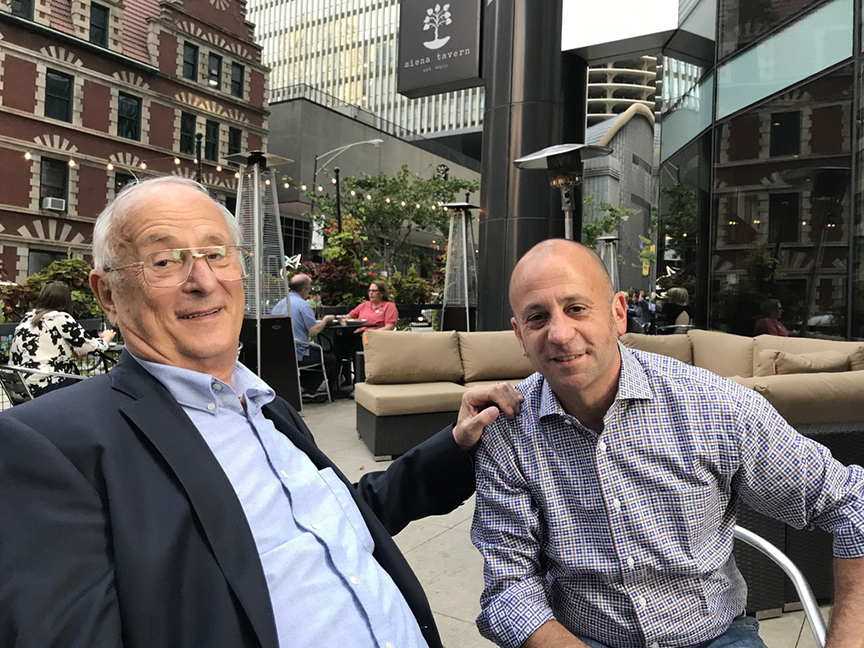
My father’s day gift came early this year…

My father’s day came early this year in the form of a beautiful forest-green Fender Jazz Bass that Tracie knew I had been wanting for the little recording studio I’ve been building. Man, it’s sweet!

But I haven’t been able to play it at all since I brought it home on Thursday. Not one lick.

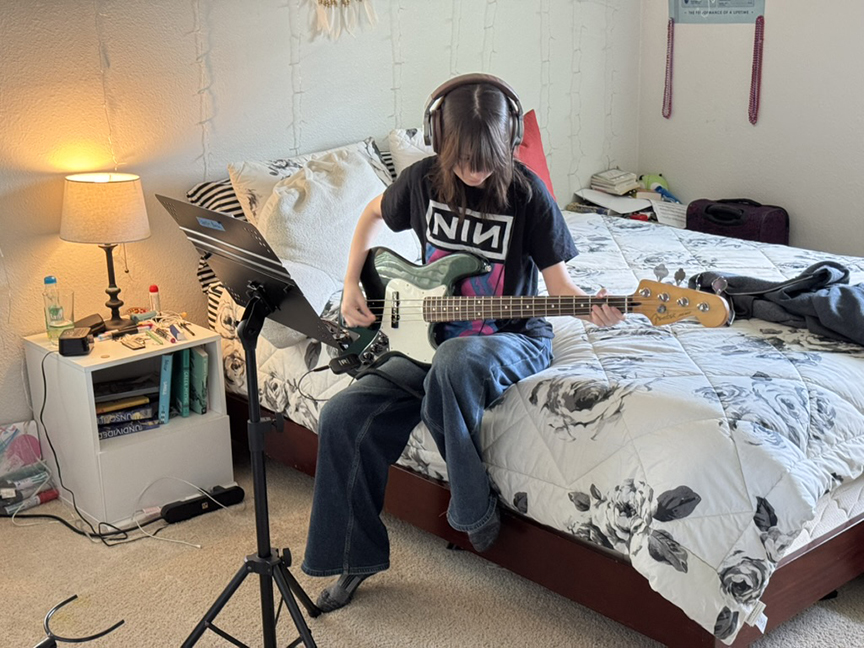
And that’s the best part: Georgia, 14-going-on-15 and soon to be high schooler, has spent every free moment of her weekend playing and practicing the songs she’s been working on.

For as long as I live, I’ll never forget the moment and the feeling when I set her and her bass up with her favorite guitar strap: a hand-stitched, star-spangled strap from Austin, Texas, that my lucky Telecaster wore when I lived in NYC and used to tour the country with a couple of different bands.

As soon as I finished tinkering with the strap locks, she got out her Green Day photo book to show me: the guitar player has a strap just like hers.

I thought I was going to melt. What a great father’s day this has already been.

Happy father’s day to all the dads, to all the families, all around!

(I’ll get my hands on the bass tomorrow while she’s at music camp…)

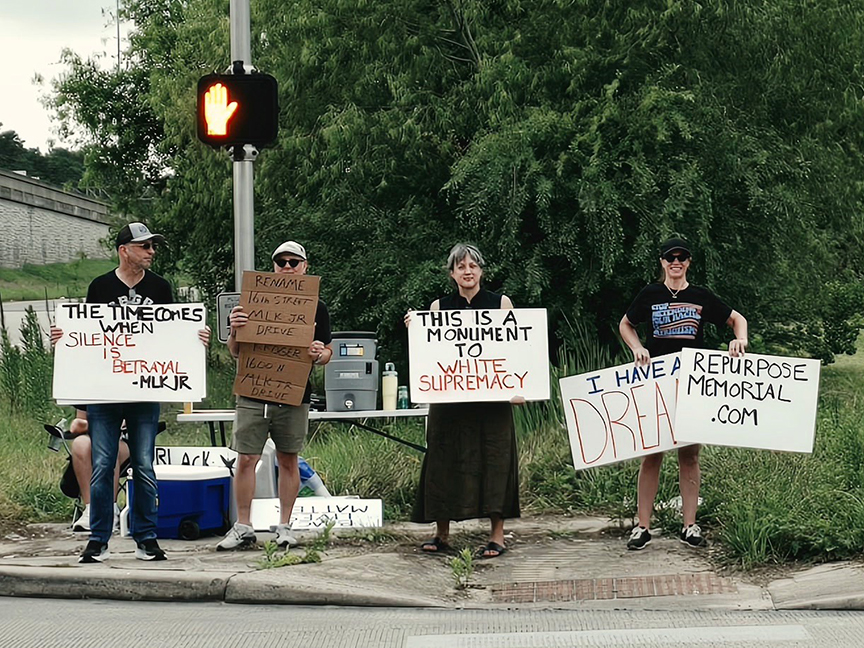
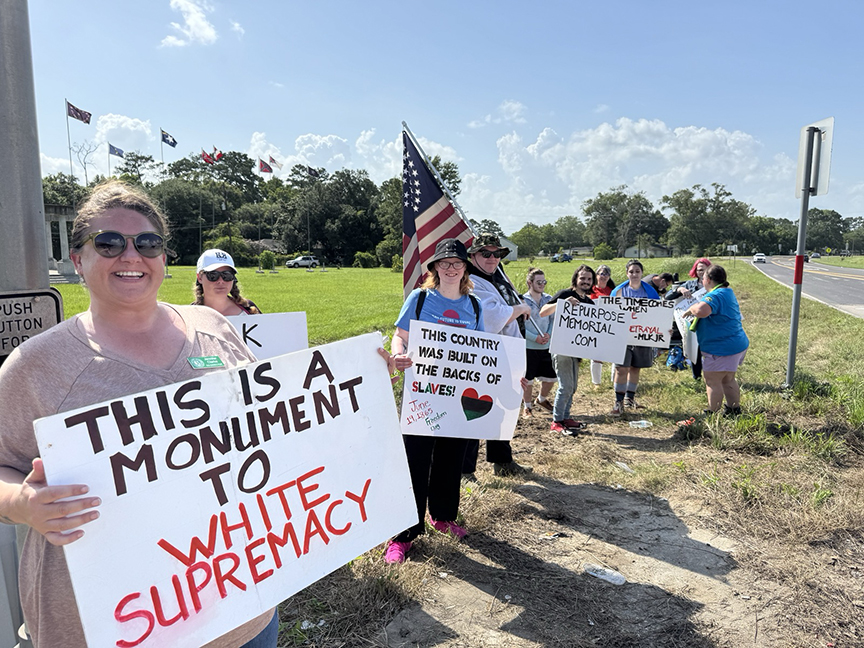
Juneteenth remains a beacon of hope. Celebrate the holiday with me by protesting at the Neo-Confederate monument in Orange, Texas.

Thanks again to everyone who called and wrote after my father died last week. It’s been a rough time. Your support means the world.

I’m excited to share my first post for Southeast Texas Impact Initiative, a Beaumont-based group that organizes, advocates, and protests against the current MAGA hegemony.

Please join me and members of the initiative as we celebrate Juneteenth by protesting from 4-6pm at the Neo-Confederate monument in Orange, Texas, where Tracie grew up. (DM me if you need more info.)

Tracie and I have been mounting protests at the site since 2017. We couldn’t be more thrilled that the initiative has now taken the lead on reminding the Sons of Confederate Veterans that conspicuous displays of racist iconography are no longer acceptable in our society.

No matter what you do to observe the federal holiday on Friday, do something on purpose, like my friend Annette Purnell, a former Orange council woman, likes to say.

Thanks for checking out my post. Hope to see you on Friday. Happy Juneteenth!

“Juneteenth Remains a Beacon of Hope for the Future, even in Bleak Gerrymandering Times.”

I’ve lived in Texas since 2008. I’ve been gerrymandered twice.

The first redrawing happened when our state lawmakers sought to go after Al Green’s seat in Houston. The district where I lived had finally flipped blue. It had been solidly red since the time of George Bush senior, who first went to Washington representing the neighborhood where I’ve lived since moving to SETX. Suddenly, Al Green was now my new congressman. I supported him gladly.

The second venture in surreal cartography infamously came recently when the house where I live with my family became part of a new district, now the only majority-Black district in the city.

There’s a disconnect that often happens when you try to explain Republican gerrymandering to someone who’s never lived in the south. While segregation exists throughout the U.S., southern emargination, with its origins stretching back to the Civil War, has created a unique overlap and interconnection between geography, race, and politics. It’s because our cities are more deeply divided along racial lines than in other parts of the country…

Click here to continue reading on the Southeast Texas Impact Initiative Substack.

What it’s like to grow up the son of a sexual predator.

Thanks to everyone who reached out to share condolences after the death of my father, Zane Parzen.

I loved my father. I also saw what a destructively toxic and even outright evil person he was. And while I was never sexually abused by him, the emotional abuse I suffered as his child was only rivaled by the awful way he treated my mother and my brothers.

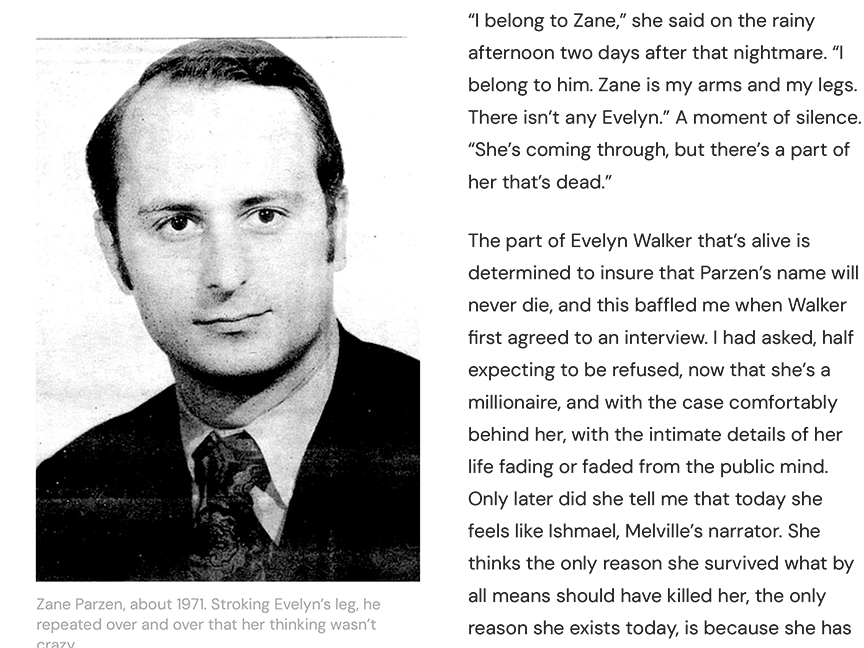
I was 15 years old when the San Diego Reader, the city’s weekly rag, published a front-page story about my father and one of the women he abused while she was in his care, including the photo above.

It was just the tip of the iceberg. His case became a national sensation and even inspired a Hollywood movie.

After my mother died in October of last year, I finally read the book that Evelyn Walker, one of his victims, wrote about him. It was published in 1986 while I was a freshman at UCLA. I also discovered that much has been written about him in the meantime. He became the “textbook” case for sexual malpractice.

Through my research, I also learned that what had happened was much worse than the adults told us when we were children. Much worse.

Even after he left our family, I always stayed in touch with him and visited him often. After he was viciously rude to Tracie at a family reunion in Texas, I cut him off from my family. But I would still go visit him when I could. As he lay dying last week in Plattsburgh, New York, where he lived with his third wife, no one came to visit him but me. No one. [update: since posting this I was informed that my little brother visited with Zane before he died; other than him I am not aware of anyone else]

It’s been a really tough week for me. One of the hardest things is that I have no one to share my mourning. That’s the saddest part: after all he did to his family and to his patients and G-d knows to whom else, no one came to say goodbye… except me. [update: as per above, except me and my little brother]

I plan to write more about him and his legacy here. Thanks for all the words of support and solidarity. As my friend Shawn Amos once wrote about a parent, I never met anyone who could be so mean and mean so much to me.

Zane Parzen, psyschoanalyst whose sexual malpractice case set legal precedent, dies at 92.

Zane Parzen, whose 1981 sexual malpractice case set a legal precedent, has died from complications from dementia. His death in Plattsburgh, New York, was confirmed by his wife Tanya Parzen.

Parzen was a prominent psychoanalyst in San Diego when he was accused of having sexual relations with multiple women who were in his care. It was later revealed that he had also been giving patients a dangerous cocktail of drugs. The emotional toll led some of the women to attempt suicide.

In the late 1970s, after Parzen had been practicing medicine in California for a decade, one of his patients, Evelyn Walker, formally revealed that she had been in a years-long sexual and romantic relationship with Parzen.

The $4.6 million settlement in her 1981 lawsuit against Parzen set a record for amount awarded in a sexual malpractice case. It also prompted insurance companies to discontinue sexual malpractice coverage. During the trial, Parzen admitted in open court that he had abused Walker and multiple other women. While the insurance company was ultimately forced to pay a reduced amount, Parzen faced no criminal charges. His medical license was restricted but never revoked.

In 1986, Walker published an account of her experience titled “A Killing Cure.” In the book, she describes the abuse, including graphic details of their relationship.

Zane Parzen was born in 1933 in South Bend, Indiana, to Louis and Ethel (Levy) Dribin. Parzen’s father died of cancer when he was eight years old. His mother remarried a rabbi, Maurice Parzen, who adopted Ethel’s sons. Parzen graduated at the top of his class at Central High School and attended Harvard for two years before completing his degree at Indiana University. He attended medical school at the University of Chicago where he was trained as a Freudian psychoanalyst.

He is survived by his wife Tanya; and three sons from his marriage to Judith Parzen: Tad Parzen, Jeremy Parzen, and Micah Parzen.

More notes about his life and legacy to come.

Remembering Italy’s (almost) “first” McDonald’s.

The passing of Slow Food founder Carlo Petrini last month opened a torrent of memories for me. I started following Petrini’s writings in the late 1980s and even met him on a few occasions during the seven years I taught at Slow Food U., also founded by him.

But the news of his death also triggered a powerful memory from my early years in Italy: McDonald’s in Rome.

According to legend, Petrini was inspired to create the Slow Food movement after he protested the opening of the “first” McDonald’s in Rome. It was actually the second. The first was launched, quietly, in Bolzano that same year. But the one in Rome became the arch nemesis of terroirists and anti-globalists because the American behemoth had planted its first highly visible outpost at the foot of one of Italy’s most iconic landmarks — the Spanish Steps.

When I first got to Italy to study in 1987, my American classmates and I craved American fast food, partly to assuage the homesickness. After all, the world was way less connected back then. Email was just beginning to emerge. International calls were prohibitively expensive, especially for students. You felt entirely disconnected from your home.

America fast food was a way to “feel” like home for a fleeting moment.

Italian students liked fast food too. At the time, the only option was Burghy, a McDonald’s like restaurant. The only one we could access was the location in the Florence train station. Trips to Rome always included a visit to the Spanish Steps franchise.

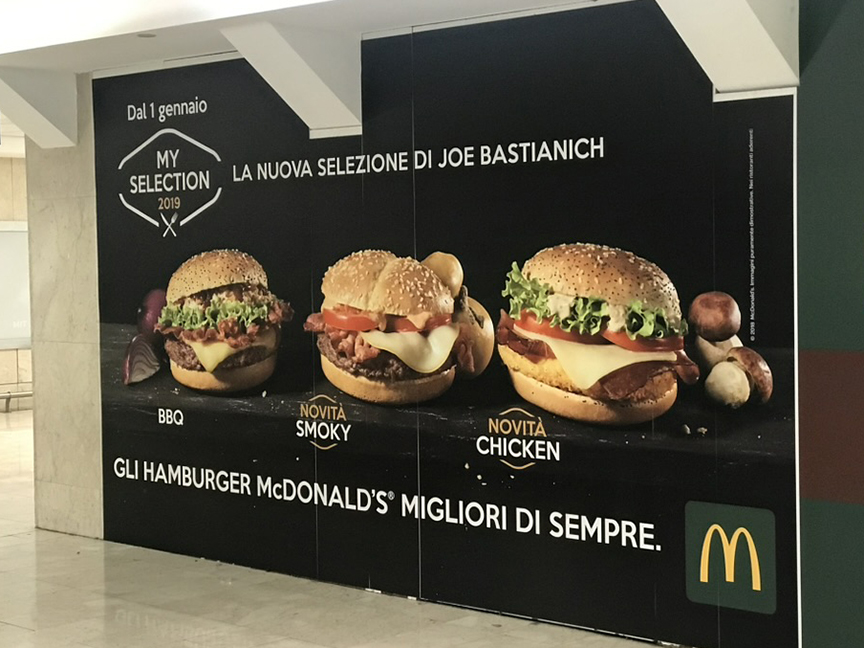
Three decades later, I couldn’t believe my eyes when I arrived at the Milan train station to see the above ad for Joe Bastianich’s line of sandwiches.

A genuine peripeteia! A restaurateur who made his name by serving rich Manhattanites authentic Italian cuisine had now gone to the “dark side” of food. Incredible.

It all seems laughable, especially today. But it does make me sad to remember what a 13-year-old told me some years ago. She was the daughter of a friend from university days. They live in downtown Milan and summer in the alps. When I asked her what her favorite food was, she told me it was the new sandwich from KFC.