Tracie P is blogging again! :-)
Click here to read her post on the wines and grapes of Campania, the first part in a series on Italian wines.

Tracie P is blogging again! :-)
Click here to read her post on the wines and grapes of Campania, the first part in a series on Italian wines.
Today’s post is the first in a series on my recent trip to Friuli with sommelier Bobby Stuckey and chef Lachlan McKinnon-Patterson, owners of Frasca in Boulder.
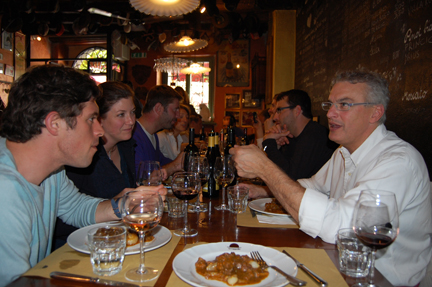
Above: Valter Scarbolo (pronounced SKAR-boh-loh), right. His family’s landmark restaurant La Frasca in the province of Udine (Friuli) helped to create a new paradigm for Italian food in the U.S. That’s Shelley Lindgren of A16 (San Francisco) and Joe Campanale of Dell’Anima (New York) in the foreground. When Valter speaks, North American restaurateurs listen intently.
Few if any Italian food and wine insiders, I’m sure, would disagree with me: the first place you need to eat when you visit Friuli for food and wine tourism is Valter Scarbolo’s La Frasca in Lauzacco (not far from Udine).
When I arrived in Friuli in mid-September, the first place my good friend Wayne took me to eat was Valter’s place. (Here’s the post I did the next day on our amazing meal.)
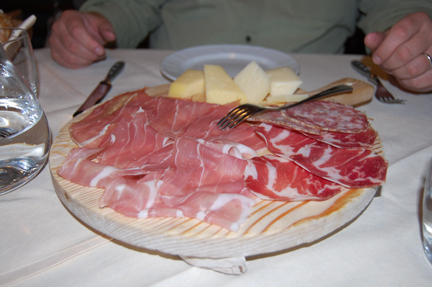
Above: Among other key elements to contemporary Italian cuisine in the U.S., Valter has introduced a generation of North American restaurateurs to the concept of “cult prosciutto,” in this case Prosciutto d’Osvaldo.
A note on the term frasca… frasca (Italian) or frasčhe (Friulian) means simply branch. Linguistically and culinarily, it represents a wonderful instance of metonymy (“the action of substituting for a word or phrase denoting an object, action, institution, etc., a word or phrase denoting a property or something associated with it,” OED online edition). In Friuli, a frasca was a roadside stand where producers of cured meats, cheeses, and wines would set up shop to sell their wares. Some believe a branch was placed by the side of the road to draw attention to the stand, while others believe that the vendors would display their products under the shade of a branch. Of course, where wine, prosciutto, and cheese are sold, customers will want to taste with the producer. Ultimately, the term frasca began to denote (as a metonym) a place where patrons gathered to eat (there is a kinship here with the word trattoria). Today, the term is regularly used to denote a restaurant, although Valter’s venue, “La Frasca,” remains the frasca by antonomasia.
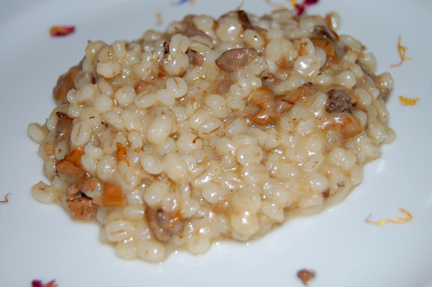
Above: One of the amazing dishes that didn’t make it into my post about dinner with Valter Scarbolo was this orzotto, a “risotto” made with barley instead of rice, chanterelle mushrooms and squab ragù.
We all (or at least some of us) remember the “Northern Italian Cuisine” revolution of the 1980s, when restaurants in New York, Los Angeles, and San Francisco seemed determined to expunge “Southern Italian Cuisine” from their menus. In fact, it would more properly be called “pseudo-Northern Italian Cuisine” because the true regional Italian cuisine shift toward the north didn’t take shape until the Bastianich-Batali powerhouse Babbo opened in New York City in the late 1990s.
With the rise of the Bastianich empire in the late 1990s, a new generation of high-end American diners were introduced to Friulian cuisine, first through the Istrian clan’s Frico bar in Manhattan, which I believe opened in 1996 and closed in 2007 (see Eric the Red’s 1996 review here), and then later through Frasca in Boulder, which was opened by Bobby and Lachlan in 2004 (IMHO, one of the top-five Italian restaurants in the U.S. today).
I can tell you from personal experience that both sets of restaurateurs view Valter and his restaurant (which can trace its origins back to the 1960s) as a paradigm for Italian cuisine and hospitality.

Above: The Tagliolini “San Daniele,” actually made at Valter’s using prosciutto by D’Osvaldo, which is made in Cormons, not San Daniele.
The Friulians are an industrious people. Valter is the apotheosis of that spirit and his bright personality and spirtuality express themselves in the metrics of his family’s wines, his superb cuisine, and his warm hospitality. Anyone who knows the man personally, I’m sure, would share my impression.
To know Valter is to know true Friulian gastronomy and I consider myself lucky to know both.
There are many places I’ll be taking Tracie P to dine when we go to Friuli for our vacation in February. But the first will be Valter’s Frasca.
Next up: Ronco del Gnemiz, one of my favorite Friulian wineries…

Tracie P and our friend Austin jazzer Liz Morphis got their smoked-pork-chop-on-a-stick on at the behemoth 50th annual Wurstfest 2010 in New Braunfels, Texas yesterday night. Entirely delicious with a cold lager beer on the side…
I knew that Central Texans were proud of their German heritage… but, sheesh, these folks dig them some Teutonic party time…

The music tents were packed and pumping the oom pah pah. And the musicians were smoking hot… You could hear some of the traces of what helped to shape the Tex Mex sound of the 1970s, a fusion of German music with Spanish instrumentation, the tuba meets the 6-string (Doug Sahm would have been right at home here).

Got sauerkraut?

Where I grew up we called them potato latkes.

The great hall of the Comal County Fairgrounds was a sight to see, and the folks, however sloshed, were super polite and well-behaved… only good times here…
And, of course, there were hot German babes…

In other news…
Tracie P is blogging again… Check it out here…

Reminiscing… Tracie P and I went on a super fun double-date last night with aunt Holly and uncle Terry… Cocktails, Mexican food, and then the Little River Band at the intimate One World Theatre (Austin).
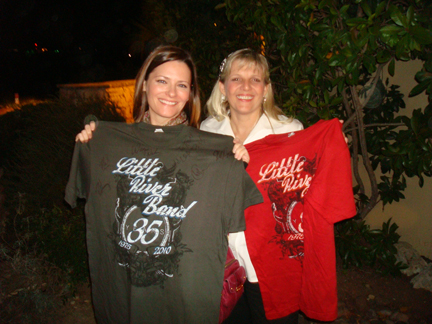
The boys got the girls t-shirts and the girls got their t-shirts signed by the band…

You see, not only does my baby love her some Little River Band… “Reminiscing” (1978) was the song that made it all happen for aunt Holly and uncle Terry when they were high school sweethearts back in Orange, Texas… uh huh…
Come on… you know you love it, too (here, sung by Australian super star John Farnham)…
What does the Little River Band have to do with wine? The band took its name from the town of Little River in Victoria, Australia. I’ve been told they make wine not far from there…
I hope ya’ll are having fun today. Tracie P and I are headed to Wurstfest in New Braunfels, home to early German settlers and our good friends Seana and Josh… and you just know we’re going to find something blogilicious… stay tuned…
I did and now I’m eating my words…

It’s a tough job but someone has to do it… I’m currently developing a new blog for a new client and I have to admit, I’ve been completely floored by the food I’ve tasted with him. I can’t reveal the restaurateur or the blog but I will once it’s ready to launch.
In the meantime, I just had to share the singed yellow tail with white soy sauce and battera kombu dressing.
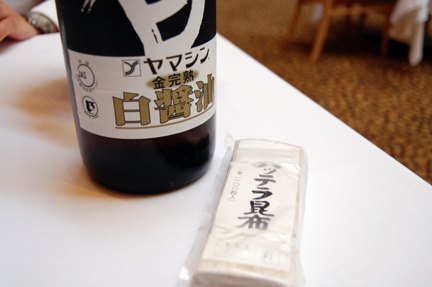
In case you were worried that we weren’t eating well here in Texas…
Buon weekend, ya’ll!

Above: Winemaker Luciano Gomiero of Vignalta (center), pioneer and unsung hero of one of my favorite appellations in the world, the Colli Euganei (Veneto). That’s my friend, the aptly named, Marco Tinello (right, the Veneto’s “best sommelier” 2008), who led our vinous journey to the Euganean Hills so beloved by Petrarch in mid-September.
There is no place in Italy that I feel more at home then the Veneto, where I spent many years at university and playing music. And there is no other place where my interests converge more mellifluously than the Colli Euganei, the Euganean Hills south of Padua, where my beloved Petrarch and great wines meet.
Petrarch took refuge in these hills toward the end of his life and it was here that he transcribed and edited his life’s work, including the Rerum Vulgarium Fragmenta, his fragments of vernacular things, a songbook composed of 366 poems written for Laura.

Above: La Casa del Petrarca, Petrarch’s house in Arquà in the heart of the Euganean Hills, is adorned with frescoes inspired by the narrative culled from the Fragmenta.
Petrarch’s favorite poet was the Latin writer Virgil and there’s no doubt that Petrarch knew and appreciated the line so often repeated from the Georgics, Bacchus amat colles, in other words, Bacchus [the divine embodiment of the vine] loves hills.
To understand why Petrarch loved this immensely beautiful place and why it is ideal for raising fine wines, here are a few photos.

Above: That’s a view from the hills looking eastward toward Venice and the Adriatic.
The eastern plains leading to Venice are otherwise flat but south of Padua, the Eugeanean Hills rise up suddenly and violently from the flats.

Above: Petrarch wrote that the Euganean Hills reminded him of the Vaucluse where he met Laura.
The soil types range from volcanic to ancient seabed to calcareous clay and the different growing sites deliver rich mineral flavors in the Cabernet Sauvignon and Merlot that have traditionally been grown there.

Above: Luciano ages all and vinifies some of his wines in recycled tonneaux and barriques — no new wood here! You could hear his 2009 Alpianae fermenting again (in other words, it had been fermenting on and off, depending on the temperature of the cellar, for more than a year!)
The Colli Euganei are best know for their red wines. Luciano doesn’t barrique his wines and you never find woodiness in them. His reds are defined by their rich, earthiness and minerality, tar and goudron notes. And while I’m not generally a fan of Cabernet Sauvignon and Merlot, I gladly drink his wines, which never show woodiness, and are extremely well priced (generally around $25-35 in the U.S.). I highly recommend them.

Above: The 2008 Sirio (dry Moscato) was stunning, with great minerality and fruit. BrooklynGuy would have loved it.
But the wines that truly fill me with emotion are his white wines, Sirio (dry moscato) and Alpianae (dried-grape Moscato Giallo) in particular. And the best news is that, like his reds, Luciano’s white wines are more than reasonably priced (the Sirio should cost about $20 retail).

Above: The name Alpianae actually came from a typo, Luciano told me. It was supposed be called Apianae, a reference to a name used by the Romans for sweet wines “belonging to the bees” (in the sense that bees are drawn to sweet wines, i.e., the best wines).
Luciano was the first to popularize dry Moscato in the Euganean Hills and he successfully lobbied the consortium and the Italian government to create the Colli Euganei Moscato DOC (previously you couldn’t write Moscato on the label). With the 2010 vintage, Fior d’Arancio (the local name for Moscato Giallo) will be the appellation first DOCG, also thanks to pioneer Luciano.
The Vignalta whites, including the dried-grape Moscato Giallo, are some of my favorite wines in the world. And I love how they are connected to a topos so imbued with cultural riches. Indeed, Petrarch’s transcriptions and collations during the last years of his life in Arquà (a stone’s throw from Luciano’s winery) are considered to by many to be the birthing of Renaissance humanism.
Like Bacchus, I love Euganean hills, too.
I posted on the fantastic lunch we had that day here.
Next up: my September trip to Italy continues with a series of posts from Friuli…
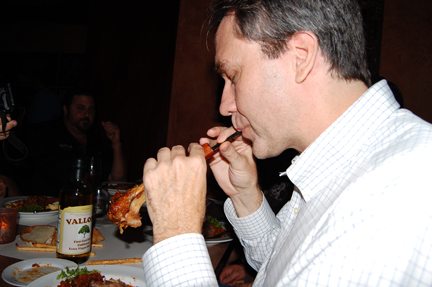
Last night I was invited to participate in a food bloggers summit hosted by Caffè Bello Taverna e Pizzeria in the hipster Montrose district of Houston (the newest member of the Tony Vallone family of Italian restaurants).
That’s Jedi food blogger Houston Foodie showing off his newly patented bone marrow delivery system (a straw!).
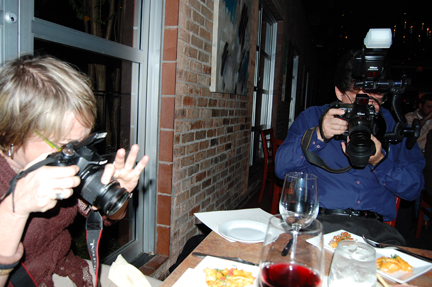
I must say that I’ve never met such a collegial (however geeky) and simpatico group of food bloggers. (And we all know how grouchy food and wine bloggers and tweeters can be!)
That’s Food Princess (above, left, my new BFF) and Bitspitter (right). Mr. Vallone and waitstaff treated the group of 10 or so bloggers to a 4-course tasting menu.
I like Tony a lot (he’s a good friend of cousin Marty) and he’s one of our country’s leading Italian restaurateurs. But the best thing about Caffè Bello (his taverna, as he likes to call it, a family-friendly unassuming Italian eatery) is that it has one our favorite wines on the list, SP68 by Occhipinti!
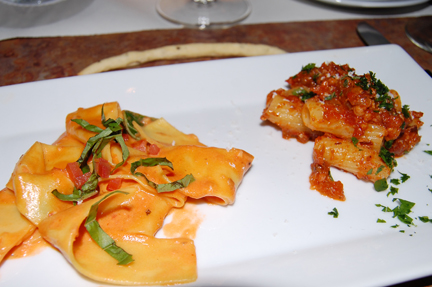
The rigatoni alla bolognese, everyone agreed, were cooked perfectly al dente and the bone marrow in the lamb shank? I think the photo above speaks a thousand blog posts…
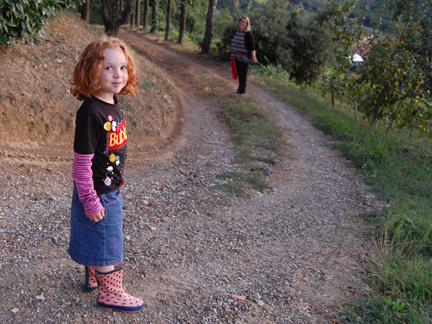
Isla, above, stole my heart about a month when I was the dinner guest of her parents, Laura and Marco, who manage Il Palazzone, producer of Brunello di Montalcino. (Of course, Isla stacked the cards by designing the place setting for me below.)
Today, Isla has a newborn little sister: Nia Rose came into this world over the weekend. (“Pronounced Nee-ah, meaning radiant champion in Gaelic,” writes Laura, whom I imagine is quite radiant herself right now.)
Mazel tov, Laura, Marco, Isla, and James! Tracie P and I are so happy for you and are sending you lots of love! And man, this baby fever is contagious! :-)

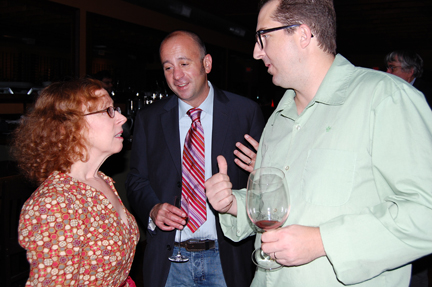
Above: My super good friend Joe Pat Clayton (right) was as geeked as me and Tracie P to taste natural Spanish wines last night with Alice Feiring (right).
Alice Feiring hit the Groover’s Paradise like a Texas tornado. The few days she spent her with us were filled with honkytonking, two-stepping, great parties and great friends and lovers of natural wine, and a superb fish dinner prepared by Chef Esteban Escobar paired with a flight of Spanish natural wines last night at Vino Vino (the best little wine bar in Texas).
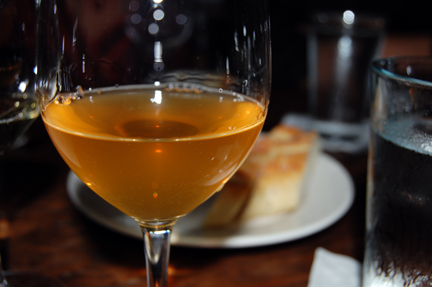
The two wines that impressed me the most were the Laureano Serres 2009 Abeurador Macabeo (above, 100% Macabeo grown in clay soils, vinified with 2 days of skin contact, no added sulfite [note by importer José Pastor]) and the Els Jelipins 2004 Sumoll (Sumoll with a small amount of Garnacha, grown in clay and limestone soils, whole-cluster fermentation in open-topped barrels, no added sulfite).
The Macabeo was rich and unctuous, tannic and chewy in the mouth and unbelievably delicious.
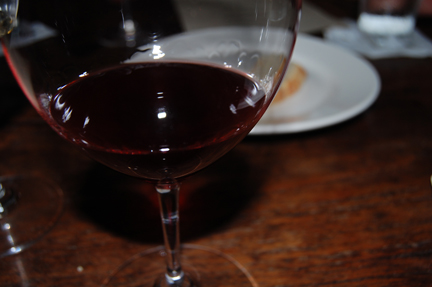
The Jelipins 2004 Sumoll was mind-boggling good. Impenetrably inky and viscous on the palate, a stilnovo sonnet with alternating rhymes of earth and fruit.
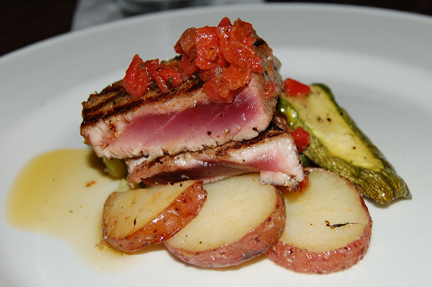
Chef Esteban’s excellent cooking has been reaching new heights lately but last night he took it over the top (especially considering the Herculean effort necessary to create a wine dinner using only Kosher fish and vegetables).
Kim and SO Alfonso also came down from Dallas expressly for the event.

Above, from left: Alice, Lewis Dickson (Texas Hill Country natural winemaker), Tracie P, Jeff Courington (owner Vino Vino), and Russ Kane (author of Vintage Texas, the top Texas wine blog).
And so this morning we took Alice to the airport (she stayed with us, of course). It was a great visit and we were sad to see her go. She certainly made a profound impression on the Texans she met. And I’d like to think that they also impressed her with the Texas-sized welcome they gave her.
We’ll miss her but somehow I think she’ll back sooner than later. Once you’ve danced to the rhythms of Dale Watson at Ginny’s Little Longhorn Saloon, there’s no turning back…
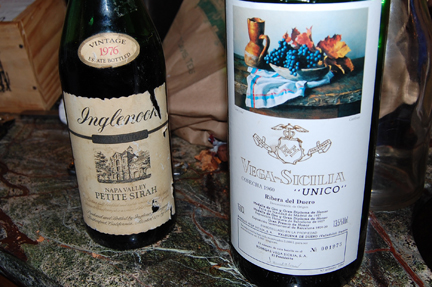
Many wonderful bottles were opened last night in the home of our good friends Patricia Winston and Bill Head to celebrate Alice Feiring’s first visit to Texas.
But it was Alfonso who gave her the BIGGEST Texas welcome with an unforgettable bottle of 1960 Vega-Sicilia Unico in magnum (!) and original wooden case. I was blown away by how savory and rich the wine was, vibrant and with an acidity that I frankly wouldn’t have expected in a wine this old. A truly amazing — in so many ways — bottle of wine.

Patricia and Bill had assembled a who’s who of Austin-based winemakers, collectors, and wine professionals for the occasion. But it was Devon Broglie (right, with me, center, and Alfonso, left) who stepped up to the plate to extract the cork. Nice work, Devon!

Even Alice looks TALLER in TEXAS! That’s our good friend, journalist, author, and radio personality Mary Gordon Spence (right).
What a great night, great wines, and great folks…
There might just be a few spots left for a dinner to be held in Alice’s honor tonight in Austin at Vino Vino. In her words, the wines we’ll be tasting are “hard-core natural.”
 Do Bianchi