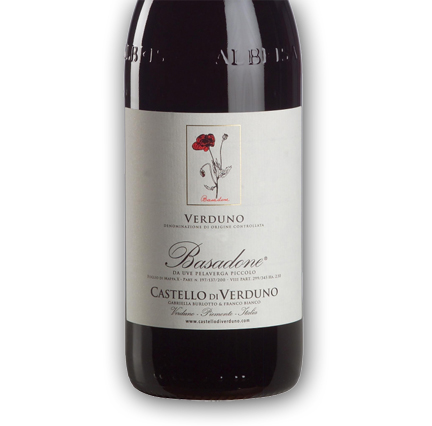
The year was 2006 and I was working in New York as the media director for a high-profile Italian restaurant group that also happened to be a direct importer of Italian wines. Earlier that year, I had made the annual trek with my colleagues to the Italian wine fairs, where we met and tasted with a young winemaker at the natural wine fair, Vini Veri: Mario Andrion of Castello di Verduno, producer of awesome Barolo and Barbaresco and a then relatively obscure grape called Pelaverga…
It’s the year 2010… People are still the same. They’ll do anything to get what they need. And they need MERLOT.
I couldn’t help but think of the classic horror movie Soylent Green (1973) when a desperate plea appeared in my feed this morning.
Yesterday, the authors of the blog In Difesa dell’Identità del Vino Cirò (In Defense of the Identity of Cirò) posted an open letter to the Italian Association of Enologists* asking them to examine the absurdity of what’s happening on the ground in their appellation in Cirò and Cirò Marina, Calabria (the letter was reposted today by one of Italy’s top wine blogs Esalazioni Etiliche and Mr. Franco Ziliani and I posted about it at VinoWire today as well).
Essentially, this is what has happened… Back in the summer of 2009, before EU reforms came into effect, a relatively small group of commercial producers in Cirò got together and rewrote appellation regulations to allow Cabernet Sauvignon and Merlot for the first time in Cirò. Calling themselves the “Consortium of Cirò producers,” they submitted their changes to the Italian government, even though their group did not include the flagship producer Librandi, nor the majority of Cirò producers. As a result, today, the EU is considering said change in the appellation even though it was proposed by a minority of greedy, commercial producers.
Mr. Franco Ziliani said it best when he first posted on what was happening there back in June 2009, calling it the “Montalcino Syndrome.” The parallels are crystal clear: a small group of large, industrial wine producers are lobbying (successfully) to eclipse their smaller competitors who not only play by the rules but actually care about the people, place, and grapes that go into their wines. (Remember what Baldo said in the Brunello debate in October 2008? Italian appellation regulations are intended to protect the territory, not the consumer.)
It’s unlikely that the blog and accompanying petition will stop the changes from being approved by Brussels. As a result of the amendment, commercial producers will pump up their Gaglioppo with Cabernet Sauvignon and Merlot (easier and cheaper to grow) and the wines… well, we already know what the wines will taste like… Soylent Green, anyone?
Here in Texas, btw, we eat Soylent Greens accompanied by Charro beans and hot sauce.
*I’m not linking to the Association website because it requires that you download the latest version of Flash to view it.
Friuli isn’t the first region that comes to mind when you think of great Italian-raised extra-virgin olive oil. In fact, very little olive oil is produced there (later in this series I will be posting on the tiny subzone of Friuli where higher winter temperatures make the cultivation of olive trees for fine olive oil possible).
“It’s just too cold here during the winter,” said the lovely Ornella Venica when we sat down for lunch at her family’s estate. Winter freezes, not uncommon in this most northeastern region of Italy, can kill the trees, she explained, making it virtually impossible for her family’s estate to produce fine olive oil there.
Determined to make great olive oil, her husband Gianni and one of his business partners launched the estate’s Terre di Balbia program in 2001 in Calabria, where they grow olives for their family’s olive oil and bottle estate-grown Magliocco and Gaglioppo.
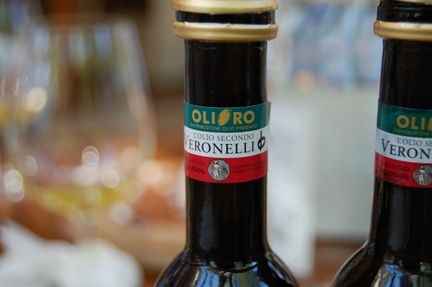
The Venica family became early undersigners of Luigi’s Veronelli’s 2001 “Olive Oil Manifesto” (you can download a PDF version of the manifesto at the movement’s official website).
Publisher, writer, editor, and gourmet Luigi Veronelli, for those of you unfamiliar with his legacy, was the architect of Italy’s current food and wine renaissance. His early catalogs of the wines of Italy (first published in the early 1980s) and his restaurant and food guides reshaped the map of Italian food and wine, domestically and abroad (Veronelli appears often here at Do Bianchi, most recently in this post).
The manifesto is extensive and meticulous, but the basic concepts of l’olio secondo Veronelli (“oil according to Veronelli,” i.e., Veronelli’s “vision” of olive oil) can be distilled as follows: 1) no-chemical farming; 2) quick pressing of the fruit in situ 3) depittting of the olive oil before pressing; 4) exclusive pressing and bottling of individual cultivars, i.e., olive varieties (the section on how to clean the press to avoid cultivar contamination is impressive); 5) detailed labeling, including the mono-cultivar, “vintage,” and provenance; 6) exclusive packaging in glass bottles. There’s a lot more to it, but the basic concepts are these.
The oil? FANTASTIC… Venica & Venica is not the only producer-member of the Veronelli movement but I have been unable to find a comprehensive list of all the members.
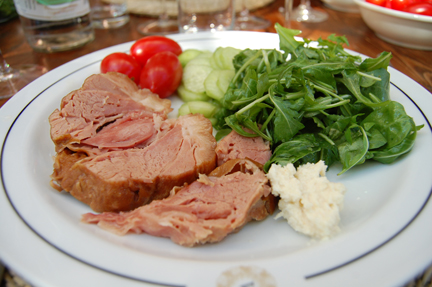
In case you were wondering what we ate for lunch that day: roast pork shank with kren and fresh greens.
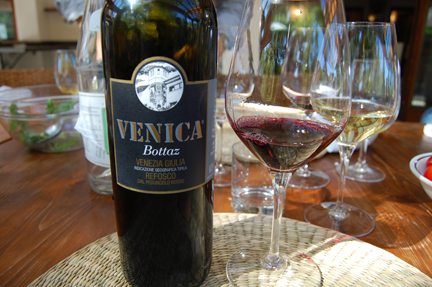
And we drank a 2005 Venica & Venica Refosco, which I had never had the opportunity to taste. Chewy and earthy and sooooooo good…
Venica and its current generation Giampaolo Venica will be appearing in an upcoming post in this series. Giampaolo was one of the most fascinating persons I met on the trip and we became fast friends. Stay tuned…
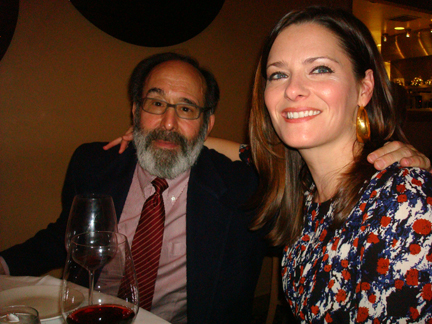
Cousin Marty (above with Tracie P) and I often remark how remarkable it is that two schlubs like him and me ended up with such jaw-droppingly beautiful women. I guess it just runs in the family.
Last night, as their wedding present to us, his better half Joanne and he treated Tracie P and me to dinner at Tony’s, the hottest see-and-be-seen table on any Saturday night in Houston. Judge Manny and wife Betty joined us for what, I think it’s fair to say, was one of the most glamorous nights of our year so far: federal judges, U.S. ambassadors, bank execs, top radiologists, and throw in a sports celebrity or two — everyone came by our table to say hello to Judge Manny.
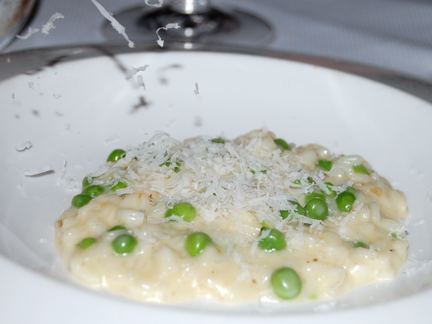
Tony, himself, presided over our table. Knowing our love of regional Italian cuisine, he answered my request for a great risotto with an improvised risi e bisi, a classic dish of the Veneto (where he knows I lived) and a favorite dish of Italian Jews. It was fantastic.
It had been preceded by a burrata drizzled with honey and a balsamic reduction and then topped with freshly grated Alba truffles (SHEESH!).
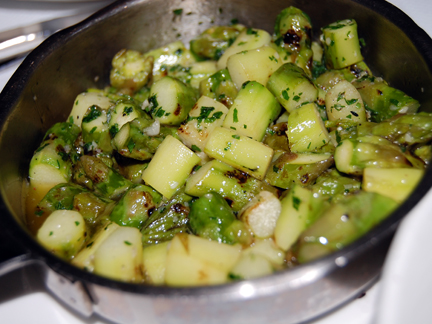
The tip-to-stalk ratio in the asparagus with Pecorino Romano gave the dish just the right balance of bitter and sweet.
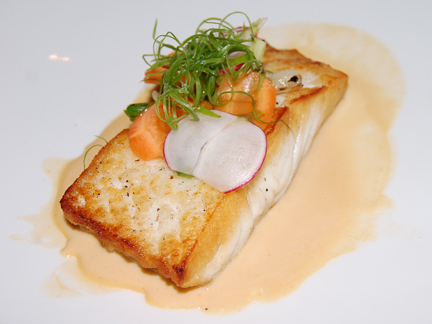
Tracie P’s halibut was served over a sea urchin sauce.
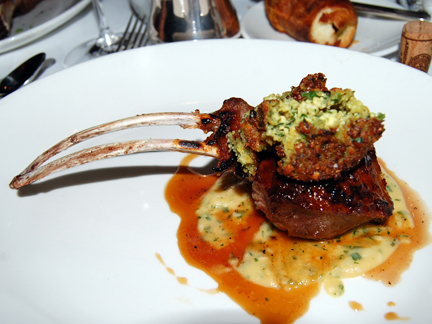
My lamb chops were served over a cannellini “humus” and topped with a crumbled green falafel. Can you humus a few bars?
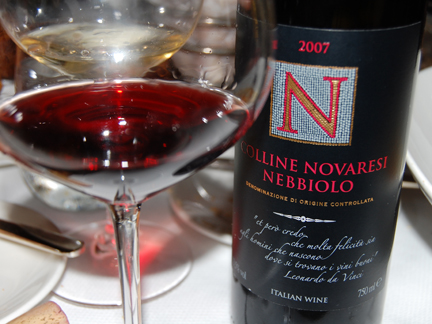
Sommelier Scott Banks surprised us with a Nebbiolo we’d never tasted, this Colline Novaresi by Fontechiara (Borgomanero, Novara). Extreme value on an otherwise high-roller list, grapey and with bright acidity, fresh on the nose and earthy on the palate, perfect for the wide variety of foods set before us.
Joanne and Marty, thank you for such a wonderful dinner… a dinner-event, really! And thanks, from the bottom of our hearts, for all the support you’ve given me and Tracie P, in this first year of our marriage, as we’ve begun building a life for ourselves in Texas. I can’t tell you how much it means, on so many levels, to both of us. We have so very much to be thankful for and are truly blessed to have you as part of our lives. And who knew my relatives were such fressers and machers?
Speaking Italian well has its perks: when Italian bigwig producers and enologists come to Texas, I generally get an invitation to dinner and am always seated next to said bigwigs.
Last night, I was the guest of Tunisian-born pharmaceutical giant Claudio Tipa and his enologist, Milanese-born Maurizio Castelli, called a “Tuscan legend” by my friend, top wine dude and author, David Lynch in his Vino Italiano.
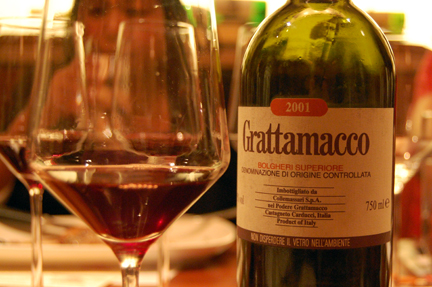
I’ve never been a big fan of Cabernet Sauvignon and Merlot grown in Tuscany, but I’ve always had a weak spot for Grattamacco. Despite the fact that it’s way out of my price range, I’ve had the good fortune to taste many older vintages over the course of the years.
Contrary to what one might expect, Claudio and Maurizio were very much alla mano, as the Italians say, easy-going and fun to talk to and I thoroughly relished Claudio’s account of the day he told erstwhile Okie oilman and fascist importer Bob Chadderdon to go to quel paese. I was also fascinated by what Maurizio had to say about his work in Georgia, the obstacles of making wine in a war-torn country, and the grand potential of that region to become a world-class producer of fine wine.
Grattamacco has remained true to its roots, as conceived by its founder Milanese industrialist Piermario Meletti Cavallari, in 1977: Cabernet Sauvignon, Merlot, and Sangiovese aged in large recycled cask.
While other Bolgheri producers have ripped out their Sangiovese, Claudio stood by the original owner’s vision when he purchased the estate’s hill-side vineyards in 2002. It’s the Sangiovese that gives the wine its trademark acidity and in my view, what makes it taste like Tuscany.
The 2001 was stunning, with earthy tones and bright, nervy acidity. The 03, 04, and 05 were honest expressions of the vintages (far from spectacular IMHO) and the 2006 showed immense promise for its future. (From what I’ve tasted so far, a lot of people made great wine in Tuscany in 06.)
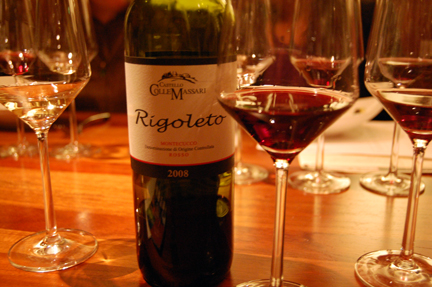
I also really liked Claudio’s 2008 Montecucco Rigoletto, an entry-level wine from his flagship Colle Massari. It was everything I want a Montecucco to be: juicy and grapey, with bright, bright acidity and balanced alcohol. The Ciliegiolo was the star of this blend with Sangiovese and Montepulciano, giving the wine that classic cherry note on the nose that reminds you that Montecucco is a sibling of Morellino and not Montalcino.
The Colle Massari Vermentino was also very good, unctuous and aromatic, honest and real. Chef Todd Duplechan’s foie gras Boudin wasn’t bad either.
Did I mention that Italian majors have all the fun?
In other news…
TGIF: Thank G-ja it’s Friday! I’m so tired of working and am very much looking forward to the weekend with that super fine lady of mine.
Above: Ubi major, minor cessat. Master Sommelier Bobby Stuckey (left) really knows his stuff and when it comes to Friulian wines, he’s at the top of his game. It was fascinating to travel and taste with him in Friuli. Ronco del Gnemiz, where he and Lachlan source some of the fruit for their Scarpetta label, was a favorite visit for everyone (for the cast of characters, click here).
In some ways, the wines I tasted that day run contrary to everything I desire in Italy wine: they were made from French grapes, grown in Italian soil, and vinified with pharmaceutical yeast. But I loved and love them… unabashedly and unconditionally… no regrets, Coyote. They were the wines of Ronco del Gnemiz in the Colli Orientali del Friuli, a winery that I have followed since my earliest days writing professionally about wine in New York more than 12 years ago.
Above: More than once, Bobby talked about “Friuli’s secret weapon, Sauvignon Blanc.” In our tasting of a vertical of vineyard-designated Chardonnay and Sauvignon Blanc at Ronco del Gnemiz, I found myself writing things like “fantastic balance,” “extreme elegance,” “rich but angular,” “gorgeous acidity.” This 2006 Sauvignon Blanc, above, was fantastic.
One of the first things that nearly every Friulian winemaker will tell you is that Friuli was completely destroyed in the First World War (Friuli was on the front line between Italy and the Austro-Hungarian empire). Between the two World Wars, wine production was not a priority for a people whose farmland sat on the edge of the Italian monarchy and then fascist regime. And it wasn’t until Italy’s “economic miracle” of the 1960s that a wine fine industry began to emerge in this uniquely positioned growing zone, with its ancient seabed ponca soils, its ventilation arriving from the Adriatic, and a “natural shield” (as Petrarch would have called it) provided by the eastern Alps.
When Serena Palazzolo’s father purchased the Gnemiz estate in 1964, long before California would make Merlot and Cabernet Sauvignon the hegemonic favorites of consumerist culture, he planted French grapes. (Gnemiz, btw, probably comes from the Slovenian nemitz meaning foreigner.)
Above: Chiristian Patat (center), Serena Palazzolo, and their eldest son Jacopo. As crazy as it sounds, I felt like I knew Christian and Serena from tasting their wines for so many years. And I knew that we were going to become friends. As it turns out, we have a great deal in common and Serena and I missed each other at the University of Padua by just a few years! We did indeed become friends and they are going to appear in a very special post, probably my favorite moment of my Friuli trip… Wonderful people…
French grapes have been grown with stunning results in Friuli since that time. (I’ll touch on this later in the series of Friulian posts.) And Ronco del Gnemiz is widely considered one of the greatest expressions of the Colli Orientali del Friuli.
Pharmaceutical yeast, explained Christian when the subject came up, is key to their approach. They’re not using cultured yeast to impart flavor to the wine. They use a neutral yeast to initiate fermentation because they want alcoholic fermentation to be completed before malolactic fermentation can begin. In doing so, they are able to maintain the gorgeous acidity in their wines that gives them such longevity. Their oak regimen consists of 25% new barrels, with the rest being recycled 4 times before being discarded.
I can’t think of any other region in Italy where modern winemaking techniques are applied with such extraordinary results. Of course, there are many who utilize technology excessively in search of high scores and Californian consumers. But most, Ronco del Gnemiz chief among them, exploit modernity judiciously, not with an eye to the American consumer but rather with an ideal of world-class winemaking.
And I can’t recommend Ronco del Gnemiz enough. I love the wines, period, end of report, and no regrets, Coyote.
Above: Now THAT’S a fine piece of meat! Bone-in rib eye is the preferred cut for steak in Texas.
Now, mind you, Pearland, Texas is not exactly on my beaten path. In fact, it’s a suburb of Houston about 40 minutes south of the city.
Last night, I gladly made the schlep with cousins Joanne and Marty to have dinner with their friend Deedee Killen at her family’s Killen’s steakhouse in Pearland. For months now, my cousins have been raving about the amazing meals they’ve had there and so last night we made the plunge.
Above: The key to Chef Ronnie’s iceberg wedge with blue cheese was the creaminess of the dressing.
As much as Texas is known for its beef, its love of beef, and its tide of steakhouses (Dallas has its own “steakhouse row”), I have to admit that I’ve been disappointed with my own personal steakhouse experiences here. But all that changed last night.
Above: Chef Ronnie’s crab cake is made with hand-shredded crab meat as opposed to ground. This was, hands-down, the best crab cake I’ve ever had.
The American steakhouse is like a sonnet. Using a rigid and highly codified format, the steakhouse chef is like a poet who has to assemble the same elements given to every troubadour and that artifice must be delivered within the confined space of 14 lines. The success of the poet and steakhouse owner is based on the ingenuity with which that reassembly takes places. Scanning and parsing dishes and the packed house at Killen’s on a Tuesday night, I’d have to rank Killen’s in the same league as Shakespeare.
Above: The American steakhouse canon is happily frozen in the 1950 and 60s. Is that a baked potato the way you remember them from when you were a kid or WHAT?
Down at Killen’s, which retains the homey air of a family-friendly restaurant while allowing plenty of wiggle room for the fat cat high rollers, they’re still talking about a 2008 visit from Food & Wine executive wine editor Ray Isle (a great guy and super fun to taste with). That meal landed Chef Ronnie and family in the magazine’s Top Ten Best Restaurant Dishes 2008 for their bread pudding.
Above: Even I ate dessert last night. Tracie P will be the first to tell you that I rarely enjoy sweets. But, man, when it’s this good… Chef Ronnie makes the brioche in house.
There was even more than one bottle of wine I could drink on the list, which had judiciously restrained pricing on all the usual suspect Napa Valley “Cabs,” a refreshing surprise for the steakhouse category, where 300% and 400% markups are generally the norm.
Marty and Joanne couldn’t believe how much I ate. I was like that little kid, who gets taken to a steakhouse for the first time, and just can’t believe how big the baked potato is. Everything you want a steakhouse to be…
Above: Italians and I are fascinated by hotdogs. Last night Tracie P and I shared a meal at Man Bites Dog and Torchy’s (south Austin) Trailer Park and Eatery with the “Uomo Armadillo” (Armadillo man, above left) and his daughter Marta.
Supreme Italian wine blogger Mr. Franco Ziliani will probably defriend me on Facebook for this: last night I paired 2006 Barbaresco by Produttori del Barbaresco with a lipsmackingly delicious chili dog by Man Bites Dog at the South Austin Trailer Park and Eatery.
And that’s not all: we also paired a gorgeous Ribolla from the new “Adriatico” label by Bastianich with chips, guacamole, and salsa. (The fruit for this transnational project by the Bastianich empire comes from Simčič vineyards.)
I know that it’s a sin but what were we to do when the Uomo Armadillo showed up with the 06 Barbaresco and the 07 Morgon by Lapierre in tow?
The 07 Lapierre Morgon was brilliant with the dogs, btw. The 06 Barbaresco was tight but opened up nicely… (Uomo Armadillo and his buddy Massimo, who was also there last night, have visited Lapierre for his annual blowout party and we all raised a glass to remember the iconic winemaker who left this world for another last month.)
This was certainly an extreme and decadent pairing but I also believe wholeheartedly that the folks who make these wines intend them to be served at the dinner table and with people you care about. In the U.S. we tend to fetishize our wines and are overly selective IMHO in how we “apply” them. Rest assured, they were applied very well last night!
And on the subject of chili dogs, here’s a less pretentious dog that I bit into a week ago Sunday at Ginny’s Little Longhorn when Alice Feiring was in town and we took her to play Chicken Shit Bingo at Ginny’s Little Longhorn Saloon.
And in case you’re wondering about the Uomo Armadillo: we actually met thanks to Mr. Ziliani, whose blog we both follow. Uomo Armadillo (Alessandro) comes to Austin from Milan every year in the fall to get his honkytonk on. His happy obsession with the Groover’s Paradise even earned him a song…

 It’s the year 2010… People are still the same. They’ll do anything to get what they need. And they need MERLOT.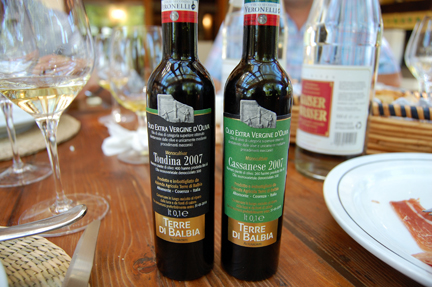





 Do Bianchi