Angelo Gaja, please call me!

From the “just for fun” department…

I like to call him the Giuseppe Baretti of Italian wine writing: my friend and colleague Franco Ziliani (pictured above holding two bottles of would-be [wood-be] Nebbiolo by Giorgio Rivetti) is one of the Italian wine writers I admire most and the feathers he ruffles with his excellent blog, Vino al Vino, often belong to the princes and princesses of Italian wine.

He reminds me of yet another great Italian writer, a Renaissance master of satire, Pietro Aretino: if anyone deserved to borrow Aretino’s motto flagellum principum (flagellator or flogger of princes) it would be my dear friend Franco.

Franco recently posted the above photo together with a post in which he lampoons a Nebbiolo producer (well, should we call him that? his wines don’t really taste like Nebbiolo at all) who — for Franco and for me — represents everything that is wrong with the world of Italian wine today: Giorgio Rivetti is a “wine wizard” and master of marketing who created wines expressly for the American market with little consideration for the great tradition and great people of the place where he makes wine. (You may remember my post on the Spinetta Affair.)

Not long after he posted the photo and satire, he received a phone call from the “bishop of Barbaresco” (who, incidentally, had recently anointed his disciple Rivetti as a member of a putative “national team” of winemakers who will lead Italy into the world cup of the future). Evidently, messer Gaja has forgotten the meaning of irony and satire — notions and literary figures cherished by the ancients and rediscovered during the renewal of learning and then again in the age of enlightenment.

This week, my partner Alfonso Cevola (aka Starsky) and I had some fun with it: Angelo, please call me!

In other news…

Yesterday, Franco sent me this photo, snapped in Maroggia, at the foot of the alps in the Valtellina, where Nebbiolo finds one of its finest expressions.

I moved to Texas for one very special lady only to discover there’s a little bit of Texas in everyone… Thanks, Franco!

Negro Amaro, false friends, and folkloric etymologies

Above: Paolo Cantele and I poured wine and spoke at an Italian wine dinner last night at Jimmy’s in Dallas, where Paolo’s wines were featured. I highly recommend Paolo’s wines and Jimmy’s for its Italian wine and Italian food selections.

For the last few days, I’ve been “riding” with Paolo Cantele (center) of the Cantele winery (Apulia) in Austin and Dallas. Every once in a while, the wine trade brings you in contact with folks you genuinely enjoy hanging out with. Beyond his wines (which are fantastic, btw, and very well priced; his family’s Fiano, Rosato, and Salice Salentino are my favorites), we discussed the Israeli-Palestinian conflict, Dario Fo and Pasolini, and he told me the funniest story about meeting Ninetto Davoli in New York in a food shop last week. (Paolo bears a striking resemblance to actors Gary Oldman and Edoardo Ballerini, the latter, a good friend of mine.)

One of the more interesting conversations that came up, was the origin of the grape name Negro Amaro. If you’ve followed my blog, you most likely have seen one of my posts where I marry my interest in philology with my passion for ampelography — the latter meaning, literally, the writing of grapes. (Check out my posts on Aglianico and Valpolicella, where I conjugate my love for philology and toponymy.)

Many believe that the origin of the grape name Negro Amaro derives from its literal meaning in contemporary Italian, black bitter.

While Calò, Scienza, and Costacurta (Vitigni d’Italia or Grape Varieties of Italy, Calderini, Bologna, 2006) concede that the origin of the name is unknown, they point the dialectal binomial niuru maru “due to the black coloring of the berries and its rich tannins which impart a bitter flavor to the wine or perhaps nero-mavro which could back [the theory that its name derives from] the black character of its skin” (p. 590).

Partisans of the nero-mavro camp believe that the name comes the Latin niger (black) and Greek mavros (black). The idea would be that the grape was named in Latin and Greek because of confluence of Greek and Roman culture in Salento (at the very tip of the heel of the Italian boot, at the top of the Mediterranean basin).

It’s important to note that mavros meant Moor in ancient Greek and that it denoted an inhabitant of North Africa and/or his language. As in other romance languages, moro in Italian ultimately came to denote the color black (probably by the 16th century, when many modern forms of grape names took shape in Italian).

But Paolo introduced a theory that I’d never heard before: that the binomial niger mavros could be due to the fact that Salento was a cross roads between the Byzantine (Greek-speaking) and Western (Latinate-speaking) empires.

The names of many grapes are early forms of wine marketing. For example, Primitivo (which was not cultivated until the modern era in Italy) is so-named because it is early-ripening (primitivus means simply early and was used to denote “first-fruits” in Latin). It’s likely that it was given that name by someone who wanted to encourage its use (i.e., this is a good grape because it ripens early, and hence, you will be able to harvest early avoiding potential bad weather during the later months of fall).

I don’t believe we’ve solved the conundrum of Negro Amaro’s etymon but I do think that its origins could lie in the fact that in antiquity it was cultivated in a place where Greek was the koiné or common language, adopted by all for expediency sake.

I have always thought that black bitter was what we call in linguistics a “false friend,” i.e., a reading based superficially on the immediately apparent meaning of word (for example, magazzino does not mean magazine in Italian in the sense of publication or weekly; it denotes a warehouse or store of military provisions). Why would anyone call a grape bitter? Historically, names were given to grapes for pneumonic or commercial value and not to encourage people not to grow them or consume them. My philological sensibility tells me that black bitter is a folkloric etymology and that the dialectal phrase noted by Calò et alia probably comes from a superficial reading of the grape name.

Either way, I’m happy to have found in Paolo a true friend and interlocutor.

Carissime Paule vale!

A propos good friends, Paolo and I have a good friend in common, Filena Ruppi, who produces a fantastic Aglianico del Vulture together with her husband Donato d’Angelo (for whom the winery is named). I caught up with Filena at Vinitaly, where she posed for my camera with her husband and an image of Mt. Vulture in the backdrop. Their Valle del Noce is one of my favorite expressions of Aglianico.

A guilty pleasure: Quintarelli 1998 Valpolicella

There was one day during my stay in Verona for Vinitaly when I managed to escape the prison walls of the fairgrounds and enjoy a stroll down the main street of a small Italian town, eat a sandwich, have something refreshing at a the counter of a bar, and chat with the owner of a fantastic charcuterie and wine shop, Francesco Bonomo (above).

The town was San Martino Buon Albergo (on the old road that leads from Verona to Vicenza). Alfonso Cevola (above) and I stopped there for a brief but much-needed hour of humanity on an otherwise inhumane week of too much travel and too many wines. That’s Alfonso munching on a panino stuffed with Prosciutto di Praga, baked and smoked ham (that we bought at the first food shop we visited).

One of the more interesting bottles displayed on Francesco’s shelves was this bottle of 1973 Barolo by Damilano. Now just a collector’s bottle, its shoulder was pretty low and Francesco agreed that the wine is surely sherryized. Francesco let me photograph the bottle using my phone (I didn’t have my camera with me) but he was careful not to disturb the bottle’s patina of dust, of which he was particularly proud.

I wish I could have taken a better photo of this wines-by-the-glass list at the little bar on the main square of San Martino: Cartizze, Verduzzo (sparkling), Soave, Fragolino, Bardolino, and Valpolicella by the glass? All under 2 Euros? The answer is YES!

Francesco presides over a modest but impressively local collection of fine wine, including an allocation of 1998 Valpolicella by Giuseppe Quintarelli, the gem of his collection. I rarely bring wine back from Italy these days but the price on this wine was too good to pass by.

However coveted and mystified in the U.S., Quintarelli is one of the most misunderstood Italian wines on this side of the Atlantic, in part because its importer is one of the most reviled purveyors in the country (his infamously elitist, classist, snobbish, monopolistic, extortionist attitude are sufficient ideological grounds for not consuming the wine here).

I’ve interviewed Giuseppe Quintarelli on a number of occasions by phone and his daughter Silvana is always so nice when I call (and, btw, they happily receive visitors for tasting and purchase of their wines). I love the wines and was thrilled to get to taste this 10-year-old Valpolicella with Tracie B on Saturday night: she made wonderful stewed pork with tomatoes and porcini mushrooms for pairing (with a side of mashed potatoes). The wine’s initial raisined notes blew off quickly, giving way to a powerful, rich expression of Valpolicella. I tasted the wine repeatedly in 2004-2005 and I was impressed by how its flavors and aromas has become even more intense.

Francesco was so proud of his Quintarelli. He told me that he sells it at just a few Euros over cost because he just wants to have it in the store and wants to be able to share it with his customers. It was great to bring back a little Valpolicella to Austin and my Tracie B, direct from the source and sourced from someone who understands it for what it really is.

Post script

Alfonso gave me this nifty “wine skin” to transport the bottle back stateside. It seals tidily, so even if the bottle breaks in your suitcase, you don’t risk leakage. Happily the bottle made it back intact.

In the olden days, you used to be able to take bottles on the plane and you even used to be able to bring your own wine for drinking. Alice developed this system for smuggling natural wine on to the plane (happily, no Cavit Merlot for her!).

Popcorn recipe and Bandol rosé pairing by Kermit Lynch

Above: Rock star importer Kermit Lynch is one of nearly every natural wine lover’s heros. Me? Guilty as charged. (Photo courtesy the SF Gate)

I cannot conceal my thrill that Kermit Lynch commented on my blog yesterday. In case you missed it, he wrote:

    One of my favorite pairings is the Bandol rosé (Domaine de Terrebrune also makes a winner) with popcorn. No, not buttered popcorn. To really make the wine and popcorn work wonders, I use olive oil, salt, and dried thyme stirred into the popped corn. A hit of Provence.

Mr. Lynch, thank you for stopping by and thanks for reading.

I also heard from Clark Terry who works with Kermit. He contacted the “Beaune” office: roughly 5,000 cases of Bandol Rosé are released by Tempier each year. I’m glad that a few of them make to Austin so that me and Tracie B can enjoy our Bandol with our Idol! Next week, we’ll have to try Kermit’s popcorn…

Brunello, a peculiar form of wine writing, and Antonioni’s surface of the world

The mere exposure to the visible surface of the world will not arouse ideas unless the spectacle is approached with ideas ready to be stirred up.
—Rudolf Arnheim

For now we see through a glass, darkly…
Corinthians 13.12

Above: Alfonso took this Antonioni-inspired (Blow up?) photo of me while he and I were traveling in Italy last week with a group of wine professionals following the wine trade fairs, visiting wineries and tasting together. In reading the “signs” of the Brunello affair, I must employ my sensibilities as semiotician and see beyond the “surface of the world.”

Last Wednesday, two days after the conclusion of Vinitaly (Italy’s annual wine trade expo), the Italian daily La Nazione reported that 1) Biondi Santi and Col d’Orcia have been cleared of any wrong doing in the Siena prosecutor’s Brunello inquiry; 2) other wineries implicated in the investigation have declassified their wines and have reached agreements with the prosecutor, avoiding further action against them; 3) “preservation of evidence” hearings were to be held (on Friday) for Argiano, Frescobaldi, and Valdicava. (You can read my translation of the article at VinoWire.)

One of things that has kept many — or at least some — of us rapt in the imbroglio of the Brunello controversy has been the Sciascia-esque twists and turns it has taken. Even though Nino Calabrese, the Siena prosecutor, has never spoken directly about those implicated in the investigation (and although he has claimed to be “abstemious” when it comes to the media), he has used ciphered leaks and statements to the press to move his agenda along. He has never directly addressed the question of who was investigated but he did issue a statement in which he claimed that:

    Many of the companies implicated have violated the appellation regulations for Brunello di Montalcino DOCG and Rosso di Montalcino DOC… 6,500,000 liters of Brunello di Montalcino and 700,000 liters of Rosso di Montalcino were impounded. Roughly 1,100,000 liters of Brunello di Montalcino have been declassified to IGT Toscana Rosso. Roughly 450,000 liters of Rosso di Montalcino have been declassified to IGT Toscana Rosso.

The article published last Wednesday does not cite its source but it would appear that the information came from the prosecutor’s office.

There is certainly some significance to the fact that the prosecutor waited until the day after the conclusion of Vinitaly to release this information. It’s not clear to me why he has singled out Argiano, Frescobaldi, and Valdicava — especially when Argiano opted to declassify voluntarily shortly after news of the inquiry broke.

Calabrese claims to be “abstemious” when it comes to the media (what an apt word choice!) but beyond the surface, he has certainly indulged in a peculiar form of wine writing!

Will another earthquake dim hopes of a renaissance for Abruzzo winemakers?

pizza_beer

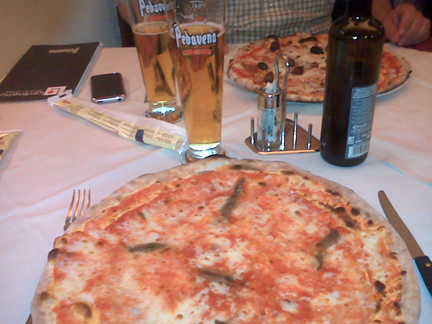
Above: Pizza romana and BEER last night at Il Giardinetto in Marghera (Venice), Italy.

When I came downstairs to the lobby of the crusty and salty 3-star hotel in the Venetian port city of Marghera, where I spent the last night of my Italy stay, I was greeted by the news that another earthquake had struck Abruzzo — 5.2 on the Richter Scale. I haven’t been able to get online with much success (and I am posting today from the Amsterdam airport where I have a short layover before a flight to Houston) but I was able to read Eric’s excellent post (using my blackberry) on the impact the earthquakes will have on Abruzzo winemaking.

To some, it could seem shallow to think about winemaking at a time like this but it’s not. Unlike the majority of Americans, Italians drink wine every day and the wine industry there is not an elitist industry that caters primarily to the affluent (as it does in the U.S. where wine is considered a luxury product, marketed to and consumed primarily by the wealthy). In a region like Abruzzo — one of the more economically depressed among Italy’s 20 regions — the wine industry is the life blood for a sizable amount of the population (including the retail, restaurant, and transport sectors).

The larger and more well-established wineries like Illuminati and Cataldi Madonna will certainly weather the current crisis and their wines will continue to represent some of the best values for quality both domestically and abroad. But it now seems likely (especially considering the current economic climate) that many of the smaller wineries will be forced to shutter their cellar doors. I regret to think that a much-anticipated and hoped-for renaissance in Abruzzo winemaking will not happen in this generation.

The red, white, and sparkling carpet at Vini Veri 2009

Posting hastily this morning as I head out for another day at the fair and then tasting later today at Dal Forno in Valpolicella… Here are some quick highlights from the “red, white, and sparkling carpet” at the 2009 gathering of Vini Veri, the “real wine” movement, “wines made how nature intended them,” as the group’s motto goes.

If ever there were a winemaker who looked like a movie star, it’s got to be Giampiero Bea of Paolo Bea. I finally got to taste his 2006 Arboreus, an Etruscan-trained 100% Trebbiano vinified with extended skin contact. In a later post, I’ll write more about the wine and what Giampiero had to tell me about the 2005 vs. 2006 vintages of his Santa Chiara. The 2004 Sagrantino was the best I’ve ever tasted.

Last year, I tasted Maria Teresa Mascarello’s 2005 Bartolo Mascarello Barolo out of barrel (literally, when the cellar master brought it up for her to taste for the first time). I was excited to taste it again a year later in bottle. She’s carrying on her father’s tradition of artist labels with polemical messages. Her “Langa Valley” label (left) is pretty hilarious.

I really dig Adelchi Follador’s natural Prosecco, which he ages on its lees and bottles in magnum. His winery, Coste Piane, also makes a still Prosecco. The wine is great, probably the best Prosecco you can find in America (imported by Dressner).

Franco turned me on to the Barbaresco Montestefano by Teobaldo Rivella. I tasted the 2004 and 2005 and was entirely blown away by how good this wine showed. It reminded me of Giacosa in style and caliber and its power and elegance made me think of an Arabian filly in a bottle.

Marco Arturi is a truly gifted writer who marries wine and literature. He posts often at Porthos. He is a steadfast defender and promoter of natural wine. We had never met before but we write to each and check in from time to time on Facebook: when we met in person it felt like we knew each other well. The whole Facebook thing is pretty cool.

Getting to taste with Franco Ziliani is one of the highlights of any trip to Italy for me. I admire him greatly for his writing, his integrity as a wine writer, and his palate, and I am proud to consider him my friend and colleague. When Franco point me in the direction of a wine, I know I’m not going to be disappointed.

Vini Veri without its co-founder Teobaldo Cappellano reminded me of the Lou Reed song “What’s Good”:

Life’s like a mayonnaise soda
And life’s like space without room
And life’s like bacon and ice cream
That’s what life’s like without you

Baldo was a wonderful man and even though the fair was great this year (and expanded to include the Triple A and Renaissance du Terroir tastings), it just didn’t feel the same without him.

The image of Baldo with his son Augusto (above) hovered over the room where he would have presented his wines.

I’ll write more on my experience at Vini Veri when I get home. Off to Valpolicella and then Alto Adige… Stay tuned…

*****

Life’s like a mayonnaise soda
And life’s like space without room
And life’s like bacon and ice cream
That’s what life’s like without you

Life’s like forever becoming
But life’s forever dealing in hurt
Now life’s like death without living
That’s what life’s like without you

Life’s like Sanskrit read to a pony
I see you in my mind’s eye strangling on your tongue
What good is knowing such devotion
I’ve been around, I know what makes things run

What good is seeing eye chocolate
What good’s a computerized nose
And what good was cancer in April
Why no good, no good at all

What good’s a war without killing
What good is rain that falls up
What good’s a disease that won’t hurt you
Why no good, I guess, no good at all

What good are these thoughts that I’m thinking
It must be better not to be thinking at all
A styrofoam lover with emotions of concrete
No not much, not much at all

What’s good is life without living
What good’s this lion that barks
You loved a life others throw away nightly
It’s not fair, not fair at all

What’s good?
Not much at all

What’s good?
Life’s good
But not fair at all

— Lou Reed

Nebbiolo Super Freak: gulf oysters and Produttori del Barbaresco

WARNING: EXTREME PAIRING AHEAD, PROCEED WITH CAUTION

It’s a very kinky pairing/the kind you don’t bring home to mother…

In Italian you say, ti tolgo il saluto, literally, I withdraw my greetings from you.

I imagine that’s what Franco will say to me tomorrow at the Vini Veri tasting when he learns that Tracie B and I paired Nebbiolo with oven-fired gulf oysters last night.

Since I moved to Texas last year, gulf oysters have become something of an obsession. I’ve always been a fan of the mollusk but I never thought the shucked shellfish of New York and Long Island could be beat. That lasted until I tasted my first gulf oyster in New Orleans last month.

Above: Coalminer Mark, aka Mark Sayre, aka “the best sommelier in Austin” serves 2007 Langhe Nebbiolo by Produttori del Barbaresco by the glass at happy hour at Trio, the excellent steakhouse in the Four Seasons Hotel in Austin. The wine list is killer, the comfort food appetizers menu is yummy, the prices are right, and the valet parking is FREE! Run, don’t walk.

The 2007 harvest in Langa was a classic vintage and will potentially be a great one, probably similar to 96, 01, and 04 in its profile. The 2007 Langhe Nebbiolo by Produttori del Barbaresco was showing handsomely last night and I cannot conceal that I am ENTIRELY geeked someone in Austin is doing it by-the-glass at a happy hour price. Wine director Coalminer Mark of the Four Seasons and the San Diego Kid might just have to bury the hatchet.

Above: Tracie B’s boss Jon Gerber served raw gulf oysters at his annual “Shuck and Suck Crawfish Boil,” a yearly blow-out party, benefiting Habitat for Humanity.

Nebbiolo and spicy, oven-fired gulf oysters? An unconventional pairing to say the least, but the freshness of the Langhe Nebbiolo and its lighter body and acidity was delightful with savory oyster and chorizo that adorned its silky surface. Hey, Franco, call me a Super Freak… ;-) I’ll see you tomorrow in Isola della Scala.

In other news…

The Italian wine trade fairs start today and I’m about to get on a plane for Venice. Stay tuned: next post from Italia…

No vote on proposed Montalcino DOC

Above: I’ve tasted Il Poggione Brunello di Montalcino and Rosso di Montalcino going back to the 1970s. One of the greatest expressions of Sangiovese I’ve ever tasted was the 1979 Rosso (bottled before the existence of the Rosso di Montalcino DOC and labeled as “Rosso” from “Brunello vines”), which Alessandro Bindocci’s father Fabrizio shared with me last year over steak dinner at Keens in Manhattan.

My friend Alessandro Bindocci, son of Il Poggione winemaker Fabrizio Bindocci, posted today on the proposed creation of a Montalcino DOC: evidently, the vote was put to the floor but no vote was held. Read more here…

I’ll be tasting with Alessandro and his father later this week at Vinitaly.

On the eve of Vinitaly, a push to create a Montalcino DOC (and reflections on a year past)

Above: Franco Ziliani (left), my friend and co-editor of VinoWire, and Mauro Mascarello, winemaker and producer of one of the greatest expressions of Nebbiolo, Giuseppe Mascarello Barolo. We tasted at Vinitaly last year together. This year, Franco and I will be tasting together at Vini Veri.

Passover and Easter will shortly be upon us and the who’s who of Italian wine is preparing to descend on the province of Verona for our industry’s annual trade fairs: Vinitaly (the largest and most commercial), Vini Veri (a gathering of natural winemakers and the most interesting in my opinion), and VinNatur (an assembly of winemakers who broke away from Vini Veri some years back). I’m particularly excited for Vini Veri because this year’s tasting sees the unification of Vini Veri with the Nicolas Joly biodynamic and quasi-biodynamic tastings, Triple A and Renaissance du Terroir (Return to Terroir).

Above: The Banfi Castle at last year’s Vinitaly. There were rumors — unfounded and untrue — that Banfi’s wines were seized on the floor of the fair last year. I am looking forward to tasting the 2004 Brunello di Montalcino by Banfi. Charles Scicolone and Tom Hyland — whose palates I respect greatly — have both told me that it’s classic Brunello, 100% Sangiovese, and one of the best wines Banfi has ever produced.

It’s remarkable to think that at this time last year, the world of Italian wine was gripped by the breaking news of the Brunello scandal: at least five major producers were accused of adulterating their wines from the 2003 vintage. A year has passed, a large quantity of wine has reportedly been declassified, and no indictments have been issued by the Siena prosecutor who supposedly launched the investigation in September of 2007.

It’s not surprising, however, that there has been a new push — albeit weak — within the association of Brunello producers to create a Montalcino DOC. Last week, a proposal to create such an appellation was put to the floor at the consortium’s assembly. (I haven’t been able to find out the results of the vote but according to most observers, it was unlikely that it would be ratified.)

Above: I am always geeked to taste Paolo Bea Sagrantino with Giampiero Bea at Vini Veri (I snapped this photo at last year’s fair). Tracie B and I have been enjoying his Santa Chiara 2006. It’s radically different than his 2005 and I hope to ask him about the vintage variation. (Is it the result of climatic differences or differences in the cellar? I imagine — knowing Giampiero and his radical belief in natural winemaking — that the former is the case.)

Currently, Montalcino producers must label their wines as Toscana IGT or Sant’Antimo DOC if they contain grapes other than Sangiovese. If approved, a Montalcino DOC would allow them to exploit the Montalcino “brand” in their labeling of so-called Super Tuscan wines. The proposed DOC is part of a greater push to create new Italian appellations before OCM reforms take effect in August 2009 and the power to issue new DOCs shifts from Rome to Brussels.

Above: This year, the world of Italian wine mourns the loss of Teobaldo Cappellano (photo courtesy of Polaner). Baldo, as he was known fondly, was one of the founders of the Vini Veri movement and one of Italy’s most zealous defenders and promoters of terroir-driven wines and natural winemaking. He was a truly delightful man and is sorely missed.

There’s a reason why the fairs are held at this time of year: historically and traditionally, the spring marks the moment when winemakers unveil their cellared wines. Long before the hegemony of the Judeo-Christian canon, spring was observed as Mother Nature’s moment of renewal and rebirth.

The ancient allegory — and it is an allegory, not a metaphor — could not be more apt this year.