Red, white, and bubbly carpet: TexSom 2010

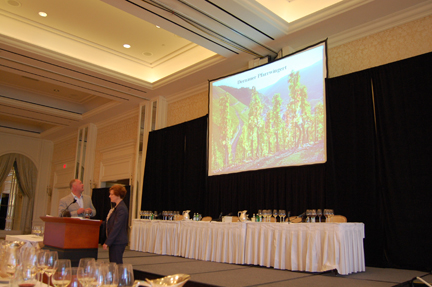
Nearly 300 people attended the standing-room-only, sold-out TexSom 2010, the 6th-annual Texas Sommelier Conference, which began yesterday at the Four Seasons hotel in Irving (Dallas, Texas). That’s reigning “Best Sommelier in Texas” June Rodil who helped out with pouring duties for the “Emerging Regions of Italy” seminar.

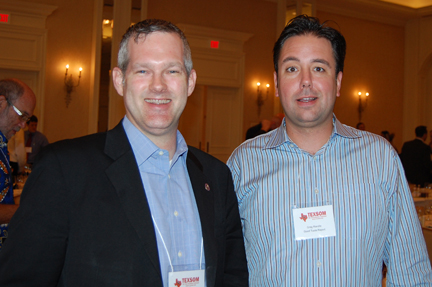
The event draws some of the best and brightest stars in the world of wine, like Master Sommelier Bobby Stuckey (left), who took time out to pose for a paparazzo with Jamie Adams, VP The Sorting Table.

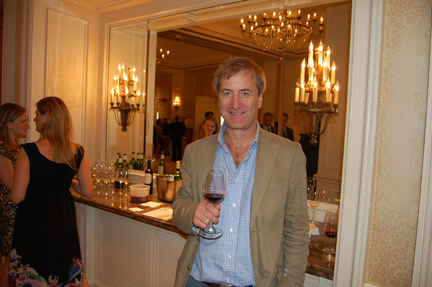
The ever-affable Bartholomew Broadbent is a sponsor and a perennial attendee.

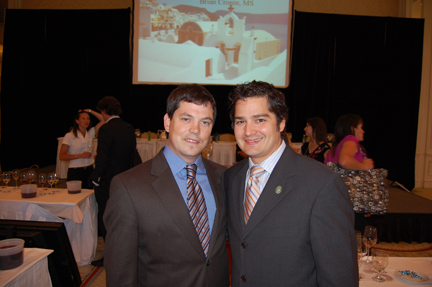
Seven Texas wine professionals will be “seated” at the Court of Master Sommeliers Masters Exam next Monday in Dallas, including Craig Collins (left) and Devon Broglie (right), both of whom serve on the board of the Texas Sommelier Conference.

Best-dressed Texas wine professional D’Lynn Proctor will also be seated at next Monday’s exam.

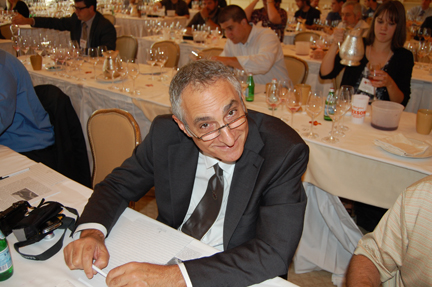
The “Italian Wine Guy” Alfonso Cevola, Italian Wine Director for Glazer’s Distribution, was in fine form as always.

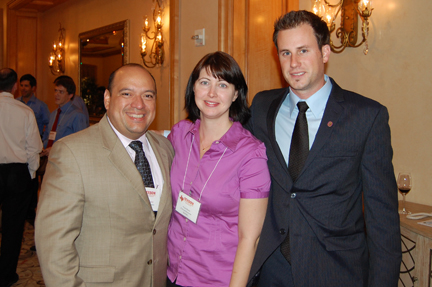
The Duchman Family Winery (Driftwood, Texas) was also a sponsor of the event and was represented by its Events Mananger Paula Rester (center), Tasting Room Manager Bill Elsey (right, who participated in the “Best Sommelier in Texas” competition) and the president of the winery’s distributor, D’Amore Wine Selections, Julio Hernández.

Wine professionals travel from all over the state to attend, like Antonio Gianola (left), who authors one of my favorite wine lists in Houston, and Greg Randle, who educates and blogs about wine in Austin.

Kevin Pike (Sales Manager for Thierry Theise), together with Master Sommelier Emily Wines (nomina sunt consequentia rerum!) delivered one of the best seminars (on German wines) I’ve ever attended… anywhere. Chapeau bas, Kevin and Emily!

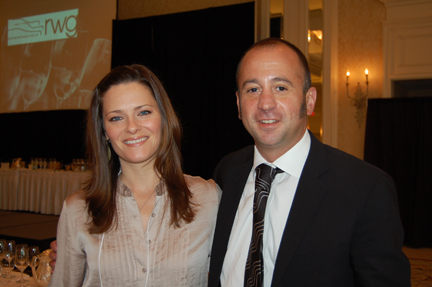
How the paparazzo always gets to go home with the prettiest girl in the room will forever remain a mystery!

Today’s trade-only event begins with a seminar on “Management of a Beverage Program” with moderator James Tidwell MS and panel Bobby Stuckey MS, Antonio Gianola, Paul Roberts MS, and Drew Hendricks MS. Nearly 300 people are expected for the Grand Tasting this evening.

Is it dangerous to visit Tijuana, Mexico?

It’s like a Sunday in TJ. It’s cheap but it’s not free.
—Donald Fagen

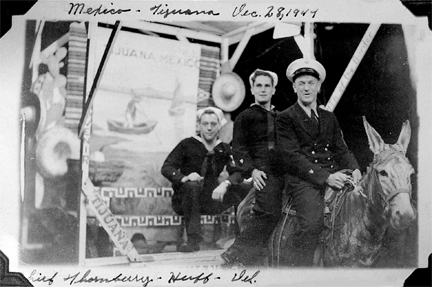
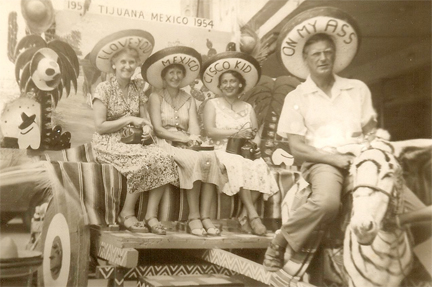
Before, during, and after our trip to Tijuana the other day for our family friend’s beautiful wedding, people have asked me and Tracie P whether we were scared or felt like we were in danger while there. The answer is no and no. On the way back home, Tracie P observed sweetly, “and I thought that folks were nice in Texas!”

Not that I’m surprised at the questions. The New York Times ran this article on how dangerous it is to go to Tijuana just one week before we went. While I don’t agree that it is dangerous for people like us to visit there, I did love the profile of Americans’s relationship with Tijuana in the piece (including quotes from Kerouac and Orson Welles). And I regret that the transnational culture that I enjoyed in the 1980s growing up in San Diego has disappeared, as one of the persons interviewed for the article observed.

    “The relationship that once existed between the two sides is broken,” lamented Luis Ituarte, who splits his time between Los Angeles, where he promotes the arts, and Tijuana, where he runs a cultural center. “There used to be so much mixing. Young people in San Diego would go for the night to Mexico. As a young boy in Tijuana, a night out in San Diego was something I did all the time. You got to know people on the other side.”

I imagine I’m probably roughly the same age as Luis. Growing up in San Diego, attending La Jolla High School in the early 1980s, I had a lot of Mexican friends (most of them very wealthy), I learned to speak Spanish fluently (my first second language), and I traveled to Tijuana and other destinations in Baja California regularly (I also lived a summer in Mexico City). And yes, I went there to party like the other kids. But I also used to take my mother and out-of-town guests there to dinner. Sometimes, we’d even make the 45-minute-or-so drive just to have lunch in one of our favorite restaurants.

And remember: there’s SO much more to Tijuana than the cheesy Revolución district where people go to party.

I much prefer the Zona Río district where there are fantastic restaurants (like the one where we ate), shopping malls, and a wonderful Centro Cultural (where, while we were there, there was a Goya exhibition).

The only thing that’s really different from my high school and college days is the extremely long wait times at the auto crossing. But that’s easily remedied by walking across the border and taking cabs (very inexpensive).

We had so much fun that mama Judy and I are planning to take Mrs. and Rev. B when they come out to California to visit with us this fall.

On this side of the border, people have asked us earnestly if we felt in danger. On the other side of the border, people asked us ironically, “are you afraid?”

The answer in both cases is an earnest, honest, and heartfelt no.

Two favorite white wines for summer (and the ultimate sushi wine?)

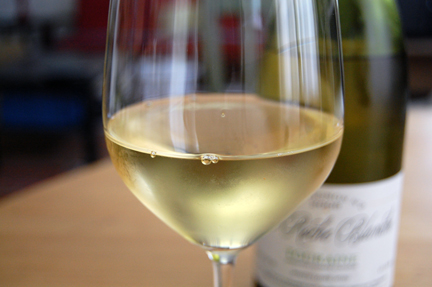
Above: Tracie P and I have been enjoying a lot of my number-two white wine of the summer of 2010, the Clos Roche Blanche 2008 Sauvignon Blanche No. 2 (does anyone know why it’s called “numéro 2”?).

Chez Parzen, we’ve been enjoying a lot of great wine this summer but two white wines have really stood out. And when I say “favorite white wines for summer,” I mean wines that we keep coming back to over and over again.

Alice first turned me on to the wines of Clos Roche Blanche five years ago in NYC and I was immediately hooked on Cot.

BrooklynGuy is also a fan of the Sauvignon Blanc: check out this tough-love post he did last year around this time.

Here in Texas, we’re still drinking the 2008 and it’s showing great, so fresh, such pure white fruit (pear and apple) in it, great acidity, low alcohol, and under $20 at The Austin Wine Merchant. Summer time means a lot of salad and canned tuna in olive oil, pasta al pomodoro, and fresh cheeses. I just love drinking this wine, as we did last night, with tomato sauce.

Just looking at the color, above, makes me wanna slurp it up!

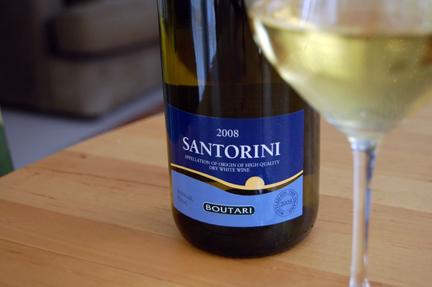
Above: The 2008 Santorini from Boutari, made from 100% Assyrtiko grapes, has a slightly oxidative thing going on. I think the gods made this wine just for me and Tracie P.

Anyone who’s been following Do Bianchi this year knows that I’ve become somewhat obsessed with the wines of Santorini. (Check out the thread here.)

I was hired this year to create content for the Boutari Social Media Project and one of the best things about the gig is how much great wine I’ve got to try for the first time: I’ve been loving Santorini by Sigalas and Gaia (both available in this country but not yet in Texas, although Sigalas is coming). But the wine Tracie P and I keep coming back to over and over again is the Boutari 2008 Santorini (also available for under $20 at The Austin Wine Merchant).

Tracie P put it best when she said it’s so mineral that “it’s like drinking seawater.” It’s salty and has a rich mouthfeel, a grainy texture that I can’t get enough of, the alcohol is well balanced in the wine, and it has that slightly oxidative note that we dig (and might even have aphrodisiacal properties where familiar matters are concerned).

Boutari’s Santorini and Santorini in general may very well be the perfect sushi wine. Remember when Aldo paired Gaia Santorini Thalassitis with raw sea urchin for me at Le Bernardin?

Santorini is such a fascinating appellation: drastically difficult grape-growing conditions, all pre-phylloxera rootstock (because the little bugs can’t jump from one Santorini’s tiny grains of volcanic sand to another), vines 80-100 years old, the whole connection to Venice and Venetian merchants in the Renaissance. Santorini, when it’s good, is just one of those wines that thrills and surprises me, stimulates my intellect, and transports me to another place.

Isn’t that what great wines are all about?

I hope everyone’s having a great summer with something great in your glass! Thanks for reading…

Sophie’s Choice: 06 Produttori del Barbaresco

This wine may be my favorite bottling yet, but not for the reason you think…

barbaresco

Above: Summertime isn’t exactly ideal for Nebbiolo but, after so much talk of this wine, I couldn’t resist opening a bottle of 2006 Barbaresco by Produttori del Barbaresco last night. Can you blame me? Dinner last night chez Parzen was cannellini dressed with extra-virgin olive oil, salt, pepper, and a kiss of red wine vinegar, wilted spinach and boiled potatoes also dressed with evoo, and some fresh feta.

Between Bruno Giacosa’s controversial decision not to bottle his 2006 vintage in Barolo and Barbaresco and Produttori del Barbaresco’s much misunderstood decision not to bottle its 2006 single-vineyard designated wines, the 2006 vintage may very well be one of the most talked-about vintages in Langa in recent years.

Let’s get one thing straight: most folks agree that 2006 was a classic, solid vintage, with a relatively balanced growing season (if not for rains in September). It wasn’t GREAT (in all caps) but it was good to very good. And while Giacosa’s decision appears outwardly based on the personal setbacks Bruno suffered that year, the decisions by Giacosa and Produttori del Barbaresco were probably based on economic reasoning: in a tough market, it’s easier to sell a more reasonably priced wine. In fact, Aldo Vacca (winemaker at Produttori del Barbaresco) said as much in a comment he left on Do Bianchi.

I tasted the 06 for the first time in New York in the spring: it was a ringer in one of the blind Greek tastings. But last night, after reading one too many blog posts about the 2006 Produttori del Barbaresco (which is now in the market), the mimetic desire kicked in and I caved and opened a bottle.

While I continue to kick myself for not cellaring more 2004 (especially) and 2005, my negligence has been rewarded by this amazing bottle of wine, which is a cuvée of all the Produttori del Barbareso crus.

barbaresco

Above: I tasted all of the 2005 single-vineyard (cru) designated wines in March at the winery with Aldo. I’ll post my notes on these, which have also just hit the market, next week.

I have always been a bigger fan of the cuvée, i.e., the classic Barbaresco blended mostly from the Ovello cru, with smaller amounts of other crus depending on the vintage. But the 2006 classic blended Barbaresco is something truly special.

Antonio Galloni, one of the top 3 palates for Nebbiolo in the world IMHO, was a fan of the otherwise “average” vintage when he tasted the first bottling of the 06 (before the decision was made not to bottle the crus): “If the regular Barbaresco holds this much power,” he wrote, “I can only wonder what the Riservas might have in store. Simply put, this is a marvelous effort.”

The wine we tasted last night was fantastic, with all the earth and all the red fruit I dream for, extremely powerful and rich, more so than other classic vintages like the winery’s 99, 01, 04, and 05.

My only misgiving about this wine is that it’s one of the few instances where I will tell you to let it age in your cellar for a few years before approaching it. I believe that with the addition of grapes from crus like Montestefano and Montefico (the most tannic), the wine has a tannic power that will only reward the patient collector.

It’s not that this wine is “better” because “better” fruit went into it, as many sales people are however earnestly but erroneously saying. The crus are not “better.” They are just different among one another.

What’s special about this wine is how it shows that terroir is also about people and where and how they decide to grow and raise things. This wine is a true collector’s item from Produttori del Barbaresco: it’s an anomaly, a rare occasion where Aldo had a better vintage than many, but decided not to bottle single-vineyard wines.

In some ways, this wine is the best bottling of my enosentient lifetime. Keep in mind that the cru system began in the late 1960s (and 1967, the year of my birth, to be exact), when Gaja, Vietti, and Produttori del Barbaresco were inspired by the French cru system to bottle single-vineyard designated wines. Ultimately, whether it’s Aldo’s cru vs. cuvée or Vajra’s Barolo Bricco delle Viole vs. Barolo Albe, or even Gaja’s Sorì-designated wines vs. its Barbaresco (to use three different stylistic examples), I always find that it’s the classic, blended wines (like Bartolo Mascarello, who has never made a cru) that keep calling me back. They don’t express a growing site: they express a vintage, an appellation, and a way of life.

So in a way, the 2006 Barbaresco by Produttori del Barbaresco is the financial crisis’s little gift to us: a wine that harks back to an era before the advent of Barbaresco’s Francophilia.

In essence, for survival’s sake (and the sake of all those who depend on him), winemaker Aldo had to make a “Sophie’s choice.” I’m glad that he chose well.

Veraison wireless in Montalcino

My friend Ale at Il Poggione (Sant’Angelo in Colle, Montalcino) is not the only one who’s been posting about the 2010 vintage on his blog.

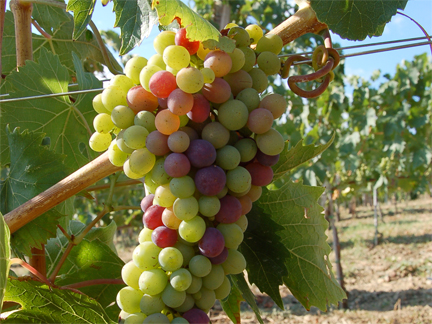
Another good friend, Laura, has been doing some amazing posts at the blog she authors for Il Palazzone. The photo above comes from a wonderful post she did showing the different ripening times in different growing zones of the winery’s estate.

One of things I’ve been enjoying about following Laura and Ale’s respective blogs is how it illustrates the subtle (and sometimes not so subtle) differences in the various subzones of the appellation.

In the case of Ale in the southwest subzone, the rate of ripening has accelerated slightly (80% of the grapes have changed color, he writes, catching up to the average) while Laura’s grapes are still about a week behind schedule. I love how she writes: “The ripening seems to be more than a week behind schedule, if it is appropriate to apply such concepts to nature.”

Check out Laura’s most recent post and Ale’s thread on the 2010 harvest in Montalcino.

In other news…

Another Brunello has been born with the 2010 vintage…

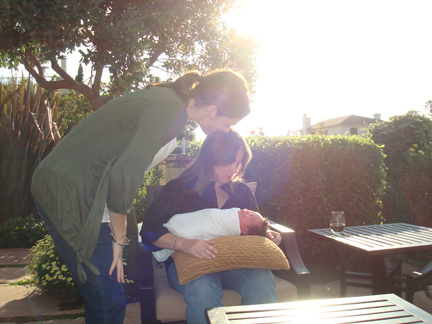
Over the weekend, Tracie P and I got to visit with our good friends Melanie and Noah, who have just welcomed Bruno into the world. Don’t they look angelic?

Noah and I grew up together (even attending Hebrew School together!) and luckily their stay in La Jolla overlapped with ours. Melanie has taken to calling the little one “Brunello.”

I still haven’t had a chance to pick up my copy but Melanie’s new book Eating for Beginners is now available.

Mazel tov, Melanie, Noah, and Bruno!

@Bruno I’ll be sure to put away some 2010 Brunello to drink with you when you turn 21!

The Summer Winter of Our Disconnect: 12.5% Cabernet? And other good stuff we ate and drank in California

chino farms

Above: Both my buddy John Rikkers and I ordered the “Market Salad” at Market in Rancho Santa Fe. It’s no longer on the menu but they’ll make it for you on request. All the lightly blanched ingredients are sourced from San Diego’s legendary Chino Farms farmers market.

Everywhere you go in California, people are complaining about the cool summer weather. By most accounts, it’s the coolest summer we’ve had here for more than 70 years.

On Sunday, Vinogirl (who authors my all-time favorite California wine blog, Vinsanity) didn’t mince words: “Actually, I am very surprised that [veraison, i.e., ripening] is happening at all as it only managed a whopping high of 70F today,” she wrote plaintfully. “So far, the weather in 2010 has been pathetic!”

mea culpa

Above: I’d never had the Bouvier grape, known as Ranina in Slovenia, until last night at Market, where sommelier Brian Donegan always has something by the glass that will surprise and delight the adventurous wine lover, like this 2007 Mea Culpa by Kogl. I would have guessed it was a dry Muscat but it had some gentle orchard fruit notes seemed to speak a Slavic as opposed to Romance language.

Yesterday, in a fantastic post, one of America’s wine industry social media pioneers Tom Wark (and all-around nice dude) wrote and asked rhetorically, is this a bad thing?

    If this weather keeps up, it’s entirely likely that some winemakers are going to have to learn how to make good Napa or Sonoma Cabernet with an alcohol content of (brace yourself)…12.5%. […]

    Clearly 2010 is looking to be a better vintage for early ripening grapes like Pinot Noir. But even the Pinots are likely to suffer a diminishing alcohol content. The question is this: is that a bad thing? I think it might be for many winemakers, particularly those that tend to produce big, fat, huge unctuous Pinots with high alcohol content.

ettore germano

Above: The acidity in Ettore Germano’s Chardonnay was, as Tracie P likes to say, “tongue-splitting.” It’s not like me to order Chardonnay from Italy (outside of Friuli) but I must say that I dug this wine completely. Very mineral, very bright acidity. Always something good by the glass at Market.

Of course, the mystery of California’s unusually cool summer begs the question among its “red state” populace: with summer temperatures like these, how can the pinkos still cling to their claims of global warming?

seaweed salad

Above: Seaweed salad at Zenbu in La Jolla.

I’m sure I imagine that Tom would agree with me: anyone who works in the wine industry and spends times with grape growers will tell you that European winemakers — even the most conservative among them — believe that global warming is indeed taking place. In Tuscany, where the grapes used to ripen in October, grape growers will tell you that they now ripen as early as late August (although this year, at least in Sant’Angelo, grapes are ripening about a week behind schedule).

California roll

Above: One of the thing I love about Zenbu is the playful California creativity in the menu, with items like the “Jackie Chan” roll and the “Mexicali” roll. That’s the gorgeous sashimi roll (a contradiction in terms?). There’s nothing worse than boring sushi!

Once, when I interviewed a famous winemaker in Piedmont for a commercial writing gig of mine, he unabashedly told me, referring to the remarkable string of great vintages in Piedmont spanning 1996-2001, “global warming has made me a very rich man.”

Above: French Toast at Jaynes Gastropub in North Park (San Diego).

To those who claim and believe global warming is part of a secret left-wing conspiracy, I say: who cares whether it’s true or not? At 43 years of age, I’m old enough to remember the first “energy crisis” in the 70s: whether or not you believe in global warming, there’s no denying that it’s high-time to “clean up our act.”

bellyup tavern

Above: My childhood and a best friend Charlie George created this “White Trash” gift basket raffle item for a benefit for local musician Michael Muldoon last night at the Belly Up Tavern in Solana Beach, where Charlie and a bunch of other friends of mine performed.

So whether (weather) you’re sweating your nuts off in the rest of the country, wearing a sweater in Sonoma, or getting ready to pick grapes in Tuscany, don’t forget to turn off the lights! And be sure to eat your California leafy greens…

Thanks for reading!

Scenes from a Boda Mexicana and the best breakfast in Tijuana

boda mexicana

Above: Sandro and Julia were wed in a Saturday evening mass at the Iglesia de la Divina Providencia in Tijuana this weekend. What a beautiful wedding, what a gorgeous couple! When Julia knelt before the image of the Virgin Mary in the cathedral’s chapel and the soprano sang Schubert’s “Ave Maria,” both Tracie P and I had tears in our eyes.

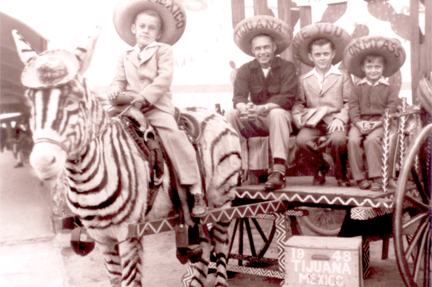
The Castro and Parzen families have been closely related and intertwined for nearly four decades. The marriage of Julia this weekend to her beloved Sandro marked a milestone that none of us will ever forget. They were married in the same cathedral where brother Micah and I were ring-bearers (he nine years old, I eleven) in 1978 at the wedding of Teresa and Felix, Julia’s parents.

boda mexicana

And so mama Judy, brother Micah and sister-in-law Marguerite, Tracie P, and I drove to Tijuana on Saturday afternoon for the night.

boda mexicana

The reception was held in the Salón de Eventos of what many consider to be the best restaurant in Tijuana these days, Cien Años, in the Zona Río shopping district (my favorite part of the city).

The main course of our dinner was a wonderful mole blanco (a mole sauce made with white as opposed to dark chocolate) with a roast potato au gratin and a julienne of fresh squash.

boda mexicana

Before heading to the wedding, we had a cocktail at our hotel next door to the event space (the Hotel Real del Río, a moderately priced, full-service hotel, highly recommended).

cien anos

The next morning, we had a fantastic breakfast at Cien Años, which opens every day at 8 a.m., btw. The main dining salon there is one of those magical rooms.

cien anos

I envied Tracie P’s crepas (crêpes) drowning in a mango and habanero sauce…

cien anos

…and stuffed with zucchini blossoms, mushrooms, and serrano peppers. Amazingly good… We used to dine regularly in Tijuana when during my college and grad years at UCLA. There are so many great places to eat there.

cien anos

Chelsea Clinton may have had the wedding of the year, but Julia and Sandro had the wedding of a lifetime! :-)

Muchisimas felicidades!

One more from California (WARNING: CONTAINS EXTREME FIG CONTENT)

wedding cakes

Just had to add these photos quickly before we head out for the next adventure: we had a great lunch at Michele Coulon Dessertier, who created our wedding cake earlier this year. Most people think of her café purely for dessert, but her savory menu is FANTASTIC. All of her ingredients sourced for local growers, like the salad above, most of which came from San Diego’s famed Chino Farms.

wedding cakes

We try to eat at Michele’s every time we’re in La Jolla.

wedding cakes

Every time we visit Michele, it brings back such a great memory of our wedding cake! :-)

Now it’s time to get dressed up and head south…

Eating our way through California

california tomatoes

Above: Top Italian wine writer Mr. Franco Ziliani (possessor of a palate I admire immensely) likes to tease me (rightly) about how I’m so crazy for the wines of Piedmont, I’ll even drink Barolo in the middle of the “scorching hot” Texas summer (and believe me, it’s been a hot one in Texas this year!). Well, yesterday I quit the California dreaming and did me some serious California eating! Those are tomatoes from Chrissa and Dan’s garden.

grilled marlin

Grilled marlin, scallops, and shrimp for lunch with client and new friend Mike K at the classic ol’ San Diego downtown eatery Dobson’s. (Thanks again for lunch, man!)

baker and olive

Savory San Diego Bread and Cie bun with locally sourced olive oil from Baker and Olive, and Fra’ Mani salame at epicurean Chrissa and Dan’s place (a truly yummy locus amoenus their house is!).

california produce

Dan’s excellent heirloom tomato salad, sourced from their garden (what’s the name of the Polish cultivar?).

california sushi

Late-night sushi at Miso Harney sushi in Old Town (they serve until 12 a.m.!) after Tracie P got in from Austin (I got in the day before). Geared for a young crowd, Miso Harney is a great place for later-in-the-night super fresh San Diego sushi and an SD-restaurant-industry fav.

california traffic

Of course, there’s also the California summer traffic to contend with. Ugh… Not so bad though, considering the view!

I bet you’re gonna like where we’re headed today… Stay tuned… It’s a special one…

Bartolo Mascarello: an academic look at “collective identity, contention, and authenticity”

Above: I met with Franca and Maria Teresa Mascarello back in 2008 in their home. Our mission was to unravel the mystery of the Bartolo Mascarello beret.

Yesterday, I received an email from my good friend Josh Kranz who lives and works in New York City: “Thought of you last night – walked by a French place on 39th b/t 5th and 6th called Barrique. ‘Jeremy would never go in there on principle.'” (Check out this great story Josh recently published about an adolescent’s fear of dropping the Torah, a sentiment that I certainly shared in my pre-teen and teen years.)

As it so happens, I also received an email from fellow Nebbiolophile Ken Vastola, who sent me a link to a wonderful research paper, published at Stanford, devoted to Bartolo Mascarello and the Mascarello’s famous campaign against barrique and Berlusconi. (The file is large so be patient when downloading.)

Here’s the title and abstract:

    NO BARRIQUE, NO BERLUSCONI: COLLECTIVE IDENTITY, CONTENTION, AND AUTHENTICITY IN THE MAKING OF BAROLO AND BARBARESCO WINES

    Abstract

    How does contention over authenticity unfold through social movement processes of mobilization and counter-mobilization? We address this issue by studying how the rise of “modern” winemaking practices embodied authenticity as creativity, how the success of the modernists triggered a countermovement seeking to preserve “traditional” wine-making practices, and how the emergent “traditional” category was premised on authenticity as conformity to a genre. This countermovement succeeded in a situation in which market forces seemed destined to displace tradition with modernity.

Photo via Spume.

“A modern winemaker is like Berlusconi,” said Maria Teresa to the researchers. “He is the model. He embodies this way of looking at the market, at the economy.”

Have a look at the paper: it’s a great read. I’m glad to report that the “counter-movement” opposing modernization is alive and well and living in Palo Alto!