
They made me drink Merlot… again…

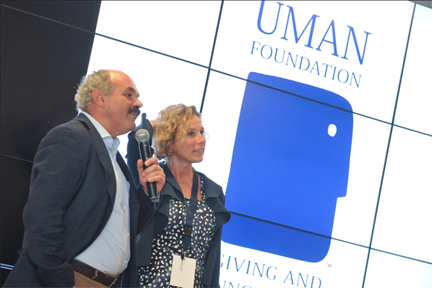
Above: Eataly founder and Italian entrepreneur Oscar Farinetti with Uman foundation president and environmental activist Giovanna Melandri in Rome, October 2012 (image via the Uman Foundation Flickr).
“Entry to Eataly is forbidden to people like [Italian senior parliamentarian] Calderoli,” said the food emporium’s founder Oscar Farinetti to a radio interviewer this week in Italy, adding that the ban was “for hygienic reasons.”
He was referring to Roberto Calderoli, Northern League (Separatist) party member and vice-president of the Italian senate, whose recent racist comments have been the subject of controversy this week in Italy.
At a political rally on Saturday in Treviglio (Lombardy province), Calderoli used a racial slur in reference to Italy’s first African-born minister, Italo-Congolese politician and opthamologist Cécile Kyenge.
Calderoli and his racist cohorts, suggests Farinetti in the interview, “shouldn’t just resign from politics… They should resign from the human race… They lack the conscience that distinguishes humans from chimpanzees.”
You can listen to the interview here.
As an Italian wine and food historian and an observer of Italy’s wine and food trade, I applaud Farinetti for his “no racists allowed” policy.
His statements came in response to the interviewer’s question: As someone who works abroad, are you ever embarrassed by the attitudes of Italian politicians?
While many international ambassadors of Italian wine and food avoid the sticky, unsavory issues of politics and racial tensions in Italy today, Oscar Farinetti’s decisive stand on this issue — zero tolerance for the manifest racism expressed by Italy’s separatist movement leaders — deserves our attention and commands our respect.
Enogastronomy is one of the greatest expressions of the Italian soul — no matter what the political affiliation. As the highest-profile representative of Italian wine and food throughout the world, Farinetti’s example should be a model for us all.

No, I’m not at my favorite trattoria in Florence, Buca dell’Orafo. But Cousin Marty and the Levy clan were there last night and these are the photos they sent.
Has the mimetic desire kicked in yet?
Today is Marty’s birthday: happy birthday, Marty! We love you so much!
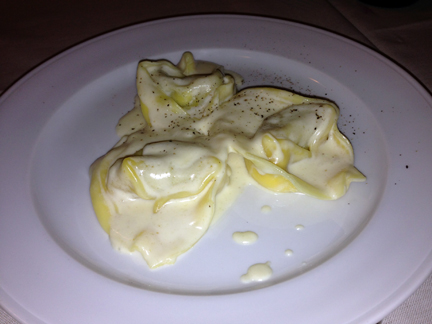
Cousins Marty and Joanne are currently touring Italy with their son (my cousin) Jonathan and his girlfriend Chiara who is from Viterbo.
And Marty asked me for some dining recommendations.
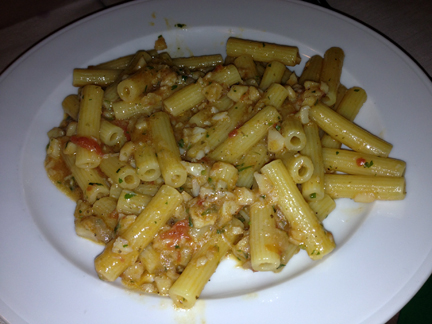
When I moved to Texas five years ago to be with Tracie P, I never imagined that I would reconnect on such a deep level with my cousins from the “estranged” side of my family (my father and Marty are first cousins).
But we’ve all grown really close and they have been so supportive of me and our new family here in Austin.
And now that things are getting so serious between Jon and Chiara (Marty and Joanne met her parents for the first time on this trip), our Italian connection is even stronger!

Chiara, who, like Jon, is an academic superstar, loves to tease me about my Veneto accent and we all had a great time visiting when they came out to see my band’s show in San Francisco earlier this year.
Chiara, Jon, Joanne, and Marty: thanks for sending the pics! As we wait patiently at home for Baby P 2013 to arrive (no developments), it’s great to live vicariously through your enogastronomic adventures! I love it…
baci e abbracci
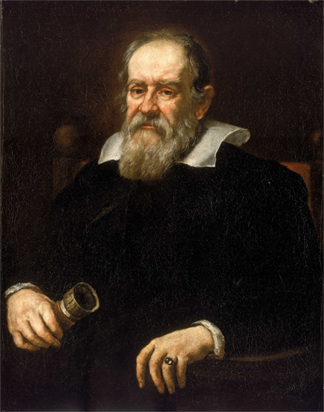
Above: Portrait of Galileo Galilei (1564-1642) by Justus Sustermans (1597-1681; image via the Wiki).
Reading the excellent Italian-language food and wine blog Porthos this morning, I was reminded by the authors of the famous and brilliantly topical lecture by U.S. physicist Richard Feynman, “The Universe in a Glass of Wine.”
“A poet once said,” it begins, “‘the whole universe is in a glass of wine.’ We will probably never know in what sense he said that, for poets do not write to be understood. But it is true that if we look in glass of wine closely enough we see the entire universe.”
Click here for the entire text (it’s very short) and the audio. If you’ve never heard it, it’s worth listening (in part because Feynman’s immense ability as orator).
(Today’s post on Porthos takes the form of a Socratic dialog on biodynamics and Natural wine and the interlocutors cite Feynman as an example of the powerful mythology of Nature as expressed through wine.)
Feynman doesn’t seem to know who the poet was. (And he notes — for comic effect but erroneously in my view — that poets “don’t write to be understood.”)
I believe that the imagery comes from a “scientific letter” by Italian philosopher Lorenzo Magalotti (1637-1712) who cites Galileo’s [attributed] maxim, wine is a compound [mixture] of moisture [humor] and light (il vino è un composto di umore e di luce).
Note that humor denoted moisture in seventeenth-century Europe (cfr. “1697 Dryden tr. Virgil Georgics i, ‘Redundant Humours thro’ the Pores expire,'” Oxford English Dictionary).
This celebrated observation of the physical world was transmitted anecdotally by Galileo’s student Raffaello Magiotti (1597-1656), who is quoted by Magalotti in the letter.
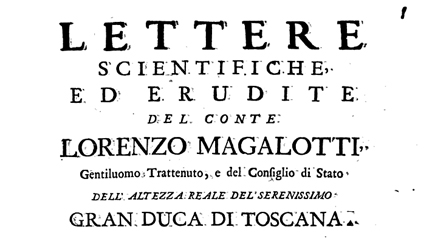
In the text (the fifth letter in the collection), he uses the maxim as a thesis in his dissertation on the nature of light. The grape and its transformation, he writes, are a perfect example of light’s ability to “penetrate a body.”
In Dante’s Commedia (Purg. 25, 76-78), the Latin poet Statius compares G-d’s creation of life to Nature’s transformation of moisture into wine by means of light:
[And, that you may be less bewildered by my words,
consider the sun’s heat, which, blended with the moisture
pressed from the vine, turns into wine.]
(Some have translated Dante’s omor [umore] with the English sap but moisture is a more accurate translation, especially given the context.)
In the light of Dante’s popularity during Galileo’s time, it’s likely (guaranteed, really) that Galileo was familiar with these lines. Magalotti cites the Dantean verses as well in his letter.
So did a poet once say that you could see the whole universe in a glass of wine?
It’s possible but unlikely.
Did the poets, as far back as Statius, consider wine to be a substance that could reveal the nature of the universe? Yes, most definitely.
Like me (however small I am compared to those giants), they were negotiating the epistemological implications of oenophilia.
Thanks for reading…

We’re in a sort of limbo these days: now one day after our official due date, Baby P 2013 could arrive at any moment but there are still no signs of labor (yesterday Tracie P had a labor-inducing massage; today, she’ll do acupuncture).
Usually for my birthday dinner, I grill a porterhouse steak Florentine-style and open one of my favorite Langa crus or a Brunello Riserva from a favorite producer.
But this year, knowing that I wouldn’t be having more than a few glasses of wine and not wanting to tempt fate with immodesty, I pan-fired a beautifully tied veal chop and finished it with cremini mushrooms that I had sautéed and deglazed with white wine (some Dettori 2009 Romangia Bianco, for the record). And I opened a bottle of 2008 Produttori del Barbaresco (classic) Barbaresco, a label that you will always find in my Saturday-night cellar selection and one of my all-time favorite wines. (I pan-fired a filet mignon for Tracie P, who’s been craving red meat in these last weeks of the pregnancy.)
In my experience, the greatest expressions of Langa Nebbiolo will be fresh and bright, with vivid fruit flavor, in their early youth. But then suddenly, as if dropping off a continental shelf, they plunge into the tannic depths of traditionally made Nebbiolo.
The bottle I opened on Saturday night, my birthday eve, had already crossed the threshold of this “shut-down” period. And as much as I enjoyed the wine, it was much more generous with its fruit the next night (paired with quesadillas). Just a few months ago, it was still very bright when first opened.
I can hear my wine board fellows crying infanticide!
But in my view of the vinous world, this episode is all part of the joy in watching a wine evolve and remembering each development over the course of my relationship with it.
I drank just two glasses of it on Saturday night and then we finished it on Sunday night (by which time it was showing brilliantly, although still very tannic).
Moral of the story: in keeping with my maxim, never expedite wine, I just needed to give the bottle a day to open up and share its fruit with me.
Thanks again to everyone for the wonderful birthday wishes (mine and Baby P 2013!)! They mean the world to us…
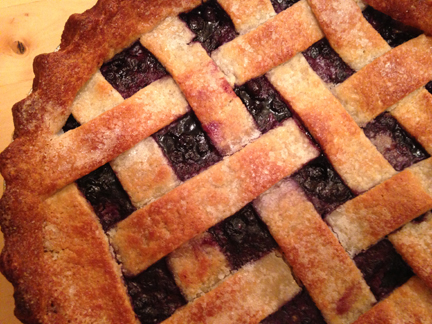
This year for my birthday, Tracie P ordered a blueberry pie from our favorite Austin cake shop, Polkadots (ever since I was a child, I’ve always had blueberry pie — a classic summer pie — for my birthday, which also happens to be Bastille Day, an unheimlich coincidence considering that I am a member of a French rock band).
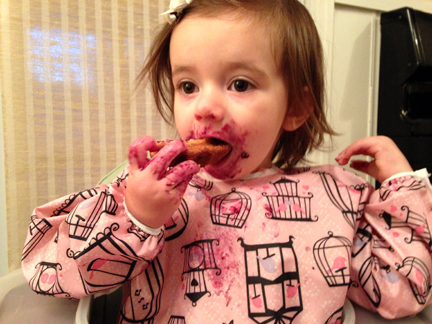
And being that it’s my birthday today, it was my birthday wish to have blueberry pie with Georgia P for breakfast.
After all, what are birthdays for if you can’t have pie for breakfast?
39-plus-weeks-pregnant mommy is still sleeping. But she gave us the greenlight last night before she went to bed.
It’s 7:30 a.m. as I write this and Georgia P and I have already had quite a morning, between pie — hers paired with milk, mine with coffee — and cleanup. :)
Labor still hadn’t begun when mommy went to bed last night. But could today be the day? Tomorrow is our official due date.
Thanks, everyone, for the birthday wishes on the Twitter and Facebook!
I couldn’t have dreamed of a better birthday…
Baby P 2013 update: no developments, no news. Just waiting. Monday is the official due date (and we have an ob/gyn appointment Monday morning)…
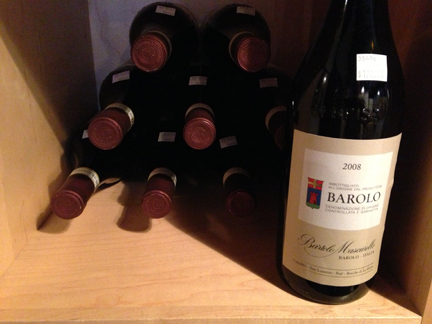
Any Texan familiar with the way Bartolo Mascarello’s wines were previously distributed in the U.S. will join me in rejoicing: Bartolo Mascarello’s wines are now available in the Lone Star State!
I snapped the above photo yesterday at The Austin Wine Merchant (where we shop religiously).
We may now have one of the most restrictive reproductive rights policies in the U.S. (with just five Planned Parenthood clinics, all located east of I-35).
But the most liberal of Italian wines has now been unchained from the tyranny of the Oklahoma oilman who hoarded the stuff.
The disconnect between the staunchly conservative anti-trust platform who had exclusive access to these wines (the Oklahoma petroliere only allowed one NYC restaurant group to buy them, for example) and the liberal, communist-era ethos of the people who made and make these wines has always baffled me.
But the wine trade has always made for strange bedfellows.
I am glad (and relieved) however that a new generation of Texan wine professionals, enthusiasts, and lovers will be able to experience this icon, this benchmark of Italian viticulture.
*****
Caro Alberto, ti mando questo manoscritto perché tu mi dia un consiglio. È un romanzo, ma non è scritto come sono scritti i romanzi veri…
Dear Alberto, I’m sending you this manuscript to get your advice. It’s a novel, but it’s not written the way real novels are written…
(This cryptic allusion will not be lost on my capelloni sisters and brothers.)

I was really, really bummed to miss legendary Italian enologist Franco Bernabei (above) when he came through Texas in May (we would have met but I was in New York at the time).
Even if you don’t know his name, you probably know Franco’s work: some of Italy’s greatest expressions of Sangiovese have been crafted by him.
My friend Lars, who reps the Sartori brand (among others), did send me the above photo of Franco getting down on the keyboard.
He also sent the below photo of Franco getting his taco and Shiner on.
(Lars, you need to tell Franco that you eat tacos with your hands!)

And he also sent me some samples from Sartori, a historic Valpolicella producer with whom Franco has been consulting recently (returning to his Veneto roots, as Lars put it).
Last night, Rev. B and I cracked one over dinner (as our Baby P 2013 watch continues).
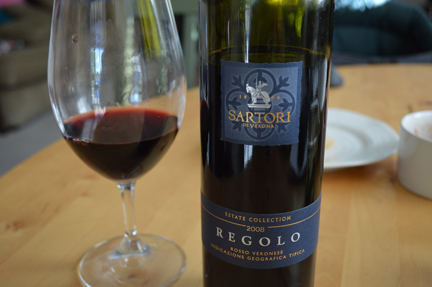
The wine was super fresh, clean, and focused. And it was classic Corvina… all the way. Healthy acidity and a gentle richness (imparted apparently from short aging over Amarone lees, according to the Sartori site).
I really dug the wine (the first from the box of samples I received; I’ll open and report on more later). And being a certified Venetophile (and alumnus of the University of Padua), I loved it even more. (It retails for about $20 according to WineSearcher.)
Thanks again, Lars!
Now bring Franco back to Texas please!
Buon weekend, yall!
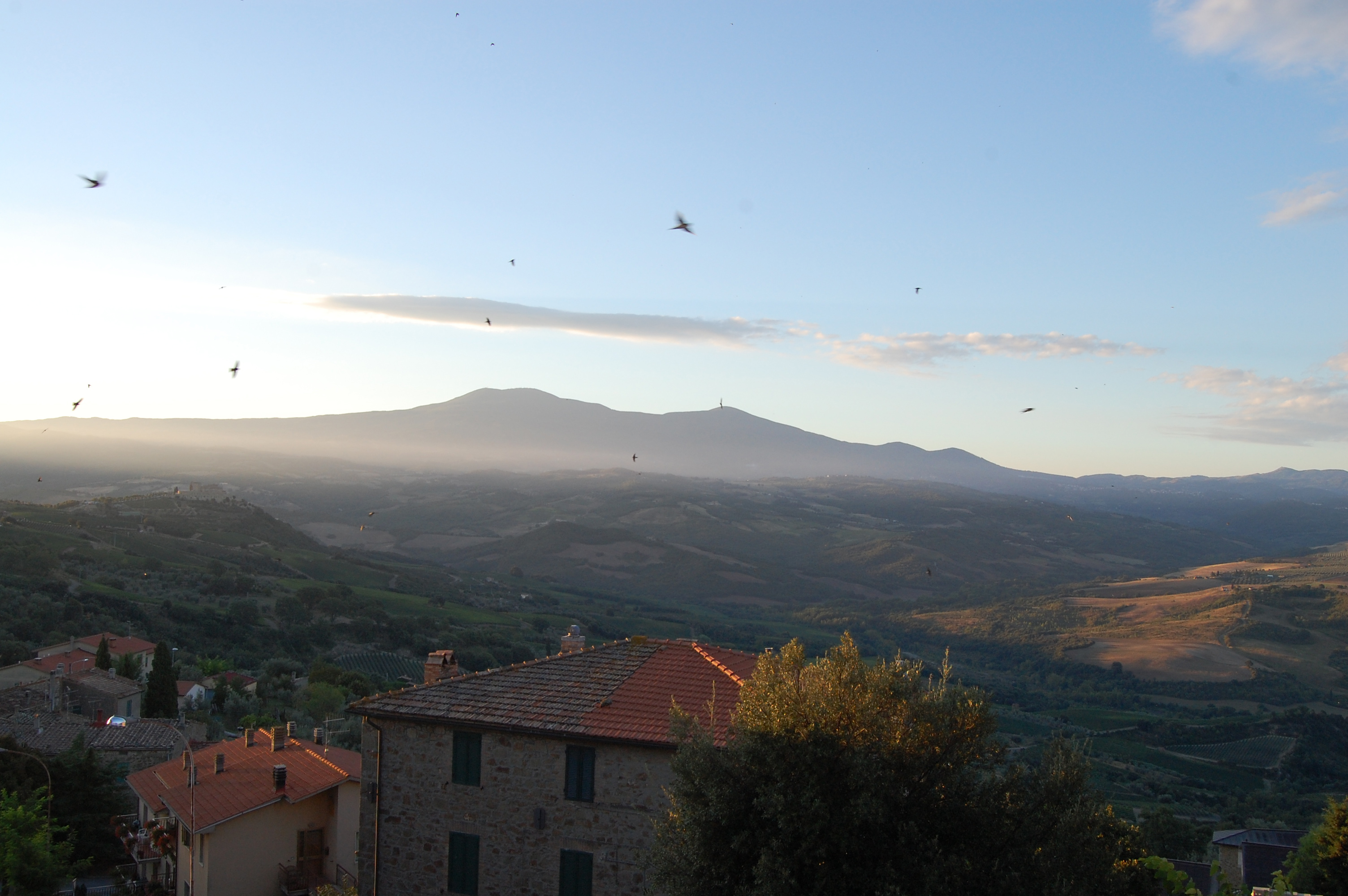
Above: A daybreak view of Mt. Amiata from the village of Castelnuovo dell’Abate (Montalcino).
This week, two major wine news outlets — Decanter and Wine Spectator — reported on the acquittal of ex-Argiano CEO Giampiero Pazzaglia, who had been charged by the Siena prosecutor with commercial fraud in the Brunello adulteration scandal of 2008 (the inquiry was dubbed “Operation Mixed Wine” by Italian authorities).
At the time, seventeen persons were indicted by the Siena prosecutor. Of those, one was absolved of any wrongdoing shortly after the news of the indictments broke; fifteen persons were convicted after entering into plea agreements with the prosecutor’s office; and Mr. Pazzaglia, alone, fought the charges.
Click the links above to read their reports.
News of Pazzaglia’s acquittal was reported in Italy in May of this year (nearly two months ago). But for some reason (unclear to me), the Decanter and Wine Spectator editors only picked up on the story now.
Argiano, which is now owned by a Brazilian investment group, did declassify a substantial amount of 2003 Brunello at the time of the scandal. But Pazzaglia — whom I interviewed by phone shortly after news of the scandal and indictments broke — always maintained that neither he nor the winery had engaged in any attempt to adulterate the estate’s wines or to falsify any documents.
According to the report of his acquittal in the Italian media, the court found that the charges were unsubstantiated.
So much has changed in Montalcino since the time of the controversy (Brunellopoli, as it was dubbed by the Italian media, a reference to Tangentopoli, the Italian government bribery scandal of the 1990s).
Ex-Brunello Consortium president Ezio Rivella, who lobbied unsuccessfully at the time to allow blending in Brunello, is long gone.
And the now second-term president, Fabrizio Bindocci, has won a long-fought campaign to create protocols for emergency irrigation in Montalcino.
Had those protocols been in place back during the blistering heat wave of 2003, it’s likely that the scandal would have never emerged on the scale that it did. If anything, it would have been a footnote in the annals of Italian vinous history.
Five years after the controversy, its long-term impact on Montalcino is negligible. In fact, as many other Italian appellations are still feeling the acute pains of the ongoing international financial crisis, Montalcino is a “happy island,” as Bindocci put it in a video posted recently by Repubblica.it.
65 percent of the wine produced there is exported, he says in the video, and the U.S. remains the largest consumer, representing 25 percent of sales (Germany is the next largest consumer at 7.5 percent).

We’ve been alternating massage and acupuncture hoping to bring on labor. But no success so far. As the old adage goes, babies come when they’re ready.
Other than that, no news to report.
Click here for Tracie P’s update on her blog.
In other news…

Georgia P is cuter than ever.
Her nanna and baw baw (paw paw) are staying with us, giving me a hand with household chores and allowing me to get some rest as we gear up for Parzen family expansion.
We’re so lucky to have them and we all have so much fun together.
Georgia P had fun with her baw baw at the splash pad yesterday afternoon and she really loved wearing his hat (above)!


