Dario Prinčič & WWI’s legacy in Slovenia & Friuli

dario princic katell pleven

Above: Importer Katell Pleven of Vine Collective (right), with Friulian winemaker Dario Prinčič, asked me to interpret for a conversation between Dario and a leading U.S. winemaker at Vini Veri this year. I am a huge fan of Katell, her portfolio, and her mission and I was happy to help out.

Every December, my soon-to-be eighty-year-old father sends a “circular” email memo to his “list serve” of ex-military-industrial-complex buddies and his children (my two brothers and me).

“Don’t forget Pearl Harbor!” exhorts the subject line.

Both of my parents were born in 1933 and were six years old when Germany invaded Poland. And from his midwestern perch, my father still remembers the days of the Second World War with the revisionist nostalgia of a character who could have appeared in Antonioni’s I Vinti (The Vanquished).

I’m always reminded of his vacant exhortations when I talk to winemakers — not much older than me — from Gorizia. They were born long after the conclusion of the First World War but they often speak about its legacy as if it ended yesterday.

Their need to express its impact on their land and the people who farm it is far from vacant. And it bespeaks the origins of the Natural and skin-contact (orange) wine movement that straddles the Friulian-Slovenian border.

dario princic favola

Above: “This wine is proof that I make Natural wine,” said Dario, referring to his 2008 Favola, a blend of Chardonnay, Sauvignon, Pinot Grigio, Tocai, and Ribolla Gialla. After an attack of peronospora (fungal disease), he lost roughly 90 percent of his crop because he refuses to “treat” his vineyards with chemicals. The 10 percent was delicious.

“My village was razed during the First World War,” Dario Prinčič told us over lunch at the Vini Veri fair in Cerea (Verona) this year.

The devastation was so great that “it could not be rebuilt on the original site. It had to be moved roughly 300 meters.”

Some of the last battles of the Great War took place in the Collio-Brda hills along the current Friuli-Slovenian border, where thousands perished in some of the conflict’s most brutal and fierce (however pointless) fighting. By the time the war had ended, the entire zone had been destroyed (Stanislao Radikon and I had a similar conversation when I visited his family’s winery a few years ago.)

And this forsaken, literally scorched swath of land was virtually abandoned until Italy’s reconstruction in the 1950s in the wake of the Second World War.

During our meeting at Vini Veri this year (where I interpreted for Dario and a U.S. wine writer), he talked about how this legacy informed the Natural wine movement there in the late 1980s and early 1990s when he and a small group of growers began to bottle their own fruit (instead of selling it to large commercial bottlers). The decades between the end of WWI and the end of WWII were essentially lost and the generation that came before Dario lived (if they did not flee) in a wasteland.

To this day, as Dario tells it, the morbose spectre of such incomprensible devastation (Arendt’s banality of evil) shapes his will to grow grapes without the use of chemicals (he has done so since 1988).

And while other growers have spoken to me about the advent of skin-contact whites (most Americans don’t realize that Italians and Slovenians don’t call their wine “orange”) as a means to reinterpret Ribolla Gialla as a tannic wine, Dario points to the nonni (grandparents) and their application of tannin as a natural anti-oxidant and preservative of wine.

In my view, these wines are an expression (maybe even a Proustian trace?) of the era before the wars.

To taste the freshness and bold fruit of his 2008 Favola is to touch one’s lips to a time before humankind’s inexplicable capacity for evil left its dark shadow over this beautiful landscape.

And to my lips, it tasted delicious…
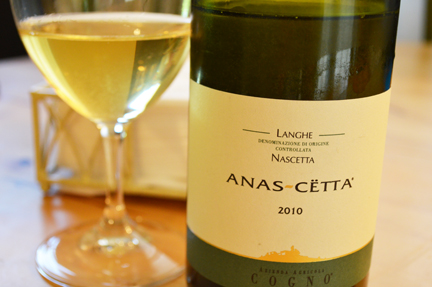
More Italians self-importing to U.S. (tasting notes for Cogno 2010 Nascetta)

nascetta cogno

Ever since winemaker Valter Fissore treated me to vertical tasting of his Nascetta (stretching back to 2001), I’ve been obsessed with this wine. That was back in 2008 and I’ve collected the wine with each new vintage since then.

Click here for a thread of posts devoted to this wine, including the correct pronunciation of the grape name and notes on its origins (and Valter’s unique spelling).

So when my local wine merchant (in Austin, Texas) told me that he was closing out his last five bottles of the 2010, I told him I’d be happy to take them.

I was glad to pick up the wine at such a good price but I was also happy to get the last few bottles left in Texas: now that the winemaker is importing the wine to the U.S. himself, he’s lost his Texas distribution and I imagine it will take some time before he gets his foot back into the iron-clad Texas door.

Valter is part of a new wave of Italian producers, small and large, who have shunned the traditional avenues paved by the big importers and their corporate-minded distributors. Instead, as a self-importer, the wines ship from Italy, kiss a dock in the U.S., and then go directly to the distributor. And he only ships wines when the distributor places an order, thus eliminating U.S. storage costs.

“It’s based on the Dalla Terra model,” he told me when I tasted with him at Vinitaly this year, referring to industry veteran Brian Larky’s “winery direct” system.

“All of the wineries use USA Wine West,” a importing and distributing service, said Valter’s broker, Becky Vuolo, an American based in Piedmont. “They just do our clearance and doc[ument]s. Nothing is stateside (no inventory). The wines go directly into our distributors’ warehouse who ordered them.”

abbazia novacella

Above: The main church of the Abbazia di Novacella (Novacella Abbey), one of the iconic Italian wineries that has recently begun “self-importing.”

Becky currently works with three wineries — Abbazia di Novacella (Trentino-Alto Adige), Cottanera (Sicily), and Cogno (Piedmont) — as their U.S. sales manager. Those familiar with the North American Italian wine market might be surprised to learn that such iconic wineries have embraced this strategy (Valter’s is the smallest of the three). And of course, it comes with some pitfalls.

Anecdotally, I’ve been told that Valter faces some serious challenges in certain U.S. cities where he’s trying to rebuild his market presence. And I imagine he has a long and hard road ahead of him.

But after the 2008 U.S. wine trade “reset” (in the wake of the financial crisis), with wineries and importers regularly and wildly shifting alliances, his story is a common one. Many winemakers are now “parcelizing” (my term) the U.S. wine market and have begun to work more closely with small importers and distributors whose territory often covers just one state.

In California (where I’m a wine buyer), many labels are represented by different importers and distributors in the northern and southern territories. In more than one instance, I’ve had two different distributors show me the same wine (both of them claiming to have exclusive distribution rights).

Whether or not this trend will prove beneficial for wineries and consumers has yet to be seen. In states like wild-west California (one of the most liberal in the U.S. in terms of the regulation of wine sales), it seems to make more labels available and at friendlier prices. In states like business-friendly-unless-your-selling-wine Texas, the Valter Fissores of the world face seemingly insurmountable challenges.

I’m sorry to see Valter’s wines disappear from the shelves of my local wine merchant, but I’ll manage to collect the wine through other channels in the meantime.

The 2010 is stunning and it just kept getting better over the course of three nights. In the more recent vintages, Valter told me, he’s been aging the wine and stirring it on its lees. The result is a richness in mouthfeel and an intense minerality that you rarely find in an Italian white wine at this price point (under $30). The 2010 is still very youthful in its evolution and it impressed me with how electric it was (even after three days open in the refrigerator). It was brilliant with cast-iron-pan-fired pork white flour tacos topped with guacamole and salsa: its depth of personality (such a unique wine!) went head-to-head with the vibrant flavors of the dish.

As I munched down my taco and enjoyed one of the “last bottles” in Texas, I couldn’t help but think about how much the wine industry parallels the music industry these days, with more and more “producers” going independent.

Like a song, a bottle of wine doesn’t have much meaning if its author just keeps it at home locked up in the cellar. This wine really sang to me and I sure hope that its music ain’t over.

Al pomodoro please: red, white & Nebbiolo for the 4th

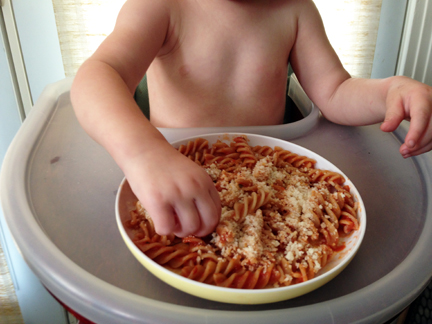
pasta al pomodoro

Mommy and daddy had hotdogs and burgers with all the trimmings for a quiet Fourth of July celebration at home as we continued to wait for the big day to arrive.

We’re now nine days away from Baby P 2013’s expected due date.

Georgia P came nine days early. So mutatis mutandis… Our bags are packed and ready to go.

Continue reading

Ut pictura oenographia: a short treatise on synaesthesia in wine writing

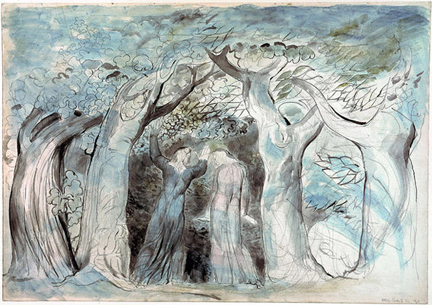
blake dante inferno

Above: William Blake’s depiction of Dante and Virgil heading toward the “dark wood” where “the sun is silent.” Image via BlakeArchive.org.

Horace, Dante, Blake, Carducci, and wine tasting? Pane per i miei denti, as the Italian says (bread for my teeth to bite into, in other words, right up my alley).

I had a lot of fun composing a short treatise on synaesthesia in wine writing this morning for my friend and client Paolo Cantele.

Click here for the post…

Prosecco police? Yes, it’s true, and Croatia-Prosecco showdown ratchets up

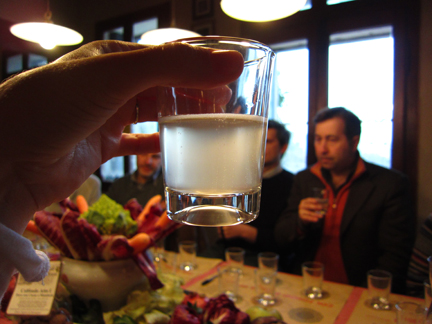
prosecco col fondo colfondo

Honestly, I couldn’t believe it either: the Prosecco DOCG growers association has appointed a “Prosecco policeman” who will fine bar and restaurant owners who improperly serve Prosecco on draft or in a caraffe.

It’s serious business. The fines are stiff (up to €20,000!).

I’ve reported on the development today for the Bele Casel blog.

In other Prosecco news…

Now that Croatia has officially become an EU member, the Italian media have been ratcheting up their coverage of the Prosecco-Prošek showdown.

The AP reported on this story back in April, 2013, back when negotiations for Croatia’s EU entry were still underway.

At the time, the Croatian agriculture minister Tihomir Jakovina suggested publicly that Croatia cease to produce Prošek.

His call to end production and avoid a showdown was met with zealous protests by Prošek producers, notably Andro Tomić, the “bard” of Prošek.

At Vinitaly this year, President of the Veneto, Luca Zaia, a former agriculture minister, stated unequivocally that Croatia must stop production of Prošek as a condition of its EU membership.

Many speculate that Croatia has a legal precedent for a claim to Prošek because the category was commercially successful long before Prosecco became a commercially viable category in Italy.

Prosecco, as a “brand,” was first sold successfully in Italy in the late 1800s by Count Marco Giulio Balbi Valier, who probably used a train station in the village of Prosecco (Carso, Friuli) as a hub for the shipment of the wines to Vienna.

Prošek, on the other hand, has been used as a commercial trademark in Croatia for many centuries.

Of course, the Hungary-Italy showdown over Tocai Friuliano and Tokay (Tokaji) looms large. Hungary ultimately won the right to the homonymous trademark and Friuli can no longer export wines labeled Tocai (as of January 2008).

Why the Marches matter more than ever (hippies & humans please read on)

Baby P 2013 update: the astronomic cost of self-employed couples having a child (via My Little Sugarpie). If we had better government regulation of health care, our family wouldn’t be going into debt to bring another healthy child into this world.

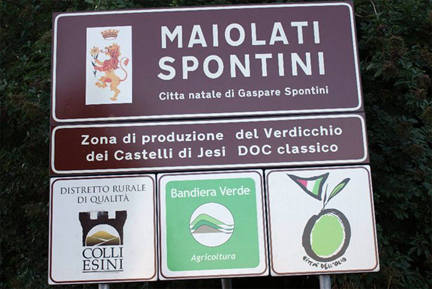
maiolati spontini

The village of Maiolati Spontini (Ancona province) is one of the 24 communes that produce Verdicchio di Castelli di Jesi. The vineyards there are part of nearly 3,200 hecatares planted to Verdicchio, 90% of which are destined to become “classico” wines. Why doesn’t the appellation command more attention in the U.S. marketplace?

At our house, we drink more white wine than red wine. And we drink more Castelli di Jesi than any other white. That’s partly because the price-quality ratio for these wines is excellent. But it’s mostly because we like to drink acidity-driven white wine in which minerality delineates the tasting profile.

When you travel to the Marches (le Marche in Italian), your senses are rewarded by one of the few remaining high-profile wine producing areas where Italy’s negrarizzazione has spared the landscape (Negrarization, the unbridled commercial and industrial development of once pristine farmland, named after the village Negrar in Valpolicella, where the corollary blight of consumerism has spread like a pox).

Life there is relatively simple (reminiscent of what Tuscany must have been like in the 1970s). The people are friendly and earnest. And the food simple, wholesome, and delicious.

As ideal as this sounds, the Marches still don’t play much of a role in Americans’ eno-universe. Just ask a wine buyer in any major U.S. market (aside from the Italophiliacs) if they can name five producers of Verdicchio dei Castelli di Jesi. Surely, they can rattle off five names from Barolo, Prosecco, or Brunello. But Jesi? And let’s not even get into Ascoli Piceno or Matelica…

But the reason why I’m writing about the Marches today goes beyond my passion for this beautiful and untouched region and my nearly daily consumption of the wines (I’m not kidding about that, either).

I’ve begun to follow the Marches carefully because I have a client there. And said client recently became a member of a new group called Terroir Marche.

The self-financed (not EU subsidized) group of organic and biodyanmic farmers believes that “the farmer is the primary source of our daily nourishment and is a pillar among those who safeguard the environmental landscape, the true but neglected patrimony of Italy.”

And its mission is to “promote awareness of organic farming in the Marches, to defend the territory and its resources, and to share the culture and practices of a sustainable and humane economy.”

I have been an avid supporter and an ardent fan of Vini Veri, VinNatur, and the Natural wholesome farming movement in general.

But I have never seen a group whose devotion to their shared cause is based so deeply and strongly in ideology.

I believe that grape growing and winemaking — like all human endeavor — is inherently and intrinsically ideological (and political) in nature. And as I have followed my client and the birth of this group, I realize that I have never encountered winemakers so passionate about the ideological and political impact of chemical-free farming.

More than any others I know, they see their mission as one of safeguarding Italy’s greatest resource, one vineyard and one field at a time. They’re not doing it to market their products. They’re not doing it because it’s trendy. They’re doing because they need to do it. Otherwise, their children and our children may not ever know this Italy — one of G-d’s great gifts to humankind, the “garden of Europe.”

I wish I had time to translate their entire mission statement. But I think I’ve conveyed their ethos here (however clumsily).

I applaud them for what they are doing and am hopeful that my daughters, thanks to them, may very well get a chance to see and taste the beautiful Marches the way that I have seen and tasted them.

Room with a view (and a toilet) remembering our honeymoon

BABY P 2013 UPDATE: No news to report but chances are that she’ll arrive this week.

Tasting Giovanna Rizzolio’s Cascina delle Rose Barbera d’Alba on Friday night brought back a flood of memories from our stay with her on our honeymoon.

One of my favorites was waking up in the morning and seeing Asili and Rabajà from our bathroom window (when seated).

In the photo above, the gaze is actually facing north-northwest. Asili and Rabajà are out of frame to the right. Here’s a Google map link with directions from Asili to Tre Stelle (where Giovanna’s estate is located) to give you some context and to illustrate the unique terrain of Langa.

When you click on the map, zoom out and note the Tanaro river and the way the Alps seems to suddenly melt away into valley… Barbaresco is simply one of the most magical places on earth for me.

Buona domenica, yall!

Cascina delle Rose in Texas! YES!

cascina delle rose

Yesterday evening, during a meeting and tasting with an Austin client and a local editor, I asked my client — Jeff Courington owner of Vino Vino — if he’d open one of the wines he plans to have on his list at his new Italian, slated to open later this summer, Al Fico.

When he produced a bottle of Cascina delle Rose 2009 Barbera d’Alba Donna Elena (above), I couldn’t believe my eyes. Cascina delle Rose is one of those wonderful but tiny producers that never seem able to break into the extremely-hard-to-crack Texas wine market.

giovanna rizzolio

The mature wine, from one of Giovanna Rizzolio’s top growing sites, was gorgeous, its acidity zinging and dancing around the Barbera’s meaty flavors.

The wine still had a strip label from a previous Louisiana importer/distributor who had tried, unsuccessfully, to bring the wine to Texas.

Jeff told me that they’re being brought in now by a new company called Rootstock (if I’m not mistaken).

I love Giovanna’s wines (and she such a super cool lady) and am thrilled that that there here.

Giovanna, welcome to Texas!

Click here for a post on our visit to Giovanna’s estate and some pretty amazing images of the underground river that gives the Barbaresco cru “Rio Sordo” its name.

Lasagne from Corleone, mimetic desire, & @TonyVallone

lasagna corleone

Above: One side of my friend Tony Vallone’s family is from Corleone, Sicily. All of last night’s dishes were “alla corleonese”.

Last night, I made one last trip to Houston before the arrival of Baby P 2013 (I drove in and back the same day).

How could I not?

My good friend and client Tony Vallone was hosting a sold-out dinner featuring cucina casereccia siciliana (homestyle Sicilian cooking) at his casual restaurant Ciao Bello. And I should be more precise: the official theme was cucina casereccia corleonese, the cuisine of his mother’s family’s hometown, Corleone. And he had asked me to speak to the guests about the Sicilian wines chosen for the meal.

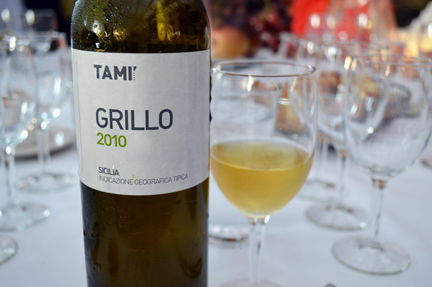
In case the mimetic desire has not yet taken hold, here’s a photo of the wine we paired with the lasagna casalinga (homemade lasagne, with mini meatballs and peas) above:

tami grillo

That’s négociant Arianna Occhipinti’s Grillo: salty and jumping with acidity, the wine tasted SO good on a sultry Houstonian evening.

As I left the dinner, everyone wished me and Tracie P well for the arrival of Baby P 2013.

Tony handed me a couple of boxes of his gallina mollicata (chicken baked with mollicata, Sicilian Corleonese-style seasoned breadcrumbs).

Mi raccomando… I’m serious,” he said. “I want you to call me when the baby arrives.”

Man, I love this guy… We’re so lucky to have him in our lives.

And here’s a little video (below) I put together this morning with scenes from the event (does anyone recognize the song I’m playing?).

From sharecropper to landowner, an Italian parable

gregoletto prosecco

Looking back on my April 2013 visit to Prosecco legacy winemaker Luigi Gregoletto (above), I realized that I’m going to need to devote a series of posts to our fascinating conversation about pre-autoclave Prosecco, Prosecco Colfòndo, and his recent embrace of biodynamic farming practices.

But first, I’d like to share this video, shot the day of our visit.

In the film, he and I make a Dantean ascent to the villa where his parents — Proseccoland sharecroppers — were born.

Luigi was born a sharecropper in 1927, five years after Mussolini’s March on Rome.

As he explains in the video, he began to purchase land from the owners about twenty-five years ago.

Today, the hilltop that overlooks the owner’s villa is planted to his prized Verdiso, from which he makes his top wine. It’s a powerful metaphor for the arc of his life.

As we began our climb up the hill that leads to the villa, I was struck by how his family’s story is an Italian parable that spans Italy’s industrialization in the twentieth century to the rise of the proletariat in the years that followed the Second World War.

Sharecropping — a form of indentured servitude — was not officially abolished in Italy until the 1960s. Its prohibition was not implemented until the 1970s. And only in the 1980s did the Italian legislature set out parameters for the redistribution of land.

His truly inspirational story reveals so much about the evolution of Prosecco and the renaissance of Italian wine. And it tells us even more about Italy’s twentieth-century history.

I have a lot more to share about our visit, but in the meantime please have a look at the video. I hope you find the experience as moving as I did.