Negroamaro: Italian grape name pronunciation project

CLICK HERE FOR ALL EPISODES.

This week is going to be “Apulia” (“Puglia”)* week here on the blog: after Tracie P and I traveled to the Veneto and to Friuli in February, I headed — for the first time — to Apulia where I spent a few days with my friend and client winemaker Paolo Cantele. That’s Paolo’s voice above, speaking the grape name Negroamaro.

When Paolo and I met for the first time nearly two years ago (when we first became friends), we had a long discussion on the etymology of the ampelonym Negroamaro, which Paolo and I believe means black black and not black bitter as subscribers to the grape name’s folkloric etymology often report. Here’s the post on Paolo’s thought and my treatment of the grape name’s etymon.

When I met with Paolo in February, it occurred to me that one of the most commonly mispronounced Italian appellation names is Salice Salentino: SAH-lee-cheh SAH-lehn-TEE-noh. I asked Paolo to pronounce it properly for my camera and hence was born the “Italian Appellation Pronunciation Project.” Note that Salice is pronounced with the stress on the first syllable of the word. (BTW, I’ve composed an overview of the origins of the toponym Salice Salentino here, for Paolo’s blog.)

Even though I’ve studied the grapes and wines of Apulia (and I even worked for 3 years as the media director for an Apulian restaurant in NYC, I Trulli), I’d never traveled to the region until recently. The thing that impressed me the most was the ubiquity of olive trees. I’ll have a lot more to say about olive groves and the wonders of Apulia this week (“Apulia Week” at Do Bianchi!). But in the meantime, you’ll note that in the videos above, the olive groves are endless as Paolo and I drive from Lecce along the highway to the airport in Brindisi…

* Even though editorial convention in the U.S. has popularized the usage of Puglia, the proper English toponym for the geographical district that forms the “heel of Italy’s boot” is Apulia (from the classical Latin Apulia or Appulia).

Super Cocina and Franco’s editorial on the Italian Unity Bottle project

Rolled in early this morning to San Diego where I’ve been asked to sit as one of the judges of the San Diego International Wine Competition (and ya’ll thought I was kidding about drinking oaky “Napa Cab” on Facebook!).

Made a beeline to Super Cocina (above) where brother Tad hooked me up with the goods. Man, anyone who comes to San Diego and doesn’t check this place out might as well just stay home… I love it that much… The chicharrònes were super tender and swam deliciously in their tomatillo sauce.

In other news…

I just finished translating Franco’s editorial on the “Italian Unity Bottle Project.” Click here to see what he had to say.

My Italy: 150 years of Italian Unity

Yesterday, in one of the most tumultuous moments of its history (between the general discontent of its people, the governmental crisis, and the situation in Libya, its historical client state), Italy celebrated 150 years of Unity.

My friend Simona, author of the excellent Italian gastronomy blog Briciole, published this FANTASTIC post including the video above. I highly recommend it: she’s composed a beautifully woven timeline for Italy’s last (and first) 150 years as a united country and she’s translated a number of the quotes from the video above (you’ll find quotes by a number of historical figures that have appeared here on my blog).

Chapeau bas, Simona!

Above: The Italian Alps, as seen from the vineyards of my friend Giampaolo Venica, September 2010.

My friend Simone, a young and gifted wine professional from Lucca, wrote me to remind me this morning of a poem dear to both of us and as vibrant and topical as it was when Petrarch wrote it (probably) during the siege of Parma in 1344-45 (the fact it was composed in Parma will not be lost on those who fear and loathe the rise of the Italian Separatist Party). It’s one of Petrarch’s most moving political poems and I spent hours and hours pouring over every line, every syllable, and every scansion as I prepared my dissertation on Petrarchan prosody. I’ve scanned and reproduced the Robert Durling prose translation below (Petrarch’s Lyric Poems, Harvard, 1976), which I also highly recommend to you.

On our recent trip to Italy, every time Tracie P and I gazed at the Alps, I couldn’t help but think of the lines (see the fifth stanza below), Nature provided well for our safety/when she put the shield of the Alps/between us and the Teutonic rage.

The incipit of the song is immensely powerful and could not be more a propos today — whether in the sphere of Italian politics or viticulture.

    Italia mia, ben che’l parlar sia indarno
    a le piaghe mortali

    My Italy, although speech does not aid
    those immortal wounds

The song’s congedo is even more moving… Your divided wills are spoling the loveliest part of the world.

A Puritanical Italy: has it come to this?

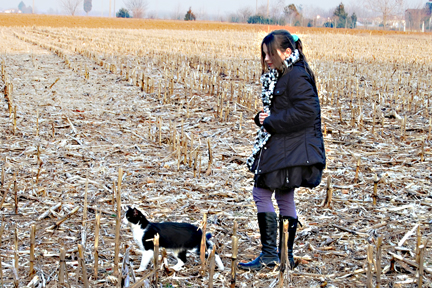
Above: On our last trip to Italy, this image — a winemaker’s daughter chasing a cat through a field — fascinated me. The cat, hoping to receive a treat, wouldn’t let the girl pick it up. But it never strayed farther than arm’s reach. She was a Pasolinian allegory of purity and innocence, the cat her serpent leading her to edge of the field where she would ultimately move beyond the farm’s borders toward the impurity of urban living and the pressures of modern society.

When we travel to Italy, Tracie P and I are very fortunate to find a host of characters gladful to share the flavors and aromas of the garden of Europe, the fair country, ancient Enotria and Esperya — the land of the setting sun, as the Greeks called it, the “Evening Land.” Blessed with a mastery of the language and endowed with years of experience there, we move seamlessly from the quartermaster of Marco Polo to the trinciante — the carver — of the osteria whom we bribe with veteran smiles and harmless guile, blank verse and syncopated song.

Don’t get me wrong: although we thoroughly enjoy every moment of it, those of you who follow (and have followed recently) along here on the blog know that we are keenly and acutely aware of how food and wine as text — as discourse — are just one red thread interwoven into the fabric of this ancient and fascinating nation.
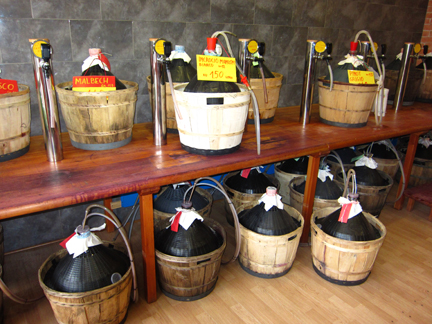
Above: Most middle-class families by their daily wine at supermarkets or at dispensaries like this one in Favaro Veneto in the terra firma of Venice.

However joy-filled and wondrous our trips seem, we never lose touch with the challenges and ills that Italians and Europeans face every day, particularly in a world where the Italian state provides less and less for the middle-class Italian, while placing more and more pressures on her/him in finding and practicing civic and national pride and ownership.

I’m deeply saddened to report (for those of you who haven’t followed the meager coverage by The New York Times) that Italian society is on the cusp of a startlingly profound peripeteia. In bizarre twist of cultural roles, Italian prosecutors are on the verge of taking down Dr. Evil himself, Silvio Berlusconi… but not by means of legal action addressing his self-serving mediatic tyranny and corruption… He will be taken out, instead, through the application of a puritanical denouement.

In early April (it was announced while I was still there last week), he will be tried for paying a minor for sex.
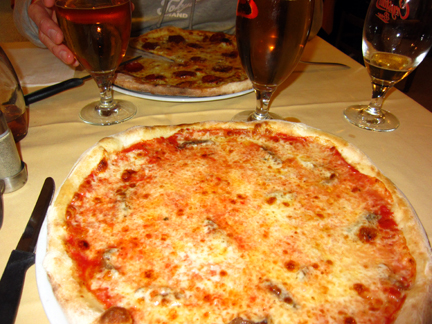
Above: My last night in Italy, this time around, I shared a pizza and a beer with a colleague and friend (who happens to be a Berlusconi supporter). The pizza was decent but forgettable. Sometimes a pizza is just pizza.

Prostitution is legal in Italy, although organized prostitution is not. And even though the legal age of consent there is 14 years of age, it is illegal to pay for sex with a minor (under 18 years of age).

Believe me: although I am not Italian and have no civic stake in Italian society other than my personal interest in Italy and the many friends I have there, I am thrilled to see Berlusconi go (and I sincerely hope this is the final nail in his political coffin). His racist remarks about Obama or his belief that “Mussolini didn’t send anyone to concentration camps… he just sent them on vacation” provide ample reason to despise him. But the manufactured consent he has generated through his control of television and newspapers, orchestrated solely in the view of his open desire to become richer through the manipulation of Italian legislation (he stated so very clearly in a now infamous interview with historian Enzo Biagi, Italy’s Walter Cronkite), offer us indisputable evidence of what a menace he is to Italian, European, and Western Civilization. Good riddance, I say.
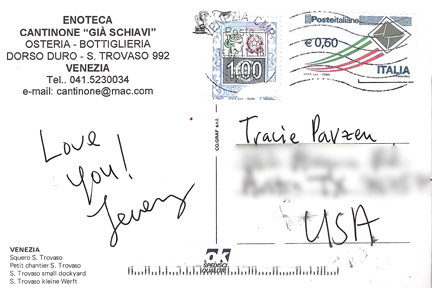
Above: Tracie P and I use all kind of electronic media to communicate when we’re in Italy but we still love postcards.

“Since when did the Italians become puritanical?” That’s what my bandmate Verena asked rhetorically in an email thread the other day. In fact, as Verena knows well, the Italians haven’t become puritanical. Indeed, one of the things I love and cherish about Italy is the fact one is not constrained by the yoke of bourgeois and Victorian attitudes there.

But it has come to this: short of taking to the streets and squares the way the Egyptians have done, Italy must resort to a Republican-inspired puritanical Bill Clinton-era tactic to oust the country richest and most despicable man from its most powerful office.
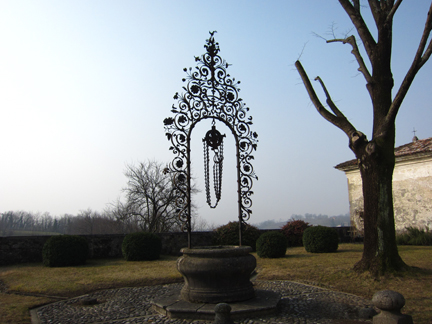
Above: If you look carefully at the wrought-iron adornment of this well (near Buttrio in Friuli), you’ll see that it is made of grape bunches, leaves, and tendrils.

I hope and pray that gourmets and gourmands of English-language literature will appreciate the allusion with which I have chosen as congedo of this post, a few lines culled from D.H. Lawrence’s poem, “Grapes.”

Buona lettura, everyone, and buona domenica. Thanks for reading…


But long ago, oh, long ago
Before the rose began to simper supreme,
Before the rose of all roses, rose of the all the world, was even in bud,
Before the glaciers were gathered up in a bunch out of the unsettled seas and winds
Or else before they had been let down again, in Noah’s flood,
There was another world, a dusky, flowerless, tendrilled world
And creatures webbed and marshy,
And on the margin, men soft-footed and pristine,
Still, and sensitive, and active,
Audile, tactile sensitiveness as of a tendril which orientates and reaches out,
Reaching out and grasping by an instinct more delicate than the moon’s as she feels for the tides.

Of which world, the vine was the invisible rose,
Before petals spread before colour made its disturbance, before eyes saw too much.

Dusky are the avenues of wine,
And we must cross the frontiers, though we will not,
Of the lost, fern-scented world:
Take the fern-seed on our lips,
Close the eyes, and go
Down the tendrilled avenues of wine and the other world.

Don’t let the farmer know…

Don’t let the farmer know how good cheese is with pears…

So goes a bourgeois Italian expression: don’t let the proletariat know how good it is to be a member of the ruling class

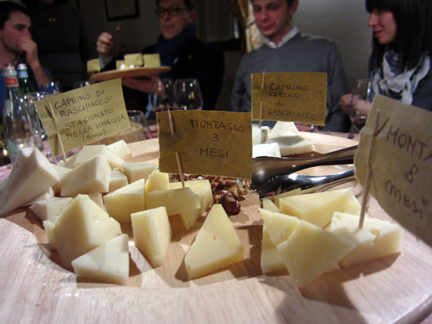
Julienned pears and shredded Montasio cheese over winter greens, served with a lightly fried pancetta rasher and drizzled with olive oil, were delicious last night in the home of Daniela and Pigi Comelli.

Montasio is Friuli’s flagship cheese.

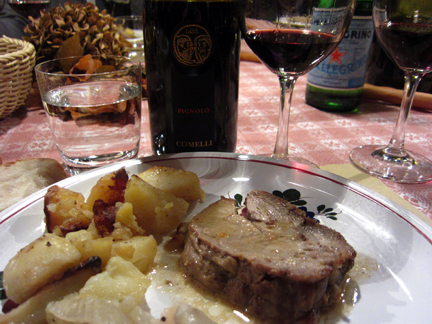
Comelli’s Pignolo (2007) was my favorite of the trip so far… Pignolo is a wildly tannic however noble grape. While most seem to vinify it in a “massive” and “muscular” style, Comelli’s was more judicious and showed nice fruit, especially when paired with roast pork loin and potatoes. Good stuff…

So much more to tell but gotta run… Follow along at COF2011.com

Fascist-era Berkel slicer with Fascist faggot

Evidently, Mussolini didn’t care for the fact that Dutch-made Berkel slicers were painted red. And so he had them painted black and added the Fascist victory emblem with the Fascist faggot (the fascio, above).

When he’s not busy growing native grape varieties and making wine, Friulian winemaker Michele Moschioni reconditions vintage Berkel slicers.

Follow along at COF2011.com.

Lunch at home with the Nonino family

Conversation over lunch in the home of the Nonino family (the first family of Italian distillation) ranged from encounters with Marcello Mastroianni, Claude Lévi-Strauss, and Luigi Veronelli to the (literal) renaissance of native grape varieties in Friuli. I was THRILLED to be invited for lunch in their home, a fascinating family with a fascinating history. That’s daughter Cristina and father Benito above. They served an aperitif of Amaro Nonino on the rocks with a slice of blood orange.

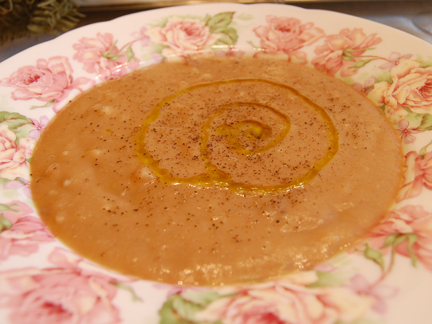
There’s so much to tell about our confabulatio and there will be time for that… in the meantime, the bean and potato soup — with barley, chestnuts, and bits of melt-in-your mouth bacon fat, drizzled with olive oil and sprinkled with freshly cracked pepper — was an amazing confluence of flavors and textures. A rustic, powerfully sensuous dish…

Stewed goose thigh was o so tender and delicious with polenta and cabbage. Benito thanked us for coming, noting that they feed him better when there are guests. They’re a very colorful bunch and the hours we spent together were literally marvelous.

This was definitely one of the most fascinating visits so far but the tale of what was told yesterday will have to wait…

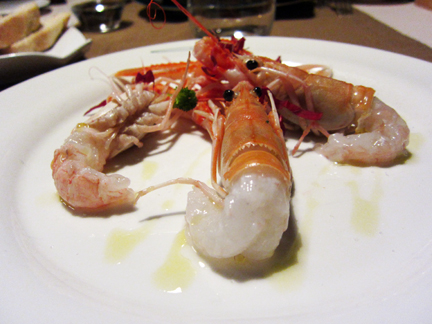
Amazing seafood and fun times in Trieste…

Before leaving for Italy, Tracie P expressed a desire to visit Trieste and so we headed there yesterday for dinner with Giampaolo Venica and wife Chiara and brother and sister prosciutto-makers Andrea and Monica d’Osvaldo to eat at the classic Ristorante al Bagatto.

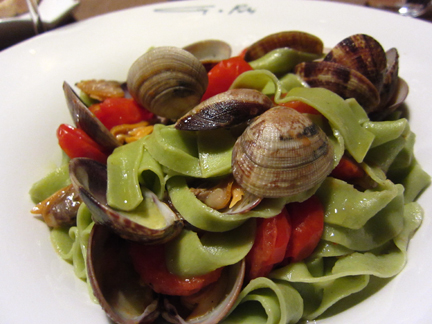
The food was fantastic, the wine wonderful (Zidarich Vitovska 06 and 08, the 08 the stunner), the laughter and conversation super fun…

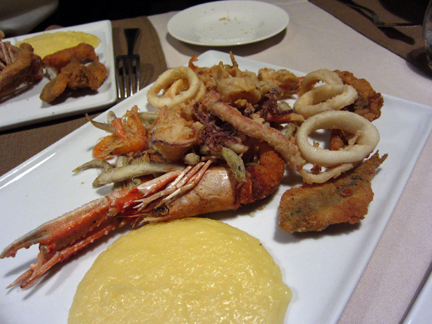
Now, THAT’s a fritto misto!

But when an Italian mother calls her son (in this case, Andrea), everything gets put on hold!

Tracie P and Tony V

There’s more to come… but first I just had to share this photo I snapped of Tracie P and Tony V, who was our host for the New Year’s eve holiday.

In our family as in his, we love to talk about food and when Tony V and Tracie P get together, I can guarantee that they will engage in finely calibrated discussions of how and when onion and garlic may be applied (never in tandem!) and how al dente al dente should be. The above photo is clear evidence of this phenomenon!

More on what we ate and drank later…

Banfi, Brunello, and the Wall Street Journal

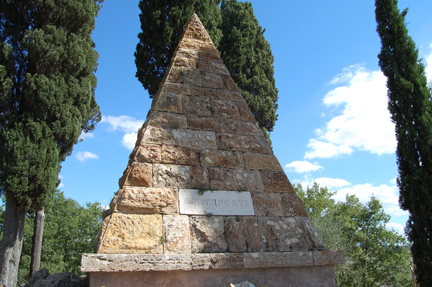
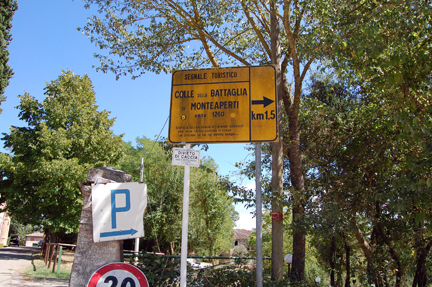
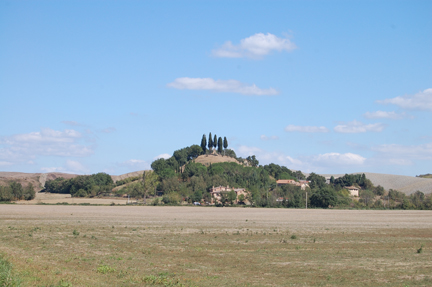
Above: When I made my annual pilgrimage to Montalcino in September of this year, I took time out to visit the monument at Montaperti, commemorating the 1260 battle there between the Guelphs of Florence (the Papacy) and the Ghibellines of Siena (Holy Roman Empire).

In her recent interview on the Wall Street Journal wine blog, “Co-CEO” of Banfi Christina Mariani states that the Brunello controversy of 2008-2009 “was just to make the press… Everyone was cleared, including us.”

When Italy’s top wine blogger Mr. Franco Ziliani (and co-editor of our blog VinoWire) reposted the interview on his blog last week, another top Italian wine blogger, Gian Luca Mazzella, posted links to two entries on his blog in the comment thread of Franco’s post: as he points out in his comment and one of the referenced posts (published by the Italian national daily Il Fatto Quotidiano on October 19, 2010), widely circulated accounts in Italy’s mainstream press reported that Banfi accepted a plea agreement in the Italian treasury’s “Operation Mixed Wine” investigation (where authorities alleged that certain Brunello producers had adulterated their wines, adding unauthorized grapes). It’s worth noting here that Il Fatto Quotidiano is one of Italy’s leading national newspapers.

The only wineries that were officially “cleared” were Biondi Santi and Col d’Orcia (a fact also widely circulated in the Italian mainstream press).

In fact, even Banfi’s current managing director, Enrico Viglierchio, told the Wine Spectator that the company had agreed to declassify some of its wine in an agreement with investigators (note that the title of the article is “Banfi’s Brunello Cleared”; the wine, not the winery, was “cleared” after the company agreed to declassify certain lots).

The Ghibellines won the battle but lost the war. Ultimately, the battle’s outcome consolidated the Pope’s power in Tuscany and a new era of Florentine and Papal dominance began.

You’ll note that I am merely reporting what has been written in Italy — before and after Mariani’s recent interview (if so inclined, please click on the links above and read my translations of Italian news reports and the report in the Spectator).

Out of respect for Ms. Mariani (and for a good friend of mine who works closely with her), there is no note of sarcasm nor sardonic editorial here.

I would like to address, however, one of her statements. In the interview, she tells wine writer Lettie Teague (one of our country’s most popular enojournalists and author and a super nice lady whom I know through our professional correspondence and tastings we’ve attended together): “If it’s not a health issue, it’s not an issue for consumers…”

She’s right: the appellation regulations that require Brunello producers to use only Sangiovese in their wine were written and approved by the producers themselves to protect the producers and appellation — not the consumer. In other words, the regulations were conceived to protect those producers who play by the rules in an appellation where 80% of the wine was being made with the addition of unauthorized grapes, according to producers association current president Ezio Rivella who served as Banfi’s managing director until 1999 and left the company after working in Montalcino since 1977 (and with the Mariani family since 1961).

The battle and the events and political turmoil that followed (particularly the papacy of Boniface VIII) are central to Dante’s poem, the Comedy, and the overarching mission of his life — to achieve separation of temporal and spiritual powers in Europe, a notion dear to the forefathers of our country (did you know that Thomas Jefferson, a winemaker, spoke and read ancient Italian and could quote the Comedy from memory?).

Why did I incorporate images of the pyramid at Montaperti in this post?

I don’t get to Montaperti every year. In fact, I hadn’t been there in probably 10 years or so. I studied the Battle of Montaperti when I was a graduate student and have been fascinated with it since then. The 1260 battle there is central to Dante’s poem and its political themes. It marked the beginning of Siena’s decline as a world power and an era of political and human upheaval in Tuscany and Italy. (Montalcino is in the province of Siena, btw.)

As for the Sienese Ghibellines who won the battle at Montaperti but ultimately lost the war, their micro-state (city state) was ultimately absorbed by the greater power of Florence. I’ll let the reader infer any analogy that can be made here.

Thanks for reading. Tomorrow, I’ll pick up where we left off, posting about family get togethers and great wines we’ve been drinking with loved ones during the holiday season.