Amazing seafood and fun times in Trieste…

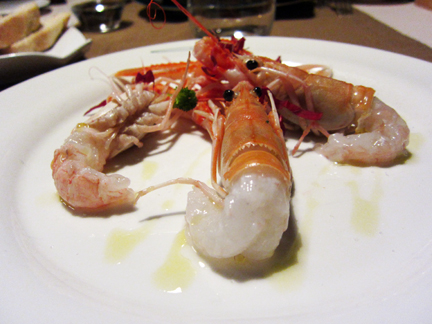
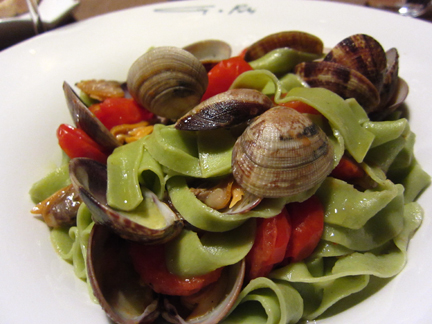
Before leaving for Italy, Tracie P expressed a desire to visit Trieste and so we headed there yesterday for dinner with Giampaolo Venica and wife Chiara and brother and sister prosciutto-makers Andrea and Monica d’Osvaldo to eat at the classic Ristorante al Bagatto.

The food was fantastic, the wine wonderful (Zidarich Vitovska 06 and 08, the 08 the stunner), the laughter and conversation super fun…

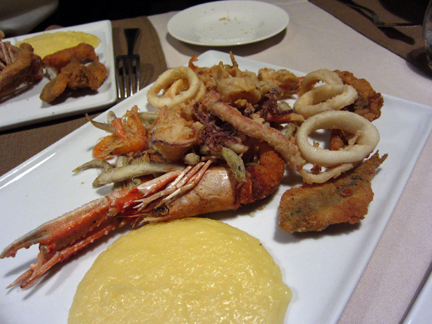
Now, THAT’s a fritto misto!

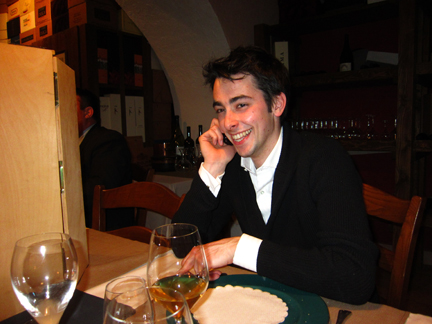
But when an Italian mother calls her son (in this case, Andrea), everything gets put on hold!

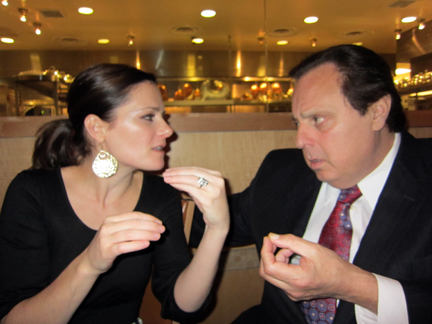
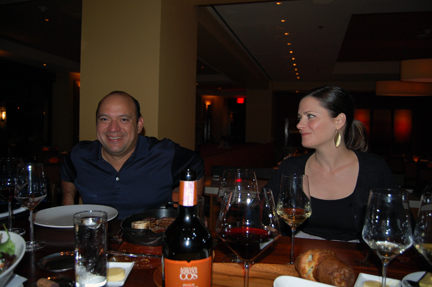
Tracie P and Tony V

There’s more to come… but first I just had to share this photo I snapped of Tracie P and Tony V, who was our host for the New Year’s eve holiday.

In our family as in his, we love to talk about food and when Tony V and Tracie P get together, I can guarantee that they will engage in finely calibrated discussions of how and when onion and garlic may be applied (never in tandem!) and how al dente al dente should be. The above photo is clear evidence of this phenomenon!

More on what we ate and drank later…

Banfi, Brunello, and the Wall Street Journal

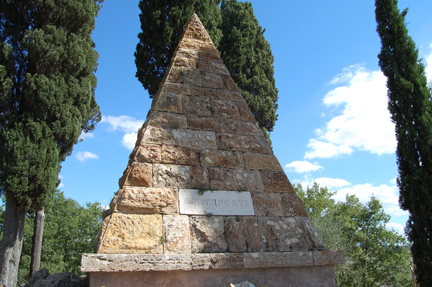
Above: When I made my annual pilgrimage to Montalcino in September of this year, I took time out to visit the monument at Montaperti, commemorating the 1260 battle there between the Guelphs of Florence (the Papacy) and the Ghibellines of Siena (Holy Roman Empire).

In her recent interview on the Wall Street Journal wine blog, “Co-CEO” of Banfi Christina Mariani states that the Brunello controversy of 2008-2009 “was just to make the press… Everyone was cleared, including us.”

When Italy’s top wine blogger Mr. Franco Ziliani (and co-editor of our blog VinoWire) reposted the interview on his blog last week, another top Italian wine blogger, Gian Luca Mazzella, posted links to two entries on his blog in the comment thread of Franco’s post: as he points out in his comment and one of the referenced posts (published by the Italian national daily Il Fatto Quotidiano on October 19, 2010), widely circulated accounts in Italy’s mainstream press reported that Banfi accepted a plea agreement in the Italian treasury’s “Operation Mixed Wine” investigation (where authorities alleged that certain Brunello producers had adulterated their wines, adding unauthorized grapes). It’s worth noting here that Il Fatto Quotidiano is one of Italy’s leading national newspapers.

The only wineries that were officially “cleared” were Biondi Santi and Col d’Orcia (a fact also widely circulated in the Italian mainstream press).

In fact, even Banfi’s current managing director, Enrico Viglierchio, told the Wine Spectator that the company had agreed to declassify some of its wine in an agreement with investigators (note that the title of the article is “Banfi’s Brunello Cleared”; the wine, not the winery, was “cleared” after the company agreed to declassify certain lots).
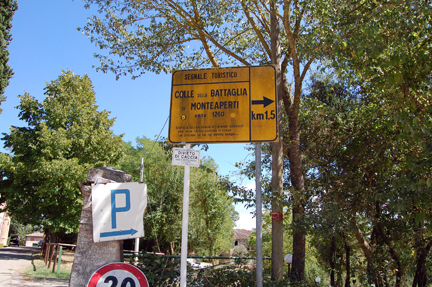
The Ghibellines won the battle but lost the war. Ultimately, the battle’s outcome consolidated the Pope’s power in Tuscany and a new era of Florentine and Papal dominance began.

You’ll note that I am merely reporting what has been written in Italy — before and after Mariani’s recent interview (if so inclined, please click on the links above and read my translations of Italian news reports and the report in the Spectator).

Out of respect for Ms. Mariani (and for a good friend of mine who works closely with her), there is no note of sarcasm nor sardonic editorial here.

I would like to address, however, one of her statements. In the interview, she tells wine writer Lettie Teague (one of our country’s most popular enojournalists and author and a super nice lady whom I know through our professional correspondence and tastings we’ve attended together): “If it’s not a health issue, it’s not an issue for consumers…”

She’s right: the appellation regulations that require Brunello producers to use only Sangiovese in their wine were written and approved by the producers themselves to protect the producers and appellation — not the consumer. In other words, the regulations were conceived to protect those producers who play by the rules in an appellation where 80% of the wine was being made with the addition of unauthorized grapes, according to producers association current president Ezio Rivella who served as Banfi’s managing director until 1999 and left the company after working in Montalcino since 1977 (and with the Mariani family since 1961).
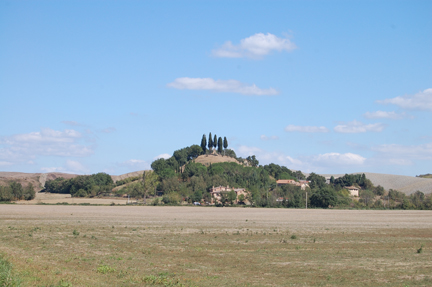
The battle and the events and political turmoil that followed (particularly the papacy of Boniface VIII) are central to Dante’s poem, the Comedy, and the overarching mission of his life — to achieve separation of temporal and spiritual powers in Europe, a notion dear to the forefathers of our country (did you know that Thomas Jefferson, a winemaker, spoke and read ancient Italian and could quote the Comedy from memory?).

Why did I incorporate images of the pyramid at Montaperti in this post?

I don’t get to Montaperti every year. In fact, I hadn’t been there in probably 10 years or so. I studied the Battle of Montaperti when I was a graduate student and have been fascinated with it since then. The 1260 battle there is central to Dante’s poem and its political themes. It marked the beginning of Siena’s decline as a world power and an era of political and human upheaval in Tuscany and Italy. (Montalcino is in the province of Siena, btw.)

As for the Sienese Ghibellines who won the battle at Montaperti but ultimately lost the war, their micro-state (city state) was ultimately absorbed by the greater power of Florence. I’ll let the reader infer any analogy that can be made here.

Thanks for reading. Tomorrow, I’ll pick up where we left off, posting about family get togethers and great wines we’ve been drinking with loved ones during the holiday season.

Power of the press blog: Chianti producers vote not to allow Super Tuscans at tasting

Above: the architects of Italian unification (1861). To the far left, Count Camillo Cavour, Italy’s first prime minister, a winemaker (Piedmont). In the center, unified Italy’s first king, Vittorio Emanuele II, a winemaker (Piedmont). To the far right, Baron Betting Ricasoli, Italy’s second prime minister, a land owner and winemaker in Chianti Classico, and the father of modern winemaking in Tuscany. Ricasoli’s estate Brolio and Vittorio Emanuele’s Fontanafredda still produce commercial wine today.

Would the founding fathers of Italy believed it if you were to tell them that a blog helped save Chianti Classico?

Today, Italy’s top wine blogger, Mr. Franco Ziliani, and I posted the following news story on VinoWire, our English-language blog devoted to the world of Italian wine: “Chianti Classico producers decide not to allow Super Tuscans at debut tasting.”

What we didn’t write was that Mr. Ziliani’s previously posted editorial, in which he harshly criticized the body for its inclusion of Super Tuscans in its annual new vintage preview, was cited by numerous members in the debate that preceded the decision (whereby the body’s president announced he was retracted the option).

It’s not the first time that Mr. Ziliani — a true flagellum principum — has helped to protect and promote traditional winemaking in Italy through his blog. Chapeau bas, Franco!

The pen is… scratch that… The pen blog is mightier than the sword!

Mario Monicelli, Italian cinema giant, free at last

One of the greatest artists of the last and current centuries, Italian film director Mario Monicelli, father of the commedia all’italiana, took his own life last night. He was 95 and terminally ill.

Please read this obituary in The New York Times, where Michael Roston quotes the director:

    “All Italian comedy is dramatic,” he said in a 2004 interview with Cineaste magazine “The situation is always dramatic, often tragic, but it’s treated in a humorous way. But people die in it, there’s no happy ending. That’s just what people like about it. The Italian comedy, the kind I make, always has this component.”

Please also see this obituary in the ANSA feed, where actor Stefania Sandrelli interprets his suicide.

I studied and loved his films in graduate school and have quoted them often here on the blog. The scene below (with Totò, Marcello Mastroianni, and Vittorio Gassman) is my favorite from I soliti ignoti (Big Deal on Madonna Street, 1958).

My favorite gag is when Mastroianni asks Totò if the famous safe-cracker Fu Cimin was Chinese. No, says, Totò, he was from Venice. “Cimin” was his last name. “Fu” means he died, he says.

Raise a glass for Luigi Veronelli

Above: I furtively managed to make a scan of Veronelli’s autograph when I visited the Terlato Wines International Tangley Oaks mansion earlier this year.

Luigi Veronelli, “intellectual, writer, liberatarian, literally the inventor of wine journalism in Italy,” wrote Italy’s top wine blogger Mr. Franco Ziliani this morning on his new blog Le Millle Bolle, raising a glass of traditional method sparkling wine to remember the architect of the Italian food and wine renaissance on the sixth anniversary of his passing.

Regrettably, very little of Veronelli’s writing has been translated into English (aside from what I’ve translated on my blog, where he appears often).

It’s difficult for the solely Anglophone lovers of Italian food and wine to gauge the reach and scope of Veronelli’s legacy (would Eataly have been possible — even conceivable — without him?).

Check out this amazing video, from 1975, when Veronelli was 49 years old and had yet to publish his landmark catalog of the wines of Italy (1983). It was posted in the comment thread of Mr. Ziliani’s post by the brilliant Giovanni Arcari, one of my favorite Italian winemakers and a good friend (look for Giovanni in the Franciacorta pavilion at Vinitaly this year and he will BLOW YOUR minds with the wines he makes and pours).

In it, he demonstrates how to make spaghetti alla chitarra. Italian is not required for viewing but the Pasolinian implications of the subtle dialectal inflections will not be lost on the Italophones among us.

Please join Tracie P and me in raising a glass tonight to this truly epic hero and sine qua non of contemporary Italian food and wine.

What is the secret of Soylent Merlot?

SPOILER ALERT: Please do not click on the below YouTube if you want the answer to be a surprise.

But please do click on the comment thread from yesterday’s post on Soylent Merlot and the Montalcino Syndrome, which includes insights from two Italian winemakers (Giampaolo Venica and Marilena Barbera). And please add your voice to our chorus.

The Montalcino Syndrome… It’s about people, people who lie, and people who face the agony of telling the truth…

A radiant champion is born in Montalcino

Isla, above, stole my heart about a month when I was the dinner guest of her parents, Laura and Marco, who manage Il Palazzone, producer of Brunello di Montalcino. (Of course, Isla stacked the cards by designing the place setting for me below.)

Today, Isla has a newborn little sister: Nia Rose came into this world over the weekend. (“Pronounced Nee-ah, meaning radiant champion in Gaelic,” writes Laura, whom I imagine is quite radiant herself right now.)

Mazel tov, Laura, Marco, Isla, and James! Tracie P and I are so happy for you and are sending you lots of love! And man, this baby fever is contagious! :-)

The earliest mention of Vin Santo in print? Maffei, Verona, 1732

Above: I’m borrowing images of grapes recently picked and laid out to dry for Vin Santo from my friends at Il Poggione.

For those of you who have been following my research into the origins of the enonyms Vinsanto (Santorini, Greece) and Vin Santo (Italy), I hope that you will find my most recent discoveries as interesting and exciting as I do.

The first comes from Francesco Scipione Maffei’s history of Verona, Verona Illustrata (parte prima) (Verona, Jacopo Vallarsi e Pierantonio Berno, 1732).

N.B.: for brevity’s sake, I’ve refrained from glossing the historical figures mentioned here. Where possible, I’ve included relevant links. On another occasion, I’ll translate more from Maffei’s wonderful book.

In discussing the historically significant agricultural products of greater Verona, Maffei devotes ample space to the wines, citing mentions in Cassiodorus and in various Roman decrees. Two wines, he writes, were highly coveted by the Romans: one white and one red. He translates (into Italian) Cassidorus’s description of a vinification process for a wine that resembles today’s Recioto di Soave (no surprise here). But a discrepancy in the nomenclature leads him to make the following observation:

    But perhaps [the wine described below] had another name in antiquity, because Pliny omits it. And it seems that [Roman jurist] Ulpian meant something else when he referred to Acinaticum or Acineum in a law.

    Select grapes are stored until December. They are then gently pressed in the great cold [of winter]. The must is stored for a long while without starting fermentation and before laying a hand on it or drinking it.

    [Ancient documents] show that this wine, although red and not white, was the very same wine that we praise today by calling it Santo [holy].

    It is also produced in greater Brescia, from here to the Chiesi river.

    [translation mine]

I believe that this may be the earliest known reference to “Vin Santo” in print (1732). Whether it is or not, it demonstrates that the citizens of the Venetian Republic produced a wine known popularly as “[Vin] Santo.” The fact that it’s mentioned in 1732 reveals that it was popular long before then.

Above: The grapes are laid out to dry on mats called cannicci in Italian.

The second fascinating discovery comes in the form of La teoria e la pratica della Viticultura e della enologia [Theory and Practice of Viticulture and Enology] by Egidio Pollacci (Milano, Fatelli Dumolard, 1883). I’ll let the text speak for itself:

    Vin-santo. — The grapes used to make this wine vary from place to place because the same grape varieties, when cultivated in different regions, naturally deliver fruit of varying character. As a result, grapes good for Vin-santo in one place are difficult to use in other places. In Tuscany, for example, the grapes best suited for Vin-santo are Tribbiano [sic], Canaiolo bianco, and San Colombano. (1)

    (1) Vin-santo di Caluso, which is famous especially in Piedmont, is prepared using grape varieties known locally as Erbaluce and Bonarda. But in other parts of Piedmont, other grapes are used. …

    [translation mine]

In other texts I’ve uncovered, there is clear evidence that the production of Vin Santo was wildly popular in Tuscany by the end of the 19th century. The fact that Pollacci uses Tuscany as an example is indicative of this phenomenon. But what’s important here is the fact that he describes how different grapes are used in different regions, thus revealing that Vin Santo was popular in other parts of Italy as well. The production of Vin Santo in Piedmont was evidently significant enough in the late 19th century that Pollacci (who was from Pistoia) felt compelled to mention it here.

carati

Above: Specially sized oak casks, called caratelli, are used for the long-term aging of Vin Santo.

I wish I had more time to devote to the many interesting texts I’ve “unearthed” recently and Maffei alone would merit his own monographic blog! Alas, it’s time to pay some bills around here… More later… and THANKS SO MUCH FOR READING!

Fusion: Cos Cerasuolo di Vittoria and smoked Texas ribeye

Last night was a night of fusions and no one was taking sides at Trio at the Four Seasons (Austin).

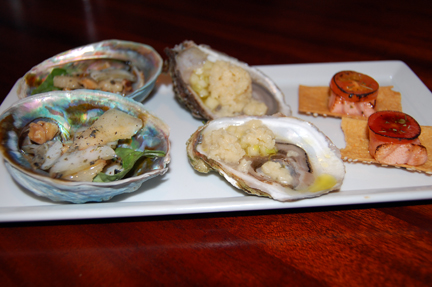
The first was Washington state abalone, oysters, and salmon, paired with Prosecco. Chef Todd was cooking for a Washington state wine event in one of the event spaces at the Four Seasons hotel and he sent down some of the pairings to our table at the restaurant downstairs where a friend and client had asked us to join him with a Prosecco producer.

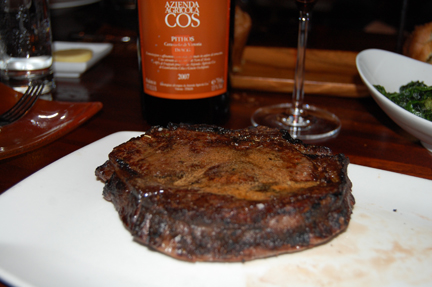
Perhaps the most extraordinary fusion came in the guise of a Texas smoked rib-eye paired with the Cos Cerasuolo di Vittoria. The Frappato character was powerful in the bottling we unstopped yesterday evening and the match between the bright fruit and the smokiness and fattiness of the beef was delicious.

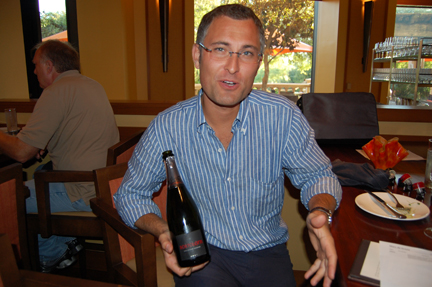
But the most intriguing fusion came with a smile and rimless glasses. Daniele d’Anna, the current generation of the Bortolotti family of Prosecco producers. Daniele is the product of a “mixed” marriage: his father is Neapolitan and his mother Veneta. I’ve never met anyone like him: he can switch between a thick Veneto accent (familiar to me) to Neapolitan (familiar to Tracie P) on the turn of a dime. I was curious to ask him about what it’s like to live in a Veneto now dominated by the Lega Nord, the xenophobe Separatist movement.

The Lega Nord wants to secede from the Italian republic and form its own country, severing ties with central and southern Italy. Let’s just say that the Lega doesn’t look so favorably on southern Italians, their customs, mores, and life rhythms. The image from the left is taken from a bizarre Lega campaign that I saw when I was in Italy recently. “They suffered immigration,” it says. “Now they live on reservations. Think about it.” Pretty scary, huh?
I liked Daniele very much and he struck me as a highly educated, cosmopolitan, and enlightened fellow. I doubt he shares the xenophobic sentiments of his Leghisti brethren. He made an interesting point: anyone who wants to get something done in Italian politics today, he observed, needs to take sides. His girlfriend, he told me, joined the Lega so that she could run for mayor of her small town in the Veneto, Asolo (one of my FAVORITE and one of the most beautiful and historically rich places in the world). Does she share the Lega’s racist platform? No, Daniele said. She just joined the Lega as a means to an end, he explained. Do they talk about politics when she comes over to the parentals’s for dinner? No, he said with a smile, they don’t. The 31-year-old woman won the election by the way and now serves as Asolo’s mayor.

Only in Austin can a Salvadoreño (my friend and client Julio, above, left), a Methodist (Tracie P), a Jew (that’s me), and a Trevisan walk into a bar and order a Texas smoked rib-eye with a wine aged in amphora from Sicily. Sounds like a joke, but I’m here to tell you, people: it ain’t!

Buon weekend, ya’ll!

There’ll be more posts from my recent Italy trip coming up next week. Stay tuned…