Ed McCarthy’s insights into Valentini, one of the absolutely best wines I’ve had in 2010

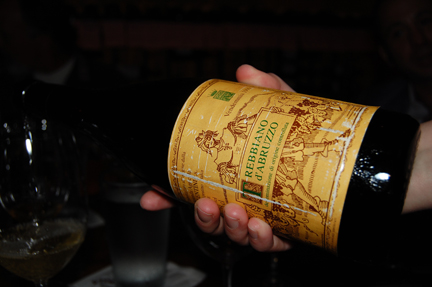
Above: One of the absolutely best wines I had this year was the 1999 Valentini Trebbiano d’Abruzzo, which I drank at the Orange Wine dinner we held at Vino Vino in Austin in April.

Ever since my friend and ex-boss Nicola Marzovilla became an importer of Edoardo Valentini wines earlier this year, this legendary winery has entered into a renaissance in the consciousness of American lovers of fine wine.

Eric did this excellent post on a portfolio tasting of the wines that took place a few weeks ago in NYC and last week, another of the wine writers whom I admire greatly, the inimitable Ed McCarthy, wrote this fantastic profile and remembrance of Valentini, his wines, and the winery (his notes on the different clones of Trebbiano are a must read for anyone interested in Italian wine).

Also worth checking out: this round-up, by my blogging colleague and friend James Taylor, of past literature on Valentini.

When I had dinner with Nicola in NYC last month, I grilled him about his recent visit to the property in Abruzzo. He was reluctant to give up the goods but he ultimately revealed some of the winery’s secrets. But you’ll have to pour me a glass to get them out of me!

06 Barbaresco: a final (?) clarification from Aldo Vacca, Produttori del Barbaresco

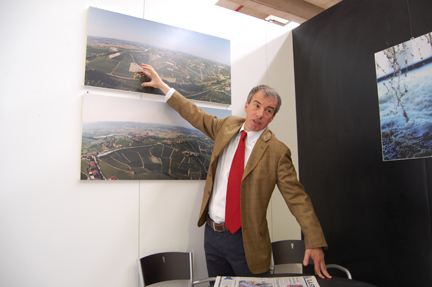
Above: As my good friend and top sommelier David Rosoff will tell you, “I learned more about Barbaresco talking to Aldo Vacca for 10 minutes” than I have in my whole career.

I wanted to draw your attention to a comment made by winemaker Aldo Vacca, Produttori del Barbaresco, posted the other day here at Do Bianchi. He was commenting in response to Charles Scicolone, who had asked plaintively whether or not Produttori del Barbaresco typically executed different bottlings destined for its domestic and international markets (the thread appeared in a post on the winery’s decision not to bottle its single-vineyard wines for the 2006 vintage).

Here’s what Aldo had to say:

    Just a quick note: we at Produttori Barbaresco never bottle wines specifically for one market or another. We do not look for specific taste for specific market and all that, we just make the wine at the best of our knowledge in one very define style. If we do more than one bottling, we try to have a similar blend in all bottling.

    We do release our new vintage in the Fall in Italy and usually, because of the logistics of the market and because we like to give some more bottle aging when we can, the next January is most export market. So, it is usually the case that the first bottling is mainly sold in Italy while the second bottling (which is also larger in size) goes to export and Italy as well: it is just a matter of timing, not of deciding which market gets what.

    Normally this will not make any difference anyway because the two bottling would be very similar.

    The one thing that happened with the 2006 vintage was the late decision of not bottling the SV. If we had made the decision earlier, as we usually do, all bottlings would have been the same.

In a somewhat unrelated note, yesterday I poured the 2008 Langhe Nebbiolo by Produttori del Barbaresco in a tasting in Austin. Man, it’s light and bright and showing great right now, better than when it first came into the market. A tough vintage in Piedmont but great for entry-level wines like this, where some of the better fruit ended up in the front-line wines.

And in a totally unrelated note, in the light of Aldo’s love of Neil Young, we’re trying to get him out to San Diego on July 8 to sit in with The Grapes.

In other news…

I highly recommend my good friend Thor’s excellent post over at the 32 Days of Natural Wine on the natural wine scene in Paris. I really love his writing and I especially appreciated his hypercorrective neolgism oenopiphany. After all, there are men who know what the word epistemology means without having to look it up in a dictionary and there are others who have to go to Brooks Brothers to find out.

In other other news…

For the wine geeks out there and anyone else who wants to wrap her or his mind around what sulfur, sulfites, and SO2 have to do with wine, I highly recommend this post on the use of sulfur in wine by bonvivant Bruce Neyers, a man who needs no introduction to the oeno-initiated.

Buona lettura e buon weekend, ya’ll!

An Oltrepò Pavese Riesling that commands our attention

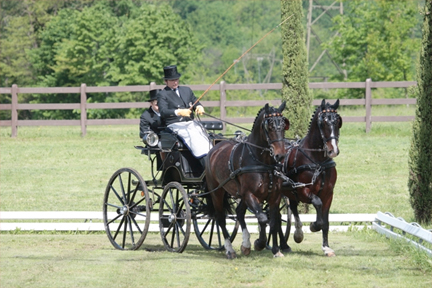
Above: Lombardy and the Oltrepò Pavese are home to an active community of 17th-century carriage collectors and competitors. The Riesling “Landò” produced by Le Fracce is so-called after its owner Count Bussolera’s collection of landau carriages.

Have a look today at a post on an Oltrepò Pavese Rhine Riesling by Italy’s top wine blogger and leading enojournalist Mr. Franco Ziliani, translated by me over at the blog we edit together, VinoWire.

For those of you studying for your master sommelier and certified wine specialist and educator exams, it’s most definitely worth a look-see. We tend to think of the Oltrepò Pavese solely as a producer of great Pinot Nero, Croatina, and Bonarda (including the many excellent traditional-method expression of Pinot Nero made there). But the appellation is one of the few Italian growing zones that can produce a Riesling DOC and bottle it with the grape name on the label (unlike, say, Piedmont, where producers like Vajra can bottle 100% Riesling but have to call it “Langhe Bianco”).

Le Fracce’s “Landò” is so-called because the owner of the estate collects 17th-century landau carriages.

Check it out here…

Don’t read my wine blog (and great things I ate in San Diego)

Above: Fish tacos at Jaynes Gastropub (served only during happy hour). So good with the Grüner Veltliner by Domäne Wachau by-the-glass.

As my lovely and most definitely better half Tracie P will surely agree: it is a rare occasion that I am left speechless. Today is such an occasion.

I was left entirely FLOORED by Levi Dalton’s piece over at the 32 Days of Natural Wine.

Above: Camaronillas (corn tortillas stuffed with shrimp and then deep-fried) at Bahia Don Bravo in Bird Rock with the crew (SO MUCH fun last night). Bahia Don Bravo 5504 La Jolla Boulevard, La Jolla, CA, (858) 454-8940. (Thanks Salavdor, Roberto, and Dora! YOU’RE THE BEST!)

I highly recommend that you check out and follow the 32 Days and there are so many great posts to come.

Above: And only because Zio Alfonso is so concerned about my cholesterol level, I only ate half of the homemade pork sausage (generously studded with fennel seeds) at Pete’s Quality Meat in Little Italy on my way to the airport. Pete’s Quality Meat, 1742 India Street, San Diego, CA, (619) 234-1684.

I’m so stoked that I got to be part of this epic undertaking and entirely humbled by the caliber and talent of the contributors.

Here’s a useful link to see an overview of all the posts to date.

Buona lettura, as the Italians say!

My 32 Days of Natural Wine post (and a note on the accompanying Latin motto on grape growing)

Why is there a photo of spiders on my blog today? You’ll have to visit my contribution to the 32 Days of Natural Wine, day 2 to find out. I wrote my post on Lewis Dickson, the only natural winemaker — to my knowledge — in Texas. Those spiders live above his cave.

In case you aren’t already hip to the 32 Days of Natural Wine, it’s one of the coolest happenings in the enoblogosphere (now in its second year) and it’s run by one of the nicest dudes in this wacky world of wine blogging, Cory Cartwright.

Cory is a friend and a greatly admired blogging colleague of mine and his writing is among the best on the internets when it comes to wine. I’ve drawn much inspiration and guidance from his blog, especially when it comes to Loire and Jura wines.

I was thrilled that he asked me to be part of the project again this year.

Please check out my post The Wild West of Natural Wine: the Texas Hill Country on winemaker Lewis Dickson and his incredible estate, Cruz de Comal.

A note on the Latin motto that opens the post

You’ll see that the post begins with a Latin motto:

    Uva uvam vivendo videndo varia fit.

    —Juvenal 2.81 (Hat Creek Cattle Company)

The strike-through is a reference to the novel by Larry McMurtry, Lonesome Dove. In the novel, a 1985 Pulitzer-prize-winning narrative that Texans have embraced as the state’s “Gone with the Wind,” a work that “forever changed the image of Texas,” according to Texas Monthly magazine, one of the cattlemen adopts the motto as his own, even though he doesn’t know what it means. And he transcribes it erroneously (hence my strike-through).

Above: The sign used in the TV mini-series version of the novel now resides in a museum collection devoted to the book and its legacy. “It was his view that Latin was mostly for looks anyway, and he devoted himself to the mottoes in order to find one with the best look. The one he settled on was Uva uvam vivendo varia fit, which seemed to him a beautiful motto, whatever it meant. One day when nobody was around he went out and lettered it onto the bottom of the sign.” (Lonesome Dove, p. 91)

The motto itself means when one grape sees another grape [change], it changes [color]. The aphorism is akin to the contemporary saying one bad apple can ruin the whole bunch.

It comes to us via a commentator of Juvenal’s Satires (2.81).

In the second Satire, Juvenal warns Creticus about the decay of morals in Rome: “This plague has come upon us by infection, and it will spread still further, just as in the fields the scab of one sheep, or the mange of one pig, destroys an entire herd; just as one bunch of grapes takes on its sickly colour from the aspect of its neighbour.”

The author of a gloss on this passage (a commentary probably written around the 4th century B.C.E., a few hundred years after Juvenal died) points to the Latin motto uva uvam videndo varia fit as a source for the line in the satire.

Anyone who has observed the vegetative cycle of a vine knows that the grapes do not ripen all of sudden nor at the same pace. A few berries will begin to ripen and then, as if the other berries are watching their riper counterparts, the entire bunch will begin to ripen more rapidly. The same thing happens as the grapes begin to rot, hence the line in Juvenal.

I wanted to make a reference to Lonesome Dove in my post about Lewis not only because June marks the 25th anniversary of this landmark novel but because like the characters in the book, Lewis has embraced the frontier spirit: he has courageously raised the Natural Wine flag for the first time in the state.

I also liked the motto because I hope that Lewis’s “bad example” will lead and inspire other Texas winemakers to revisit (or visit for the first time) the notion of place in wine. It only takes one bad apple like Lewis to ruin the whole bunch!

Chapeau bas, Lewis!

Thanks for reading and I hope you enjoy my post over at the 32 Days of Natural Wine, day 2.

The aura of BrooklynGuy’s table

From the “through a glass darkly” department…

Above: Anyone who reads BrooklynGuy’s blog knows the “aura” of his famous table. Tracie P took this photo of through a wonderful glass of Jura that he poured us when we visited with him and BrooklynFamily on a beautiful spring day in late May.

Alice has sat there. McDuff has sat there. Eric has sat there.

I just can’t convey the delight that flowed through my veins when Tracie P and I were invited to sit there last month while sojourning in New York City (once my home, too) in May.

For the life of me, I simply can’t remember why or how I discovered and started following BrooklynGuy’s blog. Over the course of the two years or so that I’ve been a fan, I’ve found vinous and culinary inspiration, buying guidance, good-natured humor, and an honesty and integrity of writing that are rivaled solely by the genuineness and purity of the style.

Above: There it is, the famous table, the one the appears in many of BrooklynGuy’s posts. Can you feel its aura?

But perhaps even more thrilling than the thought of sharing a glass of wine with BrooklynLady and BrooklynGuy and meeting the BrooklynChildren was the prospect of sitting at the storied table that appears in many of his posts and experiencing its aura.

The bottles that grace and graze that surface have passed the Litmus and acid tests of BrooklynGuy’s impeccable palate. It’s a classic case of Benjaminian mechanical reproduction. Through the repetitive appearance of the image of this simple wooden table in BrooklynGuy’s blog, the object itself has attained an aura that assumes its own unique meaning within the paradigm of ritualistic wine tasting.

Above: Look to BrooklynGuy’s blog for great tips in growers Champagne, the “mine field” of affordable Burgundy, and the often uncharted nuance of the Jura.

Over the course of these two years or so, BrooklynGuy’s become a friend and our visit with BrooklynFamily the other day revealed that not since Mel Brooks and Carl Reiner have two schlubs enjoyed the company of two such beautiful and simpatico wives.

Thanks BrooklynFamily for the wonderful Saturday afternoon visit, for the great wines and blog, and thanks — most of all — for the friendship.

Welcome back,
Your dreams were your ticket out.

Welcome back,
To that same old place that you laughed about.

Well the names have all changed since you hung around,
But those dreams have remained and they’re turned around.

Who’d have thought they’d lead ya (Who’d have thought they’d lead ya)
Here where we need ya (Here where we need ya)

Yeah we tease him a lot cause we’ve hot him on the spot, welcome back,
Welcome back, welcome back, welcome back.

Better than the Da Vinci Code: more Santorini sleuthing!

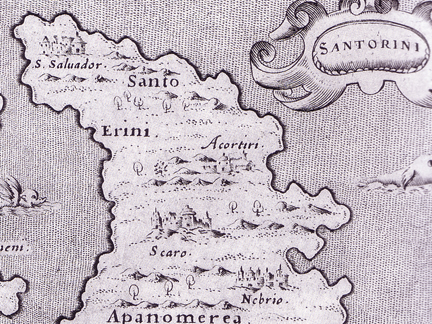
Posting in a hurry today but just had to get this up on the blog. After I posted the other day debunking the myth that Italian Vin Santo and Greek Vinsanto are related in any other way beyond a homonymical coincidence, the chief enologist at Boutari (whose social media project is managed by me), Yannis Voyatzis, express-mailed me a wonderful volume on the wines of Santorini, which (literally) just arrived. In it, I found this wonderful reproduction of a map, printed in 1576 by a Venetian printer. As you can see above and in the detail below, in late 16th-century Venice, the Venetian name of the island Santorini was already well-established.

But more importantly, you can see that the name Santo Erini was still prevalent.

I believe that this supports my theory that the Greek appellation name Vinsanto comes from Vin[o di] Santo[erini].

I’ll have a great deal to say about this in an upcoming post. Early Venetian printing was one of the subjects of my doctoral thesis and I think I’ll have some interesting insights for the philologically inclined among us.

I’m super slammed with work today but just had to share this find asap.

Is this better than the Da Vinci Code OR WHAT???!!!! :-)

Why I love Italian wine in flyover country (my Palate Press post)

Above: I was pleasantly surprised to discover that Gaia Gaja, Angelo Gaja’s daughter, was super fun to hang out with. I interviewed her over Chicago redhots for my PalatePress piece on my encounters with 3 iconic Italian winemakers in “second-tier” American cities.

Alfonso likes to call it “flyover” country: that glorious swath of land, that sweep of the scythe, those amber waves of grain that span from Chicago to the Rio Grande, the Middle West, Mittelamerika, the Third Coast, the Second Cities. In other words, the America that the Left and Right banks often ignore when it comes to the purveyance of fine wine and dining.

I’ll concede that I probably drank more old wine, thanks to the generosity of collectors, when I lived in cities like New York and Los Angeles. But, honestly, my food and wine life has only become more stimulating and rewarding since I moved to Austin, Texas. (Well, everything has become more stimulating and rewarding since Tracie P née B came into my life.)

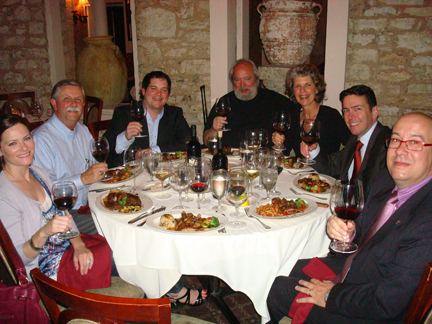
Above, at dinner in Austin, from left clockwise: Tracie P, Dave Meyer (Banfi, Texas), Mark Sayre (my super good buddy and wine director Trio, Austin), Wes Marshall (The Austin Chronicle) and wife Emily, Lars Leicht (Banfi, whom I’ve known forever), and Rudy Buratti (winemaker, Banfi).

When I realized that I would be having dinner and tasting with 3 iconic Italian winemakers in 3 different “flyover” cities, over the course of just 5 days, I thought it would make a good piece for PalatePress (and thankfully so did the editors!).

Gaia Gaja of Gaja in Chicago, Rudy Buratti of Banfi (and newly elected member of the Brunello producers association 15-person advisory council) in Austin, and Giampiero Bea of Paolo Bea in Houston.

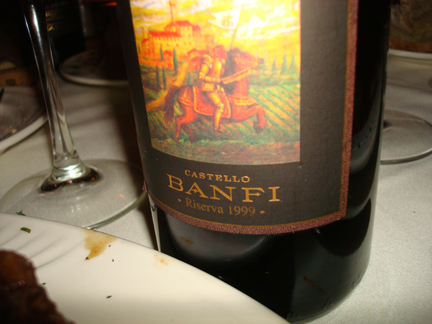
Above: Another pleasant surprise was the 1999 Banfi Brunello (top vineyard) Poggio all’Oro, a wine I would not typically reach for (nor could afford). It was honest and delicious and it tasted like Montalcino. Great wine.

The fact is that top Italian winemakers are traveling more frequently to markets they’ve neglected in the past. I recently found out that Giorgio Rivetti (producer of the infamously created-just-for-the-American-market, jammy, syrupy, ridiculously concentrated Spinetta wines) visited Austin last month. “It’s not often enough that a true gentlemen like Giorgio spends time in Texas,” wrote one wine blogger/merchant.

This is certainly one of the reasons I’ve been lucky enough to have some interesting wine encounters lately.

But then again, as the jingle for the ol’ So Cal franchise Love’s Wood Pit BBQ used to go, when you’re in Love’s, the whole world’s delicious.

Special thanks to Palate Press editor Meg Houston Maker for believing in the piece and eagle-eye editor Becky Sue Epstein for whipping my piece into shape! :-)

Tracie P’s sfincione was amazing

Above: Last night we hosted the first couple of the Austin wine scene, Craig and April Wright Collins. Tracie P truly outdid herself with her cooking.

To borrow a phrase from friend and colleague Charles Scicolone, whose wife Michele is one of the best cooks I know, “I am truly blessed.”

Tracie P simply outdid herself last night with the dishes she prepared for a dinner party we threw.

Ever since cherished family friend Mrs. Reynolds (above) made us a sfincione to celebrate our then upcoming wedding (back in December), Tracie P has wanted to make this classic savory pie from Sicily.

That’s Tracie P’s, above, on the pizza stone we received for our wedding (thanks, Aunt Holly and Uncle Terry!). Did I mention that I’m blessed?

She also made a wonderful olive oil cake for dessert. Yum…

The 2005 Barolo Ca’ Mia by Brovia was stunning. (Check out Cory’s awesome post on Brovia here.)

That’s all I got time for this morning… gotta run… thanks for reading!

Debunking the [Greek] Vinsanto and [Italian] Vin Santo myth

Map thanks to the Wiki.

Ok, so since I began working on the Boutari Social Media Project, I’ve been spending a lot of time thinking about Greek wine and trolling the internets for Greek wine tidbits. In the light of this and the fact that I am a self-proclaimed lover of Italian wine and a moonlighting Italian wine historiographer, I feel compelled today to address the forgivable yet undeniably erroneous assumption that the grand traditions of Vin Santo in Italy and Vinsanto in Santorini (Greece) are related in any other way than the homonymical resemblance of their respective designations.

In other words, I’m here today to tell you that the Italian wine is called Vin Santo and the Greek wine is called Vinsanto but the wines are highly distinct from one another in style and substance and history and their relation is purely linguistic. The names sound similar (and there’s a reason for that) but it has nothing to do with the wines themselves, ok?

Exhibit A is the map above. By 1450 The Most Serene Republic of Venice controlled areas highlighted in bright green in what is now modern-day Greece. (I could go on for hours on the Venetian control of Greece and its cultural implications at the time but that’s besides the point.)

Exhibit B is the name of the island of Santorini. The Venetians gave it this name when they controlled the island and its trade during the Renaissance and beyond. The toponym arises from a corruption of the expression agia eirini, ultimately Santa Irene, and subsequently Santorini in the parlance of the Venetian merchants of that era (up until when the Sultan came knocking again, but that’s another story).

(Nota bene: I could find no philologically credible source that pointed to xantos as the origin of the island’s name [as per the Bessarione myth]. All reliable sources point to a [pseudo] Santa Irene as the origin of the Venetians’s name and the contemporary name [Σαντορίνη in contemporary Greek] for the island.)

Above: In a politically aligned marriage that helped the Republic of Venice to secure trade routes in Greece, Venetian noblewoman Caterina Cornaro reigned as the queen of Cyprus in the late 15th century. Photo via Asolo.it.

The most likely explanation for the confusion is that Venetian merchants and perhaps their customers once called the wines they found on Santorini (as the island of Thera was known then and is known today) Vinsanto, an abbreviation of vin[o] santo[rini] (Italian readers of my blog will immediately recognize the important role that the term santo plays in the Venetians’s weakness for blasphemy and related wordplay [paranomasia]).

I don’t have time to document properly the sources I’ve consulted today and I can only beg your patience to trust that I’ve done the legwork (and I have, btw).

I will close today’s post, written in haste, with a passage from the inimitable Kostantinos Lazarakis’s The Wines of Greece (Mitchell Beazley Classic Wine Library series):

    It is difficult to compare vinsanto with Tuscany’s vin santo, especially since the latter can vary from fino sherry-like dryness to highly oxidized sweetness. Most of the volatility in vin santo comes from the barrel-ageing, while vinsanto develops it mainly through sun-drying. Vin santo is dried in the shade, more gently, but for longer. (p. 381)

In fact, the Vinsanto of Santorini is made from Assyrtico and Aidani grapes that “are left on the vine to reach high levels of ripeness… After drying, the grapes are crushed and fermented, mostly on their skins.” Vin Santo from Tuscany, the Veneto, and Trentino is made from grapes dried on mats in the attic of a farmhouse. (There are a number of other elements that make Vin Santo different: the Easter week vinficiation tradition — after the wines have dried slowly on the mats over the winter — and the use of a mother yeast culled from previously used aging cask, for example.)

And I’ll also share the following passage, a little nugget I found in my research, translated slavishly (by me), from the Dizionario del dialetto veneto [Dictionary of Venetian Dialect], compiled by Giuseppe Boerio and published by Giuseppe Cecchini in Venice in 1867, p. 527.

    Vin santo, noi chiamiamo quel vino, che in qualche luogo dello Stato ex Veneto si fa la settimana santa coll’uva appassita, ed è un eccellente liquore che chiamasi Vino santo per esser appunto fatto ne’ giorni prossimi alla Santa Pasqua.

    Vin santo [is what] we call the wine, which, in certain places of the Ex-Veneto State, is produced during Holy Week with dried grapes. And it is an excellent liquor that is called Vin santo for the very fact that it is made during the days close to Holy Easter.

This is the first credible source I’ve found so far where the name of the Italian wine is attributed to the tradition of vinification during Holy Week.

I’ll provide all the footnotes for wine geeks and the philologically inclined, I promise, soon! One lazy Sunday afternoon when Tracie P is busy in the kitchen. Thanks for reading!