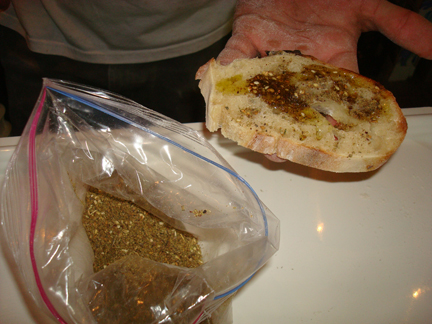
This is not marijuana: it’s za’atar (and great pizza in Austin, yes, in Austin!)

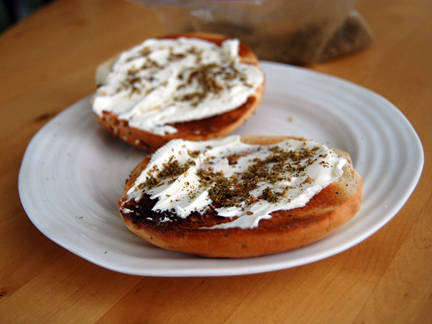
Above: This is not marijuana. It’s za’atar, a traditional Arabic spice mixture, not only delicious but with magical — miraculous, I might say — properties.

Tracie P likes to tease me: “I can’t take you anywhere,” she laments with a grin on her face, without me striking up conversation with the sommelier, chef, or in this case, the pizzaiolo.

To celebrate our wedding, my friend and client Julio Hernández and his lovely wife Lauren took me and Tracie P out to try a new Italian restaurant and pizzeria on Congress Ave., Quattro Gatti. After taking a bite of my pizza (which was delicious, see below), I couldn’t help compliment the pizzaiolo, whose wood-burning oven was an earshot from our table.

In what was a true una faccia, una razza (one face, one race) moment, he beckoned me over and offered me a taste of his za’atar. The traditional Arabic spice mixture, he said, should be sprinkled over toasted bread that has been drizzled with olive oil. Not only is it delicious, he noted, but it also helps to stimulate the digestion. How can I say this? Let’s just say it helps with your daily “miracle.”

Above: Arabs sprinkle za’atar over a pizza crust or over toasted bread. Being an Ashkenazi Jew, I sprinkled mine this morning over cream cheese spread on my toasted bagel.

Pizzaiolo Melad, an Iraqi raised in Syria, was too kind: he sent me home with a baggie (I can’t resist the term) of za’atar for me and Tracie P to enjoy with breakfast. And I’m here to tell you folks, it works! ;-)

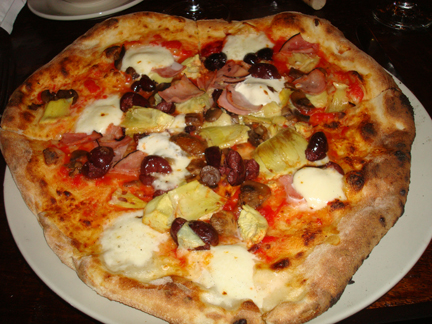
The other good news is that the pizza at Quattro Gatti is fantastic.

Above: We’ll definitely be returning to the newly opened Quattro Gatti for the pizza (that’s the Quattro Stagioni, above). Located smack-dad in the middle of downtown Austin, this place is sure to be one of the hottest tables during the upcoming SXSW music festival. The wine list was more-than fairly priced.

Owner Gianfranco Mastrangelo hails from Campania via Manhattan and he knows his pizza. We loved it: the crust was savory, firm to the bite on the outside, and slightly moist and chewy toward the center of the pie (and his house-baked bread was excellent, as well).

A Neapolitan, an Arab, and a Jew walk into a pizzeria… and the Jew leaves with the za’atar…

Thanks for reading and buon weekend, ya’ll!

I heart Barbera (and some vintage Thelonious Monk)

Barbera Asti

Today finds me “in the market” in Dallas… in other words, meeting with buyers, sommeliers, and a winemaker (you will not believe who! but I’ll reveal that later… let’s just say that I’ll be tasting a 100-point Parker wine today…).

Posting hastily but wanted to share the good news that I’ve been asked to be the official blogger for Barbera Meeting 2010 in Asti (Piedmont): four days of tasting and meeting with Barbera producers, March 8-11.

But the really super cool thing is that the PR firm who’s organized the tastings has asked me to bring some of my best blogging buddies and friends along for a veritable Barbera blogfest!

Not that I needed ANOTHER blog but here’s the blog I’ve created just for the event. The whole affair is pretty darn blogicious, if I do say so myself! And I am completely geeked to taste through scores and scores of wines with some of my favorite bloggers in the English-speaking world…

In other news…

I can’t reveal the super-secret identities of the folks who had me over for dinner last night but suffice to say she’s a nationally renowned food writer and he’s a famous music writer.

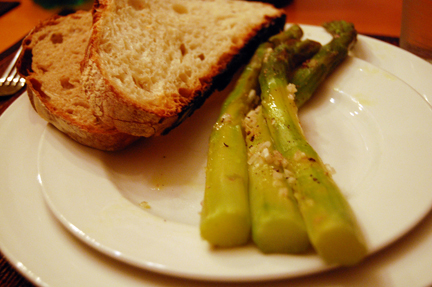
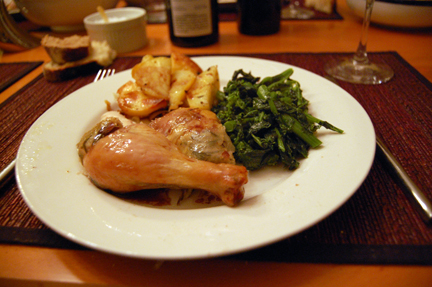
Steamed giant asparagus and vinaigrette (with home-baked white and brown bread) and roast herbed chicken and potatoes were fantastic but the coolest thing was that he let all of the guests call out requests from his music library.

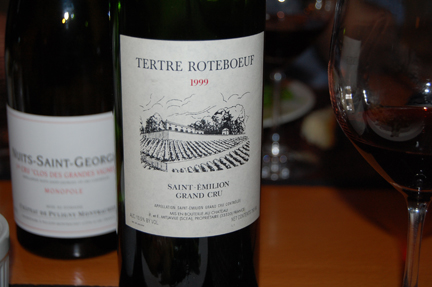
Mine was: “Thelonious Monk, 1957, New York City.” Famous French music writer then turned me on to a super cool recording I’d never heard before, Thelonious Monk Quartet with John Coltrane at Carnegie Hall in 1957. I know the Monk canon well and to hear different (new-to-me) versions of some of his classic was a real treat… and it paired nicely with the 1999 Tertre Roteboeuf.

I think Right Bank always goes better with Monk, don’t you? Miles? Definitely, Left Bank… ;-)

Thanks for reading!

A chair is still a chair…

A chair is still a chair, even when there’s no one sittin’ there
But a chair is not a house and a house is not a home
When there’s no one there to hold you tight
And no one there you can kiss goodnight…

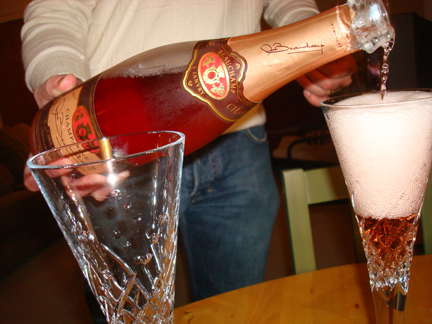
A flute is still a chair, even when there’s no Champange in there…

I’m not sure why I woke up with a sad song in my head this morning: today is one of the happiest days in a long, long time… even in a month and a new year that has been filled with moments of joy that I would have never imagined in my lifetime.

Last night, Tracie P and I opened a bottle of Champagne to celebrate our first dinner and evening at home… our very first night in our first home together… our very first sip from our Waterford crystal flutes, a first bite from our Charlotte flatware and Portmeirion “Sophie Conran White” plates…

A desk is still a desk…

The joy of this moment doesn’t erase the challenges we face: a dear and beloved family friend who is dealing with serious health issues, a misunderstanding and a useless quarrel with another good friend, and the financial and professional mountains Tracie P and I have yet to climb…

As I sit at my desk for the first time and sip my morning coffee (out of our new coffee cups), as Tracie P slumbers on an early Sunday here in Austin, I’m taking a moment to breath in the magic of this moment, this first sip of coffee, and this first blog post at my “new” desk… in our new home…

I love you so very much Tracie P and I love our new (and first!) home together… With you by my side, this little, humble house is so much more than just a house…

Thanks for reading and letting me share this moment with ya’ll… Buona domenica…

Italy meal 1: Trattoria il Pozzo, Sant’Angelo in Colle (Montalcino)

Just like people, restaurants have “good days” and “bad days.” The night we went to Trattoria il Pozzo in Sant’Angelo in Colle (Montalcino), it was one of those off-the-charts good days (and not every meal we had in Italy was worth writing home about, believe me). I’ve been going there since 1989 when I first began to “frequent” Montalcino (the fons origo of my passion for Italian wine). Paola (in the kitchen) and Franca (front of the house) Binarelli have owned and run Trattoria il Pozzo since 2001 and honestly, the food there has never been better. It was just one of those magical culinary nights, when everything came together just perfectly. I’ll let Tracie P’s superb photos do the talking…

tuscan cuisine

Salt-less bread crostini topped with liver and spleen (the chestnut-colored spread, classic Tuscan), chopped mushrooms, and tomato (not so traditional but now part of the pan-Italian culinary lexicon).

tuscan cuisine

Salt-less bread soup, drizzled (rigorously) with extra-virgin olive oil by Il Poggione (more on Il Poggione later).

tuscan cuisine

Pici (long, hand-rolled noodles) with sausage, mushroom, and tomato (this was UNBELIEVABLY good).

tuscan cuisine

Pici with wild boar ragù (the boar meat was so tender and flavorful and the combination of textures and flavors was sublime).

tuscan cuisine

We had to sneak a peak in the kitchen since they were still rolling out the pici that evening.

tuscan cuisine

One of the sine qua non elements of the bistecca fiorentina is that it must be charred on top — to heat the meat on the bone without cooking it through.

tuscan cuisine

Need I say more? To look at the meat you’d think it was over cooked. But the secret is that the beast is slaughtered young. Older than a calf but still relatively young and so the meat has a pink rather than blood-red color.

tuscan cuisine

Fried artichokes. Franca told me that Italian celebrity chef Gianfranco Vissani once complained that they had served these with lemon wedges. So no more lemon wedges!

tuscan cuisine

The chicory was at once bitter like Tuscan dirt and sweet like Tuscan heaven.

gianni brunelli

The 2004 Brunello di Montalcino by the dearly departed Gianni Brunelli, one of the great Tuscan restaurateurs of our lifetime. Beautiful acidity, gorgeous fruit, and man, the combination of the red fruit flavors of the wine and its acidity against the fat and flesh of the steak was better than… well, actually, it wasn’t better than… it was our honeymoon after all! ;-)

Ristorante Il Pozzo
53024 Montalcino (SI) – Piazza Del Pozzo, 2
tel: 0577 844015

closed Tuesdays

You shall learn how salt is the taste/of another man’s bread… Cacciaguida to Dante, Paradiso 17, 58-9.

Chips and pints at Terminal 5 (and the Gaiorny)

Huxley's

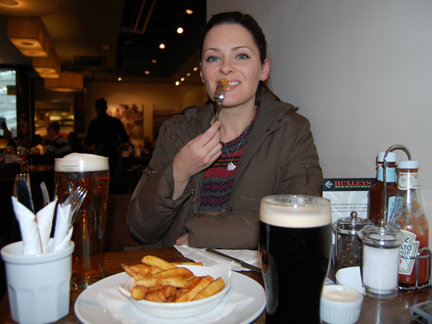
After breakfast in Rome and chips and pints for lunch at Heathrow’s Terminal 5, we got back to Texas last night safe and sound.

I know that Terminal 5 has had its problems but I’m happy to report that our passage there was seamless and the beer had a great head on it.

Enoclub

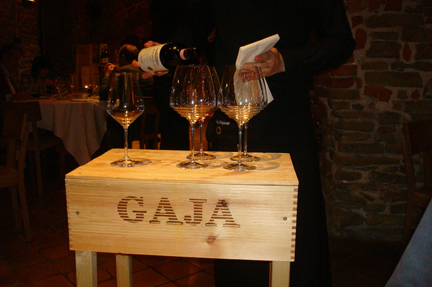
The “Gaiorny” of it: our server at Enoclub in Alba used a cart made out of a Gaja “original wooden case” to open the bottle of Bruno Giacosa 2004 Barolo Falletto that we drank with Giacosa enologist Giorgio Lavagna and Franco on Sunday at lunch. Tracie P and I couldn’t help but note the “gairony” of the modern vs. traditional dialectic going on there. It’s fun to walk into Enoclub, Alba’s most chic wine destination, and hear your lunch companion say to the hostess, “we have a reservation under Giacosa.” It raises an eyebrow or two, even in this jaded Hollywood of Italian fine wine.

I began compiling my notes from the Giacosa tasting yesterday on the plane and will post them tomorrow after I catch my breath. Thanks, everyone, for the notes and messages: we have so many tales to tell from our trip but the Giacosa tasting was the “money shot,” as we say in show biz. You might just be surprised to read what Bruno had to say about cultured yeasts, reclassification of Rabajà, and how often he changes his casks.

Stay tuned!

Someday Tracie B will be is now Tracie P!

tracie parzen

Photo by Alfonso.

An earthquake struck San Diego early Monday morning but Tracie P and me didn’t have anything to do with that… ;-)

bahia don bravo

How could our wedding be complete without ceviche at Bahia in Bird Rock? That’s where we had our rehearsal dinner.

bahia don bravo

Only one of the Texans present had ever had a camaronilla. Guess which one! ;-)

italian wine guy

We were geeked to share the Bahia experience with best man Alfonso and SO Kim.

tad parzen

Brother Tad gave a toast, welcoming the Branch/Johnson family to La Jolla.

longhorns

Uncle Terry “preached” to the choir and welcomed me to the Texas family.

We love Bahia for the view, we love Bahia for the “ambiance,” and the food is always good. But when Dora is in the kitchen, it’s our favorite.

dedication

“De parte de tu restaurante favorito,” wrote my friend Roberto who works there, “les deseamos mucha felicidad y realmente todos estamos muy contentos por ustedes. Felicidades.”

I wrote this post on the plane. We’re in NYC on our way to Italy! Stay tuned…

Si parla l’italiano a San Diego

This morning, Tracie B and I arrived early for our appointment to get our marriage license in downtown San Diego and so we popped over to the newly revitalized Little Italy neighborhood of America’s Finest City for some breakfast. There was a group of men sitting — kibbitzing, you would say in Yiddish — outside Pete’s Quality Meats (above) and so we stopped and chatted with them in Italian. Their Sicilian faces were tan and furrowed from their years working on the San Diego tuna boats.

“Auguroni! figli maschi!” they called out as we said goodbye (“Best of wishes! May you have many male children!”).

It was wonderful to hear the sun-baked rhythms of their Sicilian cadence, a relic and a trace of the era in which they immigrated to the U.S. bringing theirs skills in tuna fishery (probably in the 1960s, gauging from their language).

Si parla l’italiano a San Diego…

In other news…

I think the Rueben has officially usurped the special place in my heart once reserved solely for the Jaynes Burger at Jaynes Gastropub, where a bunch of folks gathered last night to celebrate our upcoming wedding. It paired exceedingly well with the 2007 Dolcetto d’Alba by Cavallotto by the glass (one of me and Tracie B’s favorites).

My high-school friend and bff John Yelenosky and his wife Megan (both wine professionals) treated us to a bottle of 2000 Gaston Chiquet Champagne. Wow, I love that wine.

“I know how much you like Gaston Chiquet,” Megan teased me. “‘Cause I read your blog!” ;-) Sooooo gooood… and so sweet to drink in celebration! Thanks, Megan and John!

John is going to “stand up with me” at the wedding this weekend.

O, and, btw, the marriage license? CHECK! :-)

An Italian, a Mexican, and two Jews walk into a bar…

My lunch with Tony, Manny, and Marty…

Above: At lunch on Friday, I had the great pleasure to break bread with one of the top Italian restaurateurs in this country, Tony Vallone (left). That’s his good friend, and colleague and good friend of my cousin Marty, Manny Leal, right.

Let’s face it: there’s not a lot of great Italian food in Texas. Since moving here a year ago, I’ve found some great authentic-style Italian and Italian-American pizza, notably in San Antonio and Dallas. Otherwise, I cannot honestly say that I have found Italian cuisine that Tracie B and I truly and unreservedly enjoy.

But that all changed when cousin Marty first treated me to dinner at Tony’s in Houston (where, honestly, I cannot afford to dine but have had the great privilege to enjoy many meals now, thanks to the generosity of Marty and wife Joanne).

Above: Following a little cheese-crisp nosh, the medley of regional Italian first courses opened with some wonderful gnudi, “nude dumplings,” ravioli without the casing, a classic dish from the Maremma in Tuscany, traditionally made with nettles.

Tony and his passion for regional Italian cuisine first came to my attention way back in 1998 when I was working as an editor for The Magazine of La Cucina Italiana and the regional and rustico Italian cuisine craze was just about to explode. The magazine ran a 750-word piece on Tony in the front of the book. What I didn’t know then (and only would find out later) was that Tony wasn’t doing regional Italian cuisine because it had become hip or trendy. He was doing it because it’s what he had and has always done.

Above: The ravioli d’astice (langoustine ravioli) were sinfully good. The sauce for this dish, which could have been prepared in Naples or Venice, was made using the corallo (literally, the coral) of the crustacean: when harvested during mating season, the females carry delicious coral-colored roe that gives the sauce its unique color. True mastery of pastamaking is revealed in the consistency and lightness of filled pasta. Tony’s approached divinity.

“I had to go down to the docks and buy the calamari myself from the fishermen,” said Tony, reminiscing about the opening of Tony’s second location in 1972. “They didn’t sell them: they only used them as bait!” Tony was born in Houston, to a Sicilian mother and Neapolitan father, and has worked in the restaurant industry in one capacity or another since he was 11 years old. While Sicilian and Neapolitan dialects was spoken at home, a visiting uncle — the first in their family to achieve a university degree, in anesthesiology — instructed Tony as a child in “standard” Italian.

Above: The delicious amatriciana at Tony’s is made rigorously with guanciale (the cured pork jowl of central Italy, not prosciutto or pancetta) and dressed with pecorino (not Parmigiano Reggiano). From Tuscany to the Veneto, from Naples to Latium, Italian “regional” cuisine sings like Pavarotti (a frequent visitor to Tony’s) at the restaurant.

Since he first opened the doors of his kitchen in 1965 (originally in one of his father’s gaming rooms), Tony’s top sources for regional Italian recipes, he told me, were Carnacina (the father of “regional Italian cuisine,” whose works were first published in Italian in 1961 and first translated in 1969) and the many itinerant Italian cooks and chefs who would come to Houston, where the oil business lured many easterners and Europeans (and their cosmopolitan palates) early on.

Above: One of Tony’s early supporters was his early landlord, the legendary Houston developer Gerald Hines, who encouraged Tony to develop his skills in French cuisine. This Provence-inspired tuna paillard, dressed with a fresh fava beans, heirloom tomatoes, basil, and a classic vinaigrette, perhaps bespeaks an era when French, not Italian, cuisine dominated fine dining in this country.

A turning point came when Houston developer Gerald Hines told Tony that he was not going to renew the restaurant’s lease because the building was to be razed to make way for construction of the Houston Galleria. Hines was willing to give Tony a new and larger space, the developer told him, on the condition that he cultivate his French dishes. The new menu, unveiled in 1972, included fish bonne femme and beef filet au poivre. “We used trout instead of sole because it wasn’t available then for the bonne femme,” recalled Tony. “We used gulf oysters instead of mussels!”

Above: The litmus test for any great Italian restaurant, espresso. The schiuma (the foam) was sublime.

A subsequent visit from Houston social columnist Maxine Messinger resulted in a nearly 30-year culinary love affair. “You’re in trouble,” Maxine told Tony, “I like your restaurant!” By the mid-1970s, Tony’s had become — and continues to be — Houston’s top see-and-be-seen destination. “I’ve cooked for eight U.S. presidents,” said Tony, “six of them sitting presidents.” (I wondered: did the others eat standing up? I guess it doesn’t hurt that two of the last three presidents were from Texas!)

Above: This man… this man… no, he’s not a rebi. He’s my cousin Marty (my dad’s first cousin) and getting to know him and getting to spend time with him has been one of the most delightful however unexpected surprises since I moved to Texas to be with Tracie B more than a year ago. And the best part? He LOVES good food and fine wine. Marty, I’m so very glad that you, Joanne, Dana, and Neil are part of our lives.

But despite the glamor and limelight he enjoyed by adding Francophile cuisine to his offerings, Tony continued to travel to Italy and to New York, cultivating his knowledge of Italian cuisine and authentic regional ingredients. And most importantly, he remained true to his Italian roots. I believe wholeheartedly that his “linguistic” connection to Italy (the fact that he spoke Italian as a child) is a big part of the his genuine connection to truly authentic and truly delicious Italian cuisine. (Have you ever heard Mario Batali speak Italian?) More on this later.

I’d like to think that Tony enjoyed chatting with me the other day: he promised me another meeting and more tales from the wild west of Italian cuisine in a time long before Whole Foods Market carried Arborio, Carnaroli, and Vialone Nano. I’ll look forward to it.

Thanks again, Tony, for an unforgettable meal, and thanks cousin Marty, for turning me on to great Italian cuisine in Texas! Who knew?

Bloody Mary Morning (a lil’ Tex Mex porn)

tex mex

Last weekend’s 3-day bachelor party… well, let’s just say it left me and brothers Tad and Micah a little hazy. By the time it was over, it was most definitely time for a “Blood Mary morning” and so, to make their culinary Trifecta complete (they’d already had some great Texas steak some great Texas bbq), it was time for Tex Mex at one of Austin’s classics, Chuys. My morning started with a Michelada — essentially a bloody Mary made with beer. Chuy’s features $3 margaritas and bloody Marys on Sunday, btw, I wonder why?)

tex mex

The Wild Burrito, above, is a “wet” burrito made with slowly braised tender stringy beef and Hatch chiles. Some might argue that the inclusion of Hatch chiles and the Sonora-style “wet” presentation would betray New Mexico and Arizona roots of this dish. But who needs dogmatism on a bloody Mary morning? Needless to say, I did my best “James Brown” imitation, as Tracie B likes to tease me, consuming this dish.

tex mex

Deluxe chicken enchiladas, above, are essentially, enchiladas verdes, with sour cream added to the salsa verde. An Austin original, Chuys has become a Texas franchise chain restaurant. But it’s everything Tex Mex should be: cheap, colorful, delicious, fun, and a perfect cure for a hangover!

tex mex

Fajitas are an undisputed signature of Tex Mex cuisine. Some will argue that they originated in Austin while others will claim Houston. No one will deny that they have become a calling card of Tex Mex cuisine from sea to shining sea.

Thanks, again, to brothers Micah and Tad (below), for coming out and giving me a great “lost bachelor weekend” here in Austin. I can’t think of better way to end it than with a blood Mary morning!

tex mex

Check out this amazing video of Willie doing “Blood Mary Morning” way back when before he was even playing his signature guitar. If that ain’t Texan, I don’t know what is!

Black truffle porn and a great wine from Montenegro

truffle porn

Above: Scorched earth, lunar landscape, extraterrestrial poop? No, black truffles from Umbria. The surface reminds me of the cratered earth you see in Tuscany and Umbria when they till the land.

Yesterday, found me “working the market” with colleagues in Houston, pouring and talking about wines, meeting with sommeliers and wine buyers, and being extremely well fed by some of Houstons top restaurateurs. One of the city’s top gourmets let me take this snap of his black truffle booty. I’ll post on the fantastic lunch he prepared for me and cousin Marty on Monday.

montenegro

One of the cool things about what I do for a living is what I like to call the “collegiality” of the wine biz. When I met with one of the top Italian wine buyers in this country, Joseph “Grappa Joe” Kemble, who buys Italian wines for behemoth retailer Specs, he invited me to taste a fantastic wine from Montenegro, made froma grape I’d never tasted nor heard of before, Vranac or Vranec by a winery called Plantaže.

I really dug this juice: it was earthy, with a light goudron note on the nose, balanced alcohol at 12%, and gentle red fruit in the mouth. I’ve never been to Montenegro and I really don’t know much about how the wine is grown or produced, but it had that “original” quality to it, that uniqueness that makes me believe it speaks of the land where it’s made and the people who make it.

Thanks, Grappa Joe! Keep on selling that Italian juice the way you do! (You should hear the guys on his team quote all 12 Calabrian appellations like baseball stats! I only would have got about 6 off the top of my head!)