If traditional Italian food can do it, why can’t traditional Italian wine?

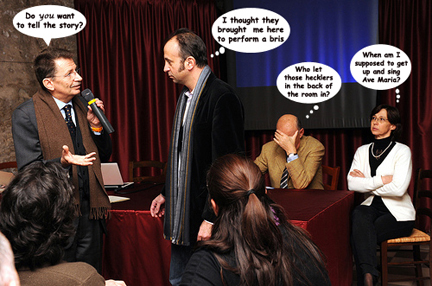
Above, from left: Professor Vincenzo Gerbi (enologist, U. of Turin), me, winemaker Michele Chiarlo, and unidentified woman, March 9, 2010, Tuesday morning in Canelli. Alfonso provided a caption and thought bubbles for the photograph, which he lifted from the Barbera Meeting Flickr feed. Alfonso’s captions are humorous, of course, but the tension was as thick as Australian Shiraz with added tannin extract. It’s never an easy to task to interpret in those situations. I was using a technique called chuchotage or whispered translation, where I would whisper translations of the questions into Professor Gerbi’s ear. Then I used consecutive translation to translate his answers. Ne nuntium necare!

The events of Tuesday, March 9, 2010, at the Barbera conference in Canelli and the heated debate that ensued have been the subject of much discussion. Perhaps the best account of the ideological arm wresting was rendered by fellow member of the Barbera 7 Cory here. (Leading Italian wine writer Franco Ziliani had high praise for Cory’s observations. And fellow Barbera 7 member Fredric chronicled the excellent luncheon here.)

Here’s what Cory had to say:

    The first event was a presentation on new research being done on pruning by a group funded by some of the bigger names that produce barbera. For those of you don’t know much about the farming of wine (i’m no expert myself) the way vines are pruned are central to the way grapes ripen, how much they produce, and how the wine comes out. Traditionally barbera has been pruned using the guyot system, (which i won’t get into in detail here). The research being done is on the spur cordon system. It’s one of those things that sounds innocuous to the outsider, but the effects on the wine were profound.

    We were told about the effects of the pruning on the acids, the tannins, the color of the wine.

    It was around this point that things began to become heated.
    Questions were asked as to why this was necessary. Do you really need to keep messing with the grape? Why would you need to control the acid in barbera?

    Isn’t acid essential to barbera?

    The answer we got was that they were making barbera… important.

Read the entire post here.
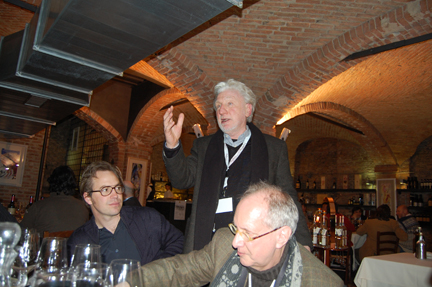
Above: During the morning and afternoon sessions, my good friend and blogger colleague Charles Scicolone challenged the winemakers directly, asking “Why don’t you make the same great, food-friendly wines you made 20 years ago?”

As the interpreter, I couldn’t jump into the debate. But as I listened and interpreted, interpreted and listened, the same thought kept rolling around my head: traditional Italian cuisine has conquered the world over; so why is it that Italians want to send modern-, international- (i.e., homogeneous-) style wine abroad? In other words, if traditional Italian cuisine can do it, why can’t traditional Italian wine?

After all, the thing that Tracie P and I love the most about real Italian wine is its food-friendliness. Whether old, regal Nebbiolo or young, bright Barbera, we look for three basic elements in the wines we like, the same three elements that make wine friendly to food: high acidity, low alcohol, and honest fruit aromas and flavors. At our house, we never serve food without wine and never serve wine without food (well, to be honest, we only rarely serve Champagne at breakfast!). Joking and clichés aside, our approach to wine can be distilled in the following chiastic aphorism (do you like that one, Thor?): never wine without food, never food without wine.

And what could go better with traditional Italian cuisine than traditional Italian wine?

In other food-friendly news…

Tracie P and I FINALLY got to spend a quiet night at home alone last night. She treated me to Salisbury steak and mashed potatoes…
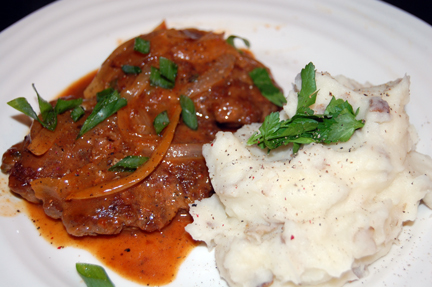
Did I mention that besides being jaw-droppingly gorgeous, the girl CAN COOK? ;-)

In other news…

Yesterday, I had the great pleasure of doing an online interview with Grappolo Rosso. I particularly enjoyed his request that I pair wines with songs. I really liked, if I do say so myself, my pairing for Australian Shiraz: a little Judas Priest, anyone? Thanks again, Jury! And complimenti per il tuo nuovo blog!

My date with the city (of Milan)

After a week of working myself to the bone in Asti and Langa, and a successful and happy epilogue to Barbera Meeting 2010 (and all the many blogilicious waves we surfed there), my little gift to myself was an afternoon of book shopping and strolling in Milan on a beautiful, crisp but not too chilly afternoon. That’s Milan’s famous gothic cathedral, the Duomo of Milan, above.

A visit to the original Feltrinelli book shop on Via Manzoni revealed a Massimo Montarari (Italian food historian) title that was missing from my collection. And a visit to one of the flagship Feltrinelli megastores in the Galleria (above) delivered the toponymic dictionary I’d been looking for.

When you exit the subway at the Duomo station, the stairs are rigged with midi triggers that play acoustic piano samples. As you walk up the stairs, if you land on each “white key” step, you play the C major scale. The eerily beautiful cacophony created by commuters and tourists reminded me of an angular Antonioni film score.

My Milan will always be a black and white movie from the 1960s but Milan is also the capital of haute couture and high design. I love the glamour and color of Milanese window shopping.

But the best part was dinner of Piave cheese, perfectly sliced Lombard bresaola (above), and Friulian Cabernet Franc in the home of my super good friends Stefano (from Treviso, Veneto) and Anna (from Ischia, Campania). None of us could stop marveling at the wonderful, uncanny counterpoints and parallels of life. This adoptive padovano has been away from his adoptive ischitana for way too long. Thank goodness the next stop is Austin, Texas, U.S. of A.

A great winebar in Asti and 3 wines that blew me away

Special thanks to Tom H, who hipped me to this place.

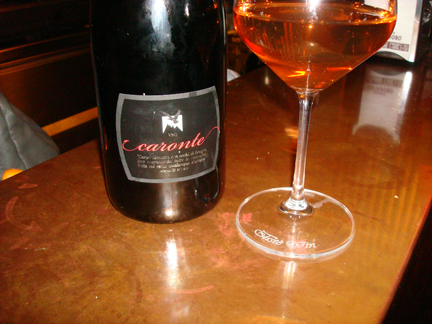
Above: Classic-method Petit Rouge “Caronte” by Morgex et de La Salle (Val d’Aosta)? Hell ya! Caronte is Dante’s Charon, as the label reveals with these lines: Charon the demon, with eyes of glowing coals/beckons to them, herds them all aboard/striking anyone who slackens with his oar (Inferno 3, 109-11). This wine had elegant structure and citrus fruit balanced by a savory minerality. One of those, I-could-drink-everyday-and-never-get-tired-of-it wines.

Posting hastily as I head out for meetings in Alba and Grinzane this morning and then to Milan to reconnect with friends, old and new, and hopefully to visit a bookshop or too before dinner.

Above: “Natural wine” is a touchy subject in Italy and the term “natural” really refers here, as Thor pointed out the other night, to a philosophy, loose but honest, rather than a rigorously enforced code. Owner Claudio called this a “natural” Barbera. 2006 Piemonte Barbera (although actually a Barbera d’Asti) by Hohler. It was earthy and savory, meaty but not over rich. I completely dug it.

After everyone left yesterday, I spent the day alone, catching up on correspondence, doing a little translating for a client, and resting. Tom H had mentioned TastéVin Vineria, a fantastic wine bar near Asti’s city walls, and so I headed out for a little walk and then took a seat at the tiny counter and chatted with owner Claudio, munching on charcuterie and cheese and tasting wines he recommended.

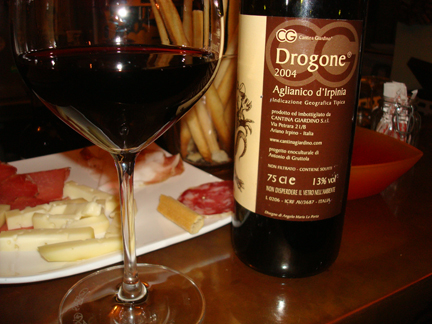
Above: I was completely floored by this wine. 2004 Aglianico d’Irpinia Drogone by Cantina Giardino. No sulfite added. Rich and savory, gorgeous tannin (slightly mellowed after having been opened the night before), rocks and red fruit, and impressive acidity. Definitely a great candidate for aging. My one word tasting note? Wow.

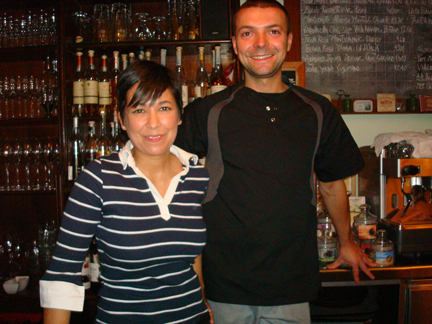
Okay. That’s all I have time for today. Gotta run. If you ever make it to Asti, please check out TastéVin Vineria. That’s a photo of owners Claudio and his fidanzata below (I’m so sorry, Claudio! I lost the card you gave me last night with your last names!).

TastéVin Vineria
Via Carlo Vassallo, 2
14100 Asti, Italy
0141 320017

In other news…

Only my love holds the other key to me…

The Marchioness of Monferrato

Above: Yesterday we “tasted” the terroir in a cellar in Monferrato at one of my new favorite wineries, La Casaccia. The unique, sandy tufaceous subsoil of Monferrato is what gives the wine its outstanding minerality and savory flavors. As per Monferrato’s tradition, La Casaccia’s cellar was literally excavated out of the subsoil. Remarkably, the crumbly walls need no support.

Long before I really knew much about Italian wine, other than the fact that I loved it, I was intrigued by the wines of Monferrato.

As Boccaccio recounts in the first day of his Decameron, when the king of France called on the Marchioness of Monferrato: “Many courses were served with no lack of excellent and rare wines, whereby the King was mightily pleased, as also by the extraordinary beauty of the Marchioness, on whom his eye from time to time rested.”

The wines of Monferrato were already famous by the middle ages and long before the current renaissance of Italian wines, Grignolino and Barbera grown in Monferrato enjoyed wide fame and graced the tables of nobility and clergy.

Above: I also really loved the wines of Marco and Giuseppina Canato, children of share croppers who now grow and vinify excellent Barbera and Grignolino and run a homey bed and breakfast. Just look at them! You can’t help but adore them.

I don’t have time this morning to post any further, as I have been re-posting vigorously over at Barbera2010. The Barbera 7 are a loquacious bunch!

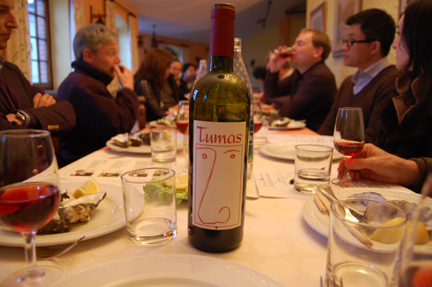
Above: I also loved this single-vineyard Grignolino “Tumas” by Scamuzza and the inimitable Laura Bertone, who paired her groovy, mineral-driven wine with oysters!

I’m exhausted after 3 days of interpreting and blogging and tasting. I miss Tracie P terribly, and in the spirit of honest blogging (something we’ve been talking about a great deal, here in Asti), I cannot conceal that a very good friend of mine has broken my heart… Yesterday was a tough day but the Barbera 7 rallied around me, with cheer and words of support, and sweet messages from my beautiful wife through the night assuaged the hurt…

How can you mend a broken heart?

Falanghina, Pepella, and Ginestra blend… killer…

This white blend from Campania was SO FRIGGIN’ good. Thanks Tom for hooking it all up!

Fantastic buffalo mozzarella from Tramonti at Pizzeria Francese in Asti (highly recommended, the place where EVERYONE goes on Sunday night). Beppe Francese’s pastiera was also off-the-charts good.

More tomorrow… gotta go sleepin’ now!

Made it to Asti…

After a long night and day of travel, I made it to Asti where I found this bag of goodies from the Pasticceria Giordanino in my hotel room waiting for me.

So far, so good…

Meeting the blogger team for an aperitivo and then to a pizzeria that everyone says is great…

Stay tuned…

Leaving on a jet plane for Barbera (and recent good stuff in San Antonio)

So kiss me and smile for me
Tell me that you’ll wait for me
Hold me like you’ll never let me go…

Above: Whole fish at Andrew Weissman’s Sand Bar in San Antonio.

It’s hard to believe but it’s true: tomorrow I’ll be leaving again for Italy, just three weeks after our return from our honeymoon there and our move into our new home, a little rental on the northwest side of Austin.

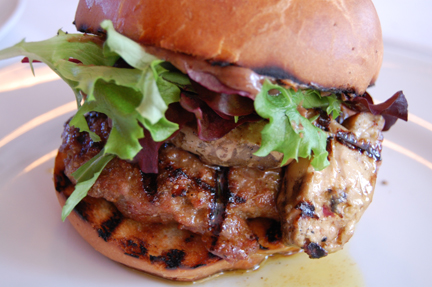
Above: Josh Cross’s Duck burger topped with foie gras at Oloroso in San Antonio.

Life has been so rich and flavorful lately, as the wine world seems to regain its footing and I can only thank my lucky stars for all the interesting projects I’ve got lined up for 2010. It’s a wonderful time for me and Tracie P (née B) but I know that the glow I feel is for the joy that she has brought to my heart. When she smiles at me, it feels as if the whole world smiles at me as well.

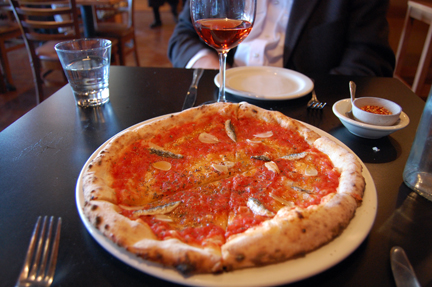
Above: A marinara with marinated, fresh anchovies at Doug Horn’s Dough Pizzeria Napoletana in San Antonio.

I feel so fortunate that I’m getting to travel to Italy for the second time this year — and with a group of really cool bloggers. We’ll be posting about our tastings and adventures in the land of Barbera over at the Barbera2010 blog. (Today, we posted an awesome guest spot from McDuff, one of my favorite wine bloggers, who wasn’t able to join us in realtime.)

Above: Alfonso and I enjoyed a bottle of Barbera last night in San Antonio at Il Sogno.

Once upon a time and a very good time it was. I can’t help but thank my lucky stars for this special time in our lives. I’m so happy to be surrounded by loving folks these days and all the good things that are happening work-wise right now. As my friend Slava back in New York used to say, I should “suck a lime.”

But it’s going to be awfully hard to board that plane tomorrow. I know I’ll be back soon but it only gets harder and harder to tell that lovely lady of mine good-bye. I’ll miss her terribly…

All my bags are packed I’m ready to go
I’m standin’ here outside your door
I hate to wake you up to say goodbye
But the dawn is breakin’ it’s early morn
The taxi’s waitin’ he’s blowin’ his horn
Already I’m so lonesome I could die

Oh babe, I hate to go…

More chestnut-flour polenta and pork facial glands

polenta

Wow, thanks, everyone, for all the wonderful comments and emails about yesterday’s post on dinner in the home of the lovely Bindocci family in Sant’Angelo in Colle (Montalcino, Siena). I thought I’d post a few more photos from the dinner. And thanks, especially, to Stefania and Fabrizio, who so graciously welcomed us into their home. That’s Stefania, above, slicing the chestnut-flour polenta with a string.

polenta

The incredible sensual experience of the chestnut-flour polenta is its combination of its sweet, chestnut flavor combined with its inimitable texture. The night we were invited, Fabrizio’s niece was there with her husband. They had just returned from Libya, where they had been living (they’re agricultural engineers and they work to create sustainable farming in the third world). To celebrate their return, Stefania had created this traditional Mt. Amiata menu (she was born in the mountains, while Fabrizio was born on the Orcia River Valley floor).

polenta

@BrooklynGuy the delicate but firm-to-the-bite texture of the pork facial glands (almost like candy), which have imparted their flavor to their cooking liquid, combined with the pillowy softness of the polenta was an unforgettable sensorial event in our mouths. The porousness of the polenta proved an ideal receptacle and medium for the rich jus of the offal. The two worked in concert, in a dynamic dialectic that rewarded the senses with its seamless ingenuity.

polenta

In another era, the slaughter of a pig was an important event in the familial and societal rhythm of life. While most of the pork was “put up,” as they say here in Texas, in the form of cured thigh and sausage, the offal was consumed in celebration of the good fortune of avere le bestie, as they say in Italian, of having beasts (i.e., livestock) on your estate. One of the coolest things about Il Poggione is that it is a working, integrated farm, where livestock is raised and sent to pasture in fields adjacent to the vineyards and olive groves. The integrated approach, says Fabrizio, is an important element in creating the terroir-driven wines for which their winery is so famous. We paired the 2006 “owner-selection” Rosso di Montalcino with the chesnut-flour polenta and pork facial glands (we served the 07 Rosso di Montalcino by Il Poggione at our wedding reception).

polenta

Some of the most memorable meals I’ve had in Tuscany have been centered around pig and boar liver. It’s so important to experience the wines of Montalcino (and Sangiovese in general) in the context of food and pairing. The 2001 Brunello by Il Poggione was such a fantastic wine — a great vintage from a great producer. But the greatest treat was to taste it in the context and flavor “economy” of traditional pairings. The tannin, red fruit, and acidity of Il Poggione’s Brunello, paired with nearly impenetrable richness and deep flavor of the liver, assumed a new ontographical significance, by which, I mean our ability to describe the nature and essence of things.

We ate liver again on the next day of our trip in Bologna… and there was an important reason for that. More on that later…

Please stay tuned and thanks, again, for reading and for the thoughtful comments… :-)

Tuscan mountain food (WARNING: EXTREME OFFAL CONTENT)

The second night and second dinner of our stay in Tuscany, we had the great pleasure of being invited into the home Stefania and Fabrizio Bindocci in Sant’Angelo in Colle. I’ve known Fabrizio, the winemaker at Tenuta Il Poggione, for many years now and Tracie P and I were thrilled to get to taste his wife’s cooking.

“We’re not having ‘Tuscan’ food,” joked Fabrizio when he invited us. “We’re having ‘mountain’ food,” he said. He met his wife, he told us, when he attended a dance as a young man on Mt. Amiata (to the south of Montalcino and Sant’Angelo in Colle). There were no women in the valley back then, he joked.

tuscany

Dinner began with a nice light chickpea soup, accompanied by Sbrancato, a Sangiovese rosé produced by Il Poggione.

tuscany

Next came a dish I’d never had before: chestnut flour polenta, a classic dish of the Tuscan mountains, said Fabrizio and wife Stefania. She used a string to slice the individual portions.

tuscany

Fabrizio’s son Alessandro authors a blog about Brunello and life in Sant’Angelo, where he has posted about the pigs they raise at Il Poggione. We dressed the chestnut flour polenta with facial glands (above), butchered from the estate-raised pigs.

tuscany

Next came the true “stick to your ribs” dish: pig liver wrapped in caul fat.

tuscany

The liver was followed by sausage made from other organs, the darker of the two was spicy.

tuscany

To my knowledge, Il Poggione was the only producer to make a “riserva” Brunello in 2003, an extremely difficult vintage throughout Europe because of the heat and lack of rain. Brunello di Montalcino does not allow irrigation (not even emergency irrigation). But the elevation of the vineyards and their age (and thus the depth of the roots, which allows the vine to find the water table even in drought years) made it possible for Il Poggione to make a superb expression of Sangiovese despite the growing conditions. This was my first taste of the 03 Riserva, which is the first vintage that the winery has labeled as its “cru” Paganelli (the oldest vineyard on the estate, with vines more than 40 years old, and the source of the clones that inform the estate’s identity). The 03 Paganelli was superb: its fruit was bolder than most vintages I’ve tasted from Il Poggione, but the surprisingly powerful tannin and acidity kept the fruit in check. Very impressive. The 2001? To my palate, that’s one of the greatest vintages for Brunello in recent memory. The wine was unbelievably good, nearly perfect I’d say, a glorious balance of fruit, tannin, and acidity, with many years ahead of it but already showing gorgeously — and what a wonderful opportunity to taste it a stone’s throw from the estate, with the winemaker, paired with his wife’s traditional cuisine!

tuscany

Winter means fresh chicory as a side dish in Tuscany, red and green chicory, dressed with the estate’s olive oil.

tuscany

What Tuscan meal would be complete without castagnaccio, a short bread made with chestnut flour, topped with pine nuts and rosemary, for dessert?

Oops, I didn’t mean “Tuscan” food. I meant “mountain” food! ;-)

Thanks, again, Stefania and Fabrizio, for an unforgettable meal…

Maybe it’s the way she grates her cheese

Maybe it’s the way she grates her cheese,
Or just the freckles on her knees.
Maybe it’s the scallions. Maybe she’s Italian.
I can’t reveal her name but Eggplant is her game.

When my baby cooks her Eggplant,
She don’t read no book.
She’s got a Gioconda kinda of dirty look.

Michael Franks, “Eggplant,” The Art of Tea, 1976

jeremy parzen

Lately, life has been brimming over, teeming with some wonderful “firsts.” Our first dance as a wedded couple, our first trip to Italy together, our first Saturday night at home together, our first meals cooked in our new kitchen — whether a quesadilla, a tuna fish sandwich or Tracie P’s killer chicken and dumplings (a wonderful new recipe she clipped from a magazine), every meal feels special and all-the-more flavorful if only because with every meal we christen another piece in our new flatware, dishware, and cookware. Can you see how much my super-fine lady likes her new Cuisinart sauté pan? Perfect for one of her signature dishes, sautéed broccoli raab.

Last night, although exhausted after a weekend of unpacking and hanging photographs and art work (and finally setting up my little home studio), we threw our first dinner party and Tracie P made her first ragù in our new home. Beyond the fact that it is unbelievably delicious, Tracie P’s ragù holds a special place in my heart because when we first started writing each other, in the very early times of our relationship when we were just pen pals, we traded a lot of notes on our respective ragù philosophies… As many of you know, ragù can be a deal-breaker in any love affair! ;-)

She served the ragù, which she made in our new Le Creuset, over penne rigate by Rustichella d’Abruzzo, one of our favorite dried pasta brands. The whole penne rigate (ridged penne) vs. penne lisce (smooth penne) could have also been a deal-breaker but luckily my gorgeous Tracie P and I are of “one mind” on this issue. ;-)

When choosing the colors for our table setting, Tracie P went with our wedding colors: robin egg blue and pomegranate red.

(Btw, some super fun wines were served as well, including the 2007 Villa Bucci Verdicchio dei Castelli di Iesi, paired with appetizers, and a wonderful 2006 Vin de Paille by Vins de Vienne, 100% Marsanne, that we paired with a cheese course for dessert.)

Maybe it’s the way she grates her cheese… I’m just crazy about her… :-)