Will another earthquake dim hopes of a renaissance for Abruzzo winemakers?

pizza_beer

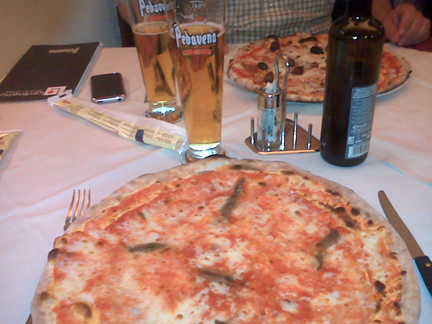
Above: Pizza romana and BEER last night at Il Giardinetto in Marghera (Venice), Italy.

When I came downstairs to the lobby of the crusty and salty 3-star hotel in the Venetian port city of Marghera, where I spent the last night of my Italy stay, I was greeted by the news that another earthquake had struck Abruzzo — 5.2 on the Richter Scale. I haven’t been able to get online with much success (and I am posting today from the Amsterdam airport where I have a short layover before a flight to Houston) but I was able to read Eric’s excellent post (using my blackberry) on the impact the earthquakes will have on Abruzzo winemaking.

To some, it could seem shallow to think about winemaking at a time like this but it’s not. Unlike the majority of Americans, Italians drink wine every day and the wine industry there is not an elitist industry that caters primarily to the affluent (as it does in the U.S. where wine is considered a luxury product, marketed to and consumed primarily by the wealthy). In a region like Abruzzo — one of the more economically depressed among Italy’s 20 regions — the wine industry is the life blood for a sizable amount of the population (including the retail, restaurant, and transport sectors).

The larger and more well-established wineries like Illuminati and Cataldi Madonna will certainly weather the current crisis and their wines will continue to represent some of the best values for quality both domestically and abroad. But it now seems likely (especially considering the current economic climate) that many of the smaller wineries will be forced to shutter their cellar doors. I regret to think that a much-anticipated and hoped-for renaissance in Abruzzo winemaking will not happen in this generation.

The tragedy in Abruzzo

My heart goes out to the victims of Monday morning’s earthquake — all the folks who have lost loved ones and their homes in Abruzzo. According to reports published this morning, more than 150 persons have lost their lives, more than 1,500 have been injured, and more than 17,000 are now homeless.

Today, I’m in Trento, in the far north of Italy, and I was in Verona, asleep, when the earthquake hit at about 3:30 in the morning on Monday, with a magnitude of 6.2 on the Richter Scale (you couldn’t feel it where I was). These are the towns and villages that have been affected: L’Aquila, Santo Stefano di Sessanio, Castelvecchio Calvisio, San Pio, Villa Sant’Angelo, Fossa, Ocre, San Demetrio ne Vestini, and villages in Altopiano delle Rocche.

Evidently, there were smaller tremors the night before, at around 10 p.m., near Florence and Forlì.

Abruzzo is a place of immense natural beauty and it produces fantastic wines. On Sunday afternoon, at the fair in Verona, I tasted with Abruzzo producers Daniela and Sofia Pepe and their father Emidio (of the Emidio Pepe winery) and Stefano Illuminati of the Illuminati family and eponymous winery.

In 1994, I was a graduate student at U.C.L.A. and I lived in West Hollywood on Larabee St. when a big earthquake hit at around 4:30 in the morning. I have never been so scared in my life.

Thank you to everyone who wrote, texted, and posted on my Facebook asking if I was OK. I am.

My heart goes out to all the folks who are suffering.

The red, white, and sparkling carpet at Vini Veri 2009

Posting hastily this morning as I head out for another day at the fair and then tasting later today at Dal Forno in Valpolicella… Here are some quick highlights from the “red, white, and sparkling carpet” at the 2009 gathering of Vini Veri, the “real wine” movement, “wines made how nature intended them,” as the group’s motto goes.

If ever there were a winemaker who looked like a movie star, it’s got to be Giampiero Bea of Paolo Bea. I finally got to taste his 2006 Arboreus, an Etruscan-trained 100% Trebbiano vinified with extended skin contact. In a later post, I’ll write more about the wine and what Giampiero had to tell me about the 2005 vs. 2006 vintages of his Santa Chiara. The 2004 Sagrantino was the best I’ve ever tasted.

Last year, I tasted Maria Teresa Mascarello’s 2005 Bartolo Mascarello Barolo out of barrel (literally, when the cellar master brought it up for her to taste for the first time). I was excited to taste it again a year later in bottle. She’s carrying on her father’s tradition of artist labels with polemical messages. Her “Langa Valley” label (left) is pretty hilarious.

I really dig Adelchi Follador’s natural Prosecco, which he ages on its lees and bottles in magnum. His winery, Coste Piane, also makes a still Prosecco. The wine is great, probably the best Prosecco you can find in America (imported by Dressner).

Franco turned me on to the Barbaresco Montestefano by Teobaldo Rivella. I tasted the 2004 and 2005 and was entirely blown away by how good this wine showed. It reminded me of Giacosa in style and caliber and its power and elegance made me think of an Arabian filly in a bottle.

Marco Arturi is a truly gifted writer who marries wine and literature. He posts often at Porthos. He is a steadfast defender and promoter of natural wine. We had never met before but we write to each and check in from time to time on Facebook: when we met in person it felt like we knew each other well. The whole Facebook thing is pretty cool.

Getting to taste with Franco Ziliani is one of the highlights of any trip to Italy for me. I admire him greatly for his writing, his integrity as a wine writer, and his palate, and I am proud to consider him my friend and colleague. When Franco point me in the direction of a wine, I know I’m not going to be disappointed.

Vini Veri without its co-founder Teobaldo Cappellano reminded me of the Lou Reed song “What’s Good”:

Life’s like a mayonnaise soda
And life’s like space without room
And life’s like bacon and ice cream
That’s what life’s like without you

Baldo was a wonderful man and even though the fair was great this year (and expanded to include the Triple A and Renaissance du Terroir tastings), it just didn’t feel the same without him.

The image of Baldo with his son Augusto (above) hovered over the room where he would have presented his wines.

I’ll write more on my experience at Vini Veri when I get home. Off to Valpolicella and then Alto Adige… Stay tuned…

*****

Life’s like a mayonnaise soda
And life’s like space without room
And life’s like bacon and ice cream
That’s what life’s like without you

Life’s like forever becoming
But life’s forever dealing in hurt
Now life’s like death without living
That’s what life’s like without you

Life’s like Sanskrit read to a pony
I see you in my mind’s eye strangling on your tongue
What good is knowing such devotion
I’ve been around, I know what makes things run

What good is seeing eye chocolate
What good’s a computerized nose
And what good was cancer in April
Why no good, no good at all

What good’s a war without killing
What good is rain that falls up
What good’s a disease that won’t hurt you
Why no good, I guess, no good at all

What good are these thoughts that I’m thinking
It must be better not to be thinking at all
A styrofoam lover with emotions of concrete
No not much, not much at all

What’s good is life without living
What good’s this lion that barks
You loved a life others throw away nightly
It’s not fair, not fair at all

What’s good?
Not much at all

What’s good?
Life’s good
But not fair at all

— Lou Reed

Nebbiolo Super Freak: gulf oysters and Produttori del Barbaresco

WARNING: EXTREME PAIRING AHEAD, PROCEED WITH CAUTION

It’s a very kinky pairing/the kind you don’t bring home to mother…

In Italian you say, ti tolgo il saluto, literally, I withdraw my greetings from you.

I imagine that’s what Franco will say to me tomorrow at the Vini Veri tasting when he learns that Tracie B and I paired Nebbiolo with oven-fired gulf oysters last night.

Since I moved to Texas last year, gulf oysters have become something of an obsession. I’ve always been a fan of the mollusk but I never thought the shucked shellfish of New York and Long Island could be beat. That lasted until I tasted my first gulf oyster in New Orleans last month.

Above: Coalminer Mark, aka Mark Sayre, aka “the best sommelier in Austin” serves 2007 Langhe Nebbiolo by Produttori del Barbaresco by the glass at happy hour at Trio, the excellent steakhouse in the Four Seasons Hotel in Austin. The wine list is killer, the comfort food appetizers menu is yummy, the prices are right, and the valet parking is FREE! Run, don’t walk.

The 2007 harvest in Langa was a classic vintage and will potentially be a great one, probably similar to 96, 01, and 04 in its profile. The 2007 Langhe Nebbiolo by Produttori del Barbaresco was showing handsomely last night and I cannot conceal that I am ENTIRELY geeked someone in Austin is doing it by-the-glass at a happy hour price. Wine director Coalminer Mark of the Four Seasons and the San Diego Kid might just have to bury the hatchet.

Above: Tracie B’s boss Jon Gerber served raw gulf oysters at his annual “Shuck and Suck Crawfish Boil,” a yearly blow-out party, benefiting Habitat for Humanity.

Nebbiolo and spicy, oven-fired gulf oysters? An unconventional pairing to say the least, but the freshness of the Langhe Nebbiolo and its lighter body and acidity was delightful with savory oyster and chorizo that adorned its silky surface. Hey, Franco, call me a Super Freak… ;-) I’ll see you tomorrow in Isola della Scala.

In other news…

The Italian wine trade fairs start today and I’m about to get on a plane for Venice. Stay tuned: next post from Italia…

No vote on proposed Montalcino DOC

Above: I’ve tasted Il Poggione Brunello di Montalcino and Rosso di Montalcino going back to the 1970s. One of the greatest expressions of Sangiovese I’ve ever tasted was the 1979 Rosso (bottled before the existence of the Rosso di Montalcino DOC and labeled as “Rosso” from “Brunello vines”), which Alessandro Bindocci’s father Fabrizio shared with me last year over steak dinner at Keens in Manhattan.

My friend Alessandro Bindocci, son of Il Poggione winemaker Fabrizio Bindocci, posted today on the proposed creation of a Montalcino DOC: evidently, the vote was put to the floor but no vote was held. Read more here…

I’ll be tasting with Alessandro and his father later this week at Vinitaly.

On the eve of Vinitaly, a push to create a Montalcino DOC (and reflections on a year past)

Above: Franco Ziliani (left), my friend and co-editor of VinoWire, and Mauro Mascarello, winemaker and producer of one of the greatest expressions of Nebbiolo, Giuseppe Mascarello Barolo. We tasted at Vinitaly last year together. This year, Franco and I will be tasting together at Vini Veri.

Passover and Easter will shortly be upon us and the who’s who of Italian wine is preparing to descend on the province of Verona for our industry’s annual trade fairs: Vinitaly (the largest and most commercial), Vini Veri (a gathering of natural winemakers and the most interesting in my opinion), and VinNatur (an assembly of winemakers who broke away from Vini Veri some years back). I’m particularly excited for Vini Veri because this year’s tasting sees the unification of Vini Veri with the Nicolas Joly biodynamic and quasi-biodynamic tastings, Triple A and Renaissance du Terroir (Return to Terroir).

Above: The Banfi Castle at last year’s Vinitaly. There were rumors — unfounded and untrue — that Banfi’s wines were seized on the floor of the fair last year. I am looking forward to tasting the 2004 Brunello di Montalcino by Banfi. Charles Scicolone and Tom Hyland — whose palates I respect greatly — have both told me that it’s classic Brunello, 100% Sangiovese, and one of the best wines Banfi has ever produced.

It’s remarkable to think that at this time last year, the world of Italian wine was gripped by the breaking news of the Brunello scandal: at least five major producers were accused of adulterating their wines from the 2003 vintage. A year has passed, a large quantity of wine has reportedly been declassified, and no indictments have been issued by the Siena prosecutor who supposedly launched the investigation in September of 2007.

It’s not surprising, however, that there has been a new push — albeit weak — within the association of Brunello producers to create a Montalcino DOC. Last week, a proposal to create such an appellation was put to the floor at the consortium’s assembly. (I haven’t been able to find out the results of the vote but according to most observers, it was unlikely that it would be ratified.)

Above: I am always geeked to taste Paolo Bea Sagrantino with Giampiero Bea at Vini Veri (I snapped this photo at last year’s fair). Tracie B and I have been enjoying his Santa Chiara 2006. It’s radically different than his 2005 and I hope to ask him about the vintage variation. (Is it the result of climatic differences or differences in the cellar? I imagine — knowing Giampiero and his radical belief in natural winemaking — that the former is the case.)

Currently, Montalcino producers must label their wines as Toscana IGT or Sant’Antimo DOC if they contain grapes other than Sangiovese. If approved, a Montalcino DOC would allow them to exploit the Montalcino “brand” in their labeling of so-called Super Tuscan wines. The proposed DOC is part of a greater push to create new Italian appellations before OCM reforms take effect in August 2009 and the power to issue new DOCs shifts from Rome to Brussels.

Above: This year, the world of Italian wine mourns the loss of Teobaldo Cappellano (photo courtesy of Polaner). Baldo, as he was known fondly, was one of the founders of the Vini Veri movement and one of Italy’s most zealous defenders and promoters of terroir-driven wines and natural winemaking. He was a truly delightful man and is sorely missed.

There’s a reason why the fairs are held at this time of year: historically and traditionally, the spring marks the moment when winemakers unveil their cellared wines. Long before the hegemony of the Judeo-Christian canon, spring was observed as Mother Nature’s moment of renewal and rebirth.

The ancient allegory — and it is an allegory, not a metaphor — could not be more apt this year.

The San Diego Kid vs. Coalminer Mark, part II

To decant or not to decant… that was the question…

It was a damn good thing that Sheriff Houston was there when Coalminer Mark “the best sommelier in town” and the San Diego Kid (that’s me) squared off the other night over a 1999 Barbaresco Pajé by Roagna and a 2001 Barbaresco Pora by Produttori del Barbaresco.

My preference is nearly always not to decant. Yes, I know the 2001 Pora was going to be “tight,” as we say in wine geek parlance. The 2001 harvest was a fantastic, classic vintage for this wine, one of the greatest in recent memory, and this young colt has powerful tannins that currently overwhelm the beautiful fruit that is sure to emerge with its evolution. Coalminer suggested we decant it for the sake of aeration and he was right to do so: as the tight or “closed” wine came into contact with the air, it began to oxygenate and age more quickly, thus gently coaxing its fruit to come forward.

But being the diehard old school Nebbiolophile that I am, my preference is to pour the wine without decanting and aerating: I want to experience it in its evolution at that very time and place, capturing a moment of its life and its story on my palate. Of course, 2001 Pora is a wine I am sure to experience many times over the course of my and its lifetime.

Luckily, Sheriff Houston intervened, a decanter and plate of house-cured charcuterie in hand. We did decant the 2001 Pora and it was delicious, as was the 1999 Pajé with its crazy eucalyptus note.

Tracie B and I retired to our room and read Gideon’s Bible. And the world was still safe for Italian wine…

Above: Coalminer Mark (Mark Sayre, foreground) and Sheriff Houston (Ryan Mayces) played bocce at April and Craig’s crawfish boil a few weeks ago.

From the “just for fun” department…

Perks of the wine trade and NN+ in SF and LA in May

Who could resist the colors in the frame above, between the Tempier Rosé and the heirloom beets offered on the forgivably precious menu at York Street in Dallas? It’s one of the perks of working in the wine trade: getting to dine at top restaurants and getting to bring your own wine. Members of our trade are accorded such liberties — a common courtesy extended to defenders of good wine.

If you don’t know the Provence producer Tempier, you should: its rosé is considered by many to be the best in the world (that’s not an exaggeration). Everyone from BrooklynGuy to Alice to Eric to Alder to Dr. V to Ray to Genevelyn would agree (Alder, wouldn’t you say that it’s the “best rosé in the world”?). I consider myself lucky to represent the winery here in Texas.

Sharon Hage of York Street has been nominated this year by the James Beard Foundation for the best Southwest Chef (together with Texas fellow Andrew Weissman of Le Rêve in San Antonio. Her “Bacon and Eggs” above are pretty darn precious, but, man, are they good.

Other perks include getting to taste some kick-ass wines, like this label-damaged Château Pichon Comtesse de Lalande 1988 that überhip sommelier D’Lynn Proctor poured me the other day at Graileys, also in Dallas. I have thumbed my nose at Bored-oh before but not this one… Not one of the greatest vintages of my lifetime but the wine is showing beautifully right now. 20-year+ Bordeaux is always fun to taste.

The greatest perk of all is the wide variety of fine wines I get to taste these days (yes, there is life beyond Nebbiolo and Chenin Blanc) and the many interesting people and palates I connect with during my travels.

Speaking of travels, NN+ will be performing in San Francisco and Los Angeles in early May. If you’re around, please come out and support our music:

MAY 7
San Francisco CA
The Rickshaw Stop
http://www.rickshawstop.com/

MAY 9
Los Angeles CA
Spaceland
http://www.clubspaceland.com/

In other news…

Check out Tracie B’s awesome post on pastasciutta. On occasion, I have been known to be the beneficiary of her fine cooking (another benefit of being in the wine trade!).

Does anyone remember this line from Hemingway’s short story, “Che ti dice la patria”?: “The pasta asciutta was good; the wine tasted of alum, and we poured water in it.”

Rules are rules: a California Chardonnay I actually like

I’m a loser. As Franco often points out, the rules are the rules and I have to ‘fess up, come clean, and admit that I lost a bet with the man above, Mr. Elton Slone (who has to be the smoothest-talking, slickest hand-shaking, baby-kissing salesman I have ever met — watch out if this dude ever decides to go into politics). I bet this man that there wasn’t a California Chardonnay that he could get me to drink (If loving Chardonnay is wrong, then I don’t want to be right, says Tracie B, btw).

Yesterday, he poured me his 2007 Robert Craig Chardonnay, sourced from the elite Durell vineyard in Sonoma (of Kistler fame). So many Californian winemakers say that they are “tired of oaky, buttery California Chardonnay” and that they make “a mineral-driven, no malolactic fermentation, food-friendly Chardonnay,” but so few deliver. Well, these guys do. Unfortunately, this stuff ain’t cheap and not a lot of it is made.

Is there terroir in California? I’m still not convinced. But as Alfonso and I bantered back and forth the other day after he returned from a Lodi, California wine festival, the conundrum occurred to me: is the absence of terroir itself an expression of terroir?

Man, I’m tired. I’ve been on the road all week and I won’t see Tracie B until tomorrow. I gotta say it’s not easy being a wine cowboy, traveling and hawking wine for a living (I’ve been in Dallas all week). But life is good and every once in a while, after you’ve visited 8 accounts in one day (starting at the un-g-dly hour of 8 in the morn’!), and you finally get to sit down for dinner and enjoy a glass of wine with your fellow travelers (around 9), a song on the juke box reminds you that even though you miss her so much it hurts, you’ll get to see her the day after tomorrow…

Is it spring yet? Rosso di Montalcino, tuna bruschette, and rock ‘n’ roll

Friday brought the spring equinox and so Sunday night, Tracie B decided to lift her yearly moratorium on fresh tomatoes and made us bruschette topped with chopped yellow and red tomatoes, cannellini beans, olive-oil-packed tuna, kosher salt, and extra-virgin olive oil (the oil courtesy of our friend Ginevra Pesciolini of the Ghizzano winery in the Colline Pisane).

A bruschetta (pronounced broo-SKEHT-tah, plural bruschette, broo-SKEHT-teh) is literally “burnt” or grilled bread, always dressed with olive oil and often topped with a combination of the above ingredients. Most believe the word and the preparation originated along the central Adriatic coast of Italy.

We paired with one of my favorite expressions of Sangiovese, 2006 Rosso di Montalcino by Canalicchio di Sopra. Canalicchio’s wine is traditional in style. It showed some of the stinky volatile acidity that you get on old-school Sangiovese like this but it quickly blew off, giving way to delicious, bright, food-friendly acidity and red, plummy fruit.

In other news…

Also on Friday, we managed to get into my friend Inara’s packed showcase with her band The Bird and the Bee at the SXSW festival. Inara rocked it! (picture taken with my phone.)