Zampone! @ the Parzen Christmas party

Alfonso and SO Kim drove down from Dallas last night for a weekend of cooking, eating, and opening some bottles that I’ve been saving for this holiday season.

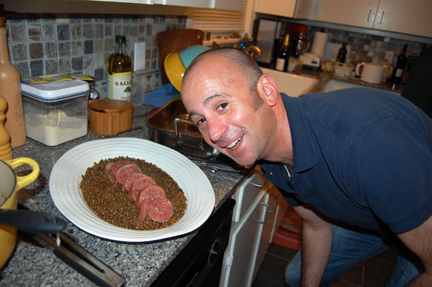
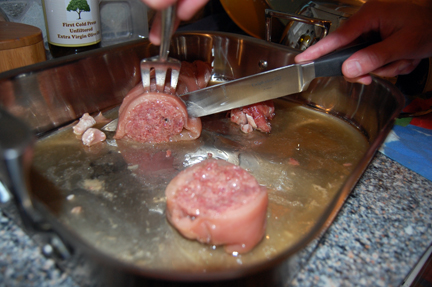
Don’t ask me how it got to our house (or how it got into this country) but last night I cooked one of my favorite Italian delicacies: zampone, a pig’s trotter stuffed with head cheese and then boiled. (@TWG you would love this stuff!)

Tracie P stewed some delicious lentils (which are traditionally served with zampone in Italy on New Year’s eve), aligot, and spinach. And I made a salsa verde (flat-leaf parsley, anchovies, garlic, and extra-virgin olive oil) and prepared some kren (grated horseradish with a touch of vinegar and sour cream) as condiments.

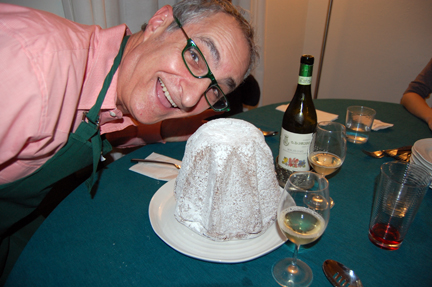
Alfonso brought a pandoro (which Tracie P and prefer over panettone) and we paired with OUR FAVORITE MOSCATO D’ASTI by Vajra. Man, that shit is good!

It’s going to be hard to top the sheer fun factor from last night but we’re going to try again tonight: Tracie P is making Jewish delicacy brisket and potato latkes for our Chanukkah party!

Stay tuned…

What we paired with Frito pie at Cullen’s Upscale American Grille

From the “just for the sheer fun of it” department…

I won’t conceal that cousin Marty and I were a little bit skeptical when we rolled up to Cullen’s Upscale American Grille the other night, not far from NASA Space Center, south of Houston. It’s a huge, sprawling events space, high-end restaurant, and music venue located smack dab in the center of one of those golden triangles of obscene wealth that orbit Houston proper. Honestly, it’s not the type of place that we would seek out. But after hanging with GM and wine director Ryan Roberts a few weeks ago at a very cool dinner where he and Cullen’s chef Paul Lewis cooked for 200 persons on a farm in the Texas plains, I knew that something interesting lay beneath the surface of this shiny, sparkling castle of indulgence in the wasteland of America’s greatest opulence.

You’d think that there would be only California Chardonnay and Napa Valley Cab to drink in a joint like this, but Ryan greeted us with raw gulf oysters and a white blend by one of my favorite Provence producers, Le Grand Blanc by Henri Milan. So salty and with such bright acidity, perfect for the oysters. Not bad, eh?

Next came the now famous Frito pie (check the thread of suggested wine pairings here). Ryan’s pairing was simply brilliant: Étienne Sauzet 2007 Puligny-Montrachet Les Combettes 1er Cru. The gentle wood and subtle malolactic fermentation sang beautifully in the key of minerality with this rich and intensely flavored dish. Here’s the menu gloss btw: “Pork & Chairman’s reserve beef chili, Fritos, Texas goat cheese, Oregon cheddar, crème fraîche” (forget sour cream: crème fraîche on Frito Pie?) Chef Lewis’s meats are sourced rigorously from the Jolie Vue in Brenham where the owners employ strict pasture-based farming (Ryan told me that his restaurant was the first restaurant in Texas to be certified “Green,” btw, another surprise in what appears from the outside to be a purely commercial venture.)

The southern-style oysters Rockefeller were pretty awesome, too.

Paired beautifully with a palate cleanser in the form of Ferran Adrià’s new beer, Inedit (the beer is salty and delicious, the website is annoying but I thought I’d include it).

My main event was chicken fried steak paired with Boillot 2006 Pommard-Rugiens 1er Cru, another brilliant pairing, where the power and spiciness of this famous cru was just right against the richness of this dish.

The night couldn’t not end on a sweet note… Ruppertsberger Reiterpfad 2004 Scheurebe Auslese.

I knew Ryan would have a lot of great stuff in store for us: we’ve met professionally and socially a number of times and he’s an awesome guy, with a great palate (and a ton of experience in this business). He has all the usual suspects on his lists (think big Napa Cab and oaky California Chardonnay) but he also has a ton of wines that really thrill me, like the Henri Milan above, and even a 2002 Gravner white, which he sells for a great price. He’s the perfect balance of someone who is trying to do well by his family and get ahead in life but never forgetting what’s great about real wine, all the while turning his staff and anyone else willing to listen on to this groovy stuff…

My only regret? I wish we would have made it down earlier to do the tour of the Space Center! Next time…

Buon weekend, ya’ll…

Power of the press blog: Chianti producers vote not to allow Super Tuscans at tasting

Above: the architects of Italian unification (1861). To the far left, Count Camillo Cavour, Italy’s first prime minister, a winemaker (Piedmont). In the center, unified Italy’s first king, Vittorio Emanuele II, a winemaker (Piedmont). To the far right, Baron Betting Ricasoli, Italy’s second prime minister, a land owner and winemaker in Chianti Classico, and the father of modern winemaking in Tuscany. Ricasoli’s estate Brolio and Vittorio Emanuele’s Fontanafredda still produce commercial wine today.

Would the founding fathers of Italy believed it if you were to tell them that a blog helped save Chianti Classico?

Today, Italy’s top wine blogger, Mr. Franco Ziliani, and I posted the following news story on VinoWire, our English-language blog devoted to the world of Italian wine: “Chianti Classico producers decide not to allow Super Tuscans at debut tasting.”

What we didn’t write was that Mr. Ziliani’s previously posted editorial, in which he harshly criticized the body for its inclusion of Super Tuscans in its annual new vintage preview, was cited by numerous members in the debate that preceded the decision (whereby the body’s president announced he was retracted the option).

It’s not the first time that Mr. Ziliani — a true flagellum principum — has helped to protect and promote traditional winemaking in Italy through his blog. Chapeau bas, Franco!

The pen is… scratch that… The pen blog is mightier than the sword!

Some of my best friends are Merlot (the Cocacolonization of Chianti Classico)

Above: Ornellaia’s Masseto vineyard in Bolgheri, Tuscany is arguably Italy’s most famous expression of Merlot.

I don’t have anything against Merlot. In fact, some of my best friends are Merlot.

As a matter of fact, on my recent trip to Friuli, I had a bona fide Merlot revelation after tasting some truly fantastic bottlings of Merlot from Radikon, Edi Keber, and Ronco del Gnemiz. (BTW, I have a backlog of Friuli posts but am hoping to get to them soon.)

But when I read that the Chianti Classico producers association is going to allow member wineries to present IGT (read “Super Tuscan”) bottlings at their annual vintage debut show in February next year, I thought I was going to heave… The nausea only grew when I learned that it would only cost the producers an extra Euro 50 per bottle of Merlot or Cabernet they present.

Italy’s top wine blogger Mr. Franco Ziliani first reported the news on his blog and we posted about it today in English at VinoWire.

At the end of a decade of Italian wine marked by the high-profile Montalcino controversy and the less-talked-about but equally significant Tuscan blending scandal, the Cocacolonization of the Italian wine industry seemed to have shifted gears, leaning more toward Bethlehem than Babylon. Unfortunately, the organizers of this landmark event have once again decided to defile the Temple.

The Chianti Classico producers association represents Italy’s most recognizable wine brand and one of its greatest historic appellations. This aberration and contamination of the sanctity of Chianti Classico’s most important yearly event is — in my mind and on my palate — a hegemonical tragedy of Gramscian proportions.

Get this woman some unyeasted, unmaloed Falanghina STAT!

The other day, when I was having lunch with BrooklynGuy in Brooklyn (of all places), we chatted about my life Texana and the wonderful “humanity” I’ve found here, even in places coastal dwellers wouldn’t expect in this mostly red state. At a certain point, he stopped me, looked me in the eye, and asked with a smile: “you’ve really fallen for Texas, haven’t you?”

Anyone who follows my blog knows that I love my wife dearly, I love my life Texana, I love my Texan family (from cousins Joanne and Marty to Mrs. and Rev. B) and I love Texas. But Texas has a problem.

Texas does not allow out-of-state retailers to ship to Texas. Technically, it has to allow them to ship here. But the big wine distributors’s shime-waza on the Texas legislature has allowed them to create a logistical obstacle, making it virtually impossible for out-of-state retailers to ship here (I’ve written about it, with documentation, here).

As a result I cannot get my beautiful wife (above) the unyeasted, unmaloed Falanghina that her heart calls out for. Please read her most recent post where she plaintively writes:

    So here we are back in Texas, and my heart calls out for the real thing. My DoBianchi brought home a shiny white ball of Mozzarella di Bufala and a bottle of Cantine del Taburno Falanghina, but, alas, I am still searching for an unoaked/unmalo-ed/non-acidified yet certified stateside version. I won’t give up. I can survive on the fumes of my memories just a little longer.

Get this woman some unyeasted, unmaloed Falanghina STAT!

In other news…

Yesterday, we officially launched a new project I’ve been working on, also close to my heart, a blog I’m writing for Houston restaurateur Tony Vallone.

We’ve been working on it for a month and I’ve really come to look forward and cherish our weekly hour-long chats where we talk about a day in the life of an Italian restaurateur in America. Check it out. I think you’ll enjoy it as much as I do.

Buona lettura, ya’ll!

Mario Monicelli, Italian cinema giant, free at last

One of the greatest artists of the last and current centuries, Italian film director Mario Monicelli, father of the commedia all’italiana, took his own life last night. He was 95 and terminally ill.

Please read this obituary in The New York Times, where Michael Roston quotes the director:

    “All Italian comedy is dramatic,” he said in a 2004 interview with Cineaste magazine “The situation is always dramatic, often tragic, but it’s treated in a humorous way. But people die in it, there’s no happy ending. That’s just what people like about it. The Italian comedy, the kind I make, always has this component.”

Please also see this obituary in the ANSA feed, where actor Stefania Sandrelli interprets his suicide.

I studied and loved his films in graduate school and have quoted them often here on the blog. The scene below (with Totò, Marcello Mastroianni, and Vittorio Gassman) is my favorite from I soliti ignoti (Big Deal on Madonna Street, 1958).

My favorite gag is when Mastroianni asks Totò if the famous safe-cracker Fu Cimin was Chinese. No, says, Totò, he was from Venice. “Cimin” was his last name. “Fu” means he died, he says.

Frito pie, impossible wine pairing?!?

chili frito pie

Above: The other night an excellent Frito Pie prompted me and my dining companions to contemplate the moisture retention quotient of the humble Frito, which, I learn via the Wiki, originated in San Antonio, Texas (where else?).

I think I might have Dr. V stumped. Chips and salsa may be tough, but Frito Pie?

If you’ve never had Frito Pie, it’s essentially a heap of Fritos drowning in Texas chili and then topped with cheese and sour cream.

I had never had Frito Pie before moving to the south. Since my life Texana began nearly 3 years ago, I eat Frito Pie — a true Texan delicacy — whenever afforded the opportunity.

The other day outside of Houston, Cousin Marty and I had what we both agreed was the BEST FRITO PIE EVER.

What did our sommelier pair with it?

As BrooklynGuy occasionally asks of his readers, you be the sommelier!

Please add your recommendations in the comment thread and I’ll provide the answer (it was brilliant, btw) on Friday along with a story about the amazing place where we were served the pie above…

Raise a glass for Luigi Veronelli

Above: I furtively managed to make a scan of Veronelli’s autograph when I visited the Terlato Wines International Tangley Oaks mansion earlier this year.

Luigi Veronelli, “intellectual, writer, liberatarian, literally the inventor of wine journalism in Italy,” wrote Italy’s top wine blogger Mr. Franco Ziliani this morning on his new blog Le Millle Bolle, raising a glass of traditional method sparkling wine to remember the architect of the Italian food and wine renaissance on the sixth anniversary of his passing.

Regrettably, very little of Veronelli’s writing has been translated into English (aside from what I’ve translated on my blog, where he appears often).

It’s difficult for the solely Anglophone lovers of Italian food and wine to gauge the reach and scope of Veronelli’s legacy (would Eataly have been possible — even conceivable — without him?).

Check out this amazing video, from 1975, when Veronelli was 49 years old and had yet to publish his landmark catalog of the wines of Italy (1983). It was posted in the comment thread of Mr. Ziliani’s post by the brilliant Giovanni Arcari, one of my favorite Italian winemakers and a good friend (look for Giovanni in the Franciacorta pavilion at Vinitaly this year and he will BLOW YOUR minds with the wines he makes and pours).

In it, he demonstrates how to make spaghetti alla chitarra. Italian is not required for viewing but the Pasolinian implications of the subtle dialectal inflections will not be lost on the Italophones among us.

Please join Tracie P and me in raising a glass tonight to this truly epic hero and sine qua non of contemporary Italian food and wine.

Scenes from Boondocks Road, life on the bayou

Sometimes on the highway of life, there are certain roads you just have to go down…

Driving back from East Texas yesterday, Tracie P and I decided on a whim to find out what lay at the end of Boondocks Road. Yes, Boondocks Road.

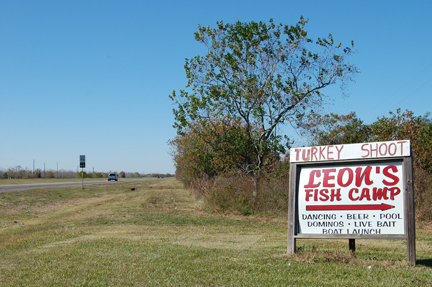
A sign told us about Leon’s Fish Camp. But we knew there had to be more to the story.

What we found was a beautiful bayou and friendly people who waved and smiled at us.

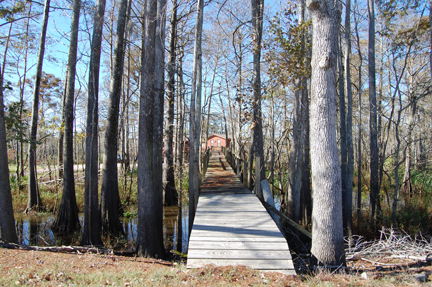
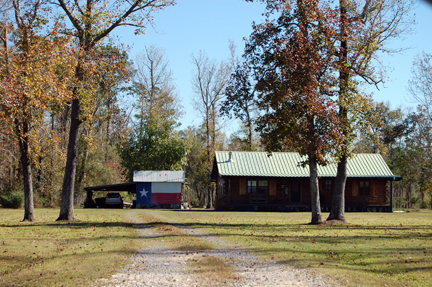
Because of the flooding that hurricane season inevitably brings, the houses are on stilts and many are connected to Boondocks Road by bridges.

The extreme weather of East Texas will most certainly put the fear of G-d in you.

Of course, everywhere you go in Texas, folks are proud of their state.

Until recently, as I discovered this morning on the internets, Boondocks Road was called Jap Road. The road had been named to honor early-twentieth century Japanese settlers who had taught their neighbors how to farm rice on the bayou. Today, rice is the predominant agricultural crop of this area. The locals greatly appreciated and recognized Yoshio Mayumi for what he had done for their community. But he and his family were forced to leave between the two world wars when the U.S. government forbade foreigners from owning land in our country (the 1924 Immigration Act; sound familiar?). Jap was not a racial slur at the time and was a commonly accepted abbreviation for Japanese (the historical entries in the Oxford English Dictionary provide hard evidence of this). In 2004, after more than ten years of lobbying, local activists were successful in their campaign to rename the road. The road’s residents chose Boondocks, after a catfish restaurant that had once operated there. (You can find all of this in the Wiki entry, including references to articles in the Christian Science Monitor and on the CNN website.)

Another hour down the highway of life, Tracie P had lox and latkes and I had white fish salad at our favorite Houston deli, Ziggy’s. Cousins Joanne and Marty and Aunt Holly and uncle Terry and cousin Grant joined. The white fish was delicious.

I’m glad they changed the name of Jap Road. But I wish they would have renamed it Mayumi Road, to remember the farm and the people that reshaped the agricultural landscape of East Texas in a more innocent and more earnest time.

But, then again, if it weren’t called Boondocks Road, we probably wouldn’t have felt the irresistible urge to go down it.

BTW, with this post, I’ve added a new category to Do Bianchi: de rebus texanis. Buona domenica ya’ll!

Cajun cooking at Larry’s French Market, Port Arthur, Texas

Texas isn’t just one state, really. It’s actually five states. As Rev. B (above) pointed out last night, the drive from San Diego to El Paso (on the western edge of Texas) is shorter than the drive from El Paso to Orange, where Tracie P grew up, along the Louisiana border.

While folks in El Paso may feel more of a connection with the west and the culture and cuisine of Mexico, folks here feel a kinship to the Cajun culture of the bordering state to the east and they often refer to this area as “Coonass country” (a designation not considered derogatory when self-referential).

Last night I had the great fortune to dine at Larry’s French Market in Groves, Texas, not far from Port Arthur. Uncle Tim, the family’s resident gourmet and gourmand, who works at the Total refinery across the road, eats there every day.

Rev. B had the “Captain’s Platter” (above), reminding me of what famous guitarist Jay Leach once told one of my bandmates in a recording session in L.A. many years ago, “Play a high C over a C major 7? Man, that’s a captain’s platter!” (meaning the musical phrase would teem with clams or mistakes).

That’s a fried bun atop a heap of fried crabs (female), crawfish, shrimp, oysters, and French fries.

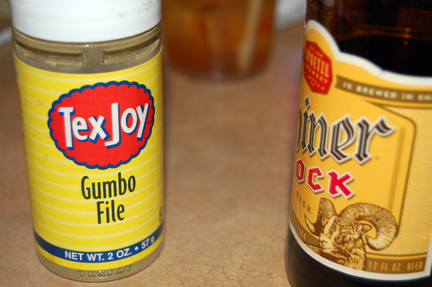
Did you know that the Oxford English Dictionary quotes Hank Williams in the entry for filé (ground sassafras used to season gumbo)?

    1952 H. WILLIAMS Jambalaya (sheet music) 3 Jambalaya and a craw-fish pie and fillet gumbo, ‘Cause tonight I’m gonna see my ma cher amio.

Pretty cool, huh? (The OED contains an entry for Coonass as well, btw.)

I had the oyster poboy. Man, that was good! (BrooklynGuy, do you now see the error of your ways and know why you MUST come visit us in Texas???!!!)

I did, however, overdo it a bit with the hot sauce. It was delicious though. And I’ve learned my lesson… Rev. B will probably be teasing me for years about how my face turned red as the sweat rolled down my cheeks!

Enjoy the rest of the holiday weekend and travel safely!