08 Cos Nero di Lupo: o my UNBELIEVABLE Nero d’Avola! (no one night stand)

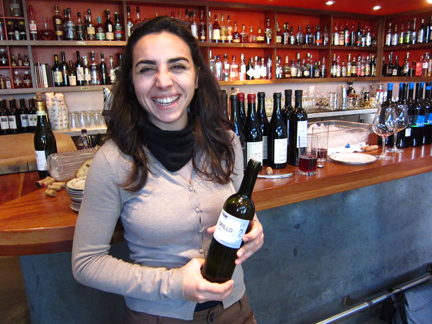
In Los Angeles this week for a series of business meetings for a new and thrilling restaurant project (more on that later) and a working dinner with one of NN+’s (my band’s) agents… and NO trip to LA is complete without a visit to the BEST WINE BAR on the planet (IMHO): Lou on Vine (with AW, of course).

As always, Lou poured an incredible flight of wines for our tavolata… but the wine that simply annihilated me with its goodness was the 2008 Nero d’Avola “Nero di Lupo” (a toponymic designation), vinified in amphora and cement… and, in this case, open from the day before !!!… think blood sausage and sour cherries and volcanic rock in a glass… unbelievable wine… So fresh, so focused, and so beautiful in the glass… Highly, highly recommended and even better, Lou said, the day after… This is definitely a wine that “you call the next day, no one night stand…”

Lou is predominantly Francophile but Italy — and southern Italy in particular — is his mistress… We also drank…

So young but showing so gorgeously right now…

Can you hear the Stevie Wonder in your head?

And though you don’t believe that they do
They do come true
For did my dreams
Come true when I looked at you
And maybe too, if you would believe
You too might be
Overnoyed, over loved, over me

(How’s that for a pun, Thor?)

Lou called it “a little farty” at first and didn’t pour it until it had aerated for about an hour. It’s so hard to find Overnoy in this country and I was thrilled to get to taste the 07 (which we drank at the end of flight… a perfect closer…). I love the mouthfeel of these wines (at once light and heavy), with that nutty oxidative note balanced by apricot and honey… utterly delicious…

Rebbe Lou presides over what is IMHO the best wine program in the country. Perhaps a little radical for some but always right for me: thrilling, delicious, and always something I haven’t tried yet… If only we could clone Lou and have him open a Lou on Vine in every major American city… we’d have a brighter and stronger next generation of young wine professionals…

Why does In-N-Out Burger taste so good when you’re depressed? (And please be nice to government workers.)

Missing Tracie P terribly and feeling down-in-the-dumps after discovering a boneheaded clerical error was going to cost me a pretty penny, I tumbled headfirst into the darkest depths of gastronomic moral nihilism and ate at one of California’s landmark In-N-Out Burgers. There’s no excuse for this aberration and abjuration of my culinary ethics. Even though folks often say that In-N-Out is the “less bad” of the fastfood franchies, it’s still junk food and it’s still bad for you. But, man, like a junkie putting that needle back into his arm, the first bite of that Double Double brought with it refuge and solace from my pain — however short-lived, false, and futile.

In the end Tracie P cheered me up with a phone call and the SUPER nice lady at above-mentioned government office emailed to say that she had managed to clear up the whole issue and that my penalty would be refunded.

We’ve all read about it in the news: government employees are under so much stress these days and who can blame them for not having a great day. In the midst of a budget crisis, California state employees are no stranger to the stresses of the current economic climate. I was very lucky to find a generous person who gave my case some extra attention and resolve my issue.

So please remember to be nice to our public servants. They deserve our support — now more than ever.

Vini Veri and VinNatur 2011 fair dates (public service announcement)

Above: Last year’s Vini Veri producers.

I’m still undecided as to whether or not I’ll be attending this year’s “Natural” and “Real” wine fairs but the lineup for both is always a who’s who of my favorite Italian producers.

Vini Veri will be held this year on April 7-9 at La Fabbrica AreaExp in Cerea (near Verona).

Here’s the link to the fair’s post (not exactly user-friendly for those of us among us who are not Italophiles).

Here’s a link with tasting details in English (thanks Marisa!).

VinNatur will be held April 10-11 at the Villa Favorita near Vicenza. Here’s the link, including ticket and location info (great site with excellent translations for the solely Anglophone among us). Hopefully my friend Ruggero Robin will be playing!

Good things I ate in San Diego

The campechana (marinated seafood salad, with octopus, squid, shrimp, et alia) was off-the-charts good at Bay Park Fish Co. in Mission Bay, San Diego.

So were the grilled halibut fish tacos. Seafood in San Diego ROCKS!

Couldn’t resist the new tortilla soup at Jaynes Gastropub, where I caught up with the crew and drank some killer wines. The crumbled queso fresco and spritz of lime took it over the top… Highly recommended…

Almost sunset from mama Judy’s window, looking out toward the La Jolla Children’s Pool

Tasted any Ramandolo lately?

Northeastern Italy’s rich tradition of dried-grape wines stretches back to the height of the Roman empire, when the acinaticum of today’s Soave, Gambellara, and Valpolicella reigned as one of Western Civilization’s earliest “celebrity” wines.

With all of today’s talk of and favor curried by so-called Natural wines and their “back-to-our-heritage” ethos, we often forget that the earliest paleo-European wines to emerge with celebrity cache were among the most manipulated of that era. The purposeful desiccation of fruit intended to obtain a more concentrated wine with higher alcohol content and greater levels of residual sugar cannot avoid (however obliquely) reminding the informed observer of the “dropped fruit” and “hang time” employed by the Californian chemists who produce Ovaltine-inspired grape-flavored beverages with 17+% alcohol.

The roughly two dozen (yes, that’s it, count ’em) producers of Ramandolo cannot trace their roots back to Roman times but they can point to documents scribed in the high middle ages when their sweet, dense wines were coveted and praised by at least one Roman Pope (Gregory XII). Centuries before the villages of Cialla and Corna di Rosazzo would earn their fame for the production of fine white wine, Ramandolo (which only recently joined the Colli Orientali del Friuli consortium) was renowned for its unique confluence of warm maritime ventilation, a natural shield from inclement weather (the Alps), chilly winters that naturally and gently stabilized the wine, and a sturdy and industrious townsfolk who express the hardships of mountain living in perseverance and patient enology.

On the last day of our Colli Orientali del Friuli blogger project, we traveled to the appellation of Ramandolo (in the northernmost, isolated subzone of the appellation) and got to taste 12 wines by 12 producers (roughly half of the entire body of wineries), all wines I had never tasted before, of which none (to my knowledge) has representation in the U.S. market.

Production levels are extremely small here. Eyeballing the anecdotal figures given to us, the average surface area planted to Verduzzo (the main grape variety) per winery is 4-5 hectares, with most weighing in with 1-2 hectares.

What sets these wines apart from their relatives in the Veneto (or their very distant relatives in Tuscany) is the fact that Verduzzo is an intensely and uniquely tannic white grape. While the majority of labels we tasted that day were dominated by invasive toasty oak (imparted from barrique aging), the best wines allowed the bitterness of the tannins and the sweetness of the residual sugar to play a gorgeous counterpoint harmony in the glass. Where I often find even some of the best dried-grape Moscato to be one-dimensional (think Sicily, think Piedmont), these wines — when done right — show depth and seductive character.

My favorites of the 12 wines tasted were Daniele Gervasi (my top wine), Maurizio Zaccomer, and Andrea Comelli, who also tasted us on an experimental botrytized Ramandolo (in one instance accidental and in another induced by wetting the grapes and covering with cellophane).

Like Rumpelstiltskin, the producers of Ramandolo seem to have awaken only recently to discover that the globalization of wine and globalized tastes might afford them a space in the market to sell their wonderful wines for the high prices they demand. They’ve got a long way to go but our experience on the ground there seemed to indicate that they are working together toward a shared goal of launching the Ramandolo “brand” on the international market. With such small production and such a tightly knit small community of winemakers, their solidarity is surely the only path toward that objective. I hope they make it because the wines can be stunning.

Tasted any great Ramandolo lately? I have…

Tracie P’s amazing pot stickers

Anyone who has had the good fortune to dine in the home of Michele and Charles Scicolone has heard the ritornello before.

“I am truly blessed,” says Charles when asked what it is like to live with one of the first ladies of Italian cuisine in the U.S. today, author and Italian food authority, the lovely Michele, one of the best cooks I’ve ever met.

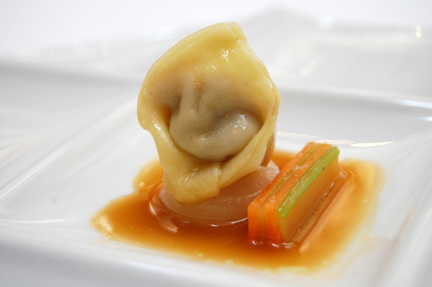
I couldn’t help but borrow Charles’s mantra last night at dinner, when I tasted Tracie P’s pot stickers, stuffed with minced pork, scallions, garlic, ginger, sesame oil, and Napa cabbage.

They were unbelievably delicious… The dough was light in body but rich in flavor (imparted from the filling) and the filling maintained its integrity and cohesive texture when you bit into the dumplings after dunking in the soy sauce, rice vinegar, and sugar dipping sauce.

It’s been so great to relax at home with my beloved Tracie P… sitting around in our PJs until noon, cooking, and eating… and just hanging out… I love her so much and she’s SO good to me…

Lot’s more to say about the last Italy trip, with many more posts to follow… but for the time being, I just want to relive those pot stickers and a bottle of Taittinger NV La Francaise one more time… aaaaaaa…

A Puritanical Italy: has it come to this?

Above: On our last trip to Italy, this image — a winemaker’s daughter chasing a cat through a field — fascinated me. The cat, hoping to receive a treat, wouldn’t let the girl pick it up. But it never strayed farther than arm’s reach. She was a Pasolinian allegory of purity and innocence, the cat her serpent leading her to edge of the field where she would ultimately move beyond the farm’s borders toward the impurity of urban living and the pressures of modern society.

When we travel to Italy, Tracie P and I are very fortunate to find a host of characters gladful to share the flavors and aromas of the garden of Europe, the fair country, ancient Enotria and Esperya — the land of the setting sun, as the Greeks called it, the “Evening Land.” Blessed with a mastery of the language and endowed with years of experience there, we move seamlessly from the quartermaster of Marco Polo to the trinciante — the carver — of the osteria whom we bribe with veteran smiles and harmless guile, blank verse and syncopated song.

Don’t get me wrong: although we thoroughly enjoy every moment of it, those of you who follow (and have followed recently) along here on the blog know that we are keenly and acutely aware of how food and wine as text — as discourse — are just one red thread interwoven into the fabric of this ancient and fascinating nation.

Above: Most middle-class families by their daily wine at supermarkets or at dispensaries like this one in Favaro Veneto in the terra firma of Venice.

However joy-filled and wondrous our trips seem, we never lose touch with the challenges and ills that Italians and Europeans face every day, particularly in a world where the Italian state provides less and less for the middle-class Italian, while placing more and more pressures on her/him in finding and practicing civic and national pride and ownership.

I’m deeply saddened to report (for those of you who haven’t followed the meager coverage by The New York Times) that Italian society is on the cusp of a startlingly profound peripeteia. In bizarre twist of cultural roles, Italian prosecutors are on the verge of taking down Dr. Evil himself, Silvio Berlusconi… but not by means of legal action addressing his self-serving mediatic tyranny and corruption… He will be taken out, instead, through the application of a puritanical denouement.

In early April (it was announced while I was still there last week), he will be tried for paying a minor for sex.

Above: My last night in Italy, this time around, I shared a pizza and a beer with a colleague and friend (who happens to be a Berlusconi supporter). The pizza was decent but forgettable. Sometimes a pizza is just pizza.

Prostitution is legal in Italy, although organized prostitution is not. And even though the legal age of consent there is 14 years of age, it is illegal to pay for sex with a minor (under 18 years of age).

Believe me: although I am not Italian and have no civic stake in Italian society other than my personal interest in Italy and the many friends I have there, I am thrilled to see Berlusconi go (and I sincerely hope this is the final nail in his political coffin). His racist remarks about Obama or his belief that “Mussolini didn’t send anyone to concentration camps… he just sent them on vacation” provide ample reason to despise him. But the manufactured consent he has generated through his control of television and newspapers, orchestrated solely in the view of his open desire to become richer through the manipulation of Italian legislation (he stated so very clearly in a now infamous interview with historian Enzo Biagi, Italy’s Walter Cronkite), offer us indisputable evidence of what a menace he is to Italian, European, and Western Civilization. Good riddance, I say.

Above: Tracie P and I use all kind of electronic media to communicate when we’re in Italy but we still love postcards.

“Since when did the Italians become puritanical?” That’s what my bandmate Verena asked rhetorically in an email thread the other day. In fact, as Verena knows well, the Italians haven’t become puritanical. Indeed, one of the things I love and cherish about Italy is the fact one is not constrained by the yoke of bourgeois and Victorian attitudes there.

But it has come to this: short of taking to the streets and squares the way the Egyptians have done, Italy must resort to a Republican-inspired puritanical Bill Clinton-era tactic to oust the country richest and most despicable man from its most powerful office.

Above: If you look carefully at the wrought-iron adornment of this well (near Buttrio in Friuli), you’ll see that it is made of grape bunches, leaves, and tendrils.

I hope and pray that gourmets and gourmands of English-language literature will appreciate the allusion with which I have chosen as congedo of this post, a few lines culled from D.H. Lawrence’s poem, “Grapes.”

Buona lettura, everyone, and buona domenica. Thanks for reading…


But long ago, oh, long ago
Before the rose began to simper supreme,
Before the rose of all roses, rose of the all the world, was even in bud,
Before the glaciers were gathered up in a bunch out of the unsettled seas and winds
Or else before they had been let down again, in Noah’s flood,
There was another world, a dusky, flowerless, tendrilled world
And creatures webbed and marshy,
And on the margin, men soft-footed and pristine,
Still, and sensitive, and active,
Audile, tactile sensitiveness as of a tendril which orientates and reaches out,
Reaching out and grasping by an instinct more delicate than the moon’s as she feels for the tides.

Of which world, the vine was the invisible rose,
Before petals spread before colour made its disturbance, before eyes saw too much.

Dusky are the avenues of wine,
And we must cross the frontiers, though we will not,
Of the lost, fern-scented world:
Take the fern-seed on our lips,
Close the eyes, and go
Down the tendrilled avenues of wine and the other world.

Bombe glacé and 2006 Brunello on my mind…

Just had to share this image of an incredible bombe glacé, captured last night at Tony’s in Houston where I had dinner with a colleague, newfound friend and fellow Italophile.

In other news…

Franco’s first impressions from Benvenuto Brunello, fresh off the presses and translated by yours truly…

The Ronco del Gnemiz Six-Pack is LIVE! Friulian food NOT INCLUDED

The Ronco del Gnemiz Six-Pack is officially LIVE over at 2Bianchi.com, Do Bianchi Wine Selections… if you live in California and would like to taste a little bit of the Colli Orientali del Friuli (the eastern hills of Friuli), I’ll be delivering the wines and shipping on Tuesday… Check it out here.

I can get you the wines but unfortunately I can’t deliver the classic Friulian meal to go along with it. That’s soft (as opposed to crunchy) frico above: aged and fresh Montasio cheese with potatoes fried in a pie.

Grilled white corn polenta.

Fresh Montasio and salame, ossocollo, pancetta, and Prosciutto di San Daniele.

Brovada, turnips fermented and braised in red wine.

The Babbo effect and a visit to the Bastianich winery in Colli Orientali del Friuli

Above: My friend Wayne Young, whom I met in 1998 in New York when he had already been working within the then-expanding Bastianich empire for three years. In the photo, Wayne is standing atop the amphitheater growing site where the top wines for the Bastianich winery are grown in the Colli Orientali del Friuli.

Babbo changed everything. It was “a fine-dining Italian à la carte restaurant below 14th St.,” as Joe Bastianich put it when I first met him in 1998 (when I was working as an editor at La Cucina Italiana in the City).

Ruth Reichl’s watershed New York Times review of the place in April 1998, “A Radical Departure with Sure Footing,” marked a point of no return for pseudo-Italian restaurateurship in the U.S.

I remember that Wednesday in August 1998 well: it was the day that Italian gastronomic irony died and the newly minted craze of Italian regional cuisine took firm hold in North America. Whether you liked Babbo or not (and who didn’t want to get a table at Babbo?), from that day forward, if you cooked Italian food in the U.S., you had to do it earnestly: your food was only as good as the authenticity that stood behind it.

Above: Alfonso tasting with the COF2011 blogger team and winemaker Emilio del Medico and winery GM Dennis Lepore.

Wayne Young and I first met back in those heady days of New York’s Italian food scene. We all knew a revolution was taking place even though, from the eye of the storm, we didn’t realize its portent. Today, Wayne — who has worked as a sommelier at Bastianich outposts Becco and Babbo — serves as the Bastianich winery’s “special ops” man on the ground in the Colli Orientali del Friuli (the blogger project there was his idea). He is involved in every aspect of the operation, from winemaking (a wasp in his pants is what gave him the idea to call the winery’s flagship white “Vespa”!) to sales (ask him what it’s like to sell wine in Serbia!) and marketing (he is the only Friulian winemaker to author a winery blog).

Wayne is a remarkable man, with great generosity of heart and a warm gentleness. I’ve never heard him say a nasty word about anyone and I admire him for the way he lives his life perfectly integrated into Friulian society where he is welcomed and beloved by all we met. Despite his nordic locks, everyone calls him “a local” up there in northeasternmost Italy.

Above: In our tasting last week at the winery, my favorite wine was the 2009 Sauvignon Bianco. Fresh and clean, with balanced aromatic character and that bright acidity that I want (and need), it should retail for under $20 in the U.S. The Bastianich Sauvignon has a screw cap, a feature that allows the winemaker to add a smaller amount of sulfite to the wine, because the screw cap allows less oxidation (where a cork, an organic substance, would allow more).

Like Wayne, the Bastianich family has been welcomed in the Colli Orientali del Friuli as winemakers. President of the COF consortium Pierluigi Comelli told us the story of how Joe and mother Lidia came to him asking for advice on where to buy property and set up their facility. Ultimately, on his advice, they revived a winery that had abandoned after the owner’s untimely passing. And they bought uncultivated growing sites where they cleared the woods themselves to make way for vineyards. After a week in the COF, I had a clear sense that winemakers there appreciate the expanded exposure and bandwidth that the Bastianich brand brings with it. “Everyone rises with the tide” seemed to be the consensus.

Above: On Friday evening, the last of our trip in the COF, we took time out to celebrate with a beer in Cividale del Friuli. You can’t really help but smile when you’re around Wayne — it’s contagious. That’s Nicolas, David, and Alfonso to the right.

Spending the week tasting and comparing notes with Wayne (who, as a local winemaker, shared a lot of interesting insights with the group), I couldn’t help but think back to 1998, when we first met and none of us really understood what was about to happen. As Eric the Red recently pointed out to me, it was a time of Italian gastronomic “innocence” (it is Eric whom Mario Batali’s father Armandino credits for having “discovered” his son’s talent in 1993).

I’m glad to know that the fame and the celebrity hasn’t changed my old friend Wayne.