Will another earthquake dim hopes of a renaissance for Abruzzo winemakers?

pizza_beer

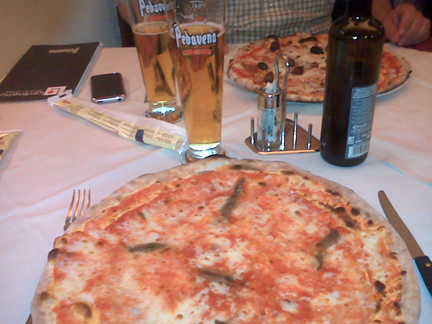
Above: Pizza romana and BEER last night at Il Giardinetto in Marghera (Venice), Italy.

When I came downstairs to the lobby of the crusty and salty 3-star hotel in the Venetian port city of Marghera, where I spent the last night of my Italy stay, I was greeted by the news that another earthquake had struck Abruzzo — 5.2 on the Richter Scale. I haven’t been able to get online with much success (and I am posting today from the Amsterdam airport where I have a short layover before a flight to Houston) but I was able to read Eric’s excellent post (using my blackberry) on the impact the earthquakes will have on Abruzzo winemaking.

To some, it could seem shallow to think about winemaking at a time like this but it’s not. Unlike the majority of Americans, Italians drink wine every day and the wine industry there is not an elitist industry that caters primarily to the affluent (as it does in the U.S. where wine is considered a luxury product, marketed to and consumed primarily by the wealthy). In a region like Abruzzo — one of the more economically depressed among Italy’s 20 regions — the wine industry is the life blood for a sizable amount of the population (including the retail, restaurant, and transport sectors).

The larger and more well-established wineries like Illuminati and Cataldi Madonna will certainly weather the current crisis and their wines will continue to represent some of the best values for quality both domestically and abroad. But it now seems likely (especially considering the current economic climate) that many of the smaller wineries will be forced to shutter their cellar doors. I regret to think that a much-anticipated and hoped-for renaissance in Abruzzo winemaking will not happen in this generation.

The tragedy in Abruzzo

My heart goes out to the victims of Monday morning’s earthquake — all the folks who have lost loved ones and their homes in Abruzzo. According to reports published this morning, more than 150 persons have lost their lives, more than 1,500 have been injured, and more than 17,000 are now homeless.

Today, I’m in Trento, in the far north of Italy, and I was in Verona, asleep, when the earthquake hit at about 3:30 in the morning on Monday, with a magnitude of 6.2 on the Richter Scale (you couldn’t feel it where I was). These are the towns and villages that have been affected: L’Aquila, Santo Stefano di Sessanio, Castelvecchio Calvisio, San Pio, Villa Sant’Angelo, Fossa, Ocre, San Demetrio ne Vestini, and villages in Altopiano delle Rocche.

Evidently, there were smaller tremors the night before, at around 10 p.m., near Florence and Forlì.

Abruzzo is a place of immense natural beauty and it produces fantastic wines. On Sunday afternoon, at the fair in Verona, I tasted with Abruzzo producers Daniela and Sofia Pepe and their father Emidio (of the Emidio Pepe winery) and Stefano Illuminati of the Illuminati family and eponymous winery.

In 1994, I was a graduate student at U.C.L.A. and I lived in West Hollywood on Larabee St. when a big earthquake hit at around 4:30 in the morning. I have never been so scared in my life.

Thank you to everyone who wrote, texted, and posted on my Facebook asking if I was OK. I am.

My heart goes out to all the folks who are suffering.

No vote on proposed Montalcino DOC

Above: I’ve tasted Il Poggione Brunello di Montalcino and Rosso di Montalcino going back to the 1970s. One of the greatest expressions of Sangiovese I’ve ever tasted was the 1979 Rosso (bottled before the existence of the Rosso di Montalcino DOC and labeled as “Rosso” from “Brunello vines”), which Alessandro Bindocci’s father Fabrizio shared with me last year over steak dinner at Keens in Manhattan.

My friend Alessandro Bindocci, son of Il Poggione winemaker Fabrizio Bindocci, posted today on the proposed creation of a Montalcino DOC: evidently, the vote was put to the floor but no vote was held. Read more here…

I’ll be tasting with Alessandro and his father later this week at Vinitaly.

On the eve of Vinitaly, a push to create a Montalcino DOC (and reflections on a year past)

Above: Franco Ziliani (left), my friend and co-editor of VinoWire, and Mauro Mascarello, winemaker and producer of one of the greatest expressions of Nebbiolo, Giuseppe Mascarello Barolo. We tasted at Vinitaly last year together. This year, Franco and I will be tasting together at Vini Veri.

Passover and Easter will shortly be upon us and the who’s who of Italian wine is preparing to descend on the province of Verona for our industry’s annual trade fairs: Vinitaly (the largest and most commercial), Vini Veri (a gathering of natural winemakers and the most interesting in my opinion), and VinNatur (an assembly of winemakers who broke away from Vini Veri some years back). I’m particularly excited for Vini Veri because this year’s tasting sees the unification of Vini Veri with the Nicolas Joly biodynamic and quasi-biodynamic tastings, Triple A and Renaissance du Terroir (Return to Terroir).

Above: The Banfi Castle at last year’s Vinitaly. There were rumors — unfounded and untrue — that Banfi’s wines were seized on the floor of the fair last year. I am looking forward to tasting the 2004 Brunello di Montalcino by Banfi. Charles Scicolone and Tom Hyland — whose palates I respect greatly — have both told me that it’s classic Brunello, 100% Sangiovese, and one of the best wines Banfi has ever produced.

It’s remarkable to think that at this time last year, the world of Italian wine was gripped by the breaking news of the Brunello scandal: at least five major producers were accused of adulterating their wines from the 2003 vintage. A year has passed, a large quantity of wine has reportedly been declassified, and no indictments have been issued by the Siena prosecutor who supposedly launched the investigation in September of 2007.

It’s not surprising, however, that there has been a new push — albeit weak — within the association of Brunello producers to create a Montalcino DOC. Last week, a proposal to create such an appellation was put to the floor at the consortium’s assembly. (I haven’t been able to find out the results of the vote but according to most observers, it was unlikely that it would be ratified.)

Above: I am always geeked to taste Paolo Bea Sagrantino with Giampiero Bea at Vini Veri (I snapped this photo at last year’s fair). Tracie B and I have been enjoying his Santa Chiara 2006. It’s radically different than his 2005 and I hope to ask him about the vintage variation. (Is it the result of climatic differences or differences in the cellar? I imagine — knowing Giampiero and his radical belief in natural winemaking — that the former is the case.)

Currently, Montalcino producers must label their wines as Toscana IGT or Sant’Antimo DOC if they contain grapes other than Sangiovese. If approved, a Montalcino DOC would allow them to exploit the Montalcino “brand” in their labeling of so-called Super Tuscan wines. The proposed DOC is part of a greater push to create new Italian appellations before OCM reforms take effect in August 2009 and the power to issue new DOCs shifts from Rome to Brussels.

Above: This year, the world of Italian wine mourns the loss of Teobaldo Cappellano (photo courtesy of Polaner). Baldo, as he was known fondly, was one of the founders of the Vini Veri movement and one of Italy’s most zealous defenders and promoters of terroir-driven wines and natural winemaking. He was a truly delightful man and is sorely missed.

There’s a reason why the fairs are held at this time of year: historically and traditionally, the spring marks the moment when winemakers unveil their cellared wines. Long before the hegemony of the Judeo-Christian canon, spring was observed as Mother Nature’s moment of renewal and rebirth.

The ancient allegory — and it is an allegory, not a metaphor — could not be more apt this year.

Memorial to Baldo Cappellano

Franco and I have posted this memorial to beloved winemaker, activist, and Barolo producer Baldo Cappellano (1944-2009) at VinoWire.

Oops I did it again: pizza and Bertani 1988 Amarone!

Oh baby
It might seem like a crush
But it doesn’t mean that I’m serious
‘Cause to lose all my senses
That is just so typically me
Oh baby, baby

Above: Charles Scicolone can often be found at La Pizza Fresca in Gramercy (Manhattan), where they allow wine luminaries to bring their own bottles. The list there leans heavily toward modern and the prices are prohibitive. The pizza is good (although not as good as the pizza I recently tasted in San Antonio! I’ll be posting on that shortly so stay tuned).

Franco is going to kill me. I did it again: while Tracie B and I were in Manhattan for the last show in the NN+ tourette a few weeks ago, I paired pizza with an absolutely, undeniably, unquestionably, and egregiously inappropriate wine.

Two inappropriate wines, actually: Bertani 1988 (yes, 88!) Amarone and Cantalupo 1996 Ghemme Collis Breclemae (above).

One of the most important things I learned in college (and one of my favorite mottoes) was “This statement is false.” (It is a classic example of the Russel paradox. The other important thing I learned was that no movie is set in the future: “If the story has been told,” film professor Tinazzi used to say in Padua, “then it has already happened.”)

Above: Charles always orders the Margherita but I am always partial to the Puttanesca there. I never ate anchovies on my pizza until a pizzaiolo wrote the name of my band using anchovies on a pizza many years ago when I was on a summer tour in the Dolomites playing cover tunes (yes, I toured in a cover band in Italy). Evidently, Elvis Presley used to eat salt-cured anchovy fillets to soothe his throat while on tour.

What bearing does the above have on the present post, you ask? In the wake of the brouhaha that followed Dr. V’s post in which he quoted me as saying pizza could not be paired with wine, and my subsequent apologia pasoliniana, I feel compelled to confess that what I did was wrong: one should never pair two such elegant wines with the acidity and saltiness, not to mention the high temperatures, of pizza. At the same time, and here’s where the paradox kicks in, the experience was decadent, sumptuous, utterly delicious, and thoroughly enjoyable.

Above: Tracie B had a pizza bianca with broccoli raab. Also in attendance were friends Frank Butler (who generously brought the Bertani) and Michele Scicolone, who recently launched her excellent blog (definitely worth adding to your feed if only for the recipes that she shares). Charles has also become an avid blogger and I’ve been enjoying his blog and Facebook as well.

Charles’s 1996 Ghemme was earthy and had a crazy eucalyptus note, still very powerful and young, an amazing expression of Nebbiolo (and very definitely Piedmontese despite what Henri Vasnier said the other day on Brooklynguy’s blog). I’ve tasted this wine a number of times over the years and it is just beginning to come into its own.

The 1988 Bertani was sublime: a great vintage by one of the appellation’s greatest producers, very traditional in style, powerful and rich, yet already attaining the ineffable lightness that Amarone begins to achieve in its late adolescence.

Were these wines wasted by a paradoxical pairing? In other words, did we ruin the wines by pairing them with foods that detracted from their aromas and flavors? My feeling is that no, we did not: we experienced them in a new and different way than their traditional pairings. After all, the traditional pairing for an Amarone like that is pastissada de caval, horse meat stewed until stringy in red wine. Where would one find a horse to eat in Manhattan?

Oops, I did it again… Thanks Frank and Charles for bringing such incredible wines!

In other news…

If you’re into Loire and Chenin Blanc, check out Tracie B’s post on our visit to Chaume and her take on Chaume vs. Sauternes.

Memories of Baldo Cappellano

Above: Teobaldo Cappellano in his cellar (photo courtesy of Polaner).

I met Teobaldo Cappellano on a number of occasions and enjoyed his wines immensely. He was a staunch, vocal defender of traditional winemaking and his Barolo was aged in large, old-oak casks. He fought tirelessly against the homogenization and over-commercialization of wine and was a steadfast opponent of the use of international grape varieties in Italian wine. His uncle, a pharmacist, was the creator Barolo Chinato, and Cappellano’s chinato was widely considered the best. It was a treat to get to taste with him over the last few years at Vini Veri and I felt honored to report on his contribution to the Brunello Debate in October 2008. If you speak Italian (and even if you don’t), I encourage you to watch the archived stream of the debate at Franco’s blog (just visit the blog and you’ll find it embedded to the right). His cadenced authority is matched only by his emboldened passion.

In his post today at Vocativo, Luigi Metropoli reminded us of Baldo’s motto: io evolvo all’indietro, “I evolve backwards.”

The world of wine has lost one of its great rabbis — if not the greatest.

Today, the blogosphere is flooded with tributes and memories of Baldo, as he was known. I’ve collected and translated some passages below.

The world of wine — and not just Piedmontese wine and not just the Barolo and Langa community (which he represented with authority) — is in mourning today for the sudden and cruel passing of Teobaldo Cappellano. He was a tireless activist and an advocate of lost causes — causes even more worthy for the very fact they were lost — because when you know that you have no chance to prevail, defending your beliefs is even more righteous.
—Franco Ziliani, Vino al Vino

Langa and the entire world of Italian wine are orphans today. Everything will be more complicated now that destiny has shown us high noon.
—Marco Arturi, Porthos

One of those gentle giants, long and weedy, he is winemaker, jokester, philosopher.
—Alice Feiring

The last of the Mohicans.
—Gigi Padovani

Barolo has died.
—Consumazione obbligatoria

Someone like Baldo Cappellano cannot die.
—Divino Scrivere

He was a winemaker philosopher.
—acquablog

In morte di messer Teobaldo Cappellano

The great winemaker Teobaldo Cappellano has died. “Barolo has died,” noted one Italian wine writer today.

Memories of Teobaldo and posts in his honor are flooding the Italian blogosphere as I write this. I’ll post some translations later today. Right now, I’m just overwhelmed by the thought of a world without him.

I could eat a horse (and I did in Legnaro, PD)

From the “keeping it real” department…

Last April, I hooked up with my really good buddy Gabriele “Elvis” Inglesi after Vinitaly for one of our favorite traditions: meeting the “gang” at the horse restaurant. Yes, the horse — equine meat — restaurant. Horse meat is considered a delicacy in the Veneto (where I lived, studied, and played music for many years) and when Gabriele (aka Lelecaster for his mastery of the Telecaster) and I used to tour as a duo there, we would often spend Sunday evening with our friends at one of the many family-friendly horse restaurants in the hills and countryside outside Padua (btw, Padua is English for Padova, like Florence for Firenze, Rome for Roma, Naples for Napoli). That Sunday night, we went to Trattoria Savio (since 1965) in Legnaro.

Here’s what we ate:

Risotto with sfilacci di cavallo. Sfilacci are thinly sliced “threads” of salt-cured, smoked horse thigh.

Griddle-seared horse salami, sfilacci, horse prosciutto, and grilled white polenta.

Pony filet. Very lean (yet tasty), horse meat became popular in Europe in the 1960s when it was promoted (in particular by the French government) as a nutritious and inexpensive alternative to beef. In Verona, pastissada de caval — horse meat, usually the rump, stewed in wine — is the traditional pairing for Recioto and Amarone (check out Franco’s alarming article on Amarone, overcropping, and excessive production in Valpolicella, published in the February issue of Decanter magazine).

At Trattoria Savio, we drank pitchers of white and red wine. I’m not sure but the white tasted like Verduzzo to me, the red was probably stainless-steel Piave Cabernet and Merlot.

Gabriele is one of the meanest chicken pickers I’ve ever heard. Great friend, great times.

Pineapple prohibited: “xenofoodism” in Italy

Above: Self-described “gastronomad” Vittorio Castellani published this vignette today on the Acquabuona blog. He grabbed the cartoon from somewhere on the internet and rewrote the caption: “Now that they have finally closed all those kebab houses, sushi bars, and Indian restaurants, we can start going out to dinner again!” The “Lucca” on the back of the man’s shirt refers to the city in Tuscany, where “ethnic food” was recently prohibited by the local government.

As I sit here translating La cucina veneziana (Venetian Cuisine) for the Oronzo Editions (New York) series of regional Italian cookbooks (to be released this spring), I feel a certain if modest confidence of my status as a purveyor of Italian gastronomic culture. After all, since my early days writing for La cucina italiana, I have been involved in Italian wine and food writing and marketing for more than a decade.

In the light of my interest in (and love and passion for) Italian culinary tradition, I feel duty-bound to share some disconcerting news that arrived today from Italy (ironically, in the same GoogleReader page of feeds informing me that Prime Minister Berlusconi has called Italy’s 1938 adoption of the Race Laws “a deep wound”): according to a report published on Tuesday in the daily La Repubblica, the township of Lucca has officially banned any “ethnic” food vendors from its historic center. The text of the new law, passed by local legislators, is as follows (reported by La Repubblica):

    “In order to safeguard culinary tradition and [Lucca’s] unique architectural, structural, cultural, and historic character and urban design, the commissioning of administrative operations is not allowed when such activities are ascribable to different ethnicities” (translation mine).

Unfortunately, this is not an isolated case of what “gastronomad” Vittorio Castellani has called Italian “xenofoodism” in a comment he left on the newspaper’s website and on the wall of his FB group The Couscous Clan (even though his neologism, etymologically, doesn’t really mean fear of the food of others; it actually means the fetishization of foreign foods, if you read the suffix -ism in the sense that it is used in sexism or racism, “Forming nouns with the sense ‘belief in the superiority of one over another'” [OED Online Edition]; xenophagophobia or xenoanorexia are more apt terms, the latter being particularly fitting in my opinion).

Above: Italy’s agriculture minister Luca Zaia has adopted nationalist and protectionist policies with racist undertones since his installment in April 2008.

In fact, since Berlusconi took office last April and installed Luca Zaia as agriculture minister, the Italian government has adopted an official policy of agricultural protectionism with racist undertones. As Christmas approached last year, Zaia published this astounding declaration of karpophobia in his blog: “Zampone [pig trotter stuffed with head cheese, boiled], cotecchino [pork sausage encased in pork rind, boiled], and lentils will surely not be missing at the Zaia residence! No pineapple, but fruit from our [Italian] farms…”

In November, he asked his readers: “How do you select restaurants for your dinners and lunches? Have you ever visited Chinese restaurants or restaurants with other ethnic origins?” Thirty-one readers responded to this racially charged survey.

Above: Traditional “tramezzini” (literally, “in-betweens”) at Sant’Ambroeus in New York, the North American satellite of the Milanese classic cafè, opened in 1936. I highly recommend it in NYC or Italy.

What business do I have posting my editorial on Italian or even Lucchese “ethnic food” policies? None, aside from my knowledge that Italian cuisine became a universal gastronomic language thanks to its absorption and incorporation of foreign culinary traditions. Dried pasta? From the Arab world (yes, the Arab world). Tomatoes? From the New World. Corn for Zaia’s beloved polenta (I love polenta, too, btw)? From the New World. Stockfish (baccalà)? From Norway.

No polenta e baccalà? I can’t imagine a world without it nor do I know of another country where these two foodstuffs could be brought together so deliciously!

I’ll say no more but leave you with food for thought. At the height of fascism, Italian “purist” linguists created the world tramezzino to purge the Italian language of the English sandwich (used to denote what were called tea sandwiches in Britain). Where would the world be today without the Italians amelioration of English cooking? If only Italian winemakers would develop a fear of foreign grape varieties!

Thank you for reading this far…

*****

Se il mare fosse de tocio
e i monti de polenta
oh mamma che tociade,
polenta e baccalà.
Perché non m’ami più?

If the sea were made of gravy
and the mountains of polenta
oh mama, what sops!
polenta and baccalà.
Why don’t you love me anymore?

— from “La Mula de Parenzo,” traditional folksong of the Veneto and Friuli