Petrarch and the unbearable thought of life without the wines of Burgundy

From the “Sunday poetry” department…

Above: In this Renaissance illuminated manuscript (painted book), Petrarch and Laura appear on the banks of a river. Laura, the river (the Sorgue), and the laurel tree (also depicted) are central to Petrarchan iconography. Petrarch knew the wines of Burgundy well but he liked the wines of Italy better.

Petrarch (1304-1374) knew the wines of Burgundy well. He spent most of his early life in and around Avignon, where his father followed the Babylonian exile of the papal court, and where the wines of the Côte d’Or already enjoyed considerable fame. It wasn’t far from Avignon where he first saw Laura, for whom he would write 366 poems, later gathered in his Rerum vulgarium fragmenta (Fragments of Vernacular Things, the title he gave to his Canzoniere or Song Book). Their first meeting took place in Vaucluse in 1327 (according to his own mythology).

Petrarch spent much of the latter half of his life trying to bring the papacy back to Rome. After one of his appeals to Pope Urban V, some of the cardinals argued that a return to Rome would be unthinkable: how could they survive, they told the pope, without the health-enhancing properties of the wines of Burgundy? Petrarch responded with one of his most famous political letters and a passage, often cited but seldom revisited, in which he chastises the gluttonous cardinals. But in the same stroke, he invites them to experience the wines of Italy:

    Is it not a puerile ambition to malign the many types of wines, so plentiful, found in all parts of Italy? … Let them come and see for themselves — all those for whom life would be unbearable without the wines of Burgundy! They will find copious amounts of grain, olive oil, wines, plants, and fruits. Here there are fruits unfamiliar to you and unknown in your [colder] climate. The woods, beasts, wild animals, game, and food and spices are so abundant that no one dies of hunger…

    Seniles 9, to Pope Urban V, August 1366 (translation adapted from Aldo Bernardo)

In last week’s Sunday poetry post, Petrarch flowed the rivers of the world together in verse. Laura is absent and he longs for the river where she appeared: no other river, he cries, could quench the fire burning in his soul.

In this week’s post, he happens upon Laura by a river, innocently washing her veil. She is more beautiful than the huntress goddess Diana who turned Acteon’s dogs upon him when he happened upon her bathing nude in a river.

Magridal 52 is one of the most exquisite compositions in Petrarch’s Rerum. As summer temperatures rise here in Texas, there is a someone special in my life, too, who can still make me “tremble with a chill of love.”

    Not so much did Diana please her lover when, by a similar
    chance, he saw her all naked amid the icy waters,

    as did the cruel mountain shepherdess please me, set to wash a
    pretty veil that keeps her lovely blond head from the breeze;

    so that she made me, even now when the sky is burning, all
    tremble with a chill of love.

    (translation by Robert Durling)

    Non al suo amante più Diana piacque
    quando per tal ventura tutta ignuda
    la vide in mezzo de le gelide acque,

    ch’a me la pastorella alpestra e cruda
    posta a bagnar un leggiadretto velo
    ch’a l’aura il vago e biondo capel chiuda;

    tal che mi fece, or quand’egli arde’l cielo,
    tutto tremar d’un amoroso gelo.

What would the Iron Baron Ricasoli say if he were alive today?

In a 1989 show entitled Le balene restino sedute (Whales, please stay seated), the Bolognese comedian Alessandro Bergonzoni (left) noted that if Sigmund Freud (center) were alive today, he would say: “Well, I sure have lived for a long time.”

Above: The Sala delle Armi or Armory Hall in the Brolio Castle in the township of Gaiole in the heart of Chianti.

Reading Carlo Macchi’s post about yesterday’s conference on the Ricasoli-Studiati Papers, held at the Ricasoli family’s Castello Brolio in Chianti Classico, I couldn’t help but wonder what would the Iron Baron Bettino Ricasoli (1809-1880, above right) say if he were alive today? Among other significant entries on Italian unification, Italian national identity, and the importance of agriculture and winemaking in the forging of a new Italian nation, the correspondence between Ricasoli — Italy’s second prime minister, one the architects of its independence, and a champion of Sangiovese — and Pisan professor Cesare Studiati contains the famed letter in which the Baron described his experimentation with “every grape variety” in his vineyards and his conclusion that Sangiovese — or Sangioveto, as it was called in Tuscany then — was the ideal grape to grow in Tuscany. (You can read my translation of the letter here.) Many claim erroneously that the Iron Baron wrote a formula or recipe for Chianti. He did not. But when he tore out international grape varieties from this vineyards and replanted with Sangiovese, Canaiolo, and Malvasia, the land holders of Tuscany followed suit. If you read the series of letters between the two men during that period, you will discover that he was trying to create (and he ultimately succeeded in creating) a fine wine that could be shipped abroad. He realized that Italian wine could help to fuel the nascent national economy if and only if it could be shipped abroad. And through his experiments, he discovered that Sangiovese grown on Tuscan soil was ideal for this purpose.

According to Carlo, who attended the event yesterday, the discussion — moderated by megawatt Italian television personality Bruno Vespa — centered around the controversial expansion of the Chianti appellation. Would this have concerned the Iron Baron? Perhaps. But if he were to taste the Chianti produced by the “40 or so winemakers” who attended the celebrity-studded event, what would he say? Would he recognize his beloved Sangiovese in those wines, now dominated by Merlot and Cabernet?

I’ll let you fill in the blank…

Poetry for Sunday: Petrarch’s musical rivers

People seemed to enjoy last week’s Poetry for Sunday so I thought I’d try another one this week…

A quick search online revealed this wonderful gallery at the Beinecke Library (Yale) site. Petrarch’s script inspired a generation of Northern Italian amanuenses and calligraphers who developed what would later be called “humanist script.” The inscription at the top of the folio reads: “Here happily begin the songs in verse in elegy of Laura by the illustrious poet Francis Petrarch.”

When I lived in Italy in the 1990s as a graduate student, I had the great fortune to meet a number of twentieth-century Italian poets, including Giovanna Sandri, whose poetry I translated for a collection of modern poetry published by my dissertation adviser. One day, when I was doing research for my dissertation at the Vatican library, she invited me over for a lunch of rice and baby shrimp — “translation and risotto di gamberetti” she wrote playfully in a dedication she signed in a copy of one of her books that she gave to me. Her primary literary interest was the group of Roman poets and the Gruppo 63 poets among whom she had come of age literarily and literally. But when she asked me about my studies devoted to Petrarch (Francesco Petrarca, fourteenth-century Italian poet and humanist) she fondly remembered her favorite sonnet. She loved the way that Petrarch ingeniously listed the great rivers of the world in meter (in this case, rhymed hendecasyllables — eleven-syllable lines, the classic meter of Italian medieval lyric).

The following is Robert Durling’s translation of the sonnet and the original Italian. Even if you don’t read Italian, try reading the lines out loud to hear the music of Petrarch’s verse.

The tree in the poem is central to the body of poetry and the new poetical language that Petrarch created for his beloved Laura: the laurel tree (do you hear the paronomasia between Laura and lauro or laurel?), the tree so dear to Apollo the god of music and poetry (among other things) because his beloved Daphne had been transformed into a laurel tree so she could escape his amorous advances.

    Not Tesino, Po, Varo, Arno, Adige, or Tiber, Euphrates, Tigris, Nile, Hermus, Indus or Ganges, Don, Danube, Alpheus, Garonne, the sea-breaker Timavus, Rhône, Ebro, Rhine, Seine, Elbe, Loire, or Hebrus —

    not ivy, fir, pine, beech, or juniper — could lessen the fire that wearies my sad heart as much as a lovely stream that from time to time weeps along with me, and the slender tree that in my rhymes I beautify and celebrate.

    I find this a help amid the assaults of Love, where I must live out in armor my life that goes by with such great leaps.

    Then let this lovely laurel grow on the fresh bank; and he who planted it, let him — in its sweet shade, to the sound of the waters — write high and happy thoughts!

    Non Tesin, Po, Varo, Arno, Adige e Tebro
    Eufrate, Tigre, Nilo, Ermo, Indo et Gange,
    Tana, Istro, Alfeo, Garona, e’l mar che frange,
    Rodano, Ibero, Ren, Sena, Albia, Era, Ebro —

    non edra, abete, pin, faggio o genebro —
    poria ‘l foco allentar che’l cor tristo ange
    quant’un bel rio ch’ad ogni or meco piange
    co l’arboscel che’in rime orno e celebro

    Questo un soccorso trovo fra gli assalti
    d’Amore, ove conven ch’armato viva
    la vita che trapassa a sì gran salti.

    Così cresca il bel lauro in fresca riva,
    e chi’l piantò pensier leggiadri et alti
    ne la dolce ombra al suon de l’acque scriva!

What does wine have to do with any of this? In his prose, Petrarch wrote famously about wine and in particular about the wines of Burgundy, but that will have to wait for another post. Today, let’s just enjoy his musical rivers.

Thanks for reading…

Produttori del Barbaresco 89 (and Mafioso)

Every once in a while you come across one of those truly special bottles, like this 1989 classic Barbaresco by Produttori del Barbaresco,* at a price you can afford. I found it the other day in a wine shop in San Antonio (where I’ve been spending a lot of time these days) and although it gently pushed the envelope of my pricepoint ceiling (sorry for the mixed metaphors), I just couldn’t resist.

The 1989 harvest in Langa was one of the greatest in contemporary memory and I’ve had the great fortune to taste a lot of Nebbiolo from both 1989 (a classic, slow-ripening vintage) and 1990 (also a classic, but with slightly warmer temperatures). This gorgeous wine is still very young: the nobility of its tannin and earthy flavors were adorned by delicate notes of berry and red stone fruit, the way Laura’s noble, alpine beauty is dressed by her golden hair and her delicate veil as she sits by the stream in Petrarch’s songs.

Many would fetishize a wine like this but we always open them with food. After all, the people who made them intended them to be consumed with food.

At the urging of our friend Howard, Tracie B had Netflixed Alberto Lattuada’s 1962 social-commentary/thriller/comedy Mafioso, starring one of the all-time greatest Italian actors, Alberto Sordi.

Lattuada doesn’t make it as often into the syllabuses of Italian film studies in the U.S. as does, say, Pietro Germi (with 1960s classics like Sedotta e abbandonata), but he should. His Mafioso is 1960s social-commentary comedy at its best, at once poignant and hilarious, bridging the Messina Straits of the paradox of the country that never was — Italy. Alberto Sordi is a Sicilian who’s moved to the industrial north and has made a life for himself and his beautiful blond alpine wife. Lattuada’s camera follows him has he fulfills his peripeteia in a journey home to visit his family. The backdrop is the “economic miracle” of the 1960s in Italy, where the north flourished while the south continued to languish. I won’t spoil it for you but the final thriller scenes had us on the edge of our seats as we sipped the last drops of that gorgeous wine.

Here’s the great scene where Sordi’s character’s family welcomes him home with a classic Sicilian luncheon. Coppola ain’t got nothing on this baby!

* Many erroneously distinguish the “cru” or single-vineyard bottlings of Produttori del Barbaresco Barbaresco from the classic Barbaresco (made with fruit sourced from multiple vineyards) using the ignominious qualifier normale. Produttori del Barbaresco Barbaresco that has been made by blending wines sourced from different vineyards is classic Barbaresco or Barbaresco classico.

Another clarification on ripasso/ripassa

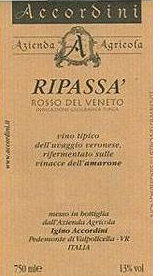
accordiniYesterday, I messaged the VinoWire group on Facebook, asking if anyone knew of a Valpolicella producer besides Zenato who used the term ripassa on its Valpolicella label. (Btw, if you’re not a member of the VinoWire FB group, please join!). Colleague, friend, and fellow blogger Tom Hyland weighed in with Accordini’s Ripassà (or Ripassa’ depending on whether your looking at the label or the winery’s website. Ripassa’ is a Veneto dialectal form of the Italian ripassato, literally passed again or refermented in this case. (I am reminded of Giacomo Leopardi’s famous observation that French is a language of terms while Italian is a language of paroles: like so many lemmae in the Italian lexicon, passare can assume a wide varieties of meanings depending on the context.) Thanks, Tom, for sharing the info and thanks also to Devon Broglie and Angelo Peretti who pointed out that Zenato’s “Ripassa” — without the accent grave or inverted comma — is indeed a trademarked proprietary name.

Has anyone tried the Accordini? Is it good?

In other news…

Just in the from the “unbelievable but true” department: Franco and James Suckling are in the midst of a cordial, collegial, and amiable exchange in a comment thread at James’s blog on the Wine Spectator site.

Here’s the link to the post and thread but since you have to subscribe (as I do) to view the blog, I’ve copied and pasted the exchange below.

User Name: James Suckling, Posted: 03:36 AM ET, May 28, 2009

    Guiseppe Mascarello & Figlio doesn’t send but we buy bottles normally for review. I find the wines very up and down. Some are amazing but others have flaws like volatile acidity.

User Name: Franco Ziliani, Italy Posted: 12:13 PM ET, May 29, 2009

    I know very well, and I’m a great fan, of Giuseppe (Mauro) Mascarello wines, but I confess that I don’t find any traces of “volatile acidity” that Mr. Suckling find…

User Name: James Suckling, Posted: 12:26 PM ET, May 29, 2009

    Franco. Some people have a high tolerance for VA. Have you ever been to their cellars? Anyway, it’s only been with a few wines. I generally like the wines as you do. Thanks for the comment.

User Name: Franco Ziliani, Italy Posted: 04:21 PM ET, May 29, 2009

    Mr. Suckling, apologies in advance for my poor English. I know very well the Giuseppe Mascarello cellars and I don’t think that is this kind of old, and very fresh in every season, cellar that create the problem of “volatile acidity” that you find in Giuseppe Mascarello wines. And I don’t think that a case of “high tolerance for VA” don’t allow me to find in Mascarello wines the “VA problem” that you find in few wines. Can you tell in what wines, Barolo, Barbera, Dolcetto (what vintages?) have you find VA “flaws like volatile acidity”? Thanks for your kind answer f.z.

We’ll have to wait for James’s next move!

Poetry for Sunday: my favorite Pasolini (and Orson Welles)

The embedded video below is one of my all-time favorite movie clips. It’s from an episodic movie called RoGoPaG (1963), to which Pasolini contributed the segment La Ricotta. In Pasolini’s segment, Orson Welles plays an American director making a movie about the life of Christ in Rome.* It is simply brilliant, on so many levels (I love the music and the dancing). It is rivaled only by the sequence where Welles recreates Pontormo’s Deposition in the Church of Santa Felicita in Florence.

In the clip, Orson Welles reads a poem by Pasolini, “I am a force of the past.” In thinking about culinary tradition, pizza paired with wine, and the recent censoring of “ethnic” food in Italy, I realize that the poem is actually and entirely topical (even more so when considered in the context of the entire Welles sequence).

I am a force of the Past.
My love lies only in tradition.

Here’s an as-of-yet unpublished translation by the Italian translator I admire most, my friend Stephen Sartarelli, who has also translated the Montalbano detective series. I wrote to Stephen who graciously shared his excellent rendering.

I am a force of the Past.
My love lies only in tradition.
I come from the ruins, the churches,
the altarpieces, the villages
abandoned in the Appennines or foothills
of the Alps where my brothers once lived.
I wander like a madman down the Tuscolana,
down the Appia like a dog without a master.
Or I see the twilights, the mornings
over Rome, the Ciociaria, the world,
as the first acts of Posthistory
to which I bear witness, for the privilege
of recording them from the outer edge
of some buried age. Monstrous is the man
born of a dead woman’s womb.
And I, a fetus now grown, roam about
more modern than any modern man,
in search of brothers no longer alive.

Io sono una forza del Passato.
Solo nella tradizione è il mio amore.
Vengo dai ruderi, dalle chiese,
dalle pale d’altare, dai borghi
abbandonati sugli Appennini o le Prealpi,
dove sono vissuti i fratelli.
Giro per la Tuscolana come un pazzo,
per l’Appia come un cane senza padrone.
O guardo i crepuscoli, le mattine
su Roma, sulla Ciociaria, sul mondo,
come i primi atti della Dopostoria,
cui io assisto, per privilegio d’anagrafe,
dall’orlo estremo di qualche età
sepolta. Mostruoso è chi è nato
dalle viscere di una donna morta.
E io, feto adulto, mi aggiro
più moderno di ogni moderno
a cercare fratelli che non sono più.

A little Sunday poetry. Thanks for reading…

Buona domenica a tutti…

* Pasolini was a deeply religious man and he made a beautiful film about the life of Christ, Il vangelo secondo matteo (The Gospel According to St. Matthew, 1964).

Eating tripe with Baron Ricasoli

Above: From left, Francesco Ricasoli and his father Bettino Ricasoli, the great-great-grandson of Iron Baron Bettino Ricasoli (in the oil on canvas), an architect of Italian unification, Italy’s second prime minister, and winemaker who reshaped the history of Tuscan winemaking by replanting the vineyards of his Castello di Brolio estate with Sangiovese.

As I write this, the world of Italian wine mourns the loss of Baron Bettino Ricasoli, the namesake and steward of one of Italy’s most illustrious winemaking families. He was 87 and his funeral is being held today in the church of the Santa Trinita in Florence (the name of the church is pronounced TREE-nee-tah, btw, with the tonic accent on the first syllable, because the Florentines use Latinate pronunciation in this and similar instances, e.g., Santa Felicita pronounced feh-LEE-chee-tah).

Above: The library at the Castello di Brolio.

Six years ago I went to visit Baron Bettino, who was one of the nicest, most generous, and most gracious hosts who has ever received me. I wanted to browse the library at the Brolio Castle and leaf through the reprinted, bound collection of his great-great-grandfather’s letters and thanks to my connections in the wine trade, I was able to contact him. I visited in January when the castle was closed and he traveled expressly that day from Florence to spend the day with me. He, personally, led me on a tour of his family’s castle and then let me spend the afternoon in the library there. It was an amazing and truly unforgettable experience.

His ancestor and namesake, the Iron Baron Bettino Ricasoli, reshaped the history of Italian winemaking when he replanted his vineyards “exclusively” with native Italian varieties in the second half of the 19th century. Franco and I have published my translation of the famous letter in which he describes his experiments and his decision to replant at VinoWire.

Many uninformed wine writers claim that the Iron Baron composed a “recipe” or “formula” for Chianti with exact percentages. This is simply not true. What he did do was to establish that fine wine could be made in Tuscany using native Italian grape varieties (viz., Sangiovese or Sangioveto, Canaiolo, and Malvasia). He replanted his estate with those varieties (inspiring other winemaking estates to abandon international varieties), and he developed techniques (modeled after what he had seen in Bordeaux) for stabilizing his wines and thus making them suitable for shipping. The culmination of his efforts and achievements was that Tuscany and a newly unified Italy established themselves for the first time as a world-class producer of fine wine that could be shipped beyond its borders.

Here are a few anecdotes from the day I spent with Baron Bettino…

We ate stewed tripe in the Florentine style at a wonderful little trattoria called Carlino d’Oro near the Brolio Castle. I highly recommend it.

He told me a story of how the Iron Baron decided to leave Florence after another man asked his fiancée to dance at a ball. Evidently, the Iron Baron was prone to jealously and so he swept his betrothed away to the Brolio Castle and began his studies on winemaking. In the end, it was a woman behind the first renaissance of Italian winemaking!

I sat at the edge of my seat as he told me about the German occupation of the castle in the last years of the second world war. The German soldiers used its turrets as mounts for their artillery and Baron Bettino was among the Allied soldiers when they liberated his family’s castle. Because he knew the terrain so well, he was able to help mount their attack. How cool is that?

It was thanks to Baron Ricasoli that I met Darrell Corti, who became an unwitting mentor to me. But that’s another story…

To be continued…

In other news…

I’m picking up the pieces after ten days on the road and ten different cities between wine, one fine woman, and song. Starting a week ago last Thursday, I have visited and eaten meals in San Francisco (twice), San Jose, Los Angeles, Austin, San Antonio, Dallas, Sedona (AZ), Jerome (AZ), Napa Valley, and Sonoma.

It’s good to be home where I belong and I have lots to post about so please stay tuned…

If you’re planning your vacation in Italy…

If you’re planning your vacation in Italy this summer, think about Abruzzo…

After breaking away from the phalanx of wine professionals with whom I was traveling on my last day at Vinitaly in April, I had the great fortune to taste with Abruzzo winemakers Sofia and Emidio Pepe. The next morning, the earthquake struck the region in the hours before dawn, taking the lives of nearly 300 people and leaving 28,000 homeless.

You may remember Eric’s post “Aftershocks” which appeared on The Pour in the days that followed the tragedy in L’Aquila. As Eric pointed out, even though the Abruzzo wine industry wasn’t affected directly by the earthquake, the long-term impact will be drastic because 10-50% of the wine produced there is sold and consumed locally.

Above: I have always loved Emidio Pepe’s Montepulicano d’Abruzzo, made in a totally natural style. “Emidio Pepe may be even more of purist than Valentini [another one of Italy’s iconic natural winemakers],” wrote Burton Anderson in his landmark book Vino. “He crushes his grapes by foot” and “possesses not a single piece of modern equipment in his rustic winery.” Drinking these stinky elegant wines is like listening to Thelonious Monk’s “Ugly Beauty.”

Abruzzo is a pristine region of immense natural beauty. Its hills are dotted with wonderful medieval villages where life was never contaminated by the industrial progress forged during fascism.

L’Aquila (where the epicenter hit) was so named (“the eagle”) by 13th-century emperor Frederick II of Swabia who was one of the greatest falconers of his time. Dante condemned Frederick to his Inferno for being an epicurean.

If you’re considering/planning a trip to Italy this summer, think about Abruzzo.

In other news…

You can find info for Nous Non Plus shows in San Francisco (tomorrow), San Jose (Friday), and Los Angeles (Saturday) here. Hope to see you at the shows. Tracie B will be Tracie B there too! (well, just in LA)

Double-take: Italy, Texas

From the “double-take” department…

Given my chronic case of Italophilia, “my new life Texana,” and my philological (and toponomastic) leanings, it was inevitable that sooner or later I would have to investigate and address the origins of the toponym Italy, Texas (the “two boots” of Italy and Texas, left, reside side-by-side on a shop-window on main street, right next to the Uptown Café in Italy, Texas). Tracie B and I stopped there yesterday on our way back from Dallas (where our dear friend Alfonso hosted us for dinner and opened a few truly unforgettable bottles — but you’ll have to wait for Tracie B’s post for more detail). Italy lies about 40 minutes south of Dallas along I-35 (which leads south from Dallas to Waco, Waco to Austin).

In his lectures and essays on memory, the contemporary Italian philosopher Remo Bodei loves to cite another noted homonymous place name in Texas — Paris, Texas, celebrated in film by the great director Wim Wenders. Why, he asks in his lecture “The Traumas of Memory,” have European emigrants named their settlements in the New World after their place of origin? “To create a transitional object? A soft landing in the flight from the known to the unknown? I believe that something analogous happens even in traumas connected to loss. In effect, monuments and burial rituals are carried out to remember and forget simultaneously. When objectified, pain hurts less.”

Above: The water tower in Italy, Texas.

As it turns out, Italy — locally pronounced IT-lee — was not named after its settlers’s country of origin but rather — at least, according to local legend — by a late-nineteenth-century post master who believed the climate of Texas was similar to Italy’s.

Above: The picturesque main street of Italy, Texas has remained virtually unchanged since the 1930s.

One of the reasons we wanted to stop there was to eat at the Uptown Café, an eatery called one of the “best small town Texas cafés” by Texas Monthly Magazine. But when we got there the proprietor, a very nice lady, told us “Ever’ Tom, Dick, and Harry dun’ came in here and ate everythang.” So we ended up eating at the Texas Best Smokehouse, the flagship restaurant and novelty store of a small, locally owned chain. They smoke their own jerky there (for all of their locations, I was told) and they also make pistachio pudding. The Texas Best Smokehouse is located on Dale Evans Dr., in turn named after one of Italy’s most famous daughters.

Above: I couldn’t resist the pistachio pudding, which is made — I believe — with Cool Whip, Jello mix, and pistachios. Metabolically, it was probably a bad decision, as was the bbq sausage sandwich. But, what the hay? You only live twice, right?

Double-meanings, paronomasia, puns, and — in this case — a homonymous place name, are the source of endless fascination for me. (One of these days, I’ll do a post on the origins of the place name California. I know of at least two towns in Italy named California.)

The other day, Franco sent a wonderful photo, snapped in the Alps, of the Italian and Texan flags flying together. As it turns out, there’s a little bit of Italy in Texas, too.

Call me crazy: white clam pizza and Nebbiolo

From the “life could be worse” department…

Above: Call me crazy but I paired cherry stone clam pizza and Nebbiolo the other day at Nonna in Dallas. It was delicious. The fruit in the 2005 Produttori del Barbaresco is showing beautifully right now and shows no signs of wanting to close up.

The San Diego Kid (that’s me, your resident wine cowboy) found himself in Dallas the other day, dusty and tired after a day of showing wine, with a six-pack of wine still slung around his back, his trusty companion Dinamite (the Silver Hyundai) beaten but not broken, and a bottle half-full of 2005 Produttori del Barbaresco still to be drunk. So he moseyed on over to the nearest saloon and parked his chaparreras at the bar at Nonna, where owner Julian Barsotti insisted he have the white pizza with cherry stone clams.

Above: Rock star owner and chef Julian Barsotti of Nonna makes some of the best pizza in Texas. He spent a season in Naples where he studied at the Associazione Verace Pizza Napoletana.

Julian opens the cherry stone clams first, reserves the juices, and then slowly wilts Vidalia onions with their juice and some cream until the onions literally melt and the cream and clam juice reduce to a thick sauce which he seasons with a mix of finely chopped herbs. Before firing the pizza in a wood-fired oven, he dresses the pizza with the clams, sauce, and a sprinkle of Parmigiano Reggiano. I’m still a big fan of his Margherita but the white clam pizza was the best I’ve ever had this side of New Haven, Connecticut.

The pairing was as decadent as it was delicious. In Italy, I still pair my pizza with beer (as tradition dictates) but here in the Wild West, crazy things can happen.

In other news…

I couldn’t be there this year (but I was last year): the first couple of Italian-American food and wine Michele and Charles Scicolone hosted their second “bygone wines” dinner in New York. Check out Eric’s post here.

In other other news…

Today (April 25) is Liberation Day in Italy, commemorating the partisans’s triumph over fascist and Nazi rule in 1945 (Milan and Turin were liberated on this day).