The world according to Soldera

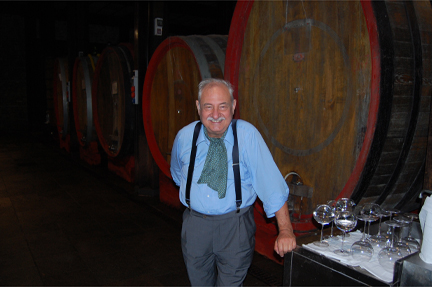
Above: Gianfranco Soldera, legendary, enigmatic, and paradigmatic winemaker, a Trevisan farmer turned Milanese industrialist turned Montalcinese winemaker.

Anyone who’s ever had the good fortune to be invited to visit Gianfranco Soldera’s estate, Case Basse, in the southwestern subzone of the Brunello appellation will surely share my impression that his winery, vineyards, and contiguous botanical garden come together to form what is undeniably one of the most impressive estates in the world.

When he began looking for an estate to purchase in the early 1970s, the Piedmontese wouldn’t sell him a decent plot of land, he told me the other day when we visited. So he decided to to buy a parcel in Montalcino on the advice of a friend who had told him you could pick up a piece of land there for a boccon di pan, a mouthful of bread, in those days.
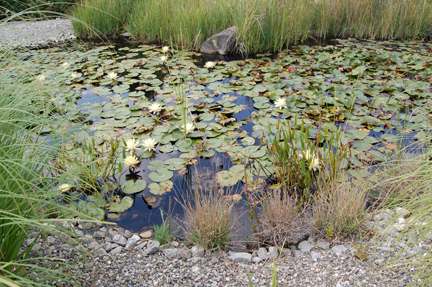
Above: The botanical gardens at Soldera’s Case Basse include a swamp (to create a maritime influence) and a white flower garden (to encourage nighttime pollination). “Ah, the white flower garden,” remembered wistfully my friend Dr. Lawrence O, the other day when he spied my visit on Facebook. Lawrence has visited there, of course.

When you talk to winemakers in Langa (Piedmont), many of the current generation still look to Soldera as a doktorvater (like Beppe Rinaldi, who told me that he often seeks advice and guidance from Soldera when the elder visits Barolo).

In many ways, it’s as if Soldera, when faced with the fact that he couldn’t make wine in Piedmont where he so obstinately desired to do so, decided to construct his own microclimate within the Brunello macroclimate. As he explains very openly, the remarkable botanical garden on his property (manicured by his wife) creates a unique ecological balance of plant and swamp life, including the “white flower garden,” so famous among wine insiders, intended to encourage pollination at night because the bright peddles attract the insects in darkness.
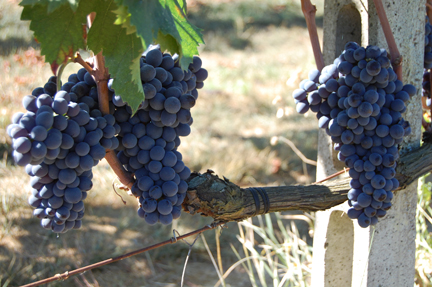
Above: “You find no vineyards with larger berries nor smaller clusters,” said Soldera proudly of his fruit. The attention to detail in his vineyard management is truly stunning.

Soldera has famously stated that he makes “natural wine.” Whether or not that’s the case is something I’ll leave that to the experts in the thorny field. He does seem to meet all the card-carrying members’s requirements: manual vineyard management, no chemicals in the vineyards, ambient yeasts in the cellar, no temperature control, lowest possible sulfuring. While I was in his presence a few weeks ago, he scolded one very famous winemaker in absentia for using cement vats for vinification, noting that wood is the natural vessel for winemaking. He also scolded another very famous winemaker for suggesting that it was okay to use a starter yeast when he had trouble initiating fermentation in his cellar.

But is it natural, I wonder, to build a botanical garden using mountains of manure (however organically prepared) in a place abandoned by sharecroppers because nothing would grow there anymore? I’ve leave that one to the exegetic forces of the rebbes and erstwhile Talmudic scholars in our field.

One thing we can all seem to agree on is that his wines are among the best in the world (and accordingly priced). I had the good fortune to taste the 2008 (extremely good) and 2006 (exceptional vintage, one of the best I’ve ever tasted) out of cask with him in the cellar. And at dinner we drank the 2003: an infamously and remarkably difficult vintage for any winemaker in Italy yet a harvest for which Soldera delivered lip-smacking acidity and gorgeously nuanced fruit aromas and flavors in his Sangiovese. These wines are simply life-changing, mind-blowing, awe-inspiring… It’s true…
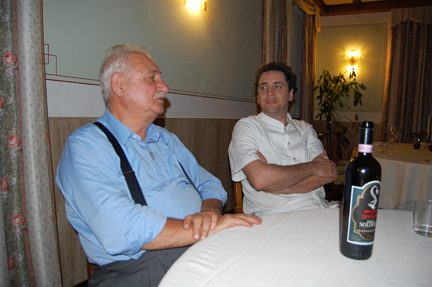
Above: Soldera with Roberto Rossi, chef/owner of Il Silene, arguably the best restaurant in southern Tuscany. The drive up to Seggiano is worth it if only to taste Roberto’s olive oil. The food and service were amazing.

Anyone who’s ever had the good fortune to be invited to visit Gianfranco Soldera’s estate, Case Basse, will tell you that Soldera keeps no secrets and he liberally shares his often salty opinions with those whom have been invited for an audience. (You’ll be surprised to find out that he has a website.)

Our conversation spanned many generations of Italian winemaking the other day when I visited him and you can imagine the controversial topics we covered. But the thing that stuck with me was what he said when I asked him what he saw for the future of winemaking in Italy.

“Commercial winemaking has come to an end in Italy,” he said referring to the recent Brunello controversy and rumors that the historic Barbi estate has plans to sell its property to Italian wine behemoth Zonin. “The nature of Italy cannot support industrial farming and commercial winemaking has run its course historically,” he told me. However many grains of salt there may be in the world according to Soldera, there’s certainly a grain of truth in this morsel of wisdom.
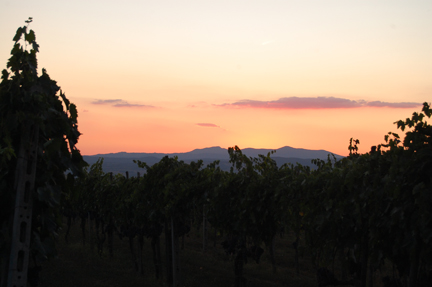
Above: Sunset at the Case Basse estate.

Another winemaker told me the same thing later on in my trip. Stay tuned to find out which one…
Gaja’s Santa Restituta restoration project fascinated me

This is the first in a series of posts culled from my recent trip to Tuscany, the Veneto, and Friuli. While on the road, I was only able to post short snippets and highlights from my visits. Starting today, and in the weeks that follow (as time permits), I’ll be posting in-depth accounts of my conversations with winemakers and restaurateurs and what I tasted. Thanks for reading…

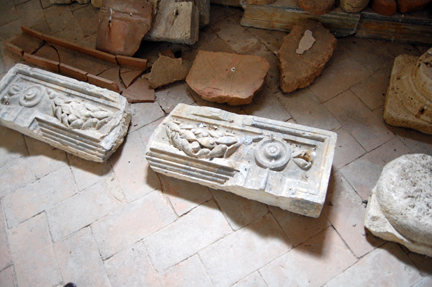
Above: Can you imagine my delight when I got to tour the Pieve di Santa Restituta restoration site in Tavernelle (Montalcino) a few weeks ago? The white bassi rilievi (bas-reliefs) are possible indications of the presence of a Romanic church on this site, i.e., a pagan temple that was converted and consecrated as a Catholic church in the Middle Ages.

When I tasted with Gaia Gaja back in the spring of this year in Chicago, one of the things I was most curious about was her family’s restoration of the Pieve di Santa Restituta and the church of the parish (pieve) in the Orcia River Valley, where her family makes Brunello di Montalcino.

I first visited the Orcia River Valley in Tuscany (perhaps the most photogenic and photographed swath of this beautiful land) in 1989 and have been fascinated ever since by the medieval hilltop towns and the rich ancient religious traditions that thrive here, like the Abbey of Sant’Antimo (in Castelnuovo) or the Madonna di Vitaleta (in San Quirico).

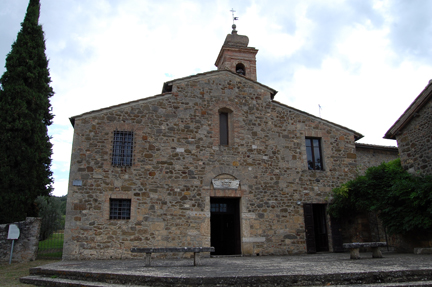
Above: The medieval façade of the Chiesa di Santa Restituta.

The pieve and church of Santa Restituta are particularly remarkable because the site represents an entirely unique and anomalous tradition in the context of the Orcia River Valley: the church is the only one in Tuscany devoted to Santa Restituta, the patron saint of Ischia, the island off the coast of Naples, where Tracie P lived for nearly 5 years before we met.

Since Gaia (the fifth-generation winemaker in one of Itay’s most famous winemaking families) first told me about the church and her family’s restoration project, I’ve also been absorbed by the powerful legend of Santa Restituta. During my recent visit with her in Tuscany, she very generously photocopied an essay entitled “Una madre vegliarda: la Pieve di Santa Restituta (Montalcino)” (“An Old Mother: the Parish of Santa Restituta”)* and published in 1978 in Arezzo by a gentleman named Angelo Tafi, who spent the better part of the second half of the twentieth century documenting the many small parishes that dot the Tuscan countryside. On the plane ride home from Europe, I devoured this wonderful piece of writing, so generously given to me by Gaia.

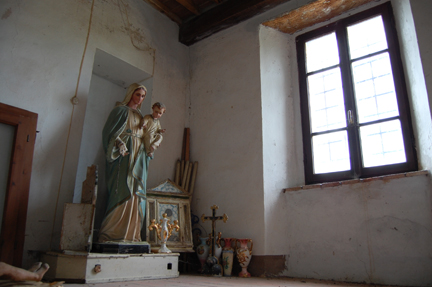
Above: Many of the relics currently being cataloged in the restoration process date are from the nineteenth century, when this parish was populated by a vibrant community of sharecroppers.

St. Restituta was born in Africa during the rule of Diocletian (284 to 305). She is believed to be one of the Martyrs of Abitina (modern-day Tunisia). When she refused to worship Jupiter, the Romans ordered that she be covered in tar and burned on a boat. Miraculously, her captors’s vessel caught fire and her boat drifted away before they could set it ablaze.

Most scholars believe that her relics were brought to Naples by African Christians who fled persecution in the sixth century. Today, the Cathedral of Naples now stands where the Church of Santa Restituta was established at that time. Ultimately, the relics were transferred to the village of Lacco Ameno on the island of Ischia where a church devoted to her still stands.

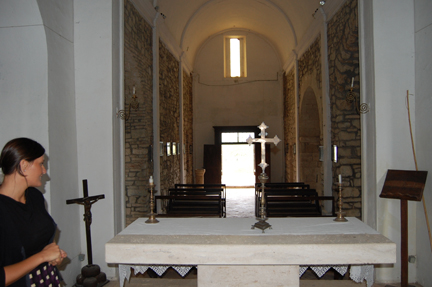
Above: I don’t know if she planned to do so, but Gaia’s handsome outfit was reminiscent of a nun’s habit that day. The parish and the church have a truly magical aura about them.

Her feast is celebrated in May on the island, where the legend is re-enacted each year in a colorful and widely popular pageant. In the contemporary version of her story, her boat finds its way to the bay of San Montano in Lacco Ameno, where her body is discovered by Lucina, a local matron, who proclaims that a virgin has been delivered by the hand of God. Her cult on the island is so powerful that many families still name their daughters Restituta (as Tracie P can attest!).

No one really knows why the church in Tavernelle was devoted to Santa Restituta, although — as Tafi demonstrates — it’s unlikely that there is a relation to Latium’s homonymous Santa Restituta di Sora. The site was a well established state-owned farming community in Roman times and it’s possible that Neapolitan merchants settled there in the late Middle Ages: anyone who knows the coastal road from Fiumicino airport in Rome to Sant’Angelo in Colle (the southern outpost of Montalcino) will immediately recognize the strategic location of the Pieve di Santa Restituta with relation to Naples.

I simply cannot convey the electric sensation of touring this beautiful property. A team of artisans buzzed around us, delicately chipping away at a stuccoed wall to reveal the classic brown limestone of the Orcia Rivery Valley underneath.

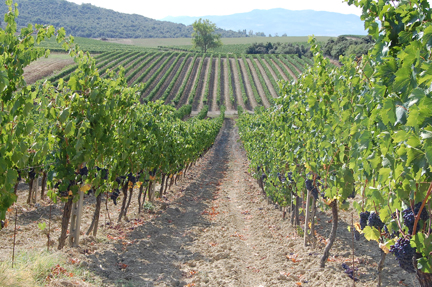
Above: Tafi’s research shows that the Sugarille vineyards were already devoted to the cultivation of grapes by the fifteenth century.

In his research, Tafi discovered that certain parcels were already devoted to viticulture by the fifteenth century. Today, Gaja uses those same growning sites for its flagship Brunello, the vineyard-designated Brunello Sugarille (the vineyard of the cork trees, sugheri in Italian).

Gaja’s vineyards lie adjacent to those of Soldera (who, together with his wines, will be the subject of an upcoming post). Many consider these historic growing sites to be among the best in the appellation. My guess is that centuries of sharecropping ultimately depleted the soil’s nutrients, making the white and brown earth ideal for the cultivation of fine wine grapes (but more on that later).

Above: Gaia poured me a flight of wines that spanned 1996 through 2008.

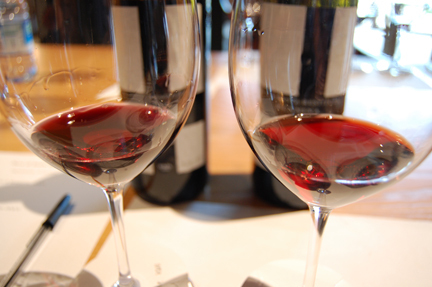
Of course, I was also there to taste Gaia’s family’s wines and I will not conceal that I was thoroughly impressed by the 2008 Brunello Sugarille (single vineyard) and the 2006 Brunello Rennina (which is sourced from three different vineyards on the estate). As you can see from the color in the image above, the wines were bright and transparent, and I found them to be excellent expressions of Sangiovese Grosso and the Brunello appellation. The red fruit was balanced by good acidity and powerful tannin (still very youthful in the case of the Sugarille) and there was none of the woodiness that I’ve found in earlier vintages of this wine. Here, in this most western subzone, elegance and purity trump the earthier expressions of Sangiovese that you find in the central, southwest, and southeast areas.

In my limited experience with Gaja’s bottlings of Brunello (since I can hardly afford them), I’ve seen an evolution (and I think that Gaia would agree) bringing them more into line with the classic profile of great Brunello. I thought the most recent vintages were great.

But, most of all, I was impressed by this fascinating restoration project, adding yet another destination to the many sites on my list of places to take Tracie P the next time we’re there. Truly exciting stuff for geeks like me!

*The reference to the madre vegliarda is culled from the great nineteenth-century Italian poet Giosué Carducci’s poem “La chiesa di Polenta” (“The Church of Polenta”). The title alone is worthy of a stand-alone blog post but it will have to wait.

Beauty (and ugly) in Italy

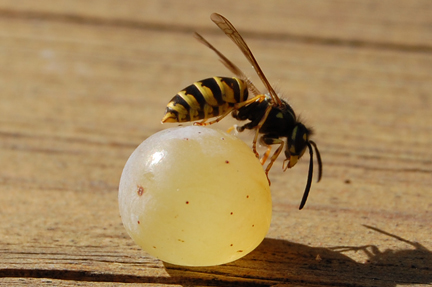
Above: A wasp feasts on newly picked Ribolla at Venica & Venica.

A quick post today, on this autumnal Monday back at my desk in Austin, comprised of photos from my trip, some of the most beautiful things I saw through my lens while in Italy. It was an incredible journey, replete with felicitous confluences, some serendipitous and delightfully unexpected, others grounded in epistemlogic contemplation and convex self-reflection.

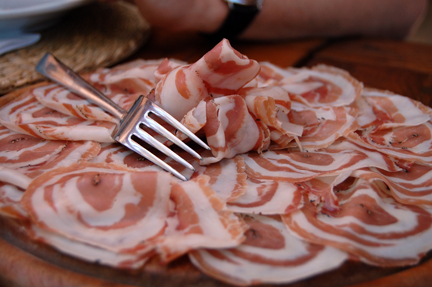
Above: Pancetta offered to weary travelers, also at Venica.

In the days that follow, I’ll begin posting in-depth accounts of my conversations and tastings with winemakers and restaurateurs in Tuscany, the Veneto, and Friuli. I am so grateful for all the comments, emails, Twitter mentions, and Facebook notes encouraging me and sharing insights into what I photographed, smelled, tasted, drank, and masticated over the course of the nearly three-week trip. And I am especially thankful for the incredible hospitality and generosity of spirit of my (literally) myriad hosts and guides.

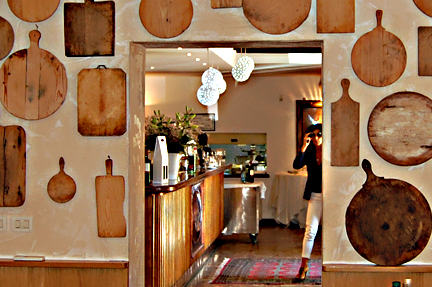
Above: A view from one of the dining rooms at Trattoria al Parco in Buttrio (Udine).

Immense and extreme beauty is offered to the willful traveler of the Italic peninsula: from her generous landscape to her innate and intrinsic humanity (both historical and topical), Italy continues to inspire me (and hopefully you) by revealing some of the mystery and joy of life through her topographic, aesthetic, and sensual pleasures.

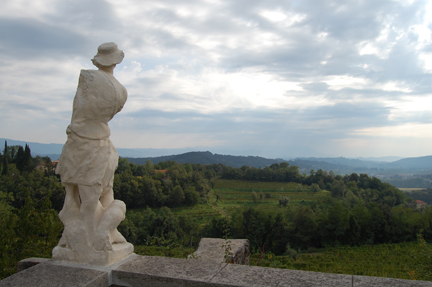
Above: A view from the Abbazia di Rosazzo in the Colli Orientali del Fiuli.

While I thoroughly enjoyed her bountiful intellectual and sensorial gifts, I was however acutely aware of the seemingly insurmountable societal and cultural issues and turmoil faced by the inhabitants (Italian and otherwise) of this profoundly gorgeous land.

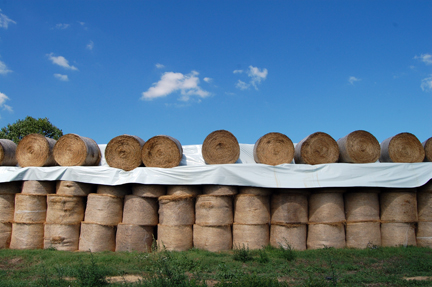
Above: Hay for Chianina cows near Pienza, Tuscany.

Whether it’s Berlusconi patently using one of his media outlets (in this case, Il Giornale, a top national daily) to sling mud at his rival Fini (now embroiled in a sticky familiar real-estate scandal) or the impending expulsion of Roma (following the highly controversial and contested model employed by Sarkozy), Italy and her peoples find themselves in circumstances eerily however distantly reminiscent of the “era between the two wars.” When I commented on the recent changing of the guard in the political regime of the region where she and her family make wine, one winemaker observed wryly but not inronically, “we were better off with the fascists in power than the [newly instated] separatists.”

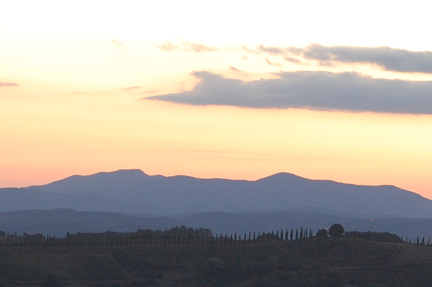
Above: Sunset in Montalcino (Tuscany), viewed from the estate of Il Palazzone.

Perhaps it’s this precarious balance of salt and sweet that makes Italy always taste so great and greatly on our tongues. Thanks for reading…

With Elda Felluga at the Abbazia di Rosazzo

“Dream Team Friuli 2010” with Elda Felluga (Livio Felluga, to Bobby’s right in the center of the photo) at the Abbazia di Rosazzo in the Colli Orientali del Friuli.

Elda is an amazing, dynamic personality and I can’t wait to tell the truly epic story of her family and how they put the Colli Orientali del Friuli “on the map,” quite literally (and about the extremely special gift that Elda gave me).

What do you think about “Dream Team Friuli 2010” as the name of our group? Strappo, McDuff, Alfonso, suggestions please!

Friuli: the obligatory dignatory dinner

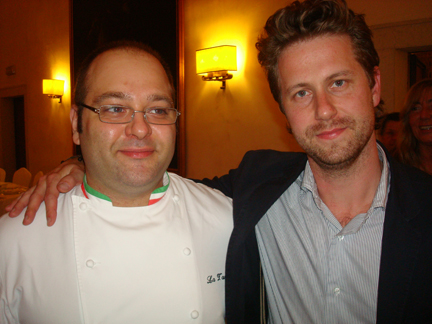
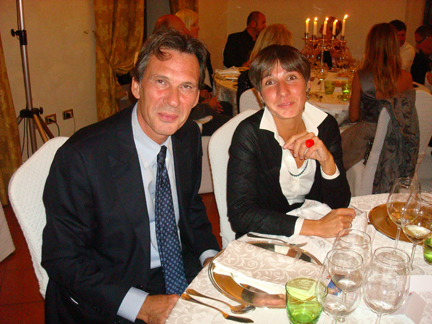
Simpatico Chef Andrea Gabin (left) of the famous Ristorante La Taverna posed for my camera with Chef Lachlan at last night’s obligatory dignatory dinner, regrettably a sine qua non of these government-sponsored trips, held at the picturesque Castello di Susans in Maiano (Udine).

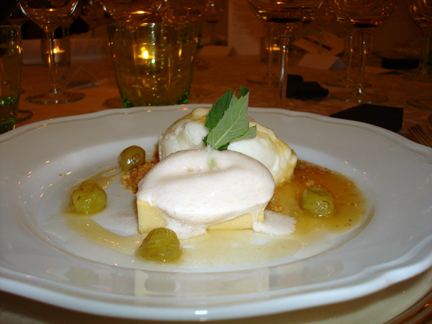
The food was surprisingly good for a dinner where more than 200 guests were seated, including all the fat cat pols who revel in their their Rolex and 12-ply cashmere habits at such functions. That’s Chef Gabin’s EXCELLENT “white chocolate sphere and white grape sorbet” paired with Bianco Tal Luc 2007 Friuli Isonzo by Lis Neris, one of my favorite wineries here.

That’s Andrea Di Giovanni (left), director of the Friuli department for development and Francesca Ghersinich, program director for the MIB school of management, who was asked to address the large group of foreigners gathered for the event because of her command of the English language. They were very nice although completely disinterested in our group of top-flight American restaurant professionals (enogastronomic tourism does not seem to be a priority in this duly industrious region).

The one pleasant surprise of this otherwise entirely ennui-driven event was my discovery that young Friulians are wonderfully proud of the great 20th-century poet, cineaste, novelist, and essayist Pier Paolo Pasolini’s association with his native Friuli.

The cast of last night’s event certainly could have made a cameo in one of his films… I’ll let you ponder which one…

Coffee culture in Friuli

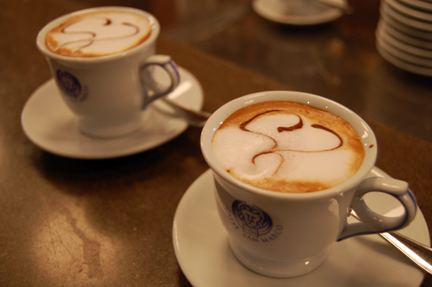
In Friuli, the default coffee service is caffé macchiato, i.e., an espresso with a spot of steamed milk, like this coffee that I had at the Caffè San Marco in Cividale del Friuli, where I stopped this morning on the way to my final destination.

One of my first major translations was the “Bottega del Caffè” (“The Coffee House”) by 18th-century Italian comediographer Carlo Goldoni, set in Venice with the then nascent European coffee culture as backdrop (New York, Marsilio, 1998).

Are you going to Scarbolo fair? First day in Friuli

Later today I hope to have the time to reveal why and how I’ve come to Friuli.

But before the official working leg of the trip begins, I wanted to take time out to catch up with my friend Wayne, who lives and works in Friuli as the sales and marketing director for the Bastianich winery here.

In a world where ego generally trumps humanity, Wayne is one of the rare and welcomed anomalies: a right guy, as one might have said a half-century ago, who just happens to work in the top tier of the food and wine industry. When he suggested we go meet winemaker Valter Scarbolo for dinner at his legendary restaurant La Frasca in Lauzacco (Udine), I couldn’t have been more thrilled.

Dinner began with Lorenzo d’Osvaldo’s superb prosciutto crudo and ossocollo and Valter’s housemade salame (above).

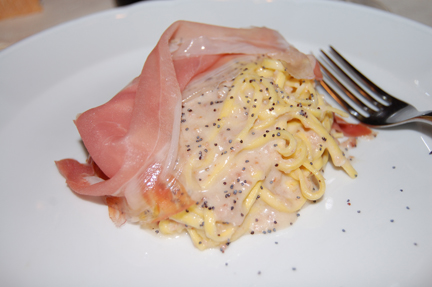
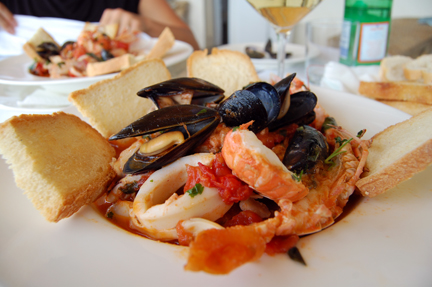
Next, di rigore, came tagliolini San Daniele.

This was followed by a dish that would have been met with wholehearted approval by any semiotician gourmand, Valter’s raviolo aperto, stuffed with montasio cheese and venison, topped with wild berries. (A bottle of sparkling Verduzzo for anyone who can place the exegetic pun I’ve made for this dish!)

As we were joined by Valter’s son Mattia who had arrived from his kick-boxing workout (and was evidently famished), the conversation turned to the current student housing crisis in Italy, soon to be faced by the young matricola.

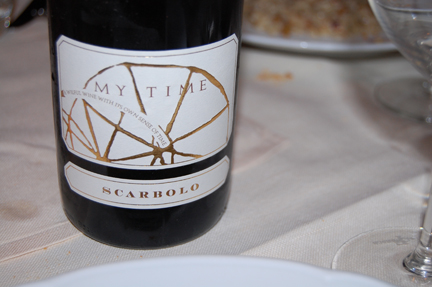
As we lingered over intensely aromatic formàdi frant (formaggio frantumato, literally splintered cheese, a classic farmer’s cheese of Friuli), the wine I kept going back to was Valter’s My Time, so-called because, despite the urgings of his enologist, he waits to bottle and releases this wine only when he feels it’s achieved its full potential. As it warmed up in the glass, this wine (made from Chardonnay, Sauvignon Blanc, and Tocai fermented in cask) was simply gorgeous, with nuanced fruit and noble structure, delightful with the pasta dishes, intriguing and intellectually stimulating with the cheese course.

Last night wasn’t a time for delving into the details of enogastronomic science: it was time for catching up with an old friend and making a new one.

When it comes your time to go to Scarbolo fair, please remember me to the one who lives there…

Stay tuned…

Tough times in Piedmont

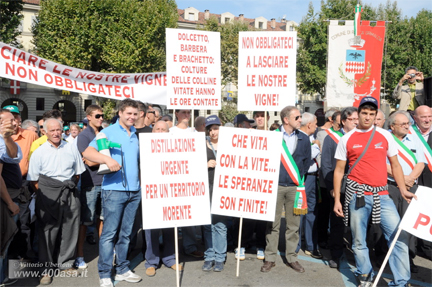
Above: In a protest mounted earlier this month in Asti, besieged Piedmont grape growers and winemakers pleaded for government aid (photo by 400AsaFoto.it).

I managed to carve out some time this morning to post over at VinoWire on recent developments in Piedmont for grape growers and winemakers affected by the global wine crisis.

On his excellent blog Sapori del Piemonte, Filippo Larganà has been providing some solid coverage of what’s happening on the ground there.

Strange hues of the Middle Ages

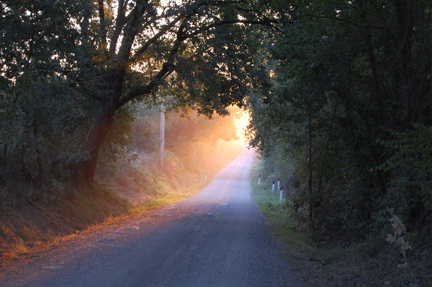
This morning, my last in Montalcino, I enjoyed a daybreak drive through the vineyards of Il Poggione with winemaker Fabrizio Bindocci as my guide (I’ve been staying at the estate’s farmhouse).

The vision above made me think of Dante, Inferno, 34, 132-33:

    Into that hidden passage my guide and I
    entered, to find again the world of light

I remembered my years as a grad student, often spent imagining the quality of light as perceived by humankind in the Middle Ages.

I remembered the famous passage from Burckhardt:

    In the Middle Ages both sides of human consciousness—that which was turned within as that which was turned without—lay dreaming or half awake beneath a common veil. The veil was woven of faith, illusion, and childish prepossession, through which the world and history were seen clad in strange hues.

And I realized that those strange hues often reveal truths lost on those inebriated by the glow of rationalism.