Mario Monicelli, Italian cinema giant, free at last

One of the greatest artists of the last and current centuries, Italian film director Mario Monicelli, father of the commedia all’italiana, took his own life last night. He was 95 and terminally ill.

Please read this obituary in The New York Times, where Michael Roston quotes the director:

    “All Italian comedy is dramatic,” he said in a 2004 interview with Cineaste magazine “The situation is always dramatic, often tragic, but it’s treated in a humorous way. But people die in it, there’s no happy ending. That’s just what people like about it. The Italian comedy, the kind I make, always has this component.”

Please also see this obituary in the ANSA feed, where actor Stefania Sandrelli interprets his suicide.

I studied and loved his films in graduate school and have quoted them often here on the blog. The scene below (with Totò, Marcello Mastroianni, and Vittorio Gassman) is my favorite from I soliti ignoti (Big Deal on Madonna Street, 1958).

My favorite gag is when Mastroianni asks Totò if the famous safe-cracker Fu Cimin was Chinese. No, says, Totò, he was from Venice. “Cimin” was his last name. “Fu” means he died, he says.

Raise a glass for Luigi Veronelli

Above: I furtively managed to make a scan of Veronelli’s autograph when I visited the Terlato Wines International Tangley Oaks mansion earlier this year.

Luigi Veronelli, “intellectual, writer, liberatarian, literally the inventor of wine journalism in Italy,” wrote Italy’s top wine blogger Mr. Franco Ziliani this morning on his new blog Le Millle Bolle, raising a glass of traditional method sparkling wine to remember the architect of the Italian food and wine renaissance on the sixth anniversary of his passing.

Regrettably, very little of Veronelli’s writing has been translated into English (aside from what I’ve translated on my blog, where he appears often).

It’s difficult for the solely Anglophone lovers of Italian food and wine to gauge the reach and scope of Veronelli’s legacy (would Eataly have been possible — even conceivable — without him?).

Check out this amazing video, from 1975, when Veronelli was 49 years old and had yet to publish his landmark catalog of the wines of Italy (1983). It was posted in the comment thread of Mr. Ziliani’s post by the brilliant Giovanni Arcari, one of my favorite Italian winemakers and a good friend (look for Giovanni in the Franciacorta pavilion at Vinitaly this year and he will BLOW YOUR minds with the wines he makes and pours).

In it, he demonstrates how to make spaghetti alla chitarra. Italian is not required for viewing but the Pasolinian implications of the subtle dialectal inflections will not be lost on the Italophones among us.

Please join Tracie P and me in raising a glass tonight to this truly epic hero and sine qua non of contemporary Italian food and wine.

What is the secret of Soylent Merlot?

SPOILER ALERT: Please do not click on the below YouTube if you want the answer to be a surprise.

But please do click on the comment thread from yesterday’s post on Soylent Merlot and the Montalcino Syndrome, which includes insights from two Italian winemakers (Giampaolo Venica and Marilena Barbera). And please add your voice to our chorus.

The Montalcino Syndrome… It’s about people, people who lie, and people who face the agony of telling the truth…

A radiant champion is born in Montalcino

Isla, above, stole my heart about a month when I was the dinner guest of her parents, Laura and Marco, who manage Il Palazzone, producer of Brunello di Montalcino. (Of course, Isla stacked the cards by designing the place setting for me below.)

Today, Isla has a newborn little sister: Nia Rose came into this world over the weekend. (“Pronounced Nee-ah, meaning radiant champion in Gaelic,” writes Laura, whom I imagine is quite radiant herself right now.)

Mazel tov, Laura, Marco, Isla, and James! Tracie P and I are so happy for you and are sending you lots of love! And man, this baby fever is contagious! :-)

The earliest mention of Vin Santo in print? Maffei, Verona, 1732

Above: I’m borrowing images of grapes recently picked and laid out to dry for Vin Santo from my friends at Il Poggione.

For those of you who have been following my research into the origins of the enonyms Vinsanto (Santorini, Greece) and Vin Santo (Italy), I hope that you will find my most recent discoveries as interesting and exciting as I do.

The first comes from Francesco Scipione Maffei’s history of Verona, Verona Illustrata (parte prima) (Verona, Jacopo Vallarsi e Pierantonio Berno, 1732).

N.B.: for brevity’s sake, I’ve refrained from glossing the historical figures mentioned here. Where possible, I’ve included relevant links. On another occasion, I’ll translate more from Maffei’s wonderful book.

In discussing the historically significant agricultural products of greater Verona, Maffei devotes ample space to the wines, citing mentions in Cassiodorus and in various Roman decrees. Two wines, he writes, were highly coveted by the Romans: one white and one red. He translates (into Italian) Cassidorus’s description of a vinification process for a wine that resembles today’s Recioto di Soave (no surprise here). But a discrepancy in the nomenclature leads him to make the following observation:

    But perhaps [the wine described below] had another name in antiquity, because Pliny omits it. And it seems that [Roman jurist] Ulpian meant something else when he referred to Acinaticum or Acineum in a law.

    Select grapes are stored until December. They are then gently pressed in the great cold [of winter]. The must is stored for a long while without starting fermentation and before laying a hand on it or drinking it.

    [Ancient documents] show that this wine, although red and not white, was the very same wine that we praise today by calling it Santo [holy].

    It is also produced in greater Brescia, from here to the Chiesi river.

    [translation mine]

I believe that this may be the earliest known reference to “Vin Santo” in print (1732). Whether it is or not, it demonstrates that the citizens of the Venetian Republic produced a wine known popularly as “[Vin] Santo.” The fact that it’s mentioned in 1732 reveals that it was popular long before then.

Above: The grapes are laid out to dry on mats called cannicci in Italian.

The second fascinating discovery comes in the form of La teoria e la pratica della Viticultura e della enologia [Theory and Practice of Viticulture and Enology] by Egidio Pollacci (Milano, Fatelli Dumolard, 1883). I’ll let the text speak for itself:

    Vin-santo. — The grapes used to make this wine vary from place to place because the same grape varieties, when cultivated in different regions, naturally deliver fruit of varying character. As a result, grapes good for Vin-santo in one place are difficult to use in other places. In Tuscany, for example, the grapes best suited for Vin-santo are Tribbiano [sic], Canaiolo bianco, and San Colombano. (1)

    (1) Vin-santo di Caluso, which is famous especially in Piedmont, is prepared using grape varieties known locally as Erbaluce and Bonarda. But in other parts of Piedmont, other grapes are used. …

    [translation mine]

In other texts I’ve uncovered, there is clear evidence that the production of Vin Santo was wildly popular in Tuscany by the end of the 19th century. The fact that Pollacci uses Tuscany as an example is indicative of this phenomenon. But what’s important here is the fact that he describes how different grapes are used in different regions, thus revealing that Vin Santo was popular in other parts of Italy as well. The production of Vin Santo in Piedmont was evidently significant enough in the late 19th century that Pollacci (who was from Pistoia) felt compelled to mention it here.

carati

Above: Specially sized oak casks, called caratelli, are used for the long-term aging of Vin Santo.

I wish I had more time to devote to the many interesting texts I’ve “unearthed” recently and Maffei alone would merit his own monographic blog! Alas, it’s time to pay some bills around here… More later… and THANKS SO MUCH FOR READING!

Fusion: Cos Cerasuolo di Vittoria and smoked Texas ribeye

Last night was a night of fusions and no one was taking sides at Trio at the Four Seasons (Austin).

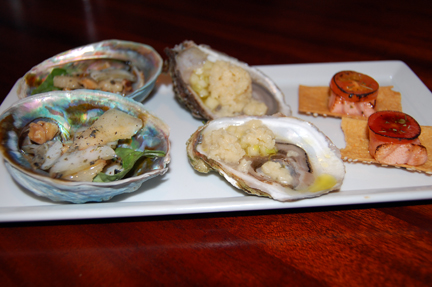
The first was Washington state abalone, oysters, and salmon, paired with Prosecco. Chef Todd was cooking for a Washington state wine event in one of the event spaces at the Four Seasons hotel and he sent down some of the pairings to our table at the restaurant downstairs where a friend and client had asked us to join him with a Prosecco producer.

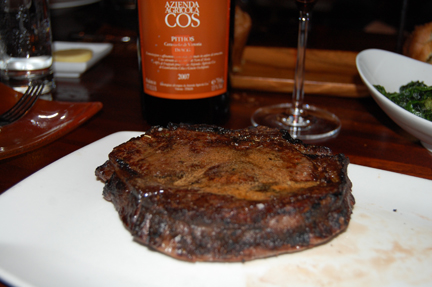
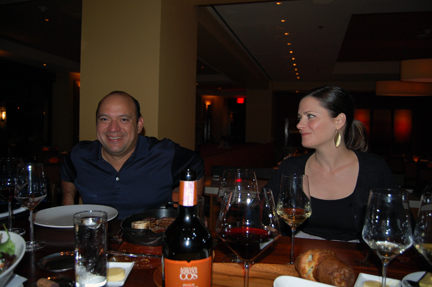
Perhaps the most extraordinary fusion came in the guise of a Texas smoked rib-eye paired with the Cos Cerasuolo di Vittoria. The Frappato character was powerful in the bottling we unstopped yesterday evening and the match between the bright fruit and the smokiness and fattiness of the beef was delicious.

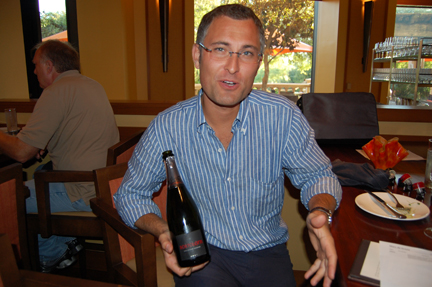
But the most intriguing fusion came with a smile and rimless glasses. Daniele d’Anna, the current generation of the Bortolotti family of Prosecco producers. Daniele is the product of a “mixed” marriage: his father is Neapolitan and his mother Veneta. I’ve never met anyone like him: he can switch between a thick Veneto accent (familiar to me) to Neapolitan (familiar to Tracie P) on the turn of a dime. I was curious to ask him about what it’s like to live in a Veneto now dominated by the Lega Nord, the xenophobe Separatist movement.

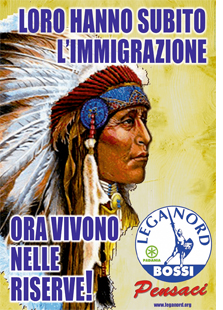
The Lega Nord wants to secede from the Italian republic and form its own country, severing ties with central and southern Italy. Let’s just say that the Lega doesn’t look so favorably on southern Italians, their customs, mores, and life rhythms. The image from the left is taken from a bizarre Lega campaign that I saw when I was in Italy recently. “They suffered immigration,” it says. “Now they live on reservations. Think about it.” Pretty scary, huh?

I liked Daniele very much and he struck me as a highly educated, cosmopolitan, and enlightened fellow. I doubt he shares the xenophobic sentiments of his Leghisti brethren. He made an interesting point: anyone who wants to get something done in Italian politics today, he observed, needs to take sides. His girlfriend, he told me, joined the Lega so that she could run for mayor of her small town in the Veneto, Asolo (one of my FAVORITE and one of the most beautiful and historically rich places in the world). Does she share the Lega’s racist platform? No, Daniele said. She just joined the Lega as a means to an end, he explained. Do they talk about politics when she comes over to the parentals’s for dinner? No, he said with a smile, they don’t. The 31-year-old woman won the election by the way and now serves as Asolo’s mayor.

Only in Austin can a Salvadoreño (my friend and client Julio, above, left), a Methodist (Tracie P), a Jew (that’s me), and a Trevisan walk into a bar and order a Texas smoked rib-eye with a wine aged in amphora from Sicily. Sounds like a joke, but I’m here to tell you, people: it ain’t!

Buon weekend, ya’ll!

There’ll be more posts from my recent Italy trip coming up next week. Stay tuned…

The world according to Soldera

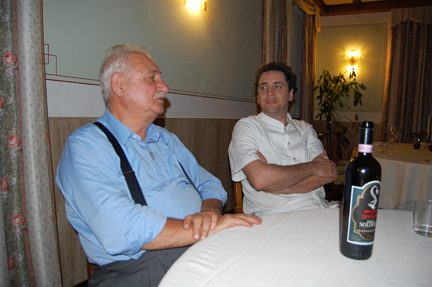
Above: Gianfranco Soldera, legendary, enigmatic, and paradigmatic winemaker, a Trevisan farmer turned Milanese industrialist turned Montalcinese winemaker.

Anyone who’s ever had the good fortune to be invited to visit Gianfranco Soldera’s estate, Case Basse, in the southwestern subzone of the Brunello appellation will surely share my impression that his winery, vineyards, and contiguous botanical garden come together to form what is undeniably one of the most impressive estates in the world.

When he began looking for an estate to purchase in the early 1970s, the Piedmontese wouldn’t sell him a decent plot of land, he told me the other day when we visited. So he decided to to buy a parcel in Montalcino on the advice of a friend who had told him you could pick up a piece of land there for a boccon di pan, a mouthful of bread, in those days.

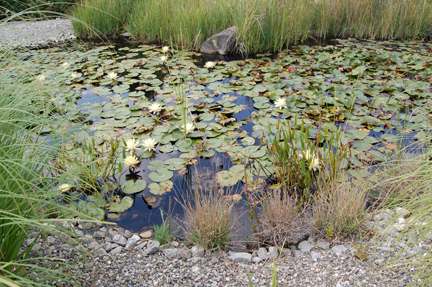
Above: The botanical gardens at Soldera’s Case Basse include a swamp (to create a maritime influence) and a white flower garden (to encourage nighttime pollination). “Ah, the white flower garden,” remembered wistfully my friend Dr. Lawrence O, the other day when he spied my visit on Facebook. Lawrence has visited there, of course.

When you talk to winemakers in Langa (Piedmont), many of the current generation still look to Soldera as a doktorvater (like Beppe Rinaldi, who told me that he often seeks advice and guidance from Soldera when the elder visits Barolo).

In many ways, it’s as if Soldera, when faced with the fact that he couldn’t make wine in Piedmont where he so obstinately desired to do so, decided to construct his own microclimate within the Brunello macroclimate. As he explains very openly, the remarkable botanical garden on his property (manicured by his wife) creates a unique ecological balance of plant and swamp life, including the “white flower garden,” so famous among wine insiders, intended to encourage pollination at night because the bright peddles attract the insects in darkness.

Above: “You find no vineyards with larger berries nor smaller clusters,” said Soldera proudly of his fruit. The attention to detail in his vineyard management is truly stunning.

Soldera has famously stated that he makes “natural wine.” Whether or not that’s the case is something I’ll leave that to the experts in the thorny field. He does seem to meet all the card-carrying members’s requirements: manual vineyard management, no chemicals in the vineyards, ambient yeasts in the cellar, no temperature control, lowest possible sulfuring. While I was in his presence a few weeks ago, he scolded one very famous winemaker in absentia for using cement vats for vinification, noting that wood is the natural vessel for winemaking. He also scolded another very famous winemaker for suggesting that it was okay to use a starter yeast when he had trouble initiating fermentation in his cellar.

But is it natural, I wonder, to build a botanical garden using mountains of manure (however organically prepared) in a place abandoned by sharecroppers because nothing would grow there anymore? I’ve leave that one to the exegetic forces of the rebbes and erstwhile Talmudic scholars in our field.

One thing we can all seem to agree on is that his wines are among the best in the world (and accordingly priced). I had the good fortune to taste the 2008 (extremely good) and 2006 (exceptional vintage, one of the best I’ve ever tasted) out of cask with him in the cellar. And at dinner we drank the 2003: an infamously and remarkably difficult vintage for any winemaker in Italy yet a harvest for which Soldera delivered lip-smacking acidity and gorgeously nuanced fruit aromas and flavors in his Sangiovese. These wines are simply life-changing, mind-blowing, awe-inspiring… It’s true…

Above: Soldera with Roberto Rossi, chef/owner of Il Silene, arguably the best restaurant in southern Tuscany. The drive up to Seggiano is worth it if only to taste Roberto’s olive oil. The food and service were amazing.

Anyone who’s ever had the good fortune to be invited to visit Gianfranco Soldera’s estate, Case Basse, will tell you that Soldera keeps no secrets and he liberally shares his often salty opinions with those whom have been invited for an audience. (You’ll be surprised to find out that he has a website.)

Our conversation spanned many generations of Italian winemaking the other day when I visited him and you can imagine the controversial topics we covered. But the thing that stuck with me was what he said when I asked him what he saw for the future of winemaking in Italy.

“Commercial winemaking has come to an end in Italy,” he said referring to the recent Brunello controversy and rumors that the historic Barbi estate has plans to sell its property to Italian wine behemoth Zonin. “The nature of Italy cannot support industrial farming and commercial winemaking has run its course historically,” he told me. However many grains of salt there may be in the world according to Soldera, there’s certainly a grain of truth in this morsel of wisdom.

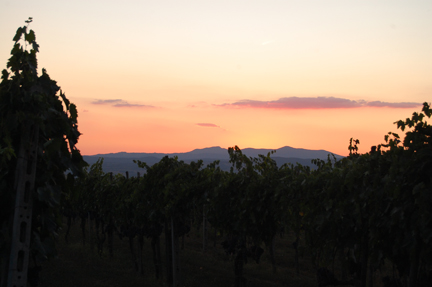
Above: Sunset at the Case Basse estate.

Another winemaker told me the same thing later on in my trip. Stay tuned to find out which one…

Gaja’s Santa Restituta restoration project fascinated me

This is the first in a series of posts culled from my recent trip to Tuscany, the Veneto, and Friuli. While on the road, I was only able to post short snippets and highlights from my visits. Starting today, and in the weeks that follow (as time permits), I’ll be posting in-depth accounts of my conversations with winemakers and restaurateurs and what I tasted. Thanks for reading…
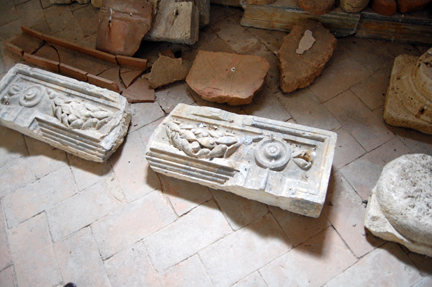
Above: Can you imagine my delight when I got to tour the Pieve di Santa Restituta restoration site in Tavernelle (Montalcino) a few weeks ago? The white bassi rilievi (bas-reliefs) are possible indications of the presence of a Romanic church on this site, i.e., a pagan temple that was converted and consecrated as a Catholic church in the Middle Ages.

When I tasted with Gaia Gaja back in the spring of this year in Chicago, one of the things I was most curious about was her family’s restoration of the Pieve di Santa Restituta and the church of the parish (pieve) in the Orcia River Valley, where her family makes Brunello di Montalcino.

I first visited the Orcia River Valley in Tuscany (perhaps the most photogenic and photographed swath of this beautiful land) in 1989 and have been fascinated ever since by the medieval hilltop towns and the rich ancient religious traditions that thrive here, like the Abbey of Sant’Antimo (in Castelnuovo) or the Madonna di Vitaleta (in San Quirico).
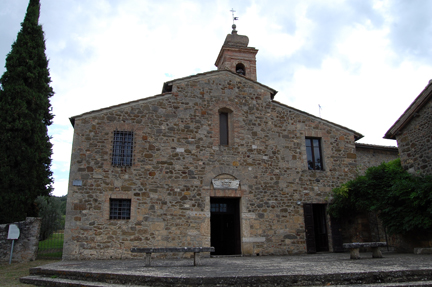
Above: The medieval façade of the Chiesa di Santa Restituta.

The pieve and church of Santa Restituta are particularly remarkable because the site represents an entirely unique and anomalous tradition in the context of the Orcia River Valley: the church is the only one in Tuscany devoted to Santa Restituta, the patron saint of Ischia, the island off the coast of Naples, where Tracie P lived for nearly 5 years before we met.

Since Gaia (the fifth-generation winemaker in one of Itay’s most famous winemaking families) first told me about the church and her family’s restoration project, I’ve also been absorbed by the powerful legend of Santa Restituta. During my recent visit with her in Tuscany, she very generously photocopied an essay entitled “Una madre vegliarda: la Pieve di Santa Restituta (Montalcino)” (“An Old Mother: the Parish of Santa Restituta”)* and published in 1978 in Arezzo by a gentleman named Angelo Tafi, who spent the better part of the second half of the twentieth century documenting the many small parishes that dot the Tuscan countryside. On the plane ride home from Europe, I devoured this wonderful piece of writing, so generously given to me by Gaia.
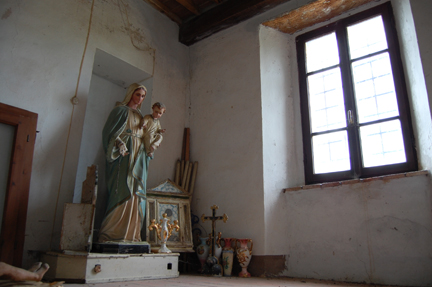
Above: Many of the relics currently being cataloged in the restoration process date are from the nineteenth century, when this parish was populated by a vibrant community of sharecroppers.

St. Restituta was born in Africa during the rule of Diocletian (284 to 305). She is believed to be one of the Martyrs of Abitina (modern-day Tunisia). When she refused to worship Jupiter, the Romans ordered that she be covered in tar and burned on a boat. Miraculously, her captors’s vessel caught fire and her boat drifted away before they could set it ablaze.

Most scholars believe that her relics were brought to Naples by African Christians who fled persecution in the sixth century. Today, the Cathedral of Naples now stands where the Church of Santa Restituta was established at that time. Ultimately, the relics were transferred to the village of Lacco Ameno on the island of Ischia where a church devoted to her still stands.
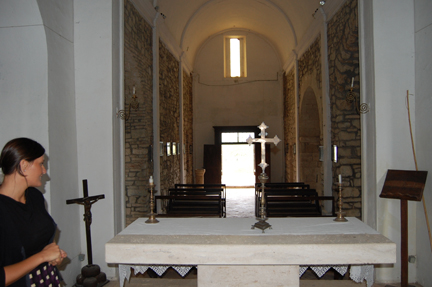
Above: I don’t know if she planned to do so, but Gaia’s handsome outfit was reminiscent of a nun’s habit that day. The parish and the church have a truly magical aura about them.

Her feast is celebrated in May on the island, where the legend is re-enacted each year in a colorful and widely popular pageant. In the contemporary version of her story, her boat finds its way to the bay of San Montano in Lacco Ameno, where her body is discovered by Lucina, a local matron, who proclaims that a virgin has been delivered by the hand of God. Her cult on the island is so powerful that many families still name their daughters Restituta (as Tracie P can attest!).

No one really knows why the church in Tavernelle was devoted to Santa Restituta, although — as Tafi demonstrates — it’s unlikely that there is a relation to Latium’s homonymous Santa Restituta di Sora. The site was a well established state-owned farming community in Roman times and it’s possible that Neapolitan merchants settled there in the late Middle Ages: anyone who knows the coastal road from Fiumicino airport in Rome to Sant’Angelo in Colle (the southern outpost of Montalcino) will immediately recognize the strategic location of the Pieve di Santa Restituta with relation to Naples.

I simply cannot convey the electric sensation of touring this beautiful property. A team of artisans buzzed around us, delicately chipping away at a stuccoed wall to reveal the classic brown limestone of the Orcia Rivery Valley underneath.
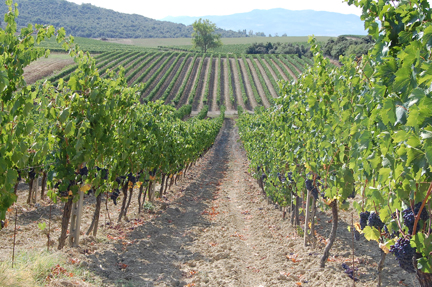
Above: Tafi’s research shows that the Sugarille vineyards were already devoted to the cultivation of grapes by the fifteenth century.

In his research, Tafi discovered that certain parcels were already devoted to viticulture by the fifteenth century. Today, Gaja uses those same growning sites for its flagship Brunello, the vineyard-designated Brunello Sugarille (the vineyard of the cork trees, sugheri in Italian).

Gaja’s vineyards lie adjacent to those of Soldera (who, together with his wines, will be the subject of an upcoming post). Many consider these historic growing sites to be among the best in the appellation. My guess is that centuries of sharecropping ultimately depleted the soil’s nutrients, making the white and brown earth ideal for the cultivation of fine wine grapes (but more on that later).
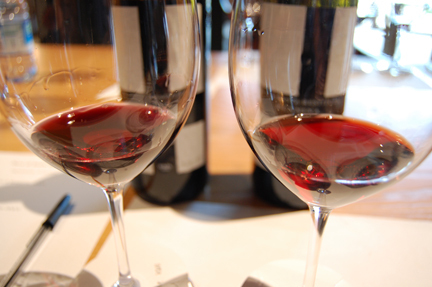
Above: Gaia poured me a flight of wines that spanned 1996 through 2008.

Of course, I was also there to taste Gaia’s family’s wines and I will not conceal that I was thoroughly impressed by the 2008 Brunello Sugarille (single vineyard) and the 2006 Brunello Rennina (which is sourced from three different vineyards on the estate). As you can see from the color in the image above, the wines were bright and transparent, and I found them to be excellent expressions of Sangiovese Grosso and the Brunello appellation. The red fruit was balanced by good acidity and powerful tannin (still very youthful in the case of the Sugarille) and there was none of the woodiness that I’ve found in earlier vintages of this wine. Here, in this most western subzone, elegance and purity trump the earthier expressions of Sangiovese that you find in the central, southwest, and southeast areas.

In my limited experience with Gaja’s bottlings of Brunello (since I can hardly afford them), I’ve seen an evolution (and I think that Gaia would agree) bringing them more into line with the classic profile of great Brunello. I thought the most recent vintages were great.

But, most of all, I was impressed by this fascinating restoration project, adding yet another destination to the many sites on my list of places to take Tracie P the next time we’re there. Truly exciting stuff for geeks like me!

*The reference to the madre vegliarda is culled from the great nineteenth-century Italian poet Giosué Carducci’s poem “La chiesa di Polenta” (“The Church of Polenta”). The title alone is worthy of a stand-alone blog post but it will have to wait.

Beauty (and ugly) in Italy

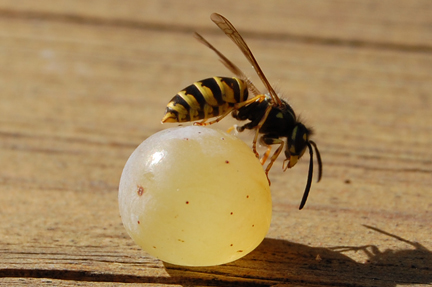
Above: A wasp feasts on newly picked Ribolla at Venica & Venica.

A quick post today, on this autumnal Monday back at my desk in Austin, comprised of photos from my trip, some of the most beautiful things I saw through my lens while in Italy. It was an incredible journey, replete with felicitous confluences, some serendipitous and delightfully unexpected, others grounded in epistemlogic contemplation and convex self-reflection.

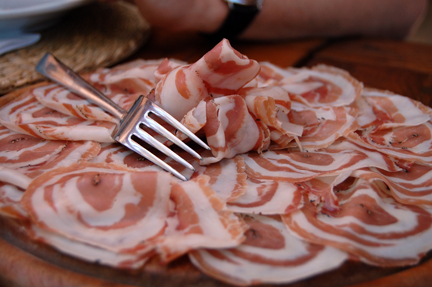
Above: Pancetta offered to weary travelers, also at Venica.

In the days that follow, I’ll begin posting in-depth accounts of my conversations and tastings with winemakers and restaurateurs in Tuscany, the Veneto, and Friuli. I am so grateful for all the comments, emails, Twitter mentions, and Facebook notes encouraging me and sharing insights into what I photographed, smelled, tasted, drank, and masticated over the course of the nearly three-week trip. And I am especially thankful for the incredible hospitality and generosity of spirit of my (literally) myriad hosts and guides.

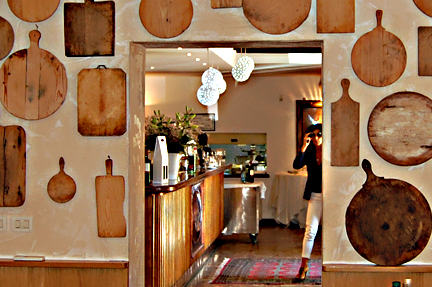
Above: A view from one of the dining rooms at Trattoria al Parco in Buttrio (Udine).

Immense and extreme beauty is offered to the willful traveler of the Italic peninsula: from her generous landscape to her innate and intrinsic humanity (both historical and topical), Italy continues to inspire me (and hopefully you) by revealing some of the mystery and joy of life through her topographic, aesthetic, and sensual pleasures.

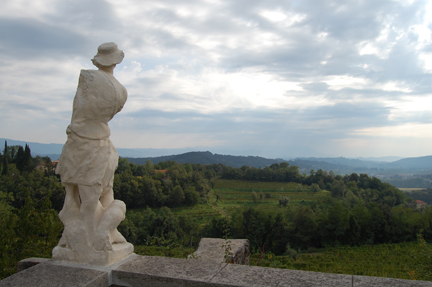
Above: A view from the Abbazia di Rosazzo in the Colli Orientali del Fiuli.

While I thoroughly enjoyed her bountiful intellectual and sensorial gifts, I was however acutely aware of the seemingly insurmountable societal and cultural issues and turmoil faced by the inhabitants (Italian and otherwise) of this profoundly gorgeous land.

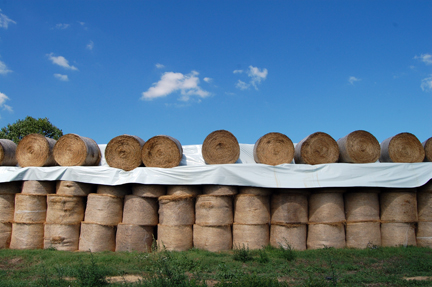
Above: Hay for Chianina cows near Pienza, Tuscany.

Whether it’s Berlusconi patently using one of his media outlets (in this case, Il Giornale, a top national daily) to sling mud at his rival Fini (now embroiled in a sticky familiar real-estate scandal) or the impending expulsion of Roma (following the highly controversial and contested model employed by Sarkozy), Italy and her peoples find themselves in circumstances eerily however distantly reminiscent of the “era between the two wars.” When I commented on the recent changing of the guard in the political regime of the region where she and her family make wine, one winemaker observed wryly but not inronically, “we were better off with the fascists in power than the [newly instated] separatists.”

Above: Sunset in Montalcino (Tuscany), viewed from the estate of Il Palazzone.

Perhaps it’s this precarious balance of salt and sweet that makes Italy always taste so great and greatly on our tongues. Thanks for reading…

With Elda Felluga at the Abbazia di Rosazzo

“Dream Team Friuli 2010” with Elda Felluga (Livio Felluga, to Bobby’s right in the center of the photo) at the Abbazia di Rosazzo in the Colli Orientali del Friuli.

Elda is an amazing, dynamic personality and I can’t wait to tell the truly epic story of her family and how they put the Colli Orientali del Friuli “on the map,” quite literally (and about the extremely special gift that Elda gave me).

What do you think about “Dream Team Friuli 2010” as the name of our group? Strappo, McDuff, Alfonso, suggestions please!