Friuli, here you come again…

Friuli, here you come again
Lookin’ better than a body has a right to
And shakin’ me up so that all I really know
Is here you come again …
And here I go…

The Colli Orientali del Friuli producers association has asked me to lead a group of bloggers to visit their appellation, taste, blog, eat, and taste some more.

Read all about how it came together and the bloggers we’ve selected here.

We arrive in Friuli a month from today, but we’ve already begun posting about COF, its grapes and wines, and its foods and folks.

Do you have a story about COF that you’d like me to repost at the #cof2011 blog? Just drop me a line by clicking here.

Buona lettura, ya’ll!

Here you come again
Just when I’ve begun to get myself together
You waltz right in the door
Just like you’ve done before
And wrap my heart ’round your little finger

Here you come again
Just when I’m about to make it work without you
You look into my eyes
And lie those pretty lies
And pretty soon I’m wonderin’ how I came to doubt you

All you have to do is smile that smile
And there go all my defenses
Just leave it up to you and in a little while
You’re messin’ up my mind and fillin’ up my senses

Here you come again
Lookin’ better than a body has a right to
And shakin’ me up so that all I really know
Is here you come again …
And here I go

Our night on the town with Lettie

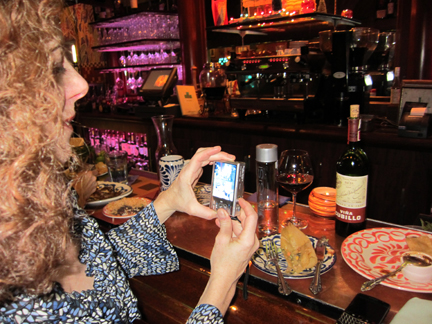
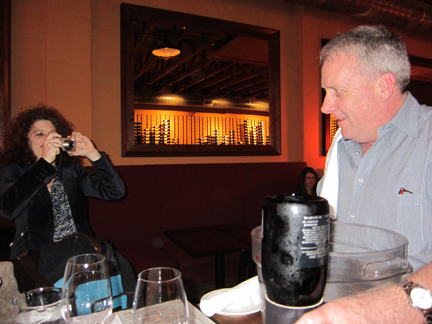
One of the more remarkable things that happened between Christmas and New Year’s was our night on the town in Austin with Lettie Teague. Lettie was in Dallas celebrating the holiday with family when Nature, by means of the east coast blizzard, decided not to let her fly back to New York. So, she decided to hit the road and come visit us in Austin, where we took her to some of our favorite spots, like Fonda San Miguel, where we had some huitlacoche tamales (de rigueur). Oddly enough, they were out of our fav Tondonia Rosado by López de Heridia and so Lettie proposed that we drink Gimmonet Champagne instead. The pairing was BRILLIANT!

Later, we took her to another one of our favorite nightspots, Vino Vino, where Jeff disgorged some Puro for her.

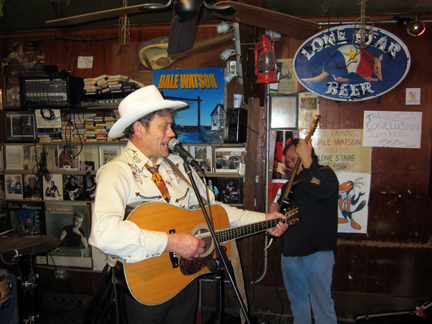
And, of course, no night on the town with Tracie P and me is complete without some late-night honkytonking at Ginny’s Little Longhorn Saloon.

Lettie wrote about our evening here. And I don’t care how much ya’ll holler: I ain’t givin’ you the number to the speakeasy we visited! Ya’ll will just have to come down and pay us a proper visit if you want to check it out!

Banfi, Brunello, and the Wall Street Journal

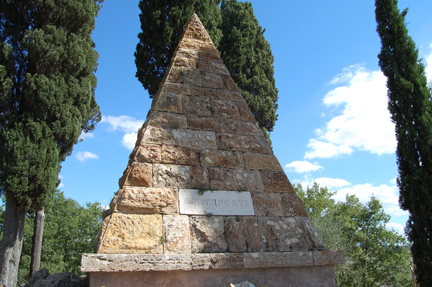
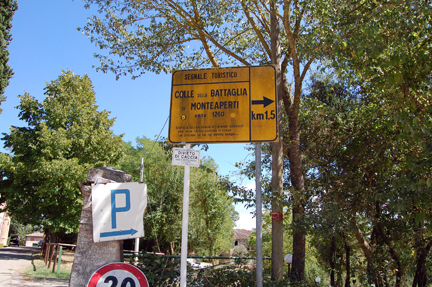
Above: When I made my annual pilgrimage to Montalcino in September of this year, I took time out to visit the monument at Montaperti, commemorating the 1260 battle there between the Guelphs of Florence (the Papacy) and the Ghibellines of Siena (Holy Roman Empire).

In her recent interview on the Wall Street Journal wine blog, “Co-CEO” of Banfi Christina Mariani states that the Brunello controversy of 2008-2009 “was just to make the press… Everyone was cleared, including us.”

When Italy’s top wine blogger Mr. Franco Ziliani (and co-editor of our blog VinoWire) reposted the interview on his blog last week, another top Italian wine blogger, Gian Luca Mazzella, posted links to two entries on his blog in the comment thread of Franco’s post: as he points out in his comment and one of the referenced posts (published by the Italian national daily Il Fatto Quotidiano on October 19, 2010), widely circulated accounts in Italy’s mainstream press reported that Banfi accepted a plea agreement in the Italian treasury’s “Operation Mixed Wine” investigation (where authorities alleged that certain Brunello producers had adulterated their wines, adding unauthorized grapes). It’s worth noting here that Il Fatto Quotidiano is one of Italy’s leading national newspapers.

The only wineries that were officially “cleared” were Biondi Santi and Col d’Orcia (a fact also widely circulated in the Italian mainstream press).

In fact, even Banfi’s current managing director, Enrico Viglierchio, told the Wine Spectator that the company had agreed to declassify some of its wine in an agreement with investigators (note that the title of the article is “Banfi’s Brunello Cleared”; the wine, not the winery, was “cleared” after the company agreed to declassify certain lots).
The Ghibellines won the battle but lost the war. Ultimately, the battle’s outcome consolidated the Pope’s power in Tuscany and a new era of Florentine and Papal dominance began.

You’ll note that I am merely reporting what has been written in Italy — before and after Mariani’s recent interview (if so inclined, please click on the links above and read my translations of Italian news reports and the report in the Spectator).

Out of respect for Ms. Mariani (and for a good friend of mine who works closely with her), there is no note of sarcasm nor sardonic editorial here.

I would like to address, however, one of her statements. In the interview, she tells wine writer Lettie Teague (one of our country’s most popular enojournalists and author and a super nice lady whom I know through our professional correspondence and tastings we’ve attended together): “If it’s not a health issue, it’s not an issue for consumers…”

She’s right: the appellation regulations that require Brunello producers to use only Sangiovese in their wine were written and approved by the producers themselves to protect the producers and appellation — not the consumer. In other words, the regulations were conceived to protect those producers who play by the rules in an appellation where 80% of the wine was being made with the addition of unauthorized grapes, according to producers association current president Ezio Rivella who served as Banfi’s managing director until 1999 and left the company after working in Montalcino since 1977 (and with the Mariani family since 1961).
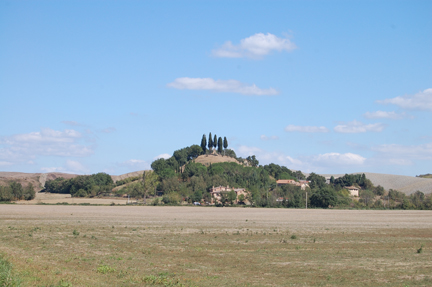
The battle and the events and political turmoil that followed (particularly the papacy of Boniface VIII) are central to Dante’s poem, the Comedy, and the overarching mission of his life — to achieve separation of temporal and spiritual powers in Europe, a notion dear to the forefathers of our country (did you know that Thomas Jefferson, a winemaker, spoke and read ancient Italian and could quote the Comedy from memory?).

Why did I incorporate images of the pyramid at Montaperti in this post?

I don’t get to Montaperti every year. In fact, I hadn’t been there in probably 10 years or so. I studied the Battle of Montaperti when I was a graduate student and have been fascinated with it since then. The 1260 battle there is central to Dante’s poem and its political themes. It marked the beginning of Siena’s decline as a world power and an era of political and human upheaval in Tuscany and Italy. (Montalcino is in the province of Siena, btw.)

As for the Sienese Ghibellines who won the battle at Montaperti but ultimately lost the war, their micro-state (city state) was ultimately absorbed by the greater power of Florence. I’ll let the reader infer any analogy that can be made here.

Thanks for reading. Tomorrow, I’ll pick up where we left off, posting about family get togethers and great wines we’ve been drinking with loved ones during the holiday season.

A shout out to Brunello and Do Bianchi in the “Journal”

Check out Lettie Teague’s Wall Street Journal interview with Cristina Mariani, co-ceo of Banfi who says that the Brunello controversy was “just to make the press.” (I’m not sure what that means.) Lettie also gives a shout out to Do Bianchi and VinoWire. Read the interview here.

And for my latest dispatch from Montalcino, read my post Sunrise with a Brunello Master here.

Where Italian wine and high tech meet (happily)

You may remember that when I first moved to Texas, I took a job hawking wine for one of the many wine “brokers” here (in the bizarre, anachronistic, archaic, and labyrinthine system through which wine is sold in this good ol’ boy state, where bowling shirts, deals made in strip clubs, and dry counties shape the topography of the business). I certainly don’t regret leaving that job (which I took to learn the lay of the land), nor do I regret the friendships I forged during that “hunker down and move forward” (à la Johnny Cash) time of my new life here.

Apulian winemaker Paolo Cantele, pictured above playing Chicken Shit Bingo at Ginny’s Little Longhorn Saloon with me and Tracie P in April 2009, is one of those friends. Paolo is a true humanist winemaker and our conversations in the time we spent together ranged from wine to Pasolini to politics to music to European literature to fine art (ask Paolo to tell you the tale of his hilarious encounter with Italian actor Ninetto Davoli).

A few months ago, Paolo asked me to give him a hand with a new and ambitious social media and technology project (in Italian, German, and English). One of his recent innovations (among many other high tech tools employed for marketing) is his new QR codes, which will appear on the back labels of his new vintages. How cool is that? But unlike the handful of northern winemakers who have begun using QR codes to send you to their corporate home page, Paolo’s link sends you to media created especially for each wine, including a video with Italy’s young, hip sommelier dude Andrea Gori and lots of other juicy info and images. Very cool stuff… Check it out here. (You can grab the code using your mobile device from the screen, btw.)

QR codes are the future and will soon begin to redefine the fabric of our consumerist lives in the U.S. (they already have in Asia and are beginning to take hold in Europe). And now they represent what is perhaps the newest form of wine writing!

I created the QR code below to link you to one of my favorite posts (use your smart phone to find out which one).

Zampone! @ the Parzen Christmas party

Alfonso and SO Kim drove down from Dallas last night for a weekend of cooking, eating, and opening some bottles that I’ve been saving for this holiday season.

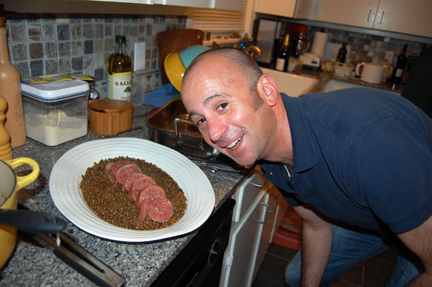
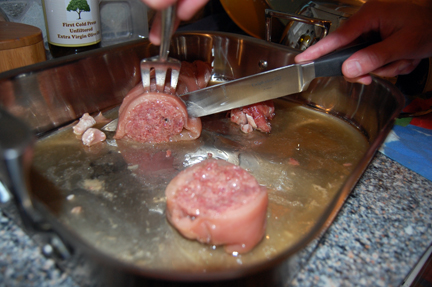
Don’t ask me how it got to our house (or how it got into this country) but last night I cooked one of my favorite Italian delicacies: zampone, a pig’s trotter stuffed with head cheese and then boiled. (@TWG you would love this stuff!)

Tracie P stewed some delicious lentils (which are traditionally served with zampone in Italy on New Year’s eve), aligot, and spinach. And I made a salsa verde (flat-leaf parsley, anchovies, garlic, and extra-virgin olive oil) and prepared some kren (grated horseradish with a touch of vinegar and sour cream) as condiments.

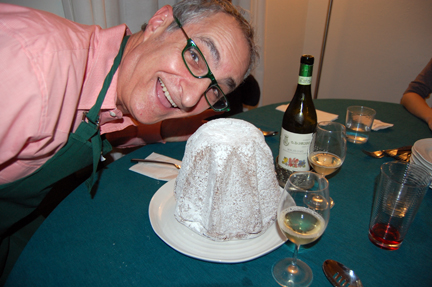
Alfonso brought a pandoro (which Tracie P and prefer over panettone) and we paired with OUR FAVORITE MOSCATO D’ASTI by Vajra. Man, that shit is good!

It’s going to be hard to top the sheer fun factor from last night but we’re going to try again tonight: Tracie P is making Jewish delicacy brisket and potato latkes for our Chanukkah party!

Stay tuned…

Power of the press blog: Chianti producers vote not to allow Super Tuscans at tasting

Above: the architects of Italian unification (1861). To the far left, Count Camillo Cavour, Italy’s first prime minister, a winemaker (Piedmont). In the center, unified Italy’s first king, Vittorio Emanuele II, a winemaker (Piedmont). To the far right, Baron Betting Ricasoli, Italy’s second prime minister, a land owner and winemaker in Chianti Classico, and the father of modern winemaking in Tuscany. Ricasoli’s estate Brolio and Vittorio Emanuele’s Fontanafredda still produce commercial wine today.

Would the founding fathers of Italy believed it if you were to tell them that a blog helped save Chianti Classico?

Today, Italy’s top wine blogger, Mr. Franco Ziliani, and I posted the following news story on VinoWire, our English-language blog devoted to the world of Italian wine: “Chianti Classico producers decide not to allow Super Tuscans at debut tasting.”

What we didn’t write was that Mr. Ziliani’s previously posted editorial, in which he harshly criticized the body for its inclusion of Super Tuscans in its annual new vintage preview, was cited by numerous members in the debate that preceded the decision (whereby the body’s president announced he was retracted the option).

It’s not the first time that Mr. Ziliani — a true flagellum principum — has helped to protect and promote traditional winemaking in Italy through his blog. Chapeau bas, Franco!

The pen is… scratch that… The pen blog is mightier than the sword!

Get this woman some unyeasted, unmaloed Falanghina STAT!

The other day, when I was having lunch with BrooklynGuy in Brooklyn (of all places), we chatted about my life Texana and the wonderful “humanity” I’ve found here, even in places coastal dwellers wouldn’t expect in this mostly red state. At a certain point, he stopped me, looked me in the eye, and asked with a smile: “you’ve really fallen for Texas, haven’t you?”

Anyone who follows my blog knows that I love my wife dearly, I love my life Texana, I love my Texan family (from cousins Joanne and Marty to Mrs. and Rev. B) and I love Texas. But Texas has a problem.

Texas does not allow out-of-state retailers to ship to Texas. Technically, it has to allow them to ship here. But the big wine distributors’s shime-waza on the Texas legislature has allowed them to create a logistical obstacle, making it virtually impossible for out-of-state retailers to ship here (I’ve written about it, with documentation, here).

As a result I cannot get my beautiful wife (above) the unyeasted, unmaloed Falanghina that her heart calls out for. Please read her most recent post where she plaintively writes:

    So here we are back in Texas, and my heart calls out for the real thing. My DoBianchi brought home a shiny white ball of Mozzarella di Bufala and a bottle of Cantine del Taburno Falanghina, but, alas, I am still searching for an unoaked/unmalo-ed/non-acidified yet certified stateside version. I won’t give up. I can survive on the fumes of my memories just a little longer.

Get this woman some unyeasted, unmaloed Falanghina STAT!

In other news…

Yesterday, we officially launched a new project I’ve been working on, also close to my heart, a blog I’m writing for Houston restaurateur Tony Vallone.

We’ve been working on it for a month and I’ve really come to look forward and cherish our weekly hour-long chats where we talk about a day in the life of an Italian restaurateur in America. Check it out. I think you’ll enjoy it as much as I do.

Buona lettura, ya’ll!

Frito pie, impossible wine pairing?!?

chili frito pie

Above: The other night an excellent Frito Pie prompted me and my dining companions to contemplate the moisture retention quotient of the humble Frito, which, I learn via the Wiki, originated in San Antonio, Texas (where else?).

I think I might have Dr. V stumped. Chips and salsa may be tough, but Frito Pie?

If you’ve never had Frito Pie, it’s essentially a heap of Fritos drowning in Texas chili and then topped with cheese and sour cream.

I had never had Frito Pie before moving to the south. Since my life Texana began nearly 3 years ago, I eat Frito Pie — a true Texan delicacy — whenever afforded the opportunity.

The other day outside of Houston, Cousin Marty and I had what we both agreed was the BEST FRITO PIE EVER.

What did our sommelier pair with it?

As BrooklynGuy occasionally asks of his readers, you be the sommelier!

Please add your recommendations in the comment thread and I’ll provide the answer (it was brilliant, btw) on Friday along with a story about the amazing place where we were served the pie above…

Raise a glass for Luigi Veronelli

Above: I furtively managed to make a scan of Veronelli’s autograph when I visited the Terlato Wines International Tangley Oaks mansion earlier this year.

Luigi Veronelli, “intellectual, writer, liberatarian, literally the inventor of wine journalism in Italy,” wrote Italy’s top wine blogger Mr. Franco Ziliani this morning on his new blog Le Millle Bolle, raising a glass of traditional method sparkling wine to remember the architect of the Italian food and wine renaissance on the sixth anniversary of his passing.

Regrettably, very little of Veronelli’s writing has been translated into English (aside from what I’ve translated on my blog, where he appears often).

It’s difficult for the solely Anglophone lovers of Italian food and wine to gauge the reach and scope of Veronelli’s legacy (would Eataly have been possible — even conceivable — without him?).

Check out this amazing video, from 1975, when Veronelli was 49 years old and had yet to publish his landmark catalog of the wines of Italy (1983). It was posted in the comment thread of Mr. Ziliani’s post by the brilliant Giovanni Arcari, one of my favorite Italian winemakers and a good friend (look for Giovanni in the Franciacorta pavilion at Vinitaly this year and he will BLOW YOUR minds with the wines he makes and pours).

In it, he demonstrates how to make spaghetti alla chitarra. Italian is not required for viewing but the Pasolinian implications of the subtle dialectal inflections will not be lost on the Italophones among us.

Please join Tracie P and me in raising a glass tonight to this truly epic hero and sine qua non of contemporary Italian food and wine.