Eating our way through California

california tomatoes

Above: Top Italian wine writer Mr. Franco Ziliani (possessor of a palate I admire immensely) likes to tease me (rightly) about how I’m so crazy for the wines of Piedmont, I’ll even drink Barolo in the middle of the “scorching hot” Texas summer (and believe me, it’s been a hot one in Texas this year!). Well, yesterday I quit the California dreaming and did me some serious California eating! Those are tomatoes from Chrissa and Dan’s garden.

grilled marlin

Grilled marlin, scallops, and shrimp for lunch with client and new friend Mike K at the classic ol’ San Diego downtown eatery Dobson’s. (Thanks again for lunch, man!)

baker and olive

Savory San Diego Bread and Cie bun with locally sourced olive oil from Baker and Olive, and Fra’ Mani salame at epicurean Chrissa and Dan’s place (a truly yummy locus amoenus their house is!).

california produce

Dan’s excellent heirloom tomato salad, sourced from their garden (what’s the name of the Polish cultivar?).

california sushi

Late-night sushi at Miso Harney sushi in Old Town (they serve until 12 a.m.!) after Tracie P got in from Austin (I got in the day before). Geared for a young crowd, Miso Harney is a great place for later-in-the-night super fresh San Diego sushi and an SD-restaurant-industry fav.

california traffic

Of course, there’s also the California summer traffic to contend with. Ugh… Not so bad though, considering the view!

I bet you’re gonna like where we’re headed today… Stay tuned… It’s a special one…

Sognando Piemonte (Piedmont Dreamin’)

bricco boschis

Above: We got to drink a bottle of 2005 Barolo Bricco Boschis by Cavallotto last night. Photo by Tracie P.

As Tony Coturri told me the other day (and as Mama Judy mentions when we talk on the phone each week), California is having the coolest summer it’s had in anyone’s memory. Out here in Texas it’s H-O-T hot — not exactly what I would call “Barolo weather.”

But when our friend (and my client) Julio messaged and said he had a bottle of 2005 Barolo Bricco Boschis by Cavallotto that he wanted to share with us, we couldn’t resist.

And, man, what a treasure in this bottle. Here’s Tracie P’s tasting note: “bright cherry acidity with graphite minerality and a balance of earthiness, so balanced and savory and fruity; it just had everything in the right place…”

The wine is young and the curious thing was how generous it was with its fruit right when we opened and decanted it. But by the time we finished the bottle, it had begun to close up.

On a hot Texas summer eve, it made me dream of Piedmont and a few new-to-me destinations I can’t wait to visit when I return. Like the Museo dei Cavatappi, the Corkscrew Musuem in the town of Barolo.

paolo annoni

I was actually scrounging the interwebs for something else (for a consulting job) when I came across Paolo Annoni (above) and his amazing museum, which preserves more than 500 corkscrews from the eighteenth century to the present. As they say in Italian, this type of stuff is pane per i miei denti, literally, bread for my teeth, in other words, I can’t wait to sink my teeth into it.

serralunga

Another destination at the top of my list is the Vinoteca Centro Storico in Serralunga. I literally drooled over my keyboard when I read about it in the excellent blog authored by McDuff, who possesses one of the palates I admire the most.

Check out his post for details. Just the thought of grower Champagne and carne cruda is enough to make the mimetic desire kick in (at 9 a.m. in the morning, I can literally feel my saliva glands working as I type). Auerbach anyone?

aaaaaaaa… Sognando Piemonte…

Frittata di pasta porn (and recipes)

After I made Spaghetti al Pomodoro the other night for dinner (in this case bucatini), Tracie P used the leftover noodles to make a Neapolitan-style Frittata di Pasta. The dish was so stunning, visually and otherwise sensorially, that I was compelled to document it. After all, this is my “web log” after all, isn’t it? Enjoy… and thanks for reading!

frittata di pasta

Spaghetti al Pomodoro

As my good friend Renato dal Piva taught me (when I used to play in his clubs in the Bellunese), you should be able to get the tomato sauce simmering by the time the water boils. By the time the pasta is done cooking, the sauce will be ready.

Finely chop ¼ medium size white or yellow onion and sautée with a handful of flat-leaf parsley together and one lightly crushed garlic clove in extra-virgin olive oil. When the onion becomes translucent , add 1½ cup puréed, crushed, or whole canned cherry tomato (if using whole Roma tomatoes, crush the tomatoes using a spatula). Add ¼ cup room-temperature white wine. Season with kosher salt, pepper, and crushed chili flakes. Simmer until the pasta is not quite cooked through (about 1-2 minutes under the suggested cooking time).

frittata di pasta

In the meantime, bring a large pot of water to boil. After it begins to boil, season with a generous handful of kosher salt. Cook the spaghetti until not quite cooked through (as above). About 3 minutes before the pasta is done, add ½ ladleful of its cooking water to the sauce. When the pasta done, fold the noodles into the sauce and toss over low heat. Serve hot, drizzled with a drop or two of extra-virgin olive oil and with freshly grated Parmigiano Reggiano on the side (ironically, I prefer not to sprinkle with the cheese, despite my northern tastes, while Tracie P, with her southern tastes, opts for cheese).

For the tomato sauce, our favorite brand is La Valle, in particular its cherry tomatoes (pomodorini). We also like Muir tomatoes from California and Progresso is good, too. The important thing is to find tomatoes to which nothing but salt has been added (Del Monte, Hunt’s etc. will all work fine). In summer months when fresh basil is available, omit the flat-leaf parsley and add torn basil leaves after the tomato sauce has begun to simmer.)

For the pasta, we used La Valle bucatini that Alfonso had brought us from Jimmy’s Food Market in Dallas. As far as commercial, easy-to-find brands are concerned, Tracie P likes DeCecco (her southern tastes), while I like Barilla (my northern tastes).

frittata di pasta

Frittata di Pasta

Beat two eggs with a handful of freshly grated Parmigiano Reggiano, add the beaten eggs to the leftover pasta in a mixing bowl, and toss gently. Cover the bottom of a small pan with extra-virgin olive (about 2 tablespoons depending on the size of the pan) and heat over medium-flame. As soon as the oil begins to smoke, add the pasta and cover. Cook for 2-3 minutes and then reduce heat to low. Cook for 20 minutes and flip (to flip, quickly remove cover and then recover with a ceramic plate; hold the plate in place, swiftly turn the frying pan over and then slide the frittata back in the pan). Cook for another ten minutes and serve hot.

Once cooled, wrap the frittata in plastic wrap and conserve in the fridge. It will be great, sliced on bread or re-warmed. With the quantities above, Tracie P and I obtain 3 meals!

Buon appetito, ya’ll!

Rock the Gulf Benefit at the Shuck Shack Austin

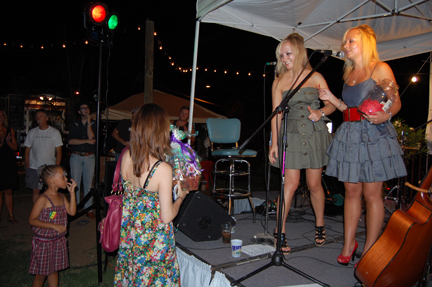
Can you think of a better place in Austin to hold a Rock the Gulf benefit than the Shuck Shack? This tasty little seafood joint is at the top of our list for summer outdoor Gulf Coast-style dining. You see, for all of ya’ll who ain’t never been down to the south too much, Gulf Coast dining spots dot the highways and cities of the Lone Star State from Orange on the Lusiana border (where Tracie P grew up) to Austin, the cradle of the west. All of these businesses, many of them locally owned liked the Shuck Shack, have been affected by the oil spill disaster.

The Shuck Shack is one of Tracie P’s accounts (and one of her favs, I may add) and she helped to rustle up donations for this exceedingly well organized (I must add) event held last night on the south side of Austin. That’s owner Katherine Fertitta and manager Bill Garcia.

Fried catfish, Texas caviar, biscuit, and corn on the cob. Uh huh…

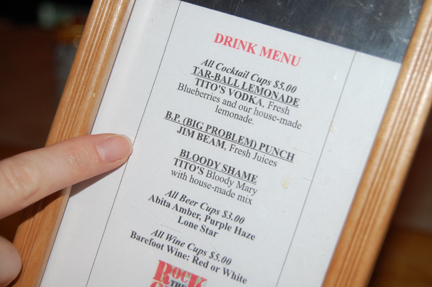
I couldn’t resist the “Bloody Shame.” Tracie P had a “Tar Ball Lemonade” (with muddled blueberries playing the starring role).

The music (I also must say) was excellent, but, then again, that happens nightly in Austin (how do you like my Texas swagger?). Tracie P even won a donated raffle prize! How about that???!!! An Eddy Summer Sausage basket that will be greatly enjoyed this estive season Chez Parzenella!

To find out about how you can help, check out the Gulf Restoration Network.

I Am Love (I Am Cinema) and good things we eat and drink

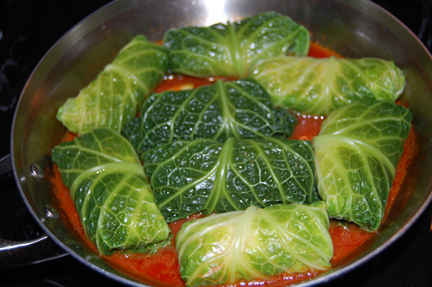
Above: Over the weekend, Tracie P made cabbage leaves stuffed with shredded pork and rice and then braised in puréed tomato. Delicious…

The same way some of my favorite wine bloggers share my passion for music, like McDuff and Eric the Red, many of my blogging colleagues share my passion for cinema, like Lyle and Tom. (They tell me I know a little about cinema and Italian cinema in particular.)

Over the weekend, Tracie P and I finally went to see I am Love, the (relatively) new (to American audiences) movie by director Luca Guadagnino. We both loved it and I highly recommend it (and I thank Comrades A and H for nudging us to see it!).

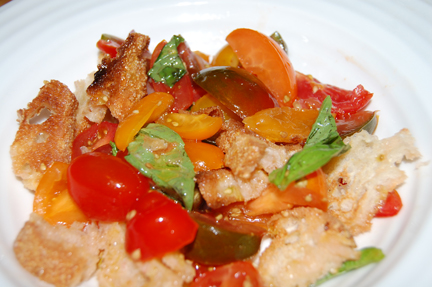
Above: Summertime means PANZANELLA chez Parzenella… so yummy…

There are plenty of insightful reviews of the movie but I wanted to make one (I feel) important point about it. So many reviewers have made reference to Guadagnino’s homage to Visconti in this work (and there is a Viscontian influence here, no doubt). But there are many other cinéaste and cinephilic references here.

I’m not the first to note that Pasolini’s Teorema is a patent model for this work, where chef Antonio is a parallel to Terrence Stamp’s character in the former.

But I may be the first to point out that Antonioni’s influence is also immensely felt here: the shots of Milan and in particular industrial Milan are clear references to Antonioni’s tetraology, L’Avventura, La Notte, L’Eclisse, and The Red Desert. And even more significantly, the characters’s sense of alienation and the “substitution” of one relationship for another in the search for elusive happiness owe much to Antonioni’s thoughtfully two-dimensional world.

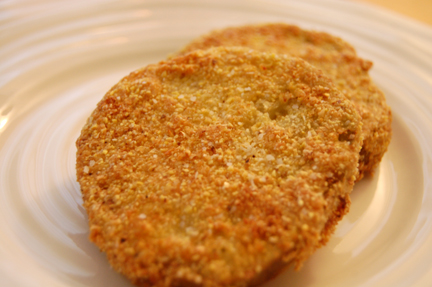
Above: Some southern girls knew how to make fried green tomatoes even before they went Hollywood! Gelatinous on the inside, crispy on the outside.

Most significantly, I Am Love is a film that is aware of being a film and being part of a great cinematic tradition: I am Cinema. The shots of industrial Milan and the textile factories, for example, evoked a genre of Italian nationalist documentary filmmaking that first emerged during fascism and reached its peak during the “economic miracle” of the 1960s. The use of Giacomo Giulio da Milano’s font Neon in the credits and captions was a sort of epicinematic allusion that paid homage to the grand tradition of Italian design at its peak in the 1930s (Neon was forged in 1935 at the Fonderia Nebiolo in Turin). Those same “happy years” of fascism saw the Recchi family expand their influence, power, and wealth (remember the conversation between Edoardo and his colleague?).

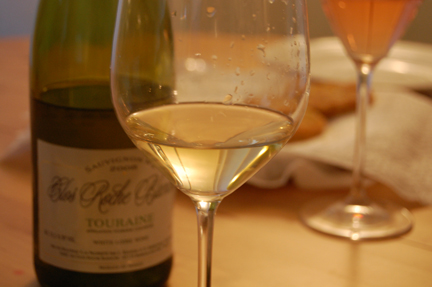
Above: The 2008 Sauvignon Blanc by Clos Roche Blanche is probably going to be my white wine of the summer. At under $20 (available at The Austin Wine Merchant, where we got it), this delicious wine paired stunningly (and affordably) well with the pork medallions that Tracie P served with shredded cabbage and homemade pear chutney. Really and truly one of those sublime pairings.

The overarching theme of Gaudagnino’s film and story is one that belongs steadfastly to Italian cinema, especially when viewed in its inherently Marxisant paradigm: the alienation of a sense of humanity through the reification of the body.

And, here, I am confident that Gaudagnino would agree with me: Antonio the proletarian chef, whose craft brings him into contact with an otherwise elitist and esoteric group (after he “beats” Edoardo in the race), becomes a conduit that allows the characters to “return to nature” using a Leopardian and ultimately Rousseauan lexicon.

The food porn sequence (where Emma eats a shrimp, how phallic is that?) and the farm-to-table sex sequence (a symphony of cross pollination) represent the triumph of nature over materialism.

After all, when the chef at some chichi lower Manhattan restaurant regales her/his patrons with tales of the farmhouse where she/he has sourced her/his heirloom cultivars of elderflowers used to infuse her/his coulis, is it not an extravagant (in the etymological sense of the word) attempt to cheat materialism for the sake of a false Mother nature?

I hope that Emma will find what she’s looking for in Antonio, but somehow I don’t think she will…

I am love, I am cinema, and I am a fried green tomato. Thanks for reading…

And buona visione, as they say…

Best wine in Chicago and what Comrade H had for dinner

Comrade T recently wrote me asking for advice on where party members find good wine in Chicago. I reached out to Comrades N and L for their advice and here’s what they said (paired with Comrade H’s excellent dinner, including Comrade B’s Dolcetto).

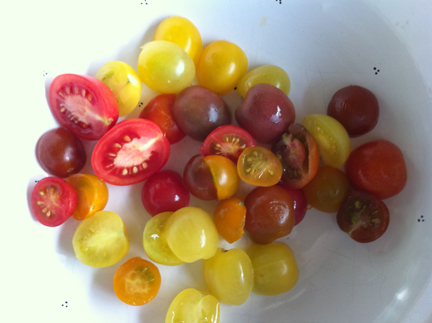
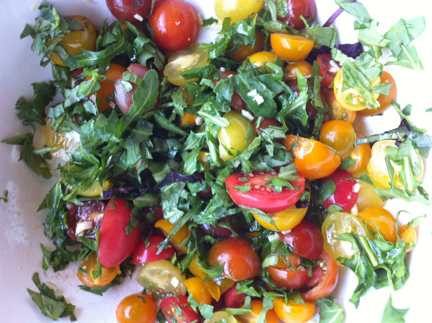
Start with the first good cherry tomatoes of the summer.

FROM COMRADE N

Comrade J, we’re always happy to aid the cause.

Webster’s and Rootstock are the most simpatico establishments in my view. Avec is also a good choice.

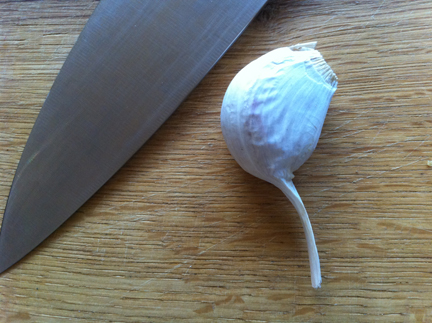
Good garlic.

If you really want top Italian wines (including properly aged), head to Spiaggia but be prepared to pay dearly for the privilege.

Comrade T, if you need recs for restaurants, shops or anything else in town, feel free to drop me a line.

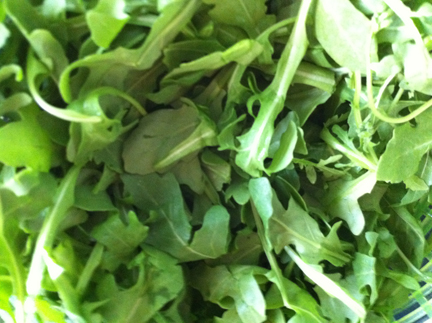
Wild arugula.

FROM COMRADE L

The two Comrade N mentioned are really it in terms of well thought out, conscientious lists. Again, Comrade N is right in that Spiaggia, while quite expensive, has a very well thought out list. And Alinea, too. This is just more of a beer town (and BYO which helps). That said some places do have nice lists. I just went to the Purple Pig the other week and was able to find a few things (they have some López de Heredia there).

Life is good.

Anyway, below is a list that I put together for someone a couple months ago. The only thing I’d add is the new Girl and the Goat that just opened by Stephanie who won Top Chef a couple seasons ago.

RESTAURANTS
http://www.longmanandeagle.com/
http://www.kumascorner.com/
http://thepurplepigchicago.com/
http://thepublicanrestaurant.com/
http://www.avecrestaurant.com/
http://www.thebristolchicago.com/
http://www.nightwoodrestaurant.com/
http://www.rickbayless.com/restaurants/xoco.html
http://bigstarchicago.com/
http://www.girlandthegoat.com/

COCKTAILS/BEER
http://www.whistlerchicago.com/
http://www.theviolethour.com/
http://www.maproom.com/
http://hopleaf.com/

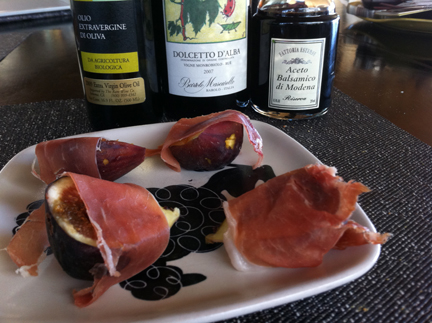
And of course, good oil (sourced from Rare Wine Company), good wine (Comrade B’s Dolcetto), good vinegar…

WINE STORES/BARS
http://www.permanwine.com/
http://www.redandwhitechicago.com/
http://www.websterwinebar.com/
http://rootstockbar.com/

AVANTI POPOLO!

(and buon weekend, ya’ll!)

Maybe it’s the way she grates her cheese: Tracie P’s rice balls

Maybe it’s the way she grates her cheese…

Above: When Tracie P asked me what I wanted for my Sunday night birthday dinner, I told her I would love her fantastic ragù. It was great as always, but she surprised me with RICE BALLS. Unbelievably good…

Whether its Faicco’s in the City or the Focacceria di Ferdinando in Brooklyn, Tracie P knows that I love me some Sicilian rice balls. On Sunday she made me one of my favorite dishes of hers, her ragù, but she surprised me with fried rice balls: stuffed with Brooklyn-style domestic mozzarella, using some leftover risotto alla parmigiana that I had made with Arborio earlier in the week for supper.

Or just the freckles on her knees…

Above: Did I mention that the GIRL CAN COOK?

She ALSO surprised me with a bottle of 2004 Sagrantino di Montefalco by Paolo Bea. This wine, at once extremely tannic and ethereal in the mouth, achieves that magic balance of simultaneous power and lightness in the mouth. It showed stunningly well last night and was such a great pairing for Tracie P’s stellar ragù alla bolognese (via Marcella Hazan).

Maybe it’s the scallions…

Above: Our favorite dried (pastasciutta) egg tagliatelle are made by Rustichella d’Abruzzo. Isn’t funny how Tracie P and I agree on the important things in life? ;-)

My good friend Charles Scicolone is not the only one “blessed” by his wife’s amazing cooking!

Maybe she’s Italian…

blueberry pie

Above: She also made me a DELICIOUS fresh blueberry crostata, a tradition for my birthday started by mama Judy.

My goodness, Tracie P, what a wonderful birthday week (I’ll have to hope my birthday falls in the middle of the week again next year!). I love you so… :-)

The lady sticks to me like white on rice…. She never cooks the same way twice…*

Above: We’ve been having so much fun with our new Polaroid 300 instant camera.

Rev. and Mrs. B and the B family gave me a power drill for my birthday over the weekend when we visited with them on Canyon Lake in the Texas Hill Country. We SO NEEDED it for our little home and the new library I’ve been setting up. :-)

Thanks, so much Rev. and Mrs. B and B family!

Birthdays used to be a nagging reminder of all the things I haven’t done yet in life. Now they remind me how lucky I am to be surrounded by wonderful folks who share such rich love and warm joy for living with me. Thanks again, also, to everyone for all the warm birthday wishes this week on Facebook, Twitter, and here at the blog… I’ve got so much to be thankful for this year… The words of support mean so much…

* “Eggplant” 1975 (same vintage as Tracie P!) by Michael Franks (my fellow La Jollan)

In other news…

Everyone in Italy is reading BrooklynGuy’s excellent post on old vintages of Vallana Spanna. Be sure to check out Alfonso’s comments to the post as well.

The James Suckling era ends (and what we ate and drank for my birthday)

poggione

Above: We treated ourselves to a bottle of 2004 Il Poggione Brunello di Montalcino and porterhouse steak last night in celebration of my birthday. When we planned this classic Tuscan meal, I had no idea that my birthday would also deliver the news that James Suckling had left the Wine Spectator.

Yesterday, as we were preparing for birthday and Bastille Day celebrations chez Parzen, the following news arrived via email from a colleague and friend:

    James Suckling, who joined Wine Spectator in 1981 and has served as European bureau chief since 1988, has retired from the company.

    Suckling’s tasting responsibilities have been reassigned. The wines will be reviewed in our standard blind-tastings in the company’s New York office.

    Senior editor and tasting director Bruce Sanderson will oversee coverage of Italy. Sanderson, who has been with the magazine for 18 years, currently reviews the wines of Burgundy, Champagne and Germany.

fiorentina

Above: To make a proper “bistecca alla fiorentina” at our house, we season the porterhouse generously with kosher salt, rubbing the salt into the meat, and then we char the T-bone, with the steak upright.

Neither Tracie P nor I could ignore the uncanny coincidence that we had decided to open a bottle of 2004 Brunello di Montalcino by Il Poggione, a traditional-style wine made by a family who has vehemently and vociferously opposed the modernization of its appellation. There’s no two ways about it: during James Suckling’s tenure at the Wine Spectator, the scores he gave to modern-style Brunello — with Casanova di Neri as its poster child — helped to eclipse the sale of traditional-style wines, like those made by Il Poggione. (In all fairness, Suckling also gave good scores to Il Poggione but his historic preference for dark, concentrated, oaky Brunello with higher alcohol levels, indisputably skewed his evaluations toward modernism.)

fiorentina

Above: Then you cook the steak on either side, very quickly at high heat. By cooking the steak upright first, the meat “heats through” entirely.

Another layer of irony was cast upon the news and our Brunello by the fact that Mr. Franco Ziliani — at times Mr. Suckling’s detractor — had suspended publication on his wine blog Vino al Vino, the leading Italian-language wine blog, a few days earlier. (Mr. Ziliani’s relationship with Mr. Suckling is even referenced by the author of the Wiki entry on the Italian wine writer.) “A pause for reflection,” wrote Mr. Ziliani on Monday, a search for “clarity” in his life and for a sense of purpose for the blog, he explained. “To blog or not to blog,” he asked rhetorically.

fiorentina

Above: High heat is the key to searing and caramelizing the fat on the outside of the steak while leaving the meat in the center tender and nearly raw.

The two events are certainly unrelated but their confluence is rich with meaning. We often forget that that the current economic crisis has affected both the wine industry and the publishing industry. Hawking wine is no easy tasks these days (especially when it comes to high-end, luxury wine like Brunello) and hawking newspapers and magazine is even harder.

fiorentina

Above: Traditional style Brunello and steak, one of the great gastronomic pairings in the Western Canon. (Honestly, I wish I would have used a slightly shorter cooking time. I prefer my steak “black and blue,” charred on the outside, blood rare on the inside. But it was delicious nonetheless!)

While I’ve been a devoted fan of Mr. Ziliani’s blog since I first discovered his writing more than 5 years ago, I can’t say that I’ve been such an admirer of Mr. Suckling’s take on Italian wine. In fact, I think that Suckling historically ignored and omitted the great icons of Italian wine from the canon of the Spectator’s “top wines of the world” because he was looking for wines that appealed to his idiosyncratic sensibility without viewing them in a broader scope and without consideration for the wines that Italians consider to be indicative of their winemaking tradition. At the same rate, looking back on Suckling’s legacy (however skewed) as an arbiter of Italian wine, I feel compelled to acknowledge his contribution to the world’s awareness of the overarching greatness of Italian wines.

fiorentina

Above: Potatoes, spinach, grilled onions, and steak, all dressed simply with kosher salt and extra-virgin olive oil.

And so we raised a glass of 2004 Brunello di Montalcino by Il Poggione last night, to both Mr. Suckling and Mr. Ziliani, polar opposites in their approach to Italian wine, leading voices of antithetically positioned vinous philosophies. I hope and trust that both will continue to share their impressions and palates, using whatever media they see fit, with a world ever-thirsty for Italy’s unique wines.

Rewind: The origins of sugo alla puttanesca?

Taking a break today and reposting something from the days when Do Bianchi was just getting started. One of my favorite posts. Little did I know at the time that I would meet and marry a wonderful, beautiful lady who had lived on the island of Ischia and who makes the best puttanesca I’ve ever tasted… Thanks for reading! And happy Bastille Day!

Above: spaghetti alla puttanesca. There’s one thing we can all agree on: “sugo alla puttanesca” (literally “whoreish sauce”) is made with tomatoes, olives, capers, salt-cured anchovies, garlic, and chili flakes (give or take an ingredient or two). There’s no questioning that it tastes good.

In the wake of my post-new-year’s eve post “Taittinger alla puttanesca”, fellow bloger Marco wrote me, collegially questioning my belief that “sugo alla puttanesca” should not be attributed to prostitutes or their culinary preferences. I promised Marco that I would do some more research and another post. Here’s what I found:

1) the earliest text to reference pasta “alla puttanesca” cited by the Grande dizionario della lingua italiana (edited by Salvatore Battaglia) is Raffaele La Capria’s 1961 novel Ferito a morte (translated as The Mortal Wound, 1962).

2) according to a study commissioned by the Unione Industriali Pastai Italiani (Italian Pasta-Makers Union), pasta “alla puttanesca” first became popular in Italy during the 1960s.

3) a search in The New York Times electronic archive revealed that the first mention of “puttanesca” sauce in the paper was made on January 28, 1972 by restaurant reviewer Jean Hewitt in her review of Trattoria da Alfredo (then located at 90 Bank street): “spaghetti Puttanesca [sic], which has a tantalizing tomato, garlic, anchovy and black olive sauce.”

4) in her landmark tome on Neapoitan cuisine, La cucina napoletana (1977), Jeanne Carola Francesconi attributes the creation of sugo alla puttanesca to Ischian painter Eduardo Maria Colucci (1900-1975) who — according to Francesconi — concocted “vermicelli alla puttanesca” as an adaptation of alla marinara or “seaside-style” sauce.

But the definitive albeit anecdotal answer to this conundrum may lie in an article published by Annarita Cuomo in the Ischia daily, Il golfo, in February, 2005: “Il sugo ‘alla puttanesca’ nacque per caso ad Ischia, dall’estro culinario di Sandro Petti,” “Puttanesca sauce was born by accident in Ischia, the child of Sandro Petti’s culinary flair.”

According to Cuomo, sugo alla puttanesca was invented in the 1950s by Ischian jet-setter Sandro Petti, co-owner of Ischia’s famed restaurant and nightspot, the “Rancio Fellone.”* When asked by his friends to cook for them one evening, Petti found his pantry bare. When he told his friends that he had nothing to cook for them, they responded by saying “just make us a ‘puttanata qualsiasi,'” in other words, “just make us whatever crap” you have (see my original post for a definition of the Italian puttanata).

“All I had was four tomatoes, a couple of capers, and some olives,” Petti told Cuomo. “So I used them to make the sauce for the spaghetti.” Petti then decided to include the dish on the menu at the Rancio Fellone but “spaghetti alla puttanata didn’t sound right. So I called it [spaghetti] alla puttanesca.”**

Petti’s anecdote is probably tenable but is by no means exhaustive (from a philological point of view). To make matters worse, Colucci was Petti’s uncle and it’s unclear why Francesconi attributes the dish to the painter. But philology is an inexact science: the origin of sugo alla puttanesca probably lies some where between the isle of Ischia and the Amalfitan coast, where tomatoes, capers, olives, anchovies, and garlic are ingredients of choice. It’s clear that the dish emerged sometime after World War II when tomato-based sauces grew in popularity among the Italian middle class. My philological sensibility leads me to favor the “puttanata/puttanesca” theory over any other and there is no evidence — at least that I can find — that points to prostitution as the origin of the dish.***

There’s one thing we can all agree on: sugo alla puttanesca tastes good.

* A rancio fellone is a sea spider or spiny crab, a common ingredient in Mediterranean cuisine.

** Like the French à la, the Italian expression “alla” (the preposition a + the definite article la) denotes “in the style of” or “after the fashion of” and is always followed by an adjective (not a noun); alla puttanesca sounded better to Petti because puttanesca is an adjective (while puttanata is a noun).

*** In his Naples at Table (1998), the otherwise venerable but hardly philologically minded Arthur Schwartz reports a number of apocryphal etymologies whereby Neapolitan prostitutes are indicated — in one way or another — as the originators of this dish. He even goes as far as to write that a seemingly celebrated nineteenth-century courtesan, Yvette “La Francese” (Yvette the French [prostitute]), a native of Provence, may have created the dish to assuage her homesickness. The fact that the dish emerged during the 1950s would seem to dispel any romantic notions of pasta alla puttanesca in nineteenth-century Neapolitan bordellos. Brothels were outlawed in Italy in 1958.

Wines I drank with Russian spies in LA at Marouch

Above: The 2000 Chateau Musar white (Sémillon) was FANTASTIC at Lebanese/Armenian restaurant Marouch in Los Angeles last night. At 10 years out, this wine is just coming into its own: oxidative and richly aromatic, with gorgeous nutty and stone fruit flavors.

Strained diplomatic relations between the two countries and the delicate nature of my mission as cultural attaché do not allow me to reveal the names of the persons with whom I dined last night. Let it suffice to say that they were all ethnic-Russian Jews who — at some point in their lives — have harbored sympathy for the Communist Party and/or own or have at one time owned a copy of Chairman Mao’s “Little Red Book.”

Above: Not to be missed at Marouch, the fried sardines. Serge, a wonderfully convivial host who came to this country more than 30 years ago, allows corkage in his fine establishment, which I cannot recommend enough.

Owner Serge Brady blew our communist party away with his superb cooking. I can’t believe I’ve almost reached 43 years of age without knowing about his restaurant. Amazing… While I was waiting for my friends, I sipped the Musar and noshed on turnips pickled in vinegar and red wine and cured olives. Perfection… simple and utterly undeniable and inconfutable perfection…

Above: My decoder ring was embedded in the Fattouch (Lebanese Salad).

Among other bottles opened last night, it was the Pascal Janvier 2009 Coteaux du Loir Rouge “Rosier,” made from Pineau d’Aunis, that captivated our senses more than any other. Some of my companions preferred it chilled, but espionage, my friends, is a dish best served température ambiante. Lip-smacking delicious wine. [PHOTO UNAVAILABLE FOR SECURITY REASONS!]

Above: Secret messages where imprinted in the Bastourma (Armenian Salami), which melted in your mouth after the for-your-tongue-only information was decoded.

But as if to prove the axiom that the signifier precedes the signified, it was another bottle brought by Comrade H, its contents now defunct, that contained the logogriphic dispatch with our orders.

Need I say more?

Get to Marouch AS QUICK AS YOU CAN!

In other news…

Readers of Do Bianchi have asked for it and here it is. A short video of The Grapes debut performance last week by the lovely Gross sisters (with whom I attended La Jolla High School). Enjoy!