Banfi, Brunello, and the Wall Street Journal

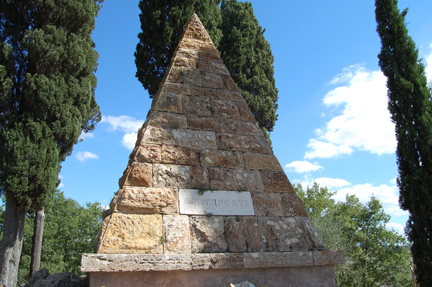
Above: When I made my annual pilgrimage to Montalcino in September of this year, I took time out to visit the monument at Montaperti, commemorating the 1260 battle there between the Guelphs of Florence (the Papacy) and the Ghibellines of Siena (Holy Roman Empire).

In her recent interview on the Wall Street Journal wine blog, “Co-CEO” of Banfi Christina Mariani states that the Brunello controversy of 2008-2009 “was just to make the press… Everyone was cleared, including us.”

When Italy’s top wine blogger Mr. Franco Ziliani (and co-editor of our blog VinoWire) reposted the interview on his blog last week, another top Italian wine blogger, Gian Luca Mazzella, posted links to two entries on his blog in the comment thread of Franco’s post: as he points out in his comment and one of the referenced posts (published by the Italian national daily Il Fatto Quotidiano on October 19, 2010), widely circulated accounts in Italy’s mainstream press reported that Banfi accepted a plea agreement in the Italian treasury’s “Operation Mixed Wine” investigation (where authorities alleged that certain Brunello producers had adulterated their wines, adding unauthorized grapes). It’s worth noting here that Il Fatto Quotidiano is one of Italy’s leading national newspapers.

The only wineries that were officially “cleared” were Biondi Santi and Col d’Orcia (a fact also widely circulated in the Italian mainstream press).

In fact, even Banfi’s current managing director, Enrico Viglierchio, told the Wine Spectator that the company had agreed to declassify some of its wine in an agreement with investigators (note that the title of the article is “Banfi’s Brunello Cleared”; the wine, not the winery, was “cleared” after the company agreed to declassify certain lots).
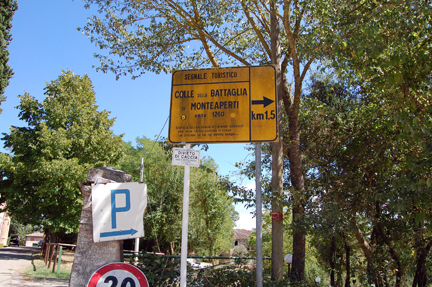
The Ghibellines won the battle but lost the war. Ultimately, the battle’s outcome consolidated the Pope’s power in Tuscany and a new era of Florentine and Papal dominance began.

You’ll note that I am merely reporting what has been written in Italy — before and after Mariani’s recent interview (if so inclined, please click on the links above and read my translations of Italian news reports and the report in the Spectator).

Out of respect for Ms. Mariani (and for a good friend of mine who works closely with her), there is no note of sarcasm nor sardonic editorial here.

I would like to address, however, one of her statements. In the interview, she tells wine writer Lettie Teague (one of our country’s most popular enojournalists and author and a super nice lady whom I know through our professional correspondence and tastings we’ve attended together): “If it’s not a health issue, it’s not an issue for consumers…”

She’s right: the appellation regulations that require Brunello producers to use only Sangiovese in their wine were written and approved by the producers themselves to protect the producers and appellation — not the consumer. In other words, the regulations were conceived to protect those producers who play by the rules in an appellation where 80% of the wine was being made with the addition of unauthorized grapes, according to producers association current president Ezio Rivella who served as Banfi’s managing director until 1999 and left the company after working in Montalcino since 1977 (and with the Mariani family since 1961).
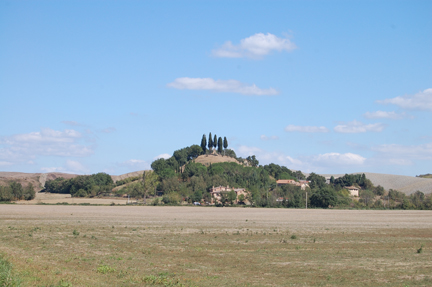
The battle and the events and political turmoil that followed (particularly the papacy of Boniface VIII) are central to Dante’s poem, the Comedy, and the overarching mission of his life — to achieve separation of temporal and spiritual powers in Europe, a notion dear to the forefathers of our country (did you know that Thomas Jefferson, a winemaker, spoke and read ancient Italian and could quote the Comedy from memory?).

Why did I incorporate images of the pyramid at Montaperti in this post?

I don’t get to Montaperti every year. In fact, I hadn’t been there in probably 10 years or so. I studied the Battle of Montaperti when I was a graduate student and have been fascinated with it since then. The 1260 battle there is central to Dante’s poem and its political themes. It marked the beginning of Siena’s decline as a world power and an era of political and human upheaval in Tuscany and Italy. (Montalcino is in the province of Siena, btw.)

As for the Sienese Ghibellines who won the battle at Montaperti but ultimately lost the war, their micro-state (city state) was ultimately absorbed by the greater power of Florence. I’ll let the reader infer any analogy that can be made here.

Thanks for reading. Tomorrow, I’ll pick up where we left off, posting about family get togethers and great wines we’ve been drinking with loved ones during the holiday season.
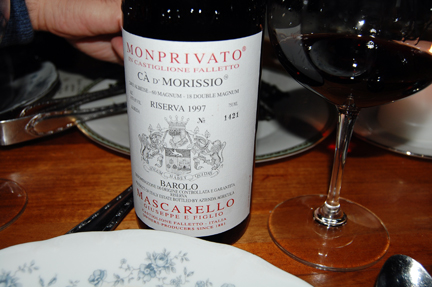
97 G. Mascarello Barolo Monprivato Ca’ d’ Morissio and great food at Tasting Kitchen LA

The Schachter factor was in high gear on Tuesday night at The Tasting Kitchen in Los Angeles. Good friend David Schachter reached deep in his cellar for a bottle he knew would thrill me (as it would anyone who knows the great wines of the world): Giuseppe Mascarello 1997 Barolo Monprivato Ca’ d’ Morissio, Mauro Mascarello’s top bottling, from one of the great if somewhat maligned vintages of the twentieth century.

The 1997 harvest was and remains a classic example of semiotician Harold Bloom’s “misunderstanding,” what he would have called the anxiety of influence (@Comrade Howard, I know it’s a stretch but I think you would agree!). Similar to what happened for 2000, many American wine writers (and you all know whom I’m talking about) praised the warm 1997 vintage for the fruit-forward, hot (read highly alcoholic) wines it delivered. In the view of most Piedmont producers, 97 was a good vintage… not a great one. Wines from this harvest, in their view, were not “classic” expressions of their territorio. They were good and sometimes great but not worthy of the hype that they attained in their trans-Atlantic crossing.

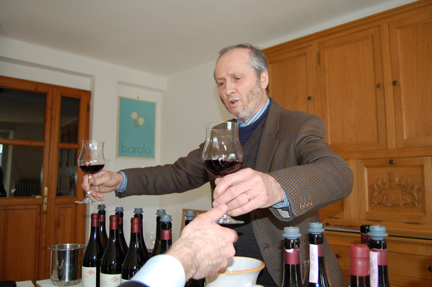
Winemaker Mauro Mascarello’s bottling of his Ca’ d’ Morissio vineyard (above, visited by me and Tracie P and top Italian wine blogger Mr. Franco Ziliani in February 2010) was an exception to this paradigm: thanks to the unique microclimate of this deservedly famous growing site (owing to exposure and elevation), Mauro is able to obtain Barolo benchmarks even in hotter vintages. In fact, to my knowledge, he was the only Barolo producer in the five core townships to produce his flagship single-vineyard wine Ca’ d’ Morissio for the extremely hot 2003 vintage (that’s the Ca’ d’ Morissio, “Maurizio’s house,” at the top of the hill, btw).

Mauro Mascarello is a remarkable man, a 19th-century man, a man whose spiritual integrity and wholesome warmth are expressed in his warm, sturdy handshake and personal manner. I’ve had the opportunity to meet and taste with him three times now (each thanks to Mr. Ziliani) and I am always as impressed by the man himself as I am by the incredible wines he produces. Many Barolo insiders point to his winery as the most recently canonized member in the pantheon of the truly great producers in the appellation.

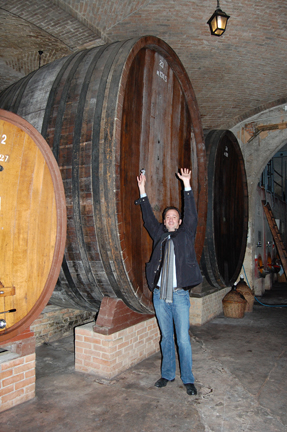
One of the hallmarks of traditional Barolo is large-cask aging: Tracie P snapped the above photo of me when we visited with Mr. Ziliani to show how large “large” is at Giuseppe Mascarello! Mauro’s father was in the lumber business and he built the cask in the photo as an experiment in dimension, said Mauro. (For a fantastic English-language profile of G. Mascarello, I highly recommend this excellent post by my blogging colleague Gregory dal Piaz who knows this winery and its wines perhaps better than anyone else in the U.S.)

I am very fortunate to have tasted a lot of fantastic wine this year (and many of the highlights have been in the last few weeks) but 97 G. Mascarello Barolo Monprivato Ca’ d’ Morissio? An astounding wine. Layers and layers of nuanced fruit and earth on the nose, with this fantastic black licorice, almost menthol note that is always a signature in wines from this vineyard. Rich tar and mushroom in the mouth, with harmonious red berry and red stone fruit. But it was the acidity, tongue-splitting acidity, as Tracie P would have said — even in the warm 1997 vintage! — that took this wine over the top. In Italian wine parlance, you often say that the acidity is a “backbone” that “supports” the flavors of the wine: this wine was the embodiment of this notion.

O, and the food at the Tasting Kitchen (yesterday named 4th best new restaurant in the U.S. by Alan Richman in GQ)?

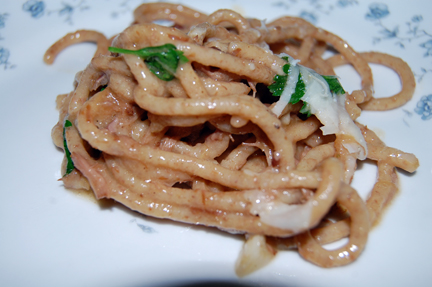
Buckwheat bigoli with lamb and anchovy ragù was my favorite.

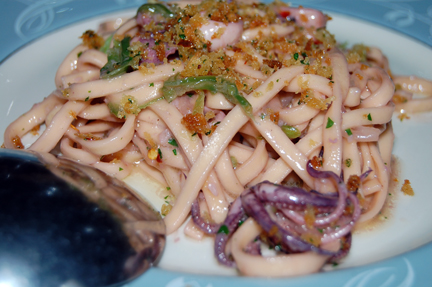
I also loved Chef Casey Lane’s unabashed use of heat in dishes like this tagliolini with baby squid (the fact that my WordPress spellcheck knows tagliolini is remarkable, no?). We spoke to Casey before our meal: he is a super cool, mellow guy (unusual for chefs of his caliber) and he’s from Texas! Awesome dude…

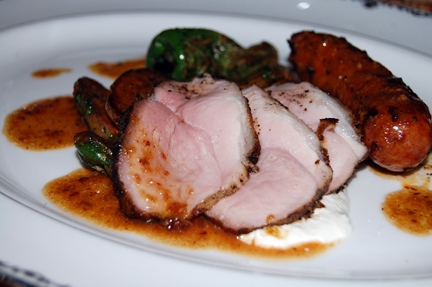
Housemade chorizo and roast pork loin were FANTASTIC with the Ca’ d’ Morissio.

Thanks again, David! And congrats, Casey! An amazing meal and an UNFORGETTABLE wine…

Power of the press blog: Chianti producers vote not to allow Super Tuscans at tasting

Above: the architects of Italian unification (1861). To the far left, Count Camillo Cavour, Italy’s first prime minister, a winemaker (Piedmont). In the center, unified Italy’s first king, Vittorio Emanuele II, a winemaker (Piedmont). To the far right, Baron Betting Ricasoli, Italy’s second prime minister, a land owner and winemaker in Chianti Classico, and the father of modern winemaking in Tuscany. Ricasoli’s estate Brolio and Vittorio Emanuele’s Fontanafredda still produce commercial wine today.

Would the founding fathers of Italy believed it if you were to tell them that a blog helped save Chianti Classico?

Today, Italy’s top wine blogger, Mr. Franco Ziliani, and I posted the following news story on VinoWire, our English-language blog devoted to the world of Italian wine: “Chianti Classico producers decide not to allow Super Tuscans at debut tasting.”

What we didn’t write was that Mr. Ziliani’s previously posted editorial, in which he harshly criticized the body for its inclusion of Super Tuscans in its annual new vintage preview, was cited by numerous members in the debate that preceded the decision (whereby the body’s president announced he was retracted the option).

It’s not the first time that Mr. Ziliani — a true flagellum principum — has helped to protect and promote traditional winemaking in Italy through his blog. Chapeau bas, Franco!

The pen is… scratch that… The pen blog is mightier than the sword!

Some of my best friends are Merlot (the Cocacolonization of Chianti Classico)

Above: Ornellaia’s Masseto vineyard in Bolgheri, Tuscany is arguably Italy’s most famous expression of Merlot.

I don’t have anything against Merlot. In fact, some of my best friends are Merlot.

As a matter of fact, on my recent trip to Friuli, I had a bona fide Merlot revelation after tasting some truly fantastic bottlings of Merlot from Radikon, Edi Keber, and Ronco del Gnemiz. (BTW, I have a backlog of Friuli posts but am hoping to get to them soon.)

But when I read that the Chianti Classico producers association is going to allow member wineries to present IGT (read “Super Tuscan”) bottlings at their annual vintage debut show in February next year, I thought I was going to heave… The nausea only grew when I learned that it would only cost the producers an extra Euro 50 per bottle of Merlot or Cabernet they present.

Italy’s top wine blogger Mr. Franco Ziliani first reported the news on his blog and we posted about it today in English at VinoWire.

At the end of a decade of Italian wine marked by the high-profile Montalcino controversy and the less-talked-about but equally significant Tuscan blending scandal, the Cocacolonization of the Italian wine industry seemed to have shifted gears, leaning more toward Bethlehem than Babylon. Unfortunately, the organizers of this landmark event have once again decided to defile the Temple.

The Chianti Classico producers association represents Italy’s most recognizable wine brand and one of its greatest historic appellations. This aberration and contamination of the sanctity of Chianti Classico’s most important yearly event is — in my mind and on my palate — a hegemonical tragedy of Gramscian proportions.

Raise a glass for Luigi Veronelli

Above: I furtively managed to make a scan of Veronelli’s autograph when I visited the Terlato Wines International Tangley Oaks mansion earlier this year.

Luigi Veronelli, “intellectual, writer, liberatarian, literally the inventor of wine journalism in Italy,” wrote Italy’s top wine blogger Mr. Franco Ziliani this morning on his new blog Le Millle Bolle, raising a glass of traditional method sparkling wine to remember the architect of the Italian food and wine renaissance on the sixth anniversary of his passing.

Regrettably, very little of Veronelli’s writing has been translated into English (aside from what I’ve translated on my blog, where he appears often).

It’s difficult for the solely Anglophone lovers of Italian food and wine to gauge the reach and scope of Veronelli’s legacy (would Eataly have been possible — even conceivable — without him?).

Check out this amazing video, from 1975, when Veronelli was 49 years old and had yet to publish his landmark catalog of the wines of Italy (1983). It was posted in the comment thread of Mr. Ziliani’s post by the brilliant Giovanni Arcari, one of my favorite Italian winemakers and a good friend (look for Giovanni in the Franciacorta pavilion at Vinitaly this year and he will BLOW YOUR minds with the wines he makes and pours).

In it, he demonstrates how to make spaghetti alla chitarra. Italian is not required for viewing but the Pasolinian implications of the subtle dialectal inflections will not be lost on the Italophones among us.

Please join Tracie P and me in raising a glass tonight to this truly epic hero and sine qua non of contemporary Italian food and wine.

A new Prosecco category emerges: colfòndo

Above: Costadilà is a member of new group of winemakers who make “Prosecco colfòndo.” Note the sediment at the bottom of the bottle (photo taken on our dining room table).

Thrilling news of a new group of Prosecco producers who make their wines colfòndo (con il fondo, i.e., aged on their lees and thus with sediment) came to my attention via Mr. Franco Ziliani’s brand spanking new blog devoted to the world of Italian sparkling wines, Le Mille Bolle (A Thousand Bubbles).

In many ways, Prosecco is the wine that started it all for me so many years ago when I started writing about wine. Back in 1998 when I got my first gig as an enojournalist, it was with a feature story on Prosecco. I know the appellation well because I spent three summers touring the provinces of Treviso and Belluno with a cover band.

To my palate, lees-aged Prosecco is the real Prosecco (not the yeasted banana candy crap that we see too often in this country). Lees-aging gives the wine the saltiness that makes Prosecco raised in Valdobbiadene stand apart from the crowd. I love it and am dying to taste more.

Above: That’s me in the middle rehearsing in the famous Birreria at Pedavena where we played 4 sets a night, 3 nights a week (no kidding). I was in my 20s and the music and beer (often unpasteurized, btw) flowed all night long. How do you like the hair?

Dulcis in fundo (pun intended): one of the producers, Riccardo Zanotto, used to come hear us play back in the day and we shared more than one beer together…

Che bei ricordi! What great memories of rock ‘n’ roll with the Dolomites as our stage and salty, gritty, utterly delicious Prosecco!

The least Piedmontese of the Piedmontese wines

Envious as I am? Click here to read my translation of top Italian wine blogger Mr. Franco Ziliani’s post on a “truly moving” vertical tasting of the “least Piedmontese of the Piedmontese wines.”

Just wait until the mimetic desire kicks in…

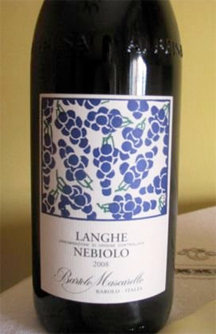
Bartolo Mascarello 2008 Langhe Nebiolo [sic]

Talk about mimetic desire! You can imagine my envy when I read Mr. Franco Ziliani’s post this morning on tasting the 2008 Langhe Nebiolo [sic] by Maria Teresa Mascarello of the Bartolo Mascarello winery in Barolo.
For those of you who don’t read Italian, I’ve translated Mr. Ziliani’s tasting notes at VinoWire (here).

Maria Teresa made only 2,000 bottles of this reclassified Barolo (for a vintage, 2008, not ideal in Piedmont because of excessive rainfall).

Man, I hope someone will save a bottle to open with me!

In the meantime, read about it here…

Pomodoro crisis

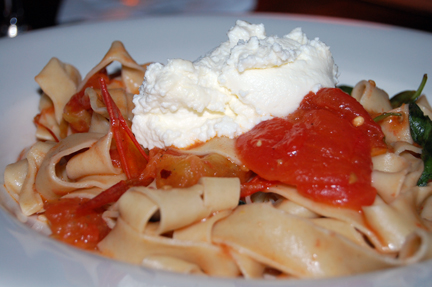
Above: Tracie P and I have been thoroughly enjoying Chef Esteban’s housemade Tagliatelle with tomato sauce and housemade ricotta at Vino Vino in Austin. I think that Esteban could go a little lighter on the heat in the sauce (my only lament) but this is Texas after all.

Although Italy’s recently installed agricultural minister Giancarlo Galan (from Padua) claims there’s no crisis in the Italian wine industry (see his comments in our post today at VinoWire via Mr. Franco Ziliani’s blog), he is planning to convene a “task force” to address Italy’s tomato crisis — yes, tomato crisis.

The issue is not the sale of tomatoes in Italy (go figure) but rather fraud and counterfeit of Italian-grown tomatoes. The so-called “agropiracy” vehemently battled by Galan’s predecessor Luca Zaia.

Contemplating the Italian tomato crisis as I drank my tea early this morning, Aldo Cazzullo’s 2009 L’Italia di noantri. Come siamo diventati tutti meridionali (The Italy We [Southerners] Remember: How We All Became Southerners, Mondadori) came to mind.*

In it, he writes: Today, “Italians all eat the same things. Two generations ago in Piedmont, they used meat or butter to dress their food. Today, tomato is found in every sauce… The tomato has become a national symbol. If an Italian has a spot on his shirt, it’s a tomato spot.” (p. 43)

Leaving the racist and separatist (and even futurist) implications aside, I do think it’s interesting to note (probably to the surprise of many) that tomatoes were not widely consumed in Italy until the 1960s. I found hard proof of this when I researched my post on the origins of the name puttanesca.

There’s much to be said on this topic but, alas, my work duties call… I’ll leave you today with one of my all-time favorite scenes by one of my all-time favorite Italian actors, Alberto Sordi, in Un americano a Roma (An American in Rome, 1954). In the scene, he plays an Italian-American who claims that the food in America is better and better for you, drinking milk instead of wine. But in the end, you can imagine what happens. Note that the “macaroni” are NOT dressed with tomato. The year is 1954.

* The title of the book plays on the fact that the Roman inflection noantri for the first person plural has been commonly absorbed by the northern dialects (in the Piedmontese of the author’s grandparents, he writes, the first person plural was nuiautri).

Basta barriques: a conversion of Constantine?

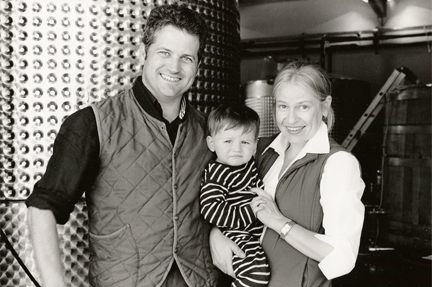
Earlier this month, Maremma producer of Morellino di Scansano and Syrah Gianpaolo Paglia (above, winemaker and owner of Poggio Argentiera, with his family) authored a short post on his blog entitled simply Basta barrqiues, enough with barriques.

In the post he informs his readers that he no longer intends to age his Sangiovese and Ciliegiolo in barriques, small new oak French barrels.

He explains: “In the last 10-15 years, the world of wine has changed. And, above all, my (and our) tastes have changed. This is no disavowal of the past, no repudiation. It’s very simple: one evolves, as a person and as a company.” (translation mine)

Yesterday, Italian wine blogger extraordinaire Mr. Franco Ziliani, who has long exhorted a more moderate use of barrique aging among Italian winemakers, posted an interview with Giampaolo.

Here are a few passages I found interesting and have translated from Gianpaolo’s answers:

    In certain wines produced with barriques, there is an excessive sweetness. However much this can be viewed in positive light, I find that it tires the palates. Complexity and nuance tend to be lost, trumped by a certain creaminess in the taste of the wine. Generally, I believe that it is more difficult draw out the character of grapes like Sangiovese and Ciliegiolo, where a certain angularity and backbone form the basis of their identity. And then there’s also the drinkability factor: I’m tired of drinking overly invasive wines.

    I can tell you that making wines that will be enjoyed by people who make wine makes much more commercial sense than trying to interpret the tastes of the market. My impression is that we tend not to fully appreciate people who buy wines and drink them. This is probably due partly to a lack of awareness and partly — and perhaps mostly — due to our lack of courage.

    There are wines that seem excellent to us but we consider them “difficult” for the market. But, then again, we discover that the market is very open to good wines, real wines, expressive wines. I see this every day, especially since I began to sell wines beyond the wines I produce.

I’m excited to taste the new vintages of Poggio Argentiera and I really admire Gianpaolo for the honesty and forthrightness of his blog and his words (he is, btw, probably the top Italian winemaker/blogger and his use of social media as a tool to promote his wines is world-class).

One of the most vocal opponents of barrique aging of Sangiovese I know is my friend Charles Scicolone, who began drinking Nebbiolo and Sangiovese in the 1970s. “They’ll crucify me on a cross made of barrique,” he likes to say humorously.

It’s too early to tell but could Gianpaolo’s declaration be an early sign of a conversion of Constantine? Let’s hope so… Chapeau bas, Gianpaolo!

In other good news…

It seems that Mr. Ziliani has returned from his blogging hiatus.