Remembering September 11…

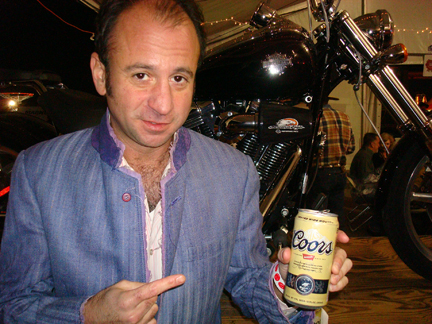
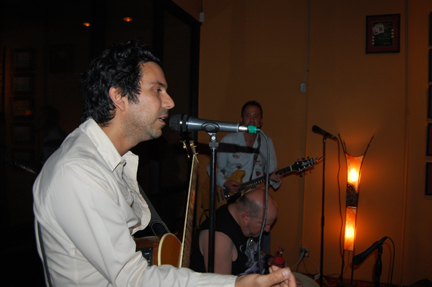
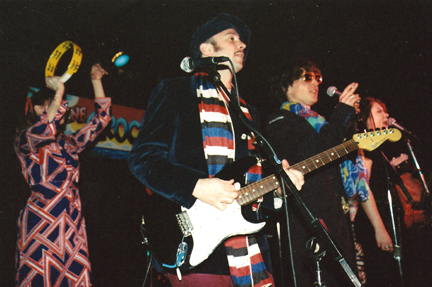
Above: This shot is from Arlene’s Grocery in Lower Manhattan but that’s pretty much what I and the French band looked like in 2001, when we used to perform regularly at The Greatest Bar on Earth (Windows on the World) in the north tower of the World Trade Center.

“There’s no fucking meeting today,” said the French voice on the other end of the line. “Turn on the news.” It was 9:00 a.m. and I was heading out the door from my apartment in Park Slope, Brooklyn to a 9:30 a.m. meeting with a client on Desbrosses Street in TriBeCa. Thank goodness I didn’t get on the 2 train. I’m not sure if the second plane had crashed at that point but by the time I was able to tune into WNYC on my Mac (I didn’t own a television then), the south tower had been hit as well.

I picked up the phone and called my mother in California. She was still asleep. “Something’s happened, mom,” I told her. “You won’t be able to reach me today but I’m calling to let you know I’m okay.”

“Thanks for calling, honey,” she said yawning. She went back to sleep and would only learn what had happened when she woke up. By that time, my cellphone (my only phone) no longer worked.

My upstairs neighbor and landlord Janet knocked at my door. She was in tears and hysterical. She asked me to sit with her in her living room until her husband and son could make it home. I did.

Later in the day, singed pieces of paper — from all sorts of documents — gently rained down on our neighborhood. All of the fire fighters from our local fire station — just a few blocks away — perished in the tragedy. In the days that followed, we learned that some of the terrorists had resided just a few blocks from the house where I lived. I passed in front of their mosque nearly every day on my way to the YWCA gym where I had a membership. On my way home from my workout, I would often buy falafel at the deli next door on Atlantic Avenue.

All of these memories flooded into my mind last night when I came home from a food and wine event in downtown Austin and Tracie P had the TV on: “President Obama is going to make an announcement,” she said. Osama bin Laden was dead.

Between 1998 and 2001, the French band (above) performed once a month at The Greatest Bar on Earth (Windows on the World) in the north tower of the World Trade Center. Burlesque was the new fashion in hipster circles and we often played with The Pontani Sisters, who danced on stage as we played. Giuliani was mayor and you could still smoke cigarettes (and pot) in NYC nightclubs.

When I finally made it back into the city to visit my client, Desbrosses Street was closed to the public but the police let me through because I had business to conduct there. The staff in my clients office were literally shell-shocked by what they had seen and heard. I saw David Bouley cooking on Canal Street for the fire fighters and police.

Later that week, I interviewed Drew Nieporent for a trade publication. He told me that the entire morning staff at Windows on the World had perished in the tragedy. I’ll never forget how he choked up during our conversation…

All this memories flooded my mind when Tracie P and I heard the news last night.

It seems like a lifetime ago… and it was… I had just purchased my first digital camera. It used 3½-inch floppy disks as memory cards. Today, I can take larger and more photos with my phone. I didn’t even know what (we)blog was.
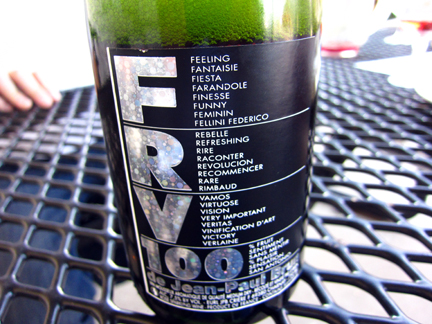
A wine that Joe Dressner AND Robert Parker like (and a Fellini movie)

People are going to wonder why I continue to write about wines imported by Louis/Dressner. In the light of Mr. Joe Dressner’s myriad waspish attacks, I’ll probably regret writing about the below wine. My blog is about our life and the wines and foods and poems and songs and films and joys and challenges that we embrace and face every day and I just couldn’t omit this wine. As the ex-Wine Digger once pointed out to me (and he was right), wines are an expression of the places where they are made and the people who make them — not the tertiaries who import them. And I certainly hold nothing against Mr. Dressner and only wish him a speedy recovery.

What a thrill to get to taste (FINALLY) the FRV100 by Jean-Paul Brun! The name of this gently sparkling 100% Gamay from Beaujolais is a rebus (as they say at the counter at Brooks Brothers in Manahattan, there are those among us who know Latin and those who don’t): FRV100 for eff-er-ves-cent, effervescent or sparkling in this context.

I loved everything about this wine: the low alcohol (around 7.5%), the gentle fizziness, the wonderful WONDERFUL fruit on the nose and in the mouth, and the playful, bright packaging (the winemaker uses the rebus as an acronym for a wonderful plaisir, a prosodic form adored by the early Occitan poets). FRV100 and barbecue? FRV100 and mole from Polvo’s? FRV100 and Tracie P’s nachos? HELL YEAH! I think it’s safe to say that this will be our wine of the summer of 2011.

But inasmuch as I believe that all wines are an expression of epistemological reflection, this bottling is all the more remarkable because — as I read in Mr. Dressner’s glistening marketese — not only does the Pope of Natural Wine like this wine, but so does Mr. Robert Parker, Jr.! The Emperor of Wine has called Brun’s wines “beautiful” and ranked the winery as a four-star affair, according to the Pope’s site. Felicitously unbelievable!

I loved the wine so much that I’ve paired it with a screening of Fellini’s 1957 Le notti di Cabiria (Nights of Cabiria) on May 18 at the Alamo Drafthouse Ritz in Austin, where I’ll be speaking about the film and the pairings (btw, the paperback version of my translation of Brunetta’s narrative guide to The History of Italian Cinema was recently published by Princeton University Press).

Why did I pair it with Fellini’s transitional classic (one of my favorite movies of his, btw)? You’ll just have to come to the screening on May 18 to find out!

@JoeDressner and @RobertMParkerJr: I’ll be happy to comp either or both of you if you’d like to attend!

A living museum of Tex-Mex at Robb Walsh’s El Real, Houston

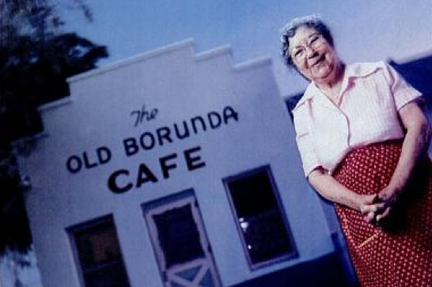
Googling around the internets this morning, reflecting on a fascinating dinner and conversation last night with legendary Texas food writer Robb Walsh and his protégé Katharine Shilcutt (both magister and alumna have been nominated for this year’s James Beard food writing awards, btw), I found the above and wonderful photograph Tula Borunda Guttierez in an archived copy of Texas Monthly, January 1986.

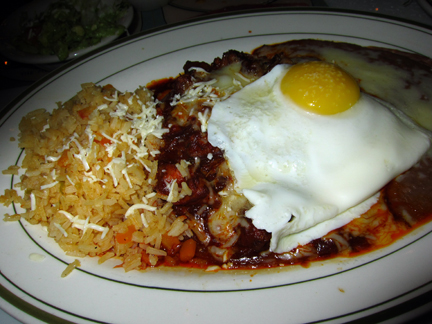
Robb wisely insisted that I have the Enchiladas Borunda last night at his newly opened, living and breathing, museum of “vintage” Tex-Mex cuisine and restaurant, El Real in Houston: stacked as opposed to rolled enchiladas, a signature dish of the Old Cafe Borunda in Marfa, Texas, a restaurant that he calls the historic epicenter of Tex-Mex cuisine.

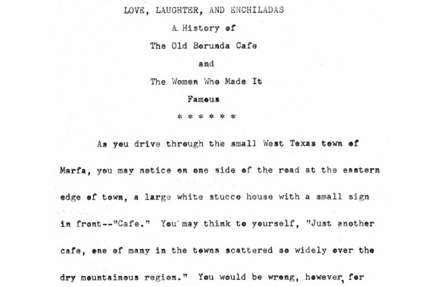
I also found this utterly riveting high school essay, dated 1965 and composed in Marfa, by Lupe Lujan, “Love, Laughter, and Enchiladas: A History of The Old Borunda Cafe and the Women Who Made it Famous.” I devoured the entire essay this morning over my coffee (don’t miss the episode where the café is visited by Rock Hudson and Elizabeth Taylor!).

El Real is the most-talked-about restaurant in Houston right now. It is, after all, the brainchild of Houston restaurateur aristocracy (from the dudes at Reef et alia) and el rey of tejano food writing, Robb, who literally wrote the book on Tex-Mex cuisine.

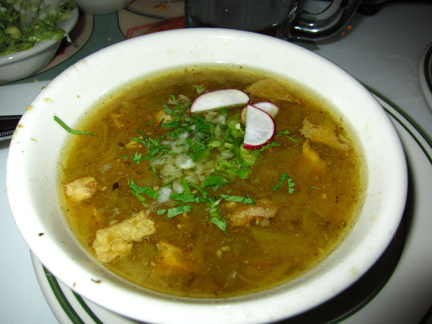
I’ll leave the punditry to the pundits and will merely inform you that the stacked Enchiladas Borunda (above, stuffed with braised pork and topped with fried egg) were delicious (“I’m glad to see we made you sweat,” said Robb.). They were preceded by the sine qua non of Tex-Mex cuisine, Queso with Picadillo (made rigorously with
Velveeta
, noted Robb), and an excellent heaping ladleful of Posoles (below).

Be sure not to miss the Tex-Mex museum in the gallery above the dining room floor and don’t hesitate to grill Robb with questions about Tex-Mex cuisine and its place in the culinary canon of Americana (as I did). He’s there every night and he loves to talk about this super fun project.

It was remarkable to watch and hear the interaction between Robb and his hand-picked successor Katharine, now the food critic at the Houston Press, the city’s weekly alternative rag. She worked in corporate America until Robb discovered her awesome blog, She Eats. Now they’re both up for James Beard awards!

Robb talked about his background in advertising and how his early gigs in food writing didn’t pay. As we got up from the table, he looked around the packed dining room and waxed, “Isn’t it incredible? I made money while I was having dinner!”

We will not be drinking Coors…

at tomorrow’s Tuscan wine party in Austin…

There are still a few spots open… Should be a fun event… Click here for details…

The new Italian DOCGs, Derrida, and the moral bankruptcy of the Italian appellation system

I will speak, therefore, of a letter.

Of the first [seventh] letter, if the alphabet, and most of the speculations which have ventured into it, are to be believed.

Jacques Derrida, “Différance” (1968)

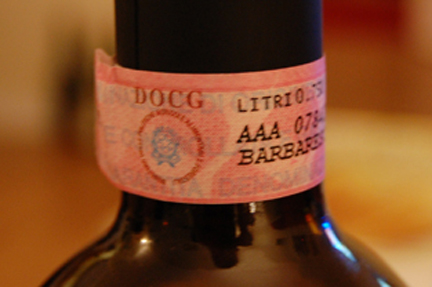
If the alphabet is to be believed, then I imagine we must seriously consider the three new DOCGs announced by the Italian government last week: Frascati Superiore, Cannellino di Frascati, and Montecucco Sangiovese. (See my paraphrase of the agricultural minister’s press release at VinoWire and see Alfonso’s wonderfully parodic treatment here.)

Of these — in an era when the Italian DOC/G system has been rendered essentially obsolete, save for its campanilian value, by the EU CMO reforms and adoption of the overarching PDO and PGI system — the most intriguing and least absurdist is the Montecucco Sangiovese.

Montecucco (in the Tuscan province of Grosseto) has grown significantly in the last 5 years, both in terms of quality and investment, and the wines raised there are aggressively marketed to the domestic and foreign markets. But the thought of a Montecucco DOCG remains laughable at best. When the DOCG was created (the first was awarded to Brunello di Montalcino in 1980), it was ostensibly intended to denote superior quality: the G in DOCG meant that the appellation had been controlled and guaranteed (in a second round of tasting after bottling) by Italian authorities before its release. Although I can find no official statement addressing the reasons for its creation, it was conceived and has been subsequently perceived as an elevated category reserved for Italy’s finest wines. As much as I wish the growers, producers, and bottlers of Montecucco well, I’d be hard-pressed to name a bottling of Montecucco that impressed me the way certain bottlings of Brunello di Montalcino, Barolo, Barbaresco, Aglianico di Vulture, Taurasi, or Amarone del Valpolicella have (for the record, among others, I’ve tasted scores of Montecucco in Paganico with the media director for the Montecucco growers association).

But the thought of a Frascati Superiore DOCG and its sister Cannellino di Frascati DOCG requires mental gymnastics too strenuous for my current state of mind. I, like my blogging colleague, Franco Ziliani, shook my head in disbelief and despair when I read the news. In an editorial posted today at VinoWire, Franco observes that “the Frascati DOC is made up of 800 grape growers who span 1,400 hectares of surface area and who produce 150,000 quintals of grapes destined to become 110,000 hectolitres of wine vinified by roughly 30 winemakers and bottled by roughly 40 bottlers.” A year ago, he points out, the Italian government applied to the EU for “emergency distillation” for Frascati bottlers so they could distill their unsold wine and reap EU subsidies. Today, Frascati has two new DOCGs. When’s the last time you tasted a Frascati that you would but in a class with Italy’s or Europe’s greatest fine wines?

Read Franco’s editorial, “The Letter G Is No Magic Wand,” translated to English by me, here.

“There is nothing outside the text,” said Derrida (in)famously. To which he often added, “everything is a text. This is a text,” as he gestured about. In the light of this observation, the G in DOCG must mean something within the (con)text… mustn’t it?

But the more closely we look at the G (borrowing from an aphorism by Karl Kraus), the more distant it appears. In fact, it has come to mean nothing beyond an insipid, vacant, morally bankrupt, and politically corrupt marketing conceit. (In the Veneto, for example, bureaucrats have created a DOCG ex novo, with no historic precedent, the Malanotte DOCG, a DOCG created before any wine labeled as Malanotte was ever released! Conceived in 2009 and awarded in 2010, the DOCG will be made available to consumers for the first time at the end of this year.)

But as Alfonso’s updated DOCG list reveals (as does the subsequent handwringing that reverberates throughout the blogosphere every time he updates the list), we recognize the signifier (the letter G) and our will to decipher its signified is so great that we are compelled to ascribe meaning. (Anyone familiar with the writings of Lacan will recognize the imagery in Alfonso’s post of biblical proportions.)

If Derrida were alive today to deconstruct the DOCG as text, he would illustrate how the différance created by the letter G is but a series of misunderstandings whereby its function is conceived, misconceived, perceived, and misperceived in its Atlantic crossing until its meaning no longer has any connection to its author.

Parodying Nietzsche, French semiotician Roland Barthes wrote famously that the author is dead. But it was Woody Allen who said, Marx is dead, Lenin is dead, and I don’t feel so good myself.

My thoughts exactly!

Southern Italian is sexy…

Above: Giampaolo Venica has become a good friend. When we’re not talking about wine, we talk about Pasolini and his legacy in Friuli (where Giampaolo and his family live). His Terre di Balbia is 100% Magliocco raised in Calabria (how about that, wine geeks?), one of my favorite wines of 2011. See notes here. I’ve just confirmed that he and I are going to be hosting a dinner at Sotto in Los Angeles on Weds. June 22.

The SOUTHERN ITALIAN SIX-PACK is live over at Do Bianchi Wine Selections, featuring wines from the list I’ve authored for Sotto in Los Angeles.

Villa Matilde 2009 Falanghina
Benanti 2008 Etna Bianco Bianco di Caselle
Benanti 2007 Etna Rosso Rosso di Verzella
Gulfi 2009 Cerasuolo di Vittoria
Terre di Balbia 2009 Balbium Rosso
Pietracupa 2007 Quirico

For details and to order, please click here.

THANK YOU to everyone who came out to support Japan last night!

From the department of “just another day in the Groover’s paradise”…

What a rush to get to play with David Garza last night at Vino Vino to raise money for the American Red Cross fund for victims of the Japan Earthquake and Pacific Tsunami!

It’s such a trip to be around David: he breaths music (as Céline Dijon noted when we were recording together last month in Austin). On stage, you never know what wonder-filled notes will stream from his voice and his fingers. My favorite number was a medley of “Electric Avenue” and “Pass the Dutchie” — in a minor key!

Later in the evening, the amazing Suzanna Choffel sat in a for a few numbers and all the while legendary Austin music photographer Todd Wolfson played percussion. A truly and utterly incredible experience for me.

And the 2008 single-vineard Erbaluce Cariola by Luigi Ferrando was awesome at the end of the night: gorgeous popping acidity, bright fruit, and righteous alcohol at 12.5%. Great wine…

We raised more than $1,200 for the American Red Cross fund for victims of the Japan Earthquake and Pacific Tsunami (if you’d like to contribute, just click here).

Singing with David Garza for Japan tonight in Austin

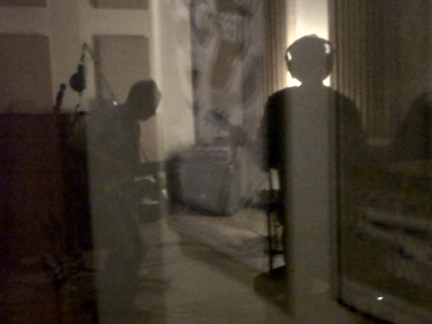
The above photo is little bit blurry and it’s hard to make out what’s going on in it. But it’s one of my favorite photos of the year so far: me with one of my musical heroes, David Garza, in the studio recording the new Nous Non Plus record last month, snapped by Tracie P through the control room window.

David is one of the most remarkable singer-songwriters I have ever seen or heard and you can imagine how thrilled I was when he agreed to play on our album (which we started mixing in Los Angeles today, btw). And he’s a super sweet and generous dude…

That’s David wearing Céline Dijon’s hair, with me (Cal d’Hommage) and Jean-Luc Retard (on the right).

David’s going to be singing for Japan tonight at Vino Vino in Austin: there’s no cover and Jeff Courington, who owns and runs this awesome wine bar, is going to be donating 25% of sales to the Red Cross Fund for Victims of the Japan Earthquake and Tsunami.

Please join us if you can (I’ll be sitting in on a song or two and Tracie P will be there, too) and please remember our sisters and brothers in Japan.

Montepulciano: Italian grape name and appellation pronunciation project

CLICK HERE FOR ALL EPISODES.

Above: Alfonso’s video camera captured winemaker Stefano Illuminati (of the Dino Illuminati winery, Abruzzo) speaking “Montepulciano” at Vinitaly a few weeks ago.

If Merlot (mehr-LOH) is the easiest European grape name for Anglophone consumers to pronounce (and is consequently America’s favorite variety), then Montepulciano (MOH-te-pool-CHEE’AH-noh) is the most confusing and one of the most challenging.

The last time you were on a date and you wanted to impress your dinner companion, did you impress him/her by ordering the Vino Nobile di Montepulciano (VEE-noh NOH-bee-leh dee MOHN-teh-pool-CHEE’AH-noh)? Or perhaps you eloquently illustrated how Montepulciano is at once a place name (the name of a township in Tuscany where Vino Nobile di Montepulciano is produced) and a grape name (the name of a variety grown and vinified primarily in Abruzzo but also elsewhere in Central Italy)?

I know that you didn’t order the Merlot!

Above: Dino Illuminati, Stefano’s father and the winery’s namesake, is one of the wonderful avuncular characters of the Italian wine world — larger than life and always bursting with life and energy. His 1998 Montepulciano d’Abruzzo blew me away when I tasted it a few months ago in Chicago (photo by Alfonso, Verona, April 2011).

The bivalence of the topo- and ampelonym Montepulciano often leads complacent wine directors to include bottlings of Montepulciano d’Abruzzo in their “Tuscany” and “Sangiovese” sections. This oversight often tragically eclipses the many wonderful expressions of Montepulciano that come from Abruzzo (anyone who has ever tasted the 1979 Montepulciano by Emidio Pepe knows just how incredible these wines can be!).

Do Bianchi isn’t exactly the blogosphere’s leading resource for dating advice. But, then again, Tracie P probably wouldn’t have given me the time of day if I didn’t know the difference between my Montepulciano d’Abruzzo and my Vino Nobile di Montepulciano!

The Italian Grape Name and Appellation Pronunciation Project got a greatly appreciated shoutout from Eric the Red last week on the Times dining blog. Thanks again, Eric! Remember: friends don’t let friends pronounce Italian grape names and appellations incorrectly! ;-)

Easter greetings from Montalcino and the etymology of Easter

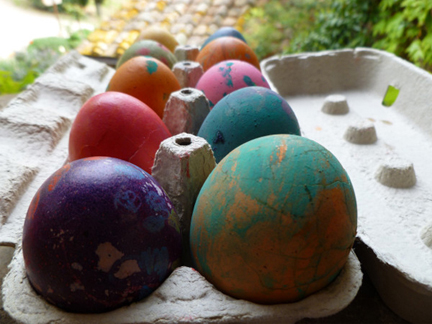
Above: I just couldn’t resist reposting this photo sent from our friends Laura and Marco at Il Palazzone in Montalcino.

In English today, we use the name Easter to denote the springtime Christian holiday and festival, from “Eostre (Northumbrian spelling of Éastre),” according to the Oxford English Dictionary (online edition), “the name of a goddess whose festival was celebrated at the vernal equinox.”

In nearly every other Western language, however, we use a name that corresponds to the name of the Jewish festival of the Passover: “Greek πασχά, Hebrew pésaḥ [pesach], Latin pascha, French Pâques, Italian Pasqua, Spanish Pascua, Dutch pask,” write the editors of the OED.

Until the late nineteenth century, Anglophones also commonly used the name pasch to denote the Easter feast (as in the expression the paschal lamb): from the “Aramaic pisḥā Passover fesival, Passover sacrifice, Passover meal (emphatic form of pasaḥ [meaning] to pass over; compare Syriac peṣḥā Passover, Easter, Hebrew pesaḥ Passover).”

What does passing over have to do with it all?

“The festival is named after the Lord’s ‘passing over’ the houses of the People of Israel, whose doorposts were marked with the blood of a lamb, while the Egyptians were punished with the death of their firstborn (Exodus 11–12).”

Buona pasqua, happy Easter, kalo pascha (Greek), ya’ll! :-)