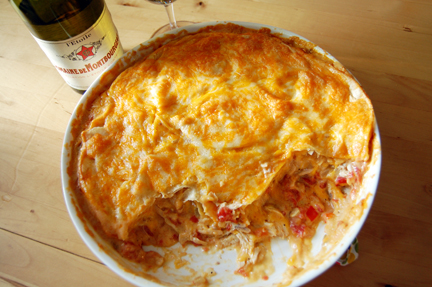
The 06 Dettori Romangia Vermentino just keeps on giving

One of my favorite things about the Do Bianchi Wine Selections wine club is sharing wines with the folks who buy wine from us. And one of the fringe benefits of running the program is that sometimes my clients generously open some of my favorite wines when I visit to deliver their wines.

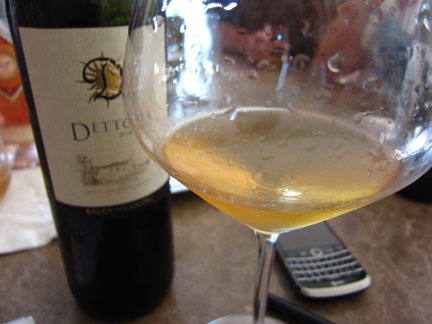
Such was the case when Chrissa and Dan popped one of my all-time favs, the 06 Dettori Romangia Bianco yesterday evening.

Man, that wine just keeps getting better and I imagine it won’t hit its peak for another 5 to 10 years, at least. It was crunchy and salty and its acidity was nervy (as the Italian say), with dried and fresh citrus notes and even richer tones of honey than the last time I tasted this stunner…

Chrissa and Dan have begun raising their own pigs on a San Diego County farm and they treated me to some Pig Pickin’ with apple-cider Bogue sauce and corn spoon bread. The pig, I was told, was a “red wattle.” The couple have launched a home butchering educational program called Carne Knowledge and they make some mean pickles, too (from homegrown cucumbers).

Thanks again, guys! LOVE LOVE LOVE that wine…

In case you want to taste the Dettori, I have a few bottles left on my list at Sotto in Los Angeles, where I’ll be working the floor tonight and tomorrow. If you happen to be in town, please stop by…

Cirò: Italian grape name and appellation pronunciation project

CLICK HERE FOR ALL EPISODES

This morning finds me in Southern California on my way to Sotto in Los Angeles, where I’ll be working the floor tonight — pouring and talking about the wines — and introducing my good friend Giampaolo Venica tomorrow night, when we’ll be hosting a dinner in his honor and featuring his wines.

The wine list at Sotto is devoted almost exclusively to Southern Italian wines and so it seemed a propos to feature the appellation of Cirò (Calabria) for this week’s episode of the Italian Grape Name and Appellation Pronunciation Project.

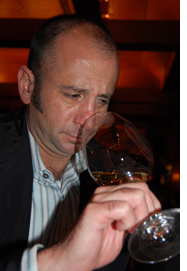
That’s Cirò winemaker Francesco De Franco, above, who appeared here previously for the pronunciation of Gaglioppo (and who made one of the most original contributions so far).

In the wake of his Gaglioppo performance, a lot of readers — many of them women — wrote me to tell me how endearing Franco is.

But I regret to inform you that my camera simply doesn’t do justice to this man’s charisma. Like his wine — ‘A Vita (Life) is the name — Franco is one of the most vibrant and electric personages of the Italian wine world today. I was thrilled to finally meet him in person at the Radici Wines festival the week before last in Apulia and I can’t recommend his wine highly enough.

The wines are scheduled to make their North American debut this fall.

But in the meantime, his moving image, as seen through my lens, will have to suffice…

Thanks again, to everyone, for all the support for this ongoing project. And thanks for speaking and drinking Italian grapes!

Smells like horse shit and I’m glad I stepped in it: 01 Taurasi by Struzziero

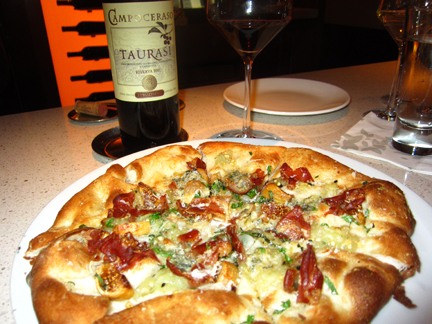
“Smells like horse shit,” said Tracie P last night with no small amount of satisfaction when she and I opened a bottle of 2001 Taurasi Riserva Campoceraso (field of the cherry tree) with our friends, sommelier Mark Sayre and chef Todd Duplechan at Trio in Austin. I bought the bottle, a current release for Taurasi, back in February from my friend and fellow champion of the wine proletariat Roberto when I was out in Los Angeles.

Whenever I teach a class or lead a tasting, the attendees are often surprised when I tell them that “I want my red wine to smell like horse shit and fruit and taste like fruit and rocks.” Smell like shit? Yes, and be glad you stepped in it!

Of course, the canonical descriptor for aromas like these is barnyard and you’ll often find it used for certain categories of Pinot Noir, most famously for example, from Burgundy.

The 01 Struzziero — probably my favorite producer of Taurasi — was meaty and salty, with bright acidity, and showed rich black fruit and savory flavors in the mouth. And as the barnyard and a little bit of Bret Michaels wore off, delicate notes of red berry fruit began to emerge on the nose.

When chef Todd tasted the wine, he ingeniously created a pizza inspired by the flavors of the wines: speck, eggplant, shallots, blue cheese and Parmigiano Reggiano, and dried fig… I loved the pairing and I thought about how wonderful it is to break the chains that bind so many of the world’s noble wines, like this Taurasi. Too often, in my experience, people insist on pairing a wine like this with braised meats. Yes, traditionally, that’s what you would pair this with. But the whimsical — capricciosa — pizza culled unexpected bright notes from this rich and intense wine.

In other Texas news…

I’m super stoked to see that Mark and Todd are tweeting these days. I’m following and you should, too. These guys perform magic nightly at the restaurant and they’re now sharing some of their enogastronomic insights with the world (Tracie P and I are hoping that Todd will write about some of the baby food he and his wife Jessica, an awesome pastry chef, are cooking up for their newborn).

In other other Texas news…

Did you see that Alfonso and I are leading a panel on wine blogging at this year’s TexSom conference? You think “horse shit” is outrageous? Wait ’til you hear what Alfonso and I are going to talk about! NC-17, for sure. Now, if we could only get young Texan wine professionals to stop saying “som”!

Aglianico del Vulture: Italian grape name and appellation pronunciation project

CLICK HERE FOR ALL EPISODES

Even though I had had the opportunity to taste and enjoy the wines many times before, I finally got to meet Sara Carbone of the Carbone winery (Melfi) at the Radici Wines festival last week in Apulia. (Btw, there are some great posts about the festival on the Facebook and Catavino just posted about our epic night of Prosciutto di Montone — “ram ham,” as he called it on the Twitter — and Aglianico.)

If ever there were an Italian appellation in need of Anglophone pronunciation help, it would be Aglianico del Vulture (see, click, and hear above). Between the palatal lateral approximant (gli) of the ampelonym and the dactylic toponym, this appellation name is laden with linguistic challenges for English-speakers. In other words, it’s a tongue-twister.

Sara is a delightful lady and I am a big fan of her wines (and I will begin posting on my favorite wines from the festival, including hers, next week). But I regret to report that she is terribly cross with me.

After I showed her my post where I dispel the myth that the grape name Aglianico comes from ellenico or Hellenic, she Tweeted plaintively about how she is now going to have to reprint all her labels!

Joking aside, Sara’s Aglianico is fantastic and it was one of the many excellent expressions of the grape variety that wowed me and fellow judges at the festival.

Thanks for speaking (and drinking) Italian grape names and appellations!

It’s true about the pickles: Tracie P and I are gonna have a baby!

Never in a million years would I have thunk that Tracie P would one day be saying, “be sure to bring home some half-sours [pickles] from Ziggy’s in Houston while you’re there, baby…”

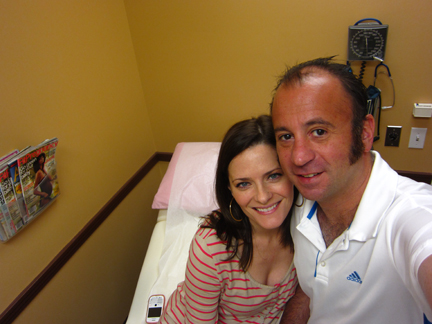
It’s true about the pickles and it’s a dream come true: Tracie P and I are going to be parents. :-)

Yesterday, we went in for our second ultrasound and we’re now in our thirteenth week, the last of the first trimester (due date is mid-December). And so, it’s finally time to share the news with our friends…

We are simply overjoyed and it seemed right (and feels good) to share this wonderful news here on the blog. So many of you have left comments, sent notes of support and love, and cheered us on as we came together, were engaged, and then married.

I wish all of you could see Tracie P right now. She’s more beautiful than ever. And I wish you could have felt the excitement that flowed through our hearts as we watched our baby’s heart beat on the monitor of the ultrasound yesterday.

Thanks, again, for all the support all of you have shared with us. We couldn’t have made it without you — friends and family — and we couldn’t have made it without each other. And we did make it… and we made a baby…

We are overjoyed…

Tracie P, I love you with all my heart and all my soul and every fiber in my body… You have given me the greatest gift of all time… I love you…

And though you don’t believe that they do
They do come true
For did my dreams
Come true when I looked at you…

Taste with me tomorrow and next Wednesday…

Taste with me tomorrow evening at Ciao Bello in Houston, where I’ll be leading a tasting of Italian wines together with Chef Bobby Matos who will be preparing pasta table-side and sharing Italian cooking tips with guests. Should be a super fun event and evening…

Next Wednesday, I’ll be presenting one of my best friends in Italian winemaking today and producer of some of my favorite wines, Giampaolo Venica, who will be leading a wine dinner featuring five of his wines (including his Magliocco from Calabria and four of his family’s legendary white wines from Friuli) at Sotto in Los Angeles.

Hope to see you there!

Sensuous world: Marx, Gramsci, Pasolini, food and wine

Just as nature provides labor with the means of life in the sense that labor cannot live without objects on which to operate, on the other hand, it also provides the means of life in the more restricted sense, i.e., the means for the physical subsistence.

—Karl Marx, Economical and Philosophical Manuscripts, Paris, 1844
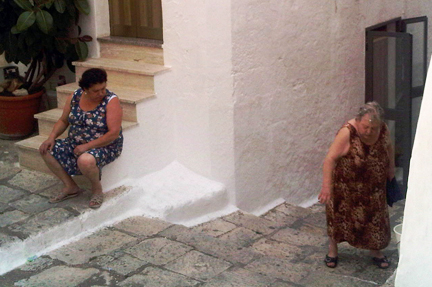
One of the things I couldn’t stop thinking about on this last trip to Italy (where I stayed at a 5-star resort, ate in a Michelin-starred restaurant, and tasted verticals of some of Southern Italy’s most famous wines) was Marx’s concept of alienation (estrangement), Gramsci’s concept of reification (objectification), and Pasolini’s “fear of naturalism” (“the natural being”) and the insight that they provide us in viewing the current global epicureanism as an expression of the bourgeoisie’s (and I count myself and you, my readers, as members of this privileged class) deep-seated yet unanswered yearning to cast off the yoke of consumerism.
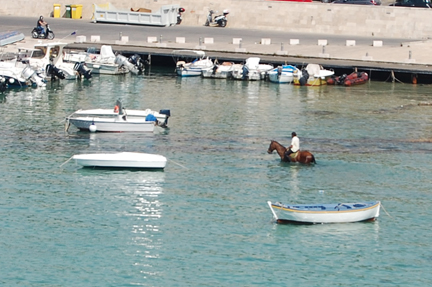
Even though we know that sunlight is bad for us, we all know that wonderful feeling of feeling the sun on our skin, watching a sunset, or walking through a park on a bright summer day.

And even though we know it’s not bad for us, a view of verdant pastures or ancient olive groves somehow soothes us. The same way we enjoy reading Virgil’s Bucolics, viewing an 18th-century painting of a pastoral scene, or reading about “hardcore” natural winemaking in Spain on a favorite wine blog, food and wine writing allows us to escape the workaday din of the consumer-driven, globalized, and frighteningly reified world in which we live.

Sadly, in the post-second-world-war industrialized and globalized world, our bodies have become mere objects and the nutriments which give us life have become mere objects and we have lost touch with the pre-industrial expressions of the one and the other. Even as we consume “heirloom” food and wine products, as good and as healthy and as wholesome as they may taste, we cannot ignore (however much we would like to) the fact that the chain of supply that has delivered them to our dinner tables has rendered them into mere objects for consumption (it has reified them) by polluting the world with its carbon foot print as it couriers otherwise nutritious sustenance to consumers.
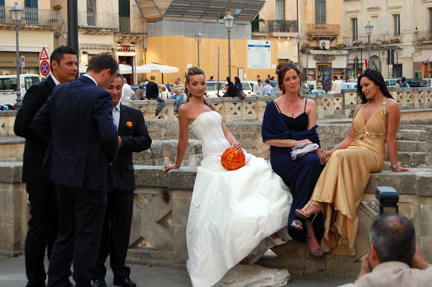
Marx would have called this “estrangement” (or “alienation” is some circles of Marxist parlance). There are very few among us who have any direct contact with the origins of the foods with which we nourish ourselves. As for Marx’s worker, food as become a mere object for us, even though it is the very substance that gives us life:

    The more the worker by his labor appropriates the external world, sensuous nature, the more he deprives himself of the means of life in two respects: first, in that the sensuous external world more and more ceases to be an object belonging to his labor — to be his labor’s means of life; and, second, in that it more and more ceases to be a means of life in the immediate sense, means for the physical subsistence of the worker.

From his jail cell, as he witnessed Mussolini and the fascists industrialize Italy (“the trains ran on time,” etc.) and promote an exodus from the countryside and a migration to the great urban centers (because they needed humanpower to populate the factories), Gramsci distilled Marx’s estrangement into his notion of the cultural hegemony, whereby the capitalist cultural model drives humanity to negate its humanness.

Pasolini took this notion a step further, I believe, when he wrote of the bourgeoisie’s “fear of naturalism” and the “natural being.” As he witnessed Italy’s youth embrace the materialism and aesthetic models of middle-class America (in part thanks to the Marshall Plan and in part thanks to the emergence — for the first time — of globalized media), abandoning the values of the generation who had come before them, he recognized that this was a result of consumerism’s revulsion toward the natural being and the natural world (this theme pervades Pasolini’s work, from his early Friulian poetry to his last films; Pasolini was born in 1922, the year Mussolini marched on Rome and rose to power, and he was assassinated by a Roman prostitute in 1975, at the peak of the Christian Democrats’ hold on power and the hegemony of its capitalist model, both economic and ethical).

Now, more than ever, I am convinced that food and wine writing represents can represent, however powerless, a subversion of the hegemony of consumerism in the world today. Whether we take joy in reading or writing about a farmer who casts off chemicals to grow grapes and shuns industrial yeast to make wines that “taste of place,” we are subconsciously repelling the yoke of consumerism as we attempt, however unaware, to recoup, recuperate, and recover the humanness that has been negated by the human condition in the industrialized and globalized world.

Food and wine and food and wine writing offer us a historically unique confluence of the objectification of the sensuous natural world and the means for living. Unlike the natural substances transformed by Marx’s worker as she/he worked in a pre-world-war factory (like iron used to build arms, for example), food and wine as Marxist objects in today’s world are at once the transformed object and a source of nourishment. As such, it gives us a historically unique opportunity to express our humanity through its exegesis (and in many cases, its worship and fetishization).

This is the reason why I continue to post here on my blog and this is the reason — I hope — why you’re reading. Thanks for making it this far into the post.

And buona domenica

Tracie P’s King Ranch Chicken recipe (from MyRecipes)

A lot of folks have been asking (here and on the Facebook) for Tracie P’s King Ranch Chicken recipe.

Here it is…

Man, I wish I could invite everyone over to taste how good it was and how well it paired with the Jura!

Buon appetito!