We’re gonna have a girl! :-)

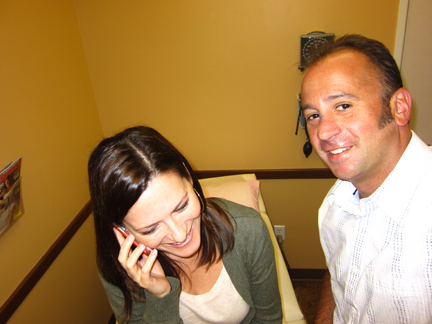
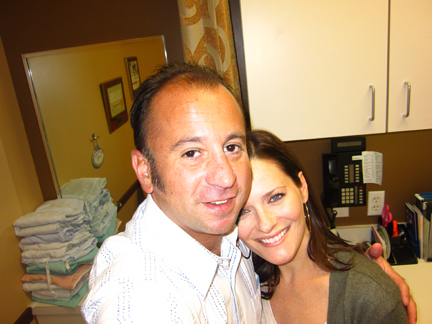
Tracie P and I just got back from our 20 weeks/5 months appointment with our doctor and WE ARE GOING TO HAVE A GIRL!

All the tests have come back negative and today’s ultrasound revealed that everything is A-OKAY! WE ARE SOOOOOOOOOO HAPPY!

It’s so nice not to say “it” anymore and it’s simply impossible to describe the joy in our hearts today…

Thanks for letting us share it with you… We are so happy…

Tarallucci e Vino (biscuits and wine), an attempt at documenting the proverb

From the “una faccia una razza (one face one race)” department…

Above: Generic however delicious taralli served to us in Apulia at the Radici Wines tasting.

It all started back in June when Jancis tweeted: “Best inter-wine nibble ever: taralli from Puglia.” For three days, we had been sitting next to each other tasting and scoring Southern Italian wines at the Radici Wines festival in Apulia.

It was our last day of tasting together and one of our Italian counterparts (I can’t find the tweet) quipped back, tweeting “Finiamo a tarallucci e vino,” literally, “we finish [the tasting] with [small] taralli and wine.”

The irony in this context is owed to the proverbial meaning of the expression in Italian. To end with tarallucci [an affectionate diminutive of taralli] and wine means to resolve a dispute by pretending there were no dispute to begin with. In other words, we argued, we disagreed, but let’s have some savory biscuits and wine and pretend that there is no acrimony between us.

While the saying can be applied to express the sentiment that all’s well that end’s well, it can also be used ironically to denote that I believe you’re wrong but there’s no use fighting about it. (The sentiment and expression are by no means unfamiliar to Italians or those who frequent Italy and Italians; it’s often used in Italian journalistic parlance to allude to the hypocrisy of Italian politicians.)

Above: Taralli probably share a kinship with Greek koulouri (I believe the unleavened biscuits in the photo, tasted at Boutari’s Santorini tasting room, fall in the category of koulouri in the Hellenic culinary canon).

Not much is known about the origins of the term tarallo. The Cortelazzo (Zanichelli) etymological dictionary notes that the etymology is obscure, possibly from the Latin torrere, to dry up, parch, roast, bake, scorch, burn. Some point to the Greek δάρατος (dàratos), a type of Thessalian bread.

I have yet to find any reliable source that addresses the origins of the expression tarallucci e vino but the tarallo’s significance as a gesture of hospitality clearly emerges in 19th century literature. It was one of the earliest street foods of pre- and post-Risorgimento Southern Italy (Pitré, Biblioteca delle tradizioni popolari siciliane, 1883) and was presented by and to travelers when they arrived. In The Bagel: the surprising history of a modest bread (Yale 2008), Maria Balińska suggests that the tarallo may be the predecessor of the bagel.

Above: Jancis and the rest of our group paired sweet taralli and spicy Sicilian chocolate with aged Primitivo at the Pichierri winery in Sava (Taranto, Apulia).

Browsing the Henry George Liddell, Robert Scott, A Greek-English Lexicon, I read that the Greek δάρατος (dàratos) was a type of unleavened bread “offered at marriage and registration ceremonies” in Hellenic Greece. And I cannot help but wonder if the tarallo’s circular, adjoined shape does not belie its use as a symbol of friendship (Balińska addresses the Italian ciambella, a similarly round unleavened bread, its relation to the bagel, and the ancient custom of presenting it to one’s host). There’s no doubt that the tarallo travels well and is easy to preserve (in Campania taralli are made with shortening and are often adorned with almonds; in Apulia, they are made with olive oil and adorned with fennel seeds).

If anyone has any insights to share, I’d greatly appreciate them. As a devout philologist, I will not rest until I get to the bottom of this conundrum and we will genuinely be able to conclude a tarallucci e vino.

Thanks for reading!

Our date with Willy Wonka: a staff training with the inimitable Randall Grahm

From the department of “so many great wines and so many great people and so little time”…

One of the best things about what I do for a living is the great wines I get to taste and the fascinating people I get to meet. And one of the most rewarding things about my career is getting to share those wines and those experiences with people I care about.

All of these elements came together week before last when the inimitable Randall Grahm — the Willy Wonka of wine in my view — graciously agreed to do a staff training with the servers at Sotto in Los Angeles where I curate the wine list.

When you work so closely with people as you do on the floor of a restaurant (often in extremely stressful situations), you develop a unique bond with them. And I was thrilled that Randall agreed to come talk to us and sprinkle some of his magic dust on us.

Of all the winemakers I’ve ever met, Randall — a polite and warm man — is perhaps the most erudite. I love the fact that he shares my love of words (philology!) and describes wines in terms of antipodian and podian (his neologism?). I love that he doesn’t mince words (I cannot repeat what he had to say about one antipodian wine). And I love his lyrical approach to describing winemaking and wine. At one point, when I asked him to address reduction in wine and why it’s not necessarily a bad thing. He replied using the follow simile: “Reduction is kind of like the male sex drive,” he said. “It can be ugly but it lets us know that everything’s working correctly and that the wine is alive.” (Reduction can be caused by wine being stored without any contact with oxygen, often the case with screw-cap wines. As a result, the wine may stink briefly when first opened. For the best definition of reduction in wine, see the entry on Jancis’s site — well worth the subscription fee, btw — or see her Oxford Companion to Wine.)

On the edges of our seats, the staff and I were entirely captivated by Randall’s spiel on the spectrum of organic, biodynamic, and Natural winemaking. And we tasted his Syrah Le Posseur together (by the glass at Sotto these days). Le posseur, the pusher in French, was inspired by the way great Syrah is like drug dealer who tempts you with his assortment of aromas and flavors. I love the analogy and I love the affordable and delicious wine (it only gets better with a day’s aeration, btw).

But dulcis in fundo, Randall also shared with us his new hope and faith in biochar — a newly developed form of charcoal that is used to restore balance to the soil. We live in such precarious times, these days (o tempora o mores!). “It is the future,” he said, referring not only to winemaking but also the survival of humankind.

Looking back on our encounter with the ineffably charming Randall, I cannot help but be reminded of the lyrics of one of favorite songs — from childhood to the present day.

If you want to view paradise
Simply look around and view it
Anything you want to, do it
Wanta change the world?
There’s nothing
To it…

Historically and with seemingly quotidian recurrence, Randall seems to seek and find beauty in the world around and in us, too.

This is one of my all-time favorite songs and cinematic moments. I’ll never forget seeing it for the first time and the emotion that filled my chest. It happens, to this very day, every single time…

Freudian Slip, my band’s new album

It’s official: Nous Non Plus’s new album “Freudian Slip” will hit the streets on October 11, 2011 on Aeronaut Records.

It’s never easy to put out a new record and this one was no exception… but I’m thrilled with the results and very proud of the music I wrote this time around.

If you like this kinda thing, please check out the new site and please follow along on Twitter and Facebook (not that you need another feed to follow!).

I’ll be updating the Nous Non Plus site every week and once I can share some of the music, I’ll also write about the genesis and meanings of each track.

As for the title, some of you already know the role that Freud and language play and have played in my life… I’ll be writing more about that as well as the release date approaches.

My music means so much to me and there’s nothing more rewarding than knowing that people enjoy it. So please have a look at the new site and learn about the more than 10-year history of the band (there’s a lot of music there, btw). It’s been a wild and wonderful ride. No regrets, Coyote!

In other news…

I’ll be speaking on Tuscan wines and breaking bread with guests tomorrow night at Vino Vino in Austin.

Click here for details.

Thanks for reading and listening…

Best fast food ever: delicious Vietnamese sandwiches at K Sandwiches (San Diego)

Tracie P and I had a wonderful week out here in “paradise” as the natives like to call it. A relaxing vacation of summer, sun, beach, good eating, and visiting with family and friends.

We’re about to board a plane back to Austin and I just had to share one more gem we discovered on this trip thanks to a few of the super nice doormen in Mama Judy’s building. On their recommendation we visited K Sandwiches in San Diego.

People, I am here to tell you: RUN DON’T WALK! The baguette was perfectly crusty on the outside and fluffy inside. I had the K Special (above and below), gently spread with pâté and stuffed with different types of cured ham and fresh cilantro, radish, carrot, and jalapeño.

My sandwich cost less than $3 and I didn’t even begin to peruse the many blended fruit and coffee drinks, not to mention the small grocery there.

At the peak of lunch, the place was packed the whole time we were there but the sandwiches were delivered with a celerity that old McDonald himself would envy.

Value, wholesome ingredients, superb service in a sparkling clean establishment? Could be the best fast food ever.

It’s been a great week in paradise but it’s time for us to go home with armadillo. As much as I love the place where I grew up, there’s nothing like waking up on a lazy Sunday in the Groover’s Paradise and rustling up some breakfast tacos for the most beautiful lady and mama-to-be I have ever seen…

Rebula and pulled pork quesadillas rock our world

One of the most delicious things we ate during our week in Southern California was the happy hour pulled pork quesadilla at Jaynes Gastropub… delicious in part because it was one of the dishes we served at our wedding reception there.

The dish paired wonderfully with a glass of Kabaj 2008 Rebula (Ribolla), vinified with skin contact. Very elegant expression of Ribolla, with gentle tannin and a great balance of savory and fruit flavors.

Slovenia, meet Southern California… brilliant…

We’ve had a fun week of eating here in San Diego and our adventures inspired a post on pairing red wine and fish over at the Houston Press, including some food shots from Jaynes.

    ​Whenever I am faced with a conundrum like the age-old question of whether or not it is imperative to pair white wine exclusively with fish, I look to antiquity. Indeed, in more cases than not, the ancients were much wiser and more well informed than we are.

    And as I pore over (excuse the pun) centuries-old manuscripts and vellum-bound tomes, I discover that — lo and behold — the ancients did not have this problem because wine was predominantly white or rosé (at its darkest) in the days of yore…

Click here to read the rest of the post…

Thanks for reading and buon weekend, yall!

Mazel tov to Craig Collins & Devon Broglie! Two of the six new Master Sommeliers!

You can only imagine our joy in hearing (just now) that our good friends Devon Broglie (left) and Craig Collins have passed the final exam (tasting) and have become Master Sommeliers.

We are so proud of them and proud to know them. And we’re looking forward to seeing them at TexSom, the Texas Sommelier Conference in a few weeks in Dallas, Texas!

Congratulations, yall! We are so stoked!

A voice of reason in Montalcino? A top producer addresses the absurdity…

Above: A monument rests atop Montaperti, not far from Montalcino. It commemorates the 1260 battle between the Guelphs and the Ghibellines, when the temporal and spiritual [im]balance of power in the Western World lay in precarious uncertainty. In the wake of the battle, a cloud of darkness fell over Italy for centuries to follow.

Italy’s top wine blogger, Mr. Franco Ziliani, has obtained and yesterday posted (with the author’s permission) a letter addressed to members of the Brunello Producers Association by the scion of a storied Montalcino family, Stefano Cinelli Colombini, owner of the Fattoria dei Barbi. Even in the wake of an aborted call for a vote early this year to allow international grape varieties in Rosso di Montalcino (which, by law, must be made with 100% Sangiovese grapes), certain members of the body are asking its technical advisory council to consider calling again for a vote on the matter.

I have translated the letter in its entirety and believe that its truths are self-evident.

*****

Dear friends and producer colleagues, I have just attended a meeting organized by the Consortium [Brunello Producers Association] where we discussed the inclusion of other grapes [besides Sangiovese] in the Rosso di Montalcino [appellation]. And I am writing to share my deep-seated reservations. We are faced with a serious problem because an overwhelming majority voted against the inclusion of other grapes in the Rosso di Montalcino [appellation] in a recent assembly.

An assembly vote should not be put up for discussion just a few months later. With all due respect, I would like to remind you that we have just put a tremendous rift behind us. It happened because the [fifteen-member technical advisory] Council was too stubborn to call for votes on votes [sic] on an argument (the blending of Brunello [with grapes other than Sangiovese]) for which the assembly had already expressed its clear dissent.

The message conveyed by the members is more than evident: appellation regulations are to be changed only if there is clear and broad consensus beforehand. All it takes is to ask for signatures from the members who wish to modify the appellations. We were just a handful of members but it took us just a week to gather the signatures of more than two thirds of the members against the blending of Brunello. I am certain that the Consortium has the means and the personnel to do a better job than we did. If as many producers were to sign [a call for a new vote], it would only be right and correct to call an assembly vote on whether or not blending should be rejected. Otherwise, you should stop.

Anyone who lives in this community knows that [a proposal for] blending will be voted down by the assembly, that such a vote will once again create a rift among members, and that a media storm will inevitably follow.

We must avoid such a useless confrontation. A new conflict between the assembly and the Council will lead only to paralysis and paralysis helps no one.

I’m not interested in who’s right and who’s wrong. Now, more than ever before, we need a Council that knows how to win the trust of its members. We don’t need a Council that opposes them.

The only plausible reason to allow blending has fallen by the wayside: the sale of Rosso di Montalcino is no longer falling. [Consortium] director [Stefano] Campatelli says that during the first six months of 2011, 500,000 more bottles have been shipped than in the first six months of the previous year. This represents phenomenal growth.

Previously, there could have been some doubt but now the numbers show that the sales of Rosso di Montalcino depend on the price of Brunello and not on the Sangiovese. When Brunello was sold in bulk at Euro 300 per hectoliter, no one wanted to buy the Rosso anymore. With Brunello at Euro 800, the Rosso is soaring with a 40% increase in sales.

If you think about it, it’s only logical that if a bottle of Brunello only costs a few Euro more than the Rosso, everyone will buy the Brunello. The cure for the Rosso di Montalcino malaise is higher prices for Brunello and not blending, which would not make the Rosso technically better. Blending would only make it the same as many other excellent wines that cost much less. It takes a lot more than slapping a Ferrari label on a [Fiat] Panda to sell it for Euro 100,000. And it takes more than the Montalcino name to set a high price for a wine that may be technically perfect but otherwise indistinguishable from many others that cost three or four Euros.

Your colleague, Stefano Cinelli Colombini, Fattoria dei Barbi

*****

In unrelated news, have you noticed that Franco has announced the winner of his recent “make me a new blog banner” competition? His new banner was created by Ms. Stefania Poletti, a native of Bergamo who now resides and works in Boston. Congratulations, Stefania! Nice work!

Yu Me Ya, the best little sake house this side of Osaka

Tracie P and I finally made it to Yu Me Ya in Encinitas, California. It’s extremely difficult to get into this small joint without a long wait — it’s that good, folks. But our good friend John Rikkers (who took the photo above) managed to make us a reservation (they only take reservations Tues.-Thurs. btw).

Man, after a day at the beach, there’s nothing like some good Japanese pub grub and cold beer!

Recommendation? RUN DON’T WAlK, people. Thanks again, John!