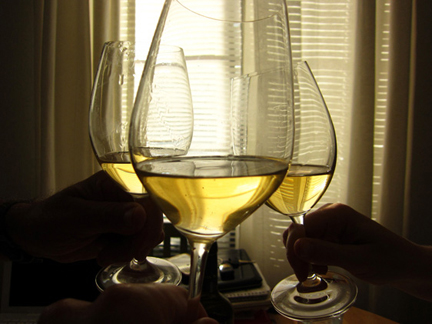
It’s pure coincidence that we happened to open a bottle of Bisson Ü Pastine last night with some penne aglio, olio, e peperoncino for a light supper — one of the most simple things and one of my most favorite dishes to prepare. This afternoon, Facebook friend Evan R sent me a link to Alan Tardi’s article on the Bisson winery, its owner Piero Lugano and his underwater-aged sparkling wines, which appeared today in The New York Times. (The article is great, btw.)
I always crave wines from Liguria during the summer. From the light-colored, nearly rosé Rossese to bright Pigato and Vermentino, the wines tend to be light and low in alcohol, fresh and spicey- and fish-friendly.
Frankly, before last night, I’d never had a wine made from 100% Bianchetta grapes from Liguria. In fact, Bianchetta is more famously grown in the Veneto and South Tyrol, where it is used to make an easy-drinking, food-friendly light white wine.

The Bisson was delicious, more unctuous than any other Bianchetta I’ve ever had, very salty and with nice white stone fruit. I was worried that the 2009 would be a little tired but it wasn’t. The acidity was kicking and happy (like little Baby P inside Mamma P’s belly!) and I saved a glass to taste tonight at dinner.
Of course, my philological curiosity got the better of me this morning, and so I did a little research on the name of this wine, ü pastine.
Regrettably, the importer’s website reports that the name is “local dialect indicating a very special product.”
And equally lamentable, a major U.S. retailer reports “‘U Pastine’ in the Ligurian dialect means, essentially ‘a gift that is specially crafted by someone for someone in particular in order to be an extra special present.'”
With all due respect, where do these people get this information? Beats me.
In fact, ü pastine is a Ligurian dialectal term that denotes the [a] field reserved for grape-growing. Used also in Tuscany and even as far south as Latium, pastine or pastene comes from the Latin pastinum, denoting a kind of two-pronged dibble, for preparing the ground and for setting plants with. In Ligurian dialect, pastinare means to till. In other words, ü pastine denotes the parcel of land chosen for grape growing because of its ideal conditions for raising wine.
I’m glad that we cleared this up!
And I plan to add pastene and pastine to my Italian winery and vineyard designation project, which I will revisit this fall.
Alfonso is coming over for dinner tonight and I’m not sure what we’re opening to pair with Tracie P’s pasta con i porri e la pancetta but I’m sure it will be good! Stay tuned… and thanks for reading!