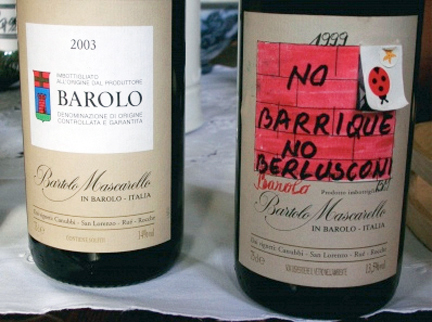
No Berlusconi but sadly still Barrique

Bartolo Mascarello’s famous label, “No Barrique, No Berlusconi,” a now iconic image that empowered wine as an ideological expression. Photo via Spume.

The great 20th-century novelist, poet, essayist, and politician Leonardo Sciascia employed Sicily as synecdoche for Italy in his novels Il giorno della civetta (The Day of the Owl, 1961) and A ciascuno il suo (To Each His Own, 1966). The works were parables of what he would later call the “Sicilianization” of Italy: a phenomenon whereby the Sicilian model of bureaucratic and political bankruptcy and clannish self-interest had contaminated the entire Italic peninsula as the nation first tasted the sweetness of prosperity thanks to the “economic miracle” of that decade.

Today, as I joyously read the news that Berlusconi has pledged to resign, I am reminded of Sciascia’s parables. In many ways, Berlusconi’s 17-year tenure as Italy’s leading politician is a parable of the Italian nation’s overarching abandonment of the social ideals that emerged in the period immediately after the second world war, when social and economic equality, dignity, and liberty were paramount in the hearts and minds of Italians who had suffered through the tragedy of fascist and Nazi domination. The memory of those wounds was still vibrant in 1994 when Berlusconi first took power. Today, the generation that embraced the humanist ideals of Italian post-war communism has greyed. And the greed and moral bankruptcy embodied by Berlusconi will remain as the legacy that has reshaped Italy and swept away the renaissance of Italian greatness — in design, technology, fashion, cuisine, etc. — of the decade that preceded his reign.

His tenure corresponds neatly to the tragic Californianization of the Italian wine industry that took shape in the 1990s when scores of Italian producers abandoned the values of the generation that had made wine before them.

Berlusconi may be on his way out. But, sadly, barriques are here to stay.

In the face of the European debt crisis and the social and economic turmoil that has gripped Italy (my first love) and Greece (my new love) — “Crisis in Italy Deepens, as Bond Yields Hit Record Highs,” New York Times — it’s been difficult to write about wine here on the blog.

Tonight Tracie P and I will raise a glass of traditionally vinified Nebbiolo to Italy’s future… and tomorrow I’ll pick it up again…
Frondisti and malpancisti, interesting Italian political nomenclature

With all the talk of Berlusconi’s imminent fall, the Italian media often mentions the so-called frondisti (the rebels in the Berlusconi coalition) and the malpancisti (literally, those who suffer from stomach aches).

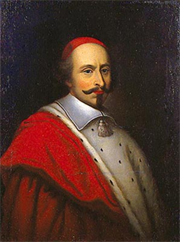
The frondisti take their name from the frondeurs of 17th-century France: the Parisian mobs who used slings (fronde in Italian, frondes in French) to hurl stones and other missiles “to smash the windows of supporters of Cardinal Mazarin,” minister to the French monarch (above, left).

“In 1644, Mazarin tried to prevent [the city of Paris from] growing further and to raise taxes by fining those who built houses outside the City Walls. This policy produced widespread resentment. The Fronde began in January 1648, when the Paris mob used children’s slings, frondes, to hurl stones at the windows of Mazarin’s associates.” (From the Wiki.)

An early documented use of malpancista dates back to 2004. It refers to members of a political alignment who express dissent or disagreement. Their “stomach ache” belies a change of heart (heartburn?).

As Italian journalist Aldo Grasso recently noted, a stomach ache is generally relieved by a visit to the toilet.

My advice to Berlusconi? Vai a cagare…

Berlusconi hangs on by a thread…

The chamber of deputies has just approved Berlusconi’s budget with 308 voting yes, 0 voting no, 1 abstention, and 321 not voting at all (!).

He’s hanging on by a thread… but he’s hanging on…

Here’s the link to the ANSA feed.

Berlusconi confidence vote live streaming

Here’s the link to live streaming from the Chamber of Deputies…

http://webtv.camera.it/light/indexflash.php

My fingers are crossed that Berlusconi will finally be ousted… But I fear that he’ll survive this round…

Civic mourning today in Genoa, crisis in Greece @Miti_Vigliero @MariaKaramitsos

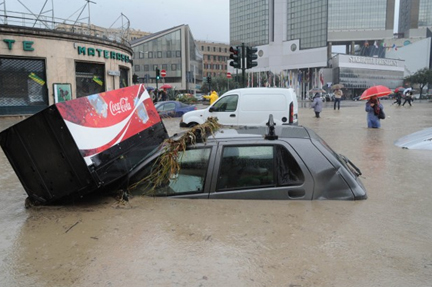
Photo via Genova.Repubblica.it.

Our hearts and prayers go out to the families of victims of torrential rains in Genoa (Genova) and northwestern Italy: 6 persons died in Genoa on Friday and the city government has declared a day of civic mourning today.

The city is still under a flash flood watch, with more rains expected today and tonight.

Like many residents, writer, poet, humorist, educator, blogger Mitì Vigliero (aka Placida Signora, one of my favorite Italian-language blogs) has left the city for higher ground but she’s posting updates on the weather and emergency resources on her Twitter feed here.

Our thoughts and prayers also go out to the people of Greece, whose economy continues to be paralyzed by its government’s inability to move forward with the European Union debt deal.

I’ve been following Chicago-based Greek-American writer Maria Karamitsos’s Twitter feed for updates on the crisis.

My short treatise on SO2 & wine for @EatingOurWords

Writing for the Houston Press has been super fun for me: it has given me the opportunity to write about a wider range of wine topics for a broader audience.

Today’s post is my short treatise on sulfur dioxide and wine and why sulfites are a good thing. You might just be surprised by what you find there…

Here’s the link to the post.

Thanks for reading!

Austerity on Santorini

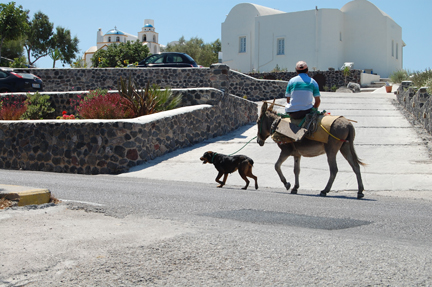
Reading about “Prime Minister George Papandreou’s surprise plan to hold a popular vote on the Greek bailout” this morning in The New York Times, I couldn’t stop thinking about the above photo I took on the island of Santorini this summer.

The next night, I was in Crete and the Greek parliament was about to vote on whether or not to adopt austerity measures imposed by the European Union. At dusk before dinner, you could still see the silhouette of the village where the modern Greek philosopher Kazantzakis was born.

The next day, the Greek parliament voted to adopt the measures. Today, I read in the Times that there’s a strong possibility that austerity won’t be embraced, that Greece will default on its debts, possibly going bankrupt and possibly leaving the Euro zone.

I’ll never forget how the folks I met on Santorini kept telling me the same thing: “It’s as if the Germans were invading us again, with these austerity measures and the bailout,” they said lugubriously.

I remember when dissertation advisor, Luigi Ballerini, told me for the first time (the first of many) how his father, an Italian soldier in the fascist army, was executed by German soldiers on the Greek island of Cephalonia after the liberation of Italy by the Allies in 1943 (Luigi wrote a cycle of poems about Cefalonia, published by Mondadori in 2005).

No matter who’s right or wrong, no matter how this mess will be resolved… has the post-war dream of self-governance and individual liberty come to a bitter end? It won’t be long before the focus of the international community shifts from Greece to Italy…

Where will this leave the farmer in the photo above? And how will explain all of this to Baby P when she arrives in December?

Someday, we’ll take her to Santorini…

Can wine be evil? Stories that haven’t been told #ewbc

In the first panel/round table where I spoke at the European Wine Bloggers Conference in Brescia a few weeks ago, I was asked “to defend the written” word as a medium for wine blogging (here’s my post on my “defense”).

In the second panel, organizer and curator Ryan Opaz asked me and the other participants to talk about “stories that haven’t been told” in wine blogging.

The different panelists had widely divergent approaches to the subject but wine writer and blogger Elisabetta Tosi made a point that resonated with me.

In Italy, she said, wine marketers continue to tell wine stories in terms of family and tradition, focusing on the generational continuity and historical significance of the wines and the wineries. Most, she observed, neglect to talk about the quality of the wine itself, concentrating solely on the cultural value of the wine.

Her point aligned with mine: I believe that, although there are some notable exceptions, English-language wine writers favor technical descriptions of the wines they cover, from how they are produced to how they taste; in Europe, where wine writing is not as rigidly codified as it is on this side of the pond, I find that wine (and culture desk) writers tend to discuss wines in terms of their cultural value and context.

To her point, I added that while English-language writers tend to limit their descriptions and assessments to the technical merits and flaws of the wines, European writers view wines as ideological and even ethical expressions of their respective nations. In other words, where Antonio Galloni — a writer and Italian wine expert whom I admire greatly — will provide tasting and vintage notes for a wine by Bartolo Mascarello, an Italian writer will attempt to delineate the epistemological implications of the winery, the winemaker, and his wines (as in this post, where a blogger lists the authors he finds on Bartolo’s shelves: “Togliatti, Longo, Marx, Liberovici, Marcuse”; can you imagine James Suckling even contemplating such authors?).

A great illustration of this divide came up in the feed today, when leading Italian wine writer and top Italian wine blogger Franco Ziliani published a post entitled “Americans are the only ones capable of believing in the fairytale of a ‘Chiantified’ Merlot.”

In the post, Franco examines a review of a Ricasoli Merlot by W. Blake Gray in which the American writer praises the winery for a “Chiantified Merlot,” his “favorite wine in the portfolio.”

Nonplussed, Franco decries Gray’s claim that the wine is “a positive example of internationalization.”

“How the devil can you take people like this seriously?” asks Franco. The lunacy of Gray’s assessment and Ricasoli’s approach to internationalized wines for the American market is self-evident in Franco’s view and that of his readers.

In America, wine writers and wine shoppers and winemakers think of wine solely as a luxury product. In Europe, they think of wine as an indispensable nutrient, even when proposed in its most elitist expressions. In America we describe how it was made and how it tastes. In Europe, wine writers address a given wine’s technical achievement and its inherent quality but they do not shy from its ideological and ethical implications.

There’s nothing wrong in asking whether a wine is good or bad, in my view. In fact, I believe that mundane assessment of wine is a wonderfully rich pretext for a deeper understanding of humanity and our humanness. But I also believe that we must approach wines metaphysically, in other words, beyond their physical limitations. Beyond asking whether a wine is good or bad, I told the audience who attended the panel, we should be asking whether or not a wine is good or evil.

Although it’s not the only story that has yet to be told, I believe it is the most urgent one that awaits our attention, our utterance, and our articulation.

Thanks for reading…

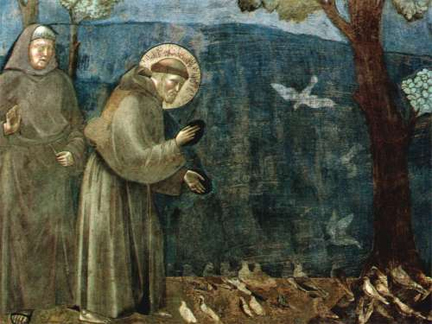
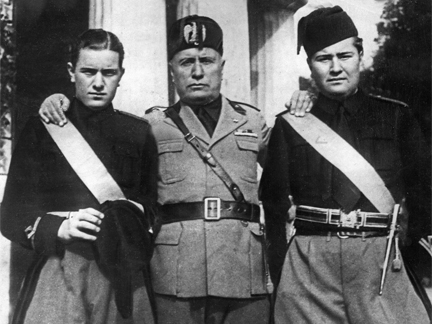
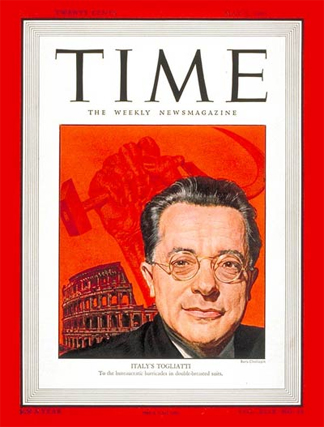
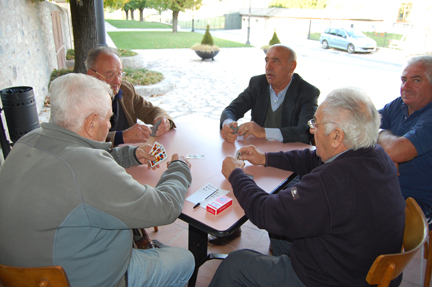
(In the photos above: St. Francis of Assisi, Mussolini, Palmiro Togliatti, and a group of old men playing cards in Borgonato in Franciacorta, province of Brescia.)

Wine and sex…

Great title, no?

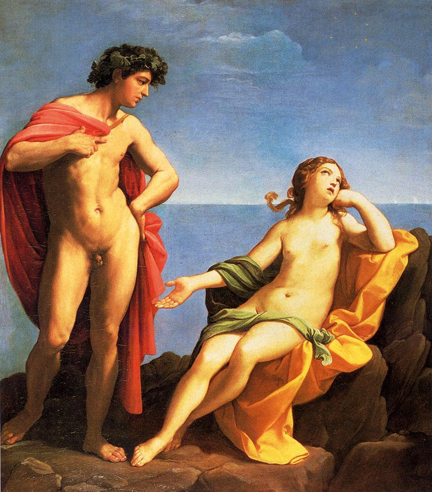
My post over at the Houston Press today is devoted to wine and sex, with references to Shakespeare, the symposia of ancient Greece, William James, and “Bacchus and Ariadne” by the Italian Baroque master painter Guido Reni, above.

What’s your favorite wine to drink before a roll (or role-play) in the hay?

Here’s the link…

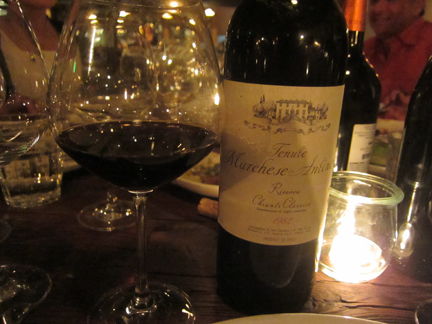
96 Giacosa Rabajà, 90 Struzziero Taurasi, 82 Antinori Chianti Classico, holy crap

From the department of “that’s what friends are for”…

Lots of good folks came out last night to share well wishes and good thoughts on my last visit to Los Angeles and Sotto for the year.

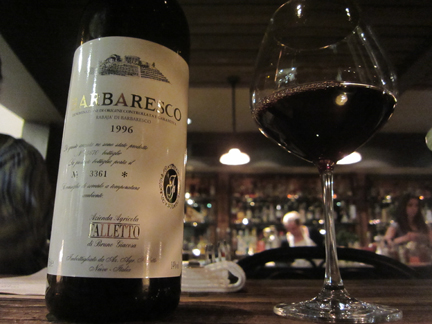
Schachter pulled out all the stops, reaching deep into his cellar for his last bottle of 1996 Bruno Giacosa Barbaresco Rabajà (white label) — honestly one of the best bottle of wine I’ve ever had. True to the legacy of the Rabajà cru, this mighty wine — from what many believe to be the greatest vintage of that decade — delivered aromas of mint and tar and earthy, savory flavors before revealing delicate, sublime fruit…

Keep smiling, keep shining, knowing you can always count on me, for sure.

Later in the evening, Anthony, Lars (who was in from Chicago), and Dan came in for a late-night dinner at the end of my shift.

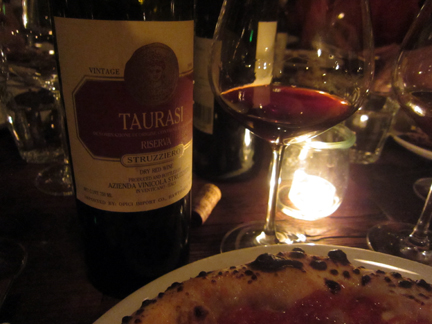
Dan brought a number of incredible bottles, including the 1990 Taurasi Riserva by Struzziero (classic blended Aglianico with no vineyard designation). I’d only ever tasted Struzziero back to 1993 (which we have on the list at Sotto) and I was blown away by the elegance and the balance of this wine, still so fresh and with the vibrant acidity that traditional Aglianico can deliver. Another best-ever wine, with gorgeous ripe red fruit and an ethereal earthiness that prompted Lars and me to call this top wine in the flight.

And now there’s so much more I see, And so by the way I thank you.

Although no show-stopper like the Struzziero Taurasi, the 1982 Chianti Classico Riserva by Antinori was fantastic — a wine, we all agreed, from a time before America, California, and Parker, a wine from a time when Antinori still made wine. Classic Sangiovese, with impressive acidity for a wine this old and delicious plum and red stone fruit flavor. It was a fantastic pairing for the sous-vide Wagyū tongue that chef Steve sent over to our table. Loved this wine and the now forgotten era of Tuscan winemaking for which it spoke to me.

My goodness… From my baby shower to all the hugs that the staff gave me before we said good-bye, from the camaraderie, solidarity, and thrilling wines to the wishes that our friends shared with me on this last trip to Los Angeles… I know that I never would have emerged from the darkness of my life before to reach this magical, blessed moment… what a year it’s been… someday I’ll tell Baby P all about it…

Oh and then for the times when we’re apart, well then close your eyes and know, the words are coming from my heart.