Isn’t she lovely? The most beautiful mamma in the world…

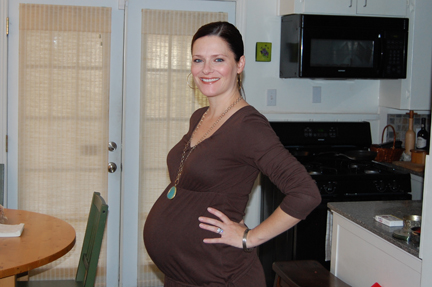
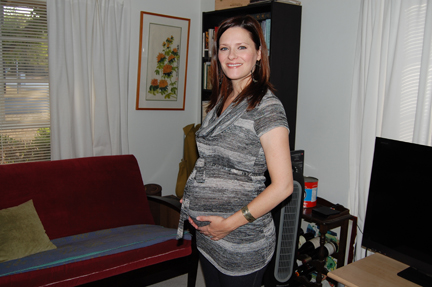
Just had to share this photo I snapped of Tracie P last week. Isn’t she lovely? :)

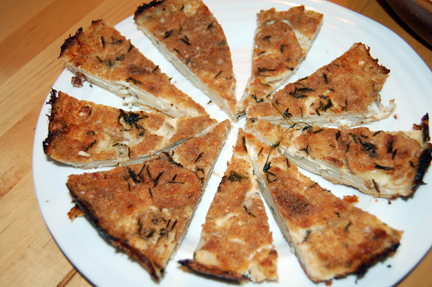
The day after Thanksgiving, we recycled her scalloped potatoes as a spuntino for out-of-town guests who came over for a visit…

Did I mention that the girl can cook? ;)

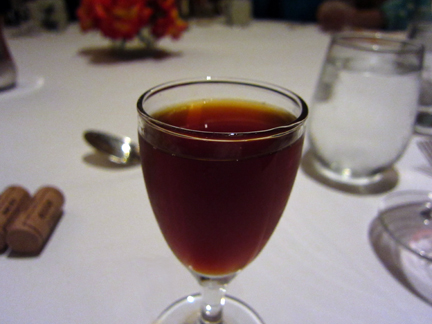
A little bubbly helped to wash it down…

I always love the focus and precision of Jacquesson… one of our favorite houses (among those that we can afford!)…

Vita servare: Pediatric CPR Training

Vita servare is the motto of the Austin-Travis County EMS department. Vita means life in Latin and servare means to make safe, save, keep unharmed, preserve, guard, keep, protect, deliver, rescue (isn’t Latin awesome?).

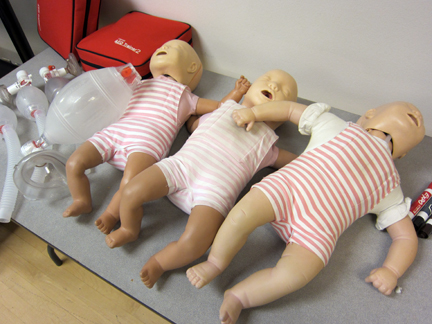
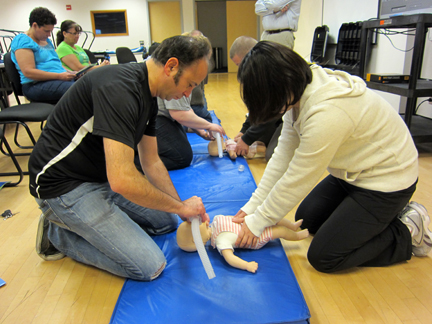
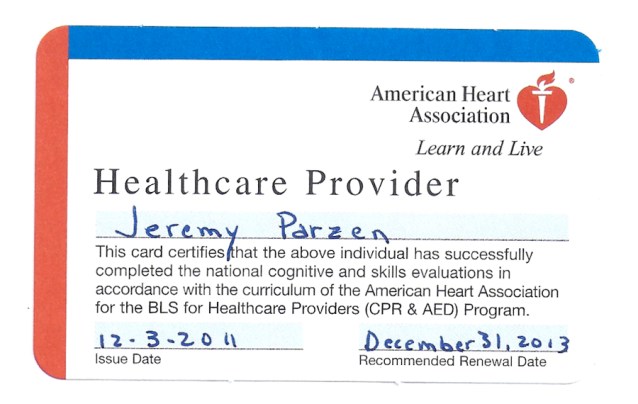
Yesterday I completed my Pediatric and Adult CPR training at their main office.

I was the only layperson in the class: all the other participants were professional health care providers who were obtaining or renewing their certification (nurses, paramedics, etc.).

After 3 hours of performing CPR on manikins, man, I was exhausted! G-d bless all the folks who do this for living. We’re lucky to have them…

My heart filled with emotion and my blood with adrenaline when I held the infant manikin in my arms for the first time. I hope I never have to perform CPR on Baby P but I’m glad that I’m ready.

We’re just a few weeks away from our due date at this point. The discomfort is not easy to deal with but we’re hanging in there. I’m doing my best to make Tracie P as comfortable as possible. And, every day, I love her all the more for carrying our little one… My Italian friends call her la piccola Parzen

And, btw, I passed! :)

I highly recommend the class. Here’s the info.

Buona domenica, yall…

Boccaccio and wine blogging

An allusion to Boccaccio in my post today for the Houston Press (on water and wine) was irresistible: citing the third novella, eighth day of the Decameron, I used a mention of wine in his description of Bengodi (the land of plenty) as an illustration of how water was commonly blended into wine in the middle ages. In the text, he describes a Vernaccia so good that no water was added to it.

Here’s the text in English (and here it is in Italian):

    Calandrino heard what passed between them, and witting that ’twas no secret, after a while got up, and joined them, to Maso’s no small delight. He therefore continued his discourse, and being asked by Calandrino, where these stones of such rare virtues were to be found, made answer: “Chiefly in Berlinzone, in the land of the Basques. The district is called Bengodi, and there they bind the vines with sausages, and a denier will buy a goose and a gosling into the bargain; and on a mountain, all of grated Parmesan cheese, dwell folk that do nought else but make macaroni and raviuoli, and boil them in capon’s broth, and then throw them down to be scrambled for; and hard by flows a rivulet of Vernaccia, the best that ever was drunk, and never a drop of water therein…”

The fact that he points out that never a drop of water was found in the wine is an indication that wine to which water wasn’t added was considered superior in quality.

There are so many wonderful mentions of wine in the Decamaron: ahimè, if I didn’t have to make a living, I could collate them into a neat little book with a critical apparatus (a little philological speak there for you).

In the meantime, any excuse to revisit Boccaccio is a good one!

The tale is one of my favorites and is a great (and funny) read: English and Italian.

Buona lettura e buon weekend yall!

Amarophilia across the USA…

Above: Fernet Branca shakerato, the way I drink it.

My colleague at Sotto in Los Angeles, mixologist Julian Cox, got a nice shout out from wine writer Ray Isle in an article on amaro in this month’s issue of Food & Wine. Julian’s amaro list at the restaurant features around 20 labels on any given day.

There’s no two ways about it: amarophilia (amaro fever? amaro mania?) is one of the new waves in mixology these days.

When I traveled to Friuli in October with a troika of über-hip mixologists, the barpeople wanted to duck into every wine shop they could in the hope of discovering a label unknown to Americans.

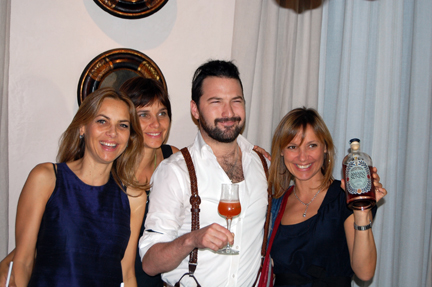
Above: That’s super cool Sam Ross of Milk & Honey (NYC) fame with the fabu Nonino sisters, an image I snapped on our trip to Friuli. He uses Nonino’s amaro in his cocktail, “the Paper Plane.”

When Ray — a friend and colleague from my NYC days — called to interview me for the article, we talked about the differences in the way that amaro is perceived and applied in the U.S. and Italy, historically and currently.

I recalled a Neapolitan-American friend of mine, Giovanni, now in his 50s, whose mother used to give him an espresso spiked with a shot of Fernet Branca and an egg yolk every morning before school.

There was a time when Italians used amaro as a tonic. And today, even though it’s no longer applied as a household remedy, Italians still serve it as a digestive. At any given bar or restaurant, you might find 3 or 4 different labels but no one would ever think of offering guests an amaro list (with 20 labels!) or using amaro as an ingredient in a cocktail.

Another expression of that great misunderstanding otherwise known as the Atlantic Ocean…

First Kiss: 07 Produttori del Barbaresco and Gianni Brunelli olive oil

Maybe it’s because she knew I was depressed by the flurry of bad news from Europe.

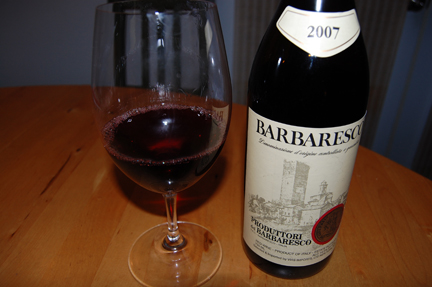
But it’s definitely because I’m the luckiest guy in the world: when Tracie P came home from work yesterday, she brought me a bottle of 2007 Barbaresco by Produttori del Barbaresco, which — believe it or not — I still hadn’t tasted.

However bizarre the 2007 vintage in Langa, everything I’ve tasted so far from Barbaresco and Barolo has been simply sensational. Here’s what one of my favorite wine writers, Antonio Galloni, had to say about this strange but glorious (imho) vintage:

    The year started off with an unusually warm and dry winter, with virtually no precipitation. Flowers and plants went into bloom nearly a full month early. Growers had never seen conditions such as these. The summer was warm, but evenly so, without noticeable heat spikes. Towards the end of the growing season nighttime temperatures lowered, slowing down the maturation of the grapes, and allowing for the development of the perfume that is such an essential component of fine Nebbiolo. The harvest was earlier than normal, but the growing season started so early in the year that the actual length of the vegetative cycle was actually close to normal if not longer than normal by a few days.

At first kiss, the 2007 classic (as opposed to vineyard-designated) Barbaresco by Produttori del Barbaresco was very generous with its fruit. Arguably the most elegant bottling I’ve ever tasted from the winery that forms the centerpiece of our wine collection, the wine showed stunning balance before quickly closing up, with the muscular tannin dominating the wine in my glass for the rest of the evening (I’ve saved the great part of the wine in the bottle and will revisit it tonight and tomorrow night). If ever there were an expression of Barbaresco “Barolo-esque” in its power, this would be it: there was a delicate menthol note in the mouth that reminded us of some of our favorite “east-side,” “Helvetian” growers.

It’s too early for final judgment on this wine, but wow, my impression is that we have a lot to look forward to…

In other news…

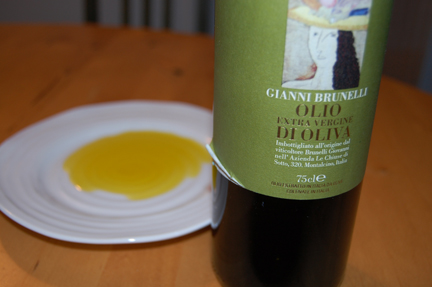
I also opened a bottle of Gianni Brunelli olive oil that Laura Brunelli gave me when I visited the family’s amazing farm in Montalcino in October.

A drizzle over some still warm toasted bread was unbelievably good, one of the mineral olive oils I’ve ever tasted. (When tasting olive oil, please be sure the olive oil is room temperature and always taste with warm bread; the gentle heat of the bread will prompt the oil to release its full flavor.)

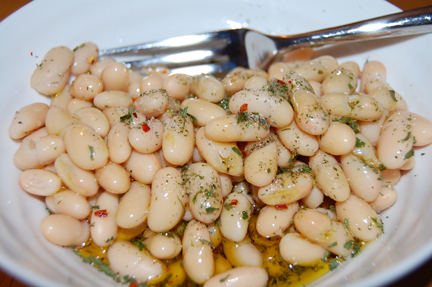
I used the oil to dress some fresh red leaf lettuce and some cannellini beans. Utterly and absolutely delicious.

Whereas Ligurian olive oil tends toward the fruity and Sicilian toward the spicy, great Tuscan olive oil leans toward salty: I added just a dash of kosher salt to both the salad and the beans and Laura’s oil imparted all the savoriness I needed to both dishes. Fantastic stuff… Enough to cheer a wine blogger up after a day of gloomy news from his adoptive country…

Stay tuned for a post on my visit with Laura, a tour of her amazing “biodynamic” house, and a tasting of some current and older vintages of her family’s incredible wines… one of the best tastings from my last trip to Italy… Thanks for reading!

A sad day in Siena…

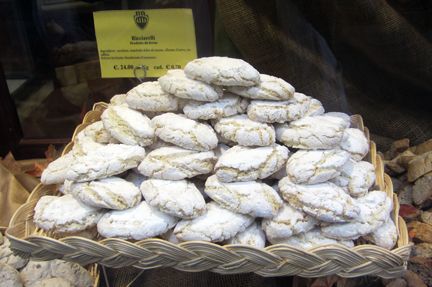
Above: Ricciarelli from Nannini in Siena. I took these photos in October while visiting a good friend there.

From Frank Bruni’s editorial today on Berlusconi’s “post-script” to the report in the Wall Street Journal that the Monte dei Paschi Foundation might lose control of the historic bank — the “world’s oldest bank” — the news from Italy is depressing these days.

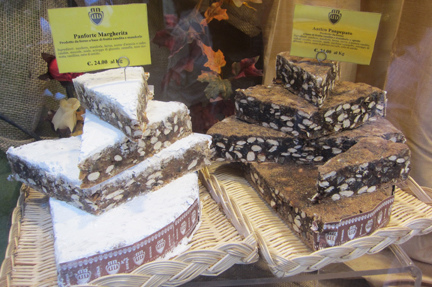
Panforte.

It’s hard for me to write about Italian wine these days when people I know and care about are being affected directly by the economic crisis in Europe.

A good friend from Siena writes:

    [Monte dei Paschi] is the oldest bank in the world (founded in 1472). It is the third largest bank in Italy and it has represented everything for Siena since the beginning. It is the financial lung of the city and of the province. It used to distribute Euro 250 million ($400 million) every year to everybody who asked for restoration of the bathrooms of the contradas in Siena, or for a new soccer field, or for a book illustrating the old gates of Siena, or to make a show, or to go to a wine fair. Directly or indirectly MPS [Monte dei Paschi di Siena] has been the Babbo Monte [“Daddy Monte”] exactly like a generous dad [see this WSJ profile and report on the crisis]. Now MPS is in big crisis like anyone else in Italy but with a bigger aftermath than any other. On the stock exchange, MPS lost from the beginning of the this year 88% of the value dropping from 3,00 euros to 0,29 euros for share. So this is a problem. A big problem. A huge problem for Siena.

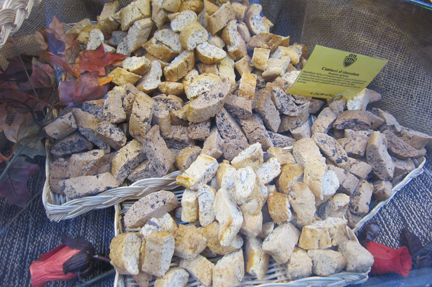
Cantucci.

“Maybe it is finally the time to consider tourism the first industry of Siena,” writes my friend, “and start again from this point.”

If you’ve ever been to Siena, you know that it is one of the most beautiful cities in the world. It’s also a cultural hub of Western Civilization, a city whose contribution to Italy’s national history is rivaled only by its intellectual and aesthetic treasure.

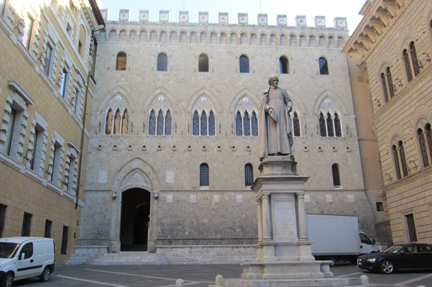
The Monte dei Paschi di Siena bank is just up the street from the Nannini pastry shop.

I’m no fan of bankers but it’s sad to think of what Siena would be like without Monte dei Paschi, an institution that has helped to protect and cultivate the city’s works of art for more than 500 years.

Some of Italy’s greatest wines are raised within a forty-minute radius of Siena — Chianti, Montalcino, Montepulciano…

Our Italian friends are in our thoughts these days…

Italy’s greatest rosé? Biondi Santi’s Rosato di Toscana

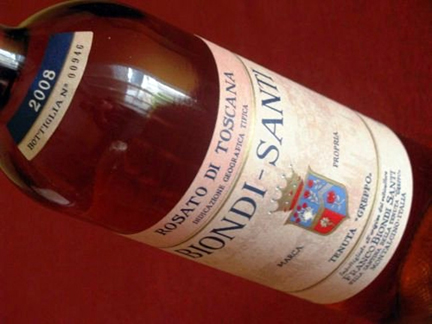
I couldn’t resist translating this post by Italy’s top wine blogger Mr. Franco Ziliani for VinoWire today. And the mimetic desire was so overwhelming that I was compelled to post my translation here as well. I haven’t yet tasted the 2008 Rosato by Biondi Santi but the 2006 was fantastic. Until I get back to Italy, I’ll just to live vicariously through Franco’s post… Buona lettura!

When my fifty-fifth birthday arrived this year, I didn’t reach for a powerful red, nor an elegant Champagne, nor a juicy Franciacorta. No, I drank a stunning rosé on my birthday, perhaps the most important and most celebrated of all the Italian rosés (and probably the most expensive, since more than one online wine store offer it at Euro 33). I’m talking about the Rosato di Toscano, 100% Sangiovese, created by the Gentleman of Brunello, Franco Biondi Santi on his Tenuta del Greppo estate in Montalcino.

On another occasion, I wrote the following about this wine: It is the youngest child of the Greppo estate, a wine obtain by vinifying estate-grown Sangiovese at 16-18° C. without skin contact, aged for 18 months in stainless steel. We could call it a youthful Sangiovese, a quasi Brunello… in pink, obtained from young vines roughly 5 to 10 years in age. The vineyards are located in zones rich with stony subsoil and galestro [schist], with exposition to the North-East, South, and North, and elevation ranging from 250-500 meters.

I drank the 2008 Rosato di Toscana by the great Franco Biondi Santi with a simple however delicious, everyday dish: exquisite beef meatballs braised in tomato sauce and paired with green beans that had been sautéed with bread crumbs. We’re talking about enthusiasm cubed here: a truly extraordinary rosé in every sense.

Light cherry in color, jus of squab with an orange hue. Dry and direct on the nose, very salty and focusedd, dominated by red cherry followed by a gradual evolution of citrus ranging from pink grapefruit to mandarin oranges and citron. Then came notes of multi-colored Mediterranean maquis, tomato leaf, flint, and hints of rose. Together, they created a weave of color and mosaic of aroma.

Ample in the mouth, juicy, overflowing with personality and refined, ample layers of texture. Well structured on the palate, with vertical depth, endowed with focus, an absolute release of magnificent vitality and complexity.

A stony, salty wine, with perfect balance of fruit, acidity, and tannin (the magnificent tannin of Sangiovese from Montalcino). Great harmony, extreme polish, aristocratic elegance, and absolute drinkability despite the 13.5% alcohol and richness of this highly enjoyable Rosato di Toscana.

It would be suited to a wide variety of dishes, from Caciucco alla Livornese to fish soup, to baby octopus cooked in red wine to braised calamari with peas. But it also could be paired with a roast beef, braised beef, or even veal… and even a well-stocked pizza. Why not?

The greatest of Italian rosés and one of the greatest rosés in the world, including France. Chapeau bas!

Franco Ziliani

The dream of every Jew…

The dream of every Jew (at least this one)? To write Christmas music, of course!

Every since I was a child, I’ve dreamed of writing Christmas music… just like one of my idols, Irving Berlin, who wrote “White Christmas” and “Happy Holiday,” among others…

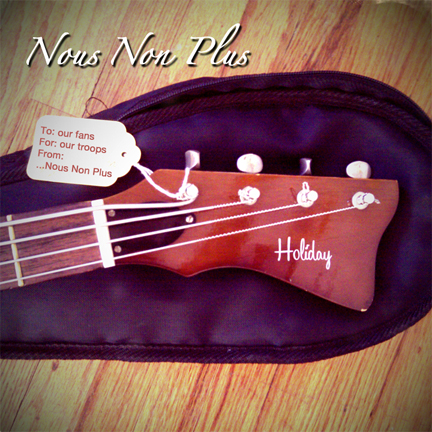
And so when we “went into the studio” this year to make Nous Non Plus’s new album, Freudian Slip (Aeronaut 2011), we also recorded some holiday music.

The A-side of our new self-released single, “Holiday,” was inspired by and written for Tracie P (every day with you is a holiday…)…

The B-side is a song inspired by our troops, “(General, Please) Keep My Baby Safe This Christmas Eve”: it’s an anti-war song, sung from the point-of-view of a soldier’s wife or mother… Céline did an awesome job with the video… And the song features an heart-wrenching guitar solo by our friend David Garza, one of the greatest musicians I’ve ever had the chance to work with…

The single is only available on CD (no digital release) and costs $5 (including shipping).

For every CD shipped, Nous Non Plus will donate $1 to Operation Homefront, providing “emergency financial and other assistance to the families of our service members.”

Even if you don’t want a CD, please consider Operation Homefront (based in San Diego, California, and San Antonio, Texas) for your charitable giving this year…

To order a copy of the disk, please send me an email by clicking here (or leave a comment in the comment section below).

Tracie P and I LOVE Christmas music (Karen Carpenter, anyone?) and we have a strict rule at our house: NO Christmas music until the day after Thanksgiving… and then LET THOSE BELLS RING! :)

Happy Holidays, yall! And thanks for listening…

Letter to Baby P (Thanksgiving 2011)

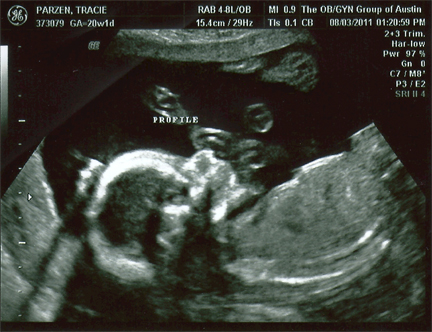
Baby P, the image above is your first “close up” from an early ultrasound. Someday we’ll tell you about what it felt like to “see” you for the first time.

Dear Baby P,

Mom is going to have a laugh when she reads this and discovers that I am at a loss for words… since I’m generally the one who talks too much!

She and I talk to you all the time and sometimes — especially in the morning when we say goodbye before the workday — I put my lips to her belly and I tell you I love you.

I’ve finally sat down to write you the letter I’ve been meaning to write you. But today I don’t know what to say.

I thought I’d have some nuggets of wisdom to share or some insights about becoming a parent. But I don’t.

When folks find out that you’re pregnant, they always ask the same three questions: is it a boy or a girl? do you have a name? are you excited? Sometimes I think they ask you those questions because they want to say something but, like me, they don’t know what to say.

There are plenty of people who offer advice about being a parent and much of it is sound and some of it has been useful. But most of it is their way of sharing the experience with you. As one Italian friend of our wrote, having a child is the most normal thing in life and it is also the most extraordinary.

But then there are the grandparents. They don’t offer advice. But nearly all of them say the same thing: having a child will change your life in ways that you can’t imagine.

Baby P, that’s a photo of your beautiful mom! And it’s also a photo of you. Some folks say she’s the most beautiful mother-to-be they’ve ever seen. I have to say that I agree! She’s been such a good mother to you and I love her so much.

Becoming a parent sure does change your life: your rhythms and daily routines change; your lifestyle changes; your body changes. Every time mom and I go to the doctor for your checkup, we marvel at the miracle of life. Even with all the science of the twenty first century, the great brains of the world still can’t figure out how it all works. (And it’s probably better that way.)

But it also changes how you see the world: from the milk that I buy for mom at the store to the way a line from the poet Virgil scans; from the car seats that I installed last week to the financial challenges that we and our friends in Europe are facing every day; from your baby clothes neatly folded in your nursery to the sadness in a best friend’s voice when he talks about missing his child. Everything looks, tastes, smells, feels, and appears differently to me. But it’s not because everything is different. It’s because I’m different.

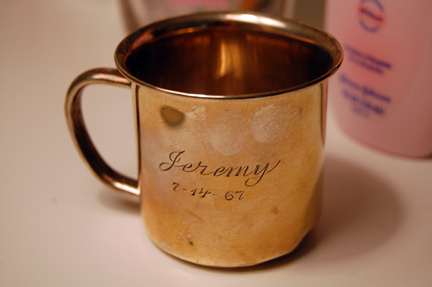
Baby P, that’s my silver milk cup from when I was born. Your grandmother, Mamma Judy, had your name engraved on the other side of the cup.

Baby P, there’s so much I want to tell you. About the world and its great cities, about music and poetry, about philosophy and art…

But today, the words just won’t come.

And so I think I’ll just put my lips to mom’s belly and tell you I love you…

Sincerely,

Dad

Thanksgiving Day, 2011

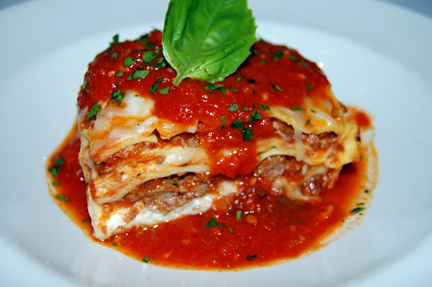
“It’s not Thanksgiving without the lasagne…” @TonyVallone

As my friend Tony in Houston says, “It’s not Thanksgiving without the lasagne…”

Happy Thanksgiving, everyone… and safe travels for those of you on the road…