The world of Italian wine mourns Giulio Gambelli, the great maestro of Sangiovese

Sit tibi terra [tuscolana] levis Juli.

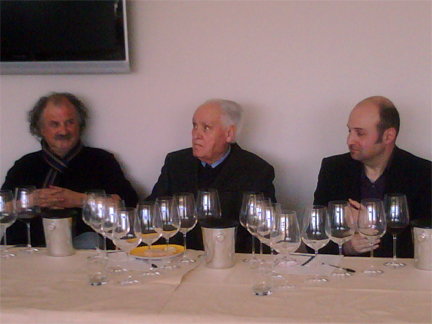
When Italy’s top wine blogger Franco Ziliani wrote me yesterday to share the news that the great Maestro of Sangiovese, Giulio Gambelli (left, photo by A. Pagliantini via Enoclub Siena) had left this world for another, the feeds were already overflowing with tributes for the man who shaped a generation of winemakers in Tuscany and helped to craft some of the world’s greatest wines (see below). As Tuscany continues to abandon the traditional-style Sangiovese (“translucent and profound” to borrow Aldo’s phrase) that he championed, it’s hard not to imagine that his passing will not be remembered as the end of an era…

I’ve translated a few passages below (with links to the orignal posts for Italophones).

A very sad new year for the world of Italian wine: Giulio Gambelli, 87, the great maestro of Sangiovese has died in Poggibonsi, Tuscany. Gambelli was not an enologist but rather a master taster and the world’s greatest expert on Sangiovese — the often challenging, supreme grape of Italy. He was a modest, unassuming person, wine’s humble servant, not an oversized personality but rather an anti-celebrity. To his friends, he was known affectionately as Bicchierino, the little glass.

—Franco Ziliani

He was the man who had taught all the producers in Montalcino how to make wine, not to mention a healthy slice of Chianti Classico. He was a (towering) piece of the history of the last 60 years in Tuscan winemaking. But if you told him so, he would start laughing and he would huff and puff, unamused because he didn’t want to carry the weight for something that he did out of pure passion and because he loved to do it.

—Carlo Macchi

For those who didn’t know him, the following are just some of the Sangiovese producers for whom he consulted: Montevertine, Poggio di Sotto, Soldera, Ormanni, Villa Rosa, Bibbiano, San Donatino…

Gambelli had taught winemaking to so many producers in Montalcino and Chianti Classico that the adjective gambelliano had come to denote true Sangiovese…

—Aldo Fiordelli

Decanter’s obit here.

Photo by Consumazione obbligatoria.

Nous Non Plus California tour dates

Hope to see you at one of our shows!

And, no, guys, no matter how many beers you buy me, I still can’t introduce you to Céline

SODA BAR – SAN DIEGO
THURSDAY FEBRUARY 9

RICKSHAW STOP – SAN FRANCISCO
FRIDAY FEBRUARY 10
(BARDOT A GO GO’S PRE-VALENTINE’S DAY PARTY)

BOOTLEG BAR (THE FOLD) – LOS ANGELES
SATURDAY FEBRUARY 11
(WITH PARIS LOVES LA)

Poggio di Sotto 2006 Rosso di Montalcino

Since the arrival of Georgia P three weeks ago today, we’ve been cooking at home every night (no takeout a casa Parzen except for Christmas day, when we just had to have Chinese and Woody Allen) and drinking “everyday” wines that we love — entry-tier Santorini by Sigalas, Verdicchio by Bucci, Produttori del Barbaresco Langhe Nebbiolo, all ideal because they’ll last for a few days once opened).

Meals have been simple and wine hasn’t been a focus at our house lately but I did open a special bottle of wine for Alfonso when he and his SO Kim came to meet their putative granddaughter for the first time.

Together with Brunelli, Poggio di Sotto is one of the “younger” estates that has really carved out a name for itself as an indisputable icon of the appellation. And the bottle that we shared that night — from a good to great vintage, depending on the producer — was a true benchmark for Sangiovese: brilliant nervy acidity, technicolor fruit balanced by layered minerality, and a focus and precision that is uncommon among the sea of Brunello bottlers who came late to the game.

The wine isn’t cheap but it’s one of those wines that I wish every young wine professional in our country could taste: it is the apotheosis of what Sangiovese can and should be (as Alfonso pointed out in his excellent post yesterday). And perhaps more significantly, it’s an expression of what the variety can attain when it’s grown in the best sites and with the proper care.

The Poggio di Sotto farm lies in the southern subzone of the appellation, in the village of Castelnuovo dell’Abate. In the photo above, I’m looking south-southeast toward Mt. Amiata from the village. The Poggio di Sotto farm is about a three-minute drive east, with some of the highest south-and southeast-facing vineyards in the appellation (I’ve actually never visited the farm but I’ve driven by it a thousand times).

Poggio di Sotto was recently sold to pharmaceutical giant, northerner Claudio Tipa, whose Tuscan empire continues to grow. But from what I’ve seen with his other acquisitions of legacy wineries (like Grattamacco), Tipa seems to be committed to maintaining continuity. Let’s hope it’s the case: to lose these wines would be to lose an icon, a benchmark, and a piece of that “cultural patrimony” that some of us continue to hold dear…

For our vines have tender grapes…

HAPPY NEW YEAR, EVERYONE! :)

For lo, the winter is past,
The rain is over and gone.
The flowers appear on the earth;
The time of singing has come,
And the voice of the turtledove
Is heard in our land.

The fig tree puts forth her green figs,
And the vines with the tender grapes
Give a good smell.
Rise up, my love, my fair one,
And come away!

O my dove, in the clefts of the rock,
In the secret places of the cliff,
Let me see your face,
Let me hear your voice;
For your voice is sweet,
And your face is lovely.”

Catch us the foxes,
The little foxes that spoil the vines,
For our vines have tender grapes.

Song of Solomon

Best meals 2011: Le Logge (Siena)

Thanks again to my friends Marina and Francesco who treated me to this incredible dinner at Laura Brunelli’s Osteria Le Logge in October of this year…

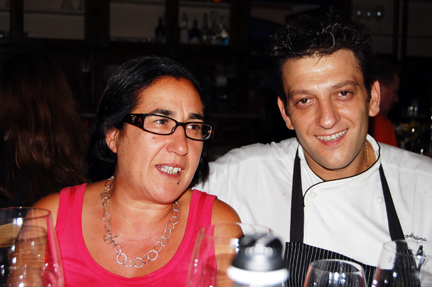
I’d eaten at Le Logge many years ago but not since the Brunelli family brought chef Nico Atrigna (right) to Siena from Campania in the mid-1990s. Laura Brunelli (left), whom I’d never met, also dined with us.

Parisi Slow-Cooked Egg with Dashi Broth, Licorice, Chives.

Note the intense yellow orange of the yolk. Parisi feeds his chickens goat milk to obtain the rich flavor and color. The best egg I’ve ever had, hands down. (See Katie Parla’s excellent post on Parisi.)

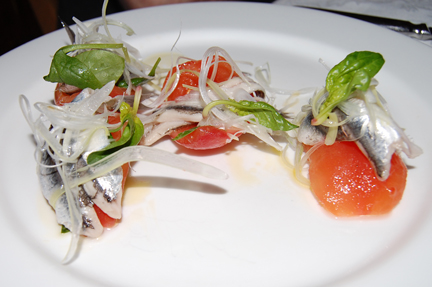
Marinated Anchovies with Tomato and Spring Onion.

Ricotta Pudding with Eggplant and Thyme Cream.

Ox Tongue with Cured Cinta Senese Shoulder Served over a Spinach Orzotto. (Cinta Senese is Siena’s heirloom striped pig, smaller in size than most hogs, making for ineffably delicate salt-cured pork.)

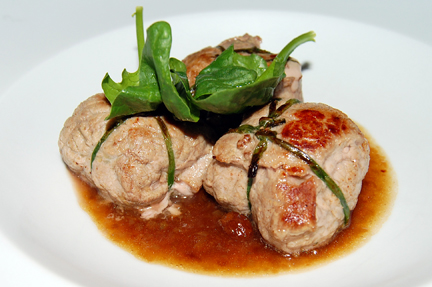
Veal Roulades Stuffed with Escarole and Pine Nuts Served over a Raisin and Onion Ragù.

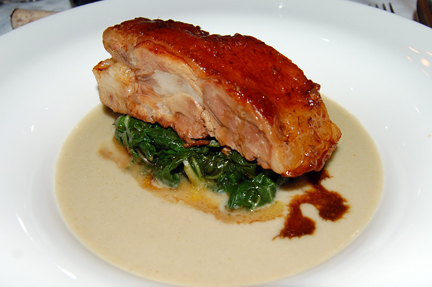
Lamb Confit with Dried Fava Bean and Swiss Chard Sauce.

What did we drink?

Except for the Gianni Brunelli 2004 Brunello di Montalcino, all of the wines from Thursday night’s dinner at Le Logge came from my generous friend Francesco’s cellar (see below).

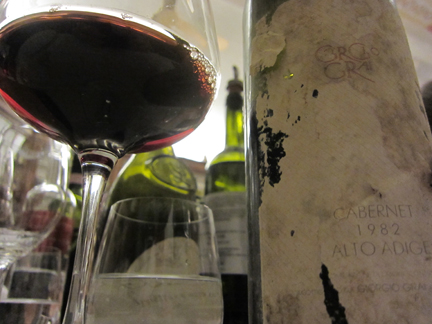
Giorgio Grai 1982 Alto Adige Cabernet

In nearly every region of Italy where I’ve tasted, I’ve met winemakers who cite Giorgio Grai as their mentors. I met the man once, many years ago, in New York at a tasting of his wines at Le Cirque. Now in his 80s, the tireless Italian master continues to consult and make wine (and drive race cars). Elegant, refined, polyglot, polymath… I think of him as the James Bond of Italian wine. Francesco called him from the table and we shared the immense sensorial and intellectual pleasure inspired by this wine, still very youthful in its development.

The acidity and freshness in this wine were brilliant and its focus and precision awe-inspiring. Ripe red fruit with notes of cinnamon and eastern spice and a gentle menthol note that emerged with aeration. Where other expressions of Cabernet Sauvignon make me yawn, this wine made me cry…

Baron de Ladoucette 1983 Pouilly-Fumé Baron de L

This wine was actually the opener but ubi major, minor cessat… I have to confess that I had never tasted Ladoucette: Francesco informed me that the winery’s Baron de L is considered one of the great (if not the greatest) expression of Pouilly-Fumé and Sauvignon Blanc. This wine shared its last breath of life with us, rewarding us with richness in mouthfeel and flavors of lemon custard and freshly baked pie crust and a gentle aromatic note of country herbs. With aeration, it started to wilt but its last gasps of vitality were thrilling.

Gianni Brunelli 2004 Brunello di Montalcino

When Francesco asked Laura Brunelli which vintage of her family’s wine we should drink, she and sommelier Mirko agreed that the 2004 is in a moment of grace. Its current openness shared that signature zinging acidity of Brunelli’s Sangiovese, with plum fruit and intense minerality and just a touch of savory (think carpaccio not filet mignon). Gorgeous wine that will probably close up again soon.

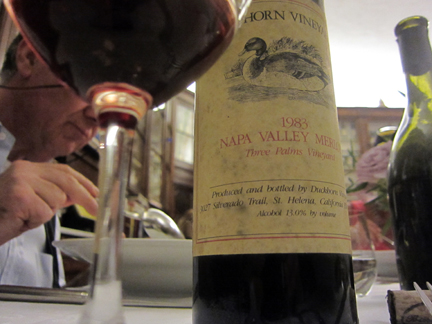
Duckhorn 1983 Napa Valley Merlot Three Palms

Francesco inherited his Americanophilia from his father, whose happy memories of the American liberation of Italy during the second world war, said Francesco, spurred his father to go west. Knowing that I’m from California, Francesco brought the Duckhorn as a homage to my origins. It surprised us with bright red fruit on the nose and honest acidity. But the dominance of wood in the mouth disappointed me. As balanced as it was otherwise, the wood sat on top of the wine, lacking cohesion with the other elements. Alas… America’s love affair with oaky wine always leaves me scratching my head…

I was so happy to meet Francesco and his lovely wife Marina back in June in Apulia, where he and I were both judges in a Southern Italian wine competition. Their familiar Paduan cadence brought back memories of my many years at the Università di Padova. Francesco is the president of Vinarius, the association of Italian wineshop owners. I enjoy Francesco’s company and conversation immensely and his tales of the late and great Italian wine importer Lou Iacucci had me on the edge of my seat. Here’s the link to his wine shop, just off the Piazza del Campo.

Best meals 2011: Frasca (Boulder)

Dinner at Frasca with Tracie P in September was one of the best meals of my life… for the food, for the wine, for the fun, and for the sheer joy of sharing it all with the woman I love…

When Tracie P and I talked about one last “babymoon” before the last trimester of our pregnancy (when she can’t fly anymore), she expressed her desire to dine at Frasca in Boulder. And so on Saturday, we headed for the Rocky Mountains and one of the best meals we’ve ever had.

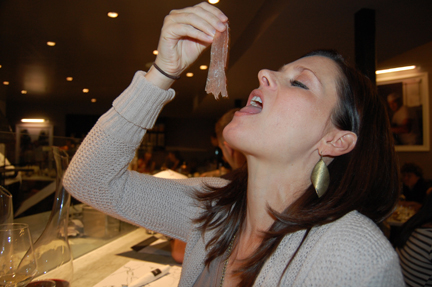
It’s so hard to get properly sliced prosciutto in this country and I have told Tracie P about Chef Lachlan Mackinnon-Patterson’s obsession with reconditioned vintage Berkel slicers and how their beveled blades make all the difference (it’s in the diffusion of the heat, Lachlan explained to me last year when we traveld in Friuli together). When our server asked us about what we wanted to eat, the first thing out of (and into) Tracie P’s mouth was: P-R-O-S-C-I-U-T-T-O!

Co-owner Master Sommelier Bobby Stuckey graciously offered to select the wines for us and it was only fitting that we start with 2010 Malvasia by Venica & Venica: Lachlan, he, and I tasted the wine together last September at the winery in Collio not long after it had been harvested. We loved the spice in this vintage of Malvasia by our good friend Giampaolo Venica.

Lachlan’s frico was off-the-charts good.

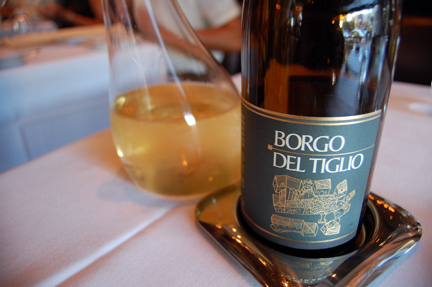
Bobby surprised us with this 09 lees-aged Sauvignon Blanc by Borgo del Tiglio, a winery I’d never tasted or seen in the U.S. I love the muscular style of Sauvignon Blanc embraced by certain Friulian producers. If ever there were an international grape variety to grow in Italy, it would be Sauvignon Blanc in Friuli, where winemakers can obtain sublime expressions of this aromatic grape. The 09 Tiglio had a crazy spearmint note on it and it was amazing to see this intense wine evolve over the course of the evening. (Note how Bobby decanted it for us.)

Lachlan’s cooking is a benchmark for Italian cuisine in the U.S. His gnocchi had that perfect balance of substance and lightness.

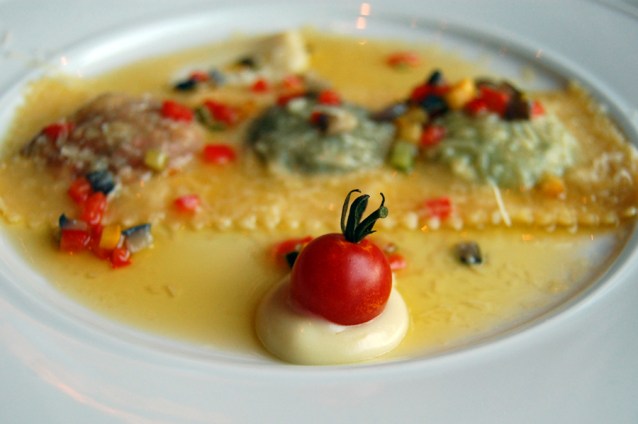
His ravioli were stuffed with a “deconstructed ratatouille,” in other words, all of the ingredients of the classic French dish, but prepared separately. Again, the quality of Lachlan’s pasta is a benchmark for Italian cuisine in the U.S. (Note the yellow color.)

1997 Schioppettino by Ronchi di Cialla was one of the most incredible wines we’ve drunk this year. Unbelievable minerality with this bright, fresh grapey note and under 13% alcohol. Simply incredible… It was gorgeous with Lachlan’s roast pork loin.

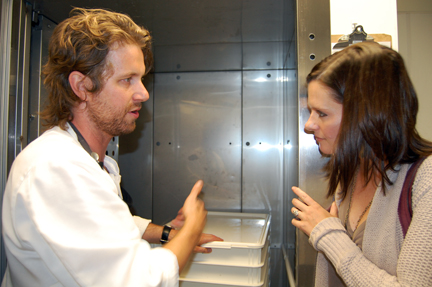
After dinner, Lachlan gave us a tour of the kitchen and revealed some of the secrets behind his Neapolitan pizza, served at their new pizzeria next door. Believe it or not, we actually went next door after our 3-hour dinner and ate again! I’ll post on the pizza later this week.

At certain point during our dinner, we were having so much fun that we were nearly overwhelmed by the joy of sharing food and together. Almost simultaneously, we looked into each other’s eyes and it was as if the same thought had just come to our minds at the same moment. I looked at Tracie P and told her I loved her and that it’s a miracle that we found each other: there’s no one else in the world that I could share an experience like this.

See that glimmer in her eye (as she enjoys a Sanbitter before dinner)? It makes me melt like prosciutto on her tongue…

IMHO, Frasca is the best Italian restaurant in the U.S. and you really can’t go wrong there. But it’s so much better if you go with someone you love…

There’s so much more to show and tell about our dinner in Boulder but it’ll just have to wait… Stay tuned and thanks for letting me share this special evening with you!

Best meals 2011: Quintarelli and Mascarello at Tony’s (Houston)

Curating Tony’s website and serving as his media director has its perks. This dinner, in August, was one of them. It’s a tough job but someone has to do it!

From the department of “dreams do come true”…

When we sat down for dinner last week, Tony Vallone looked across the table at me and matter-of-factly said, “I have some special wines picked out for you tonight. I know you’re going to like them.” He wasn’t kidding.

I’ve been curating his blog since October 2010 and our weekly meeting has evolved into a familial kibitz where we talk about everything under the sun, alternating between English and Italian. (Long before Tracie P and I announced that we were pregnant, Tony had intuited that we were with child. “I can read it on your face,” he told me. And, all along, Tony said it was going to be a girl. He was right.)

The occasion for our dinner was an interview with one of the top wine writers in the country and Tony had asked me to join them.

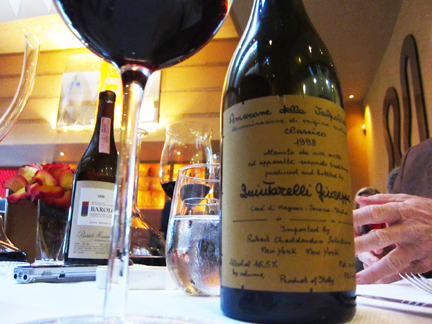
After an aperitif of light, bright Colle Massari Montecucco Vermentino, the first wine in the flight was 1998 Barolo by Bartolo Mascarello (above).

I’ve tasted this wine on a number of occasions and it’s extremely tight right now, favoring its tannin and jealously guarding its fruit.

But when the server arrived with a porcini risotto topped with Umbrian truffles shaved tableside, the wine started to open up and its delicate menthol note began to give way to wild berry fruit tempered by mushrooms and earth. The acidity in this wine was singing and I couldn’t help but be reminded of Angelo Gaja’s antithetical comparison of Cabernet Sauvignon and Nebbiolo. Cabernet Sauvignon is like John Wayne, I once heard Gaja say: he who stands in the center of the room and cannot help but be noticed. Nebbiolo is like Marcello Mastroianni: he enters the room and stands quietly in the corner, waiting for you to approach him. (There’s a punchline that cannot be repeated in polite company.)

The acidity in the 98 Amarone della Valpolicella Classico was equally vibrant and its melody played a counterpoint against the delicately marbled fat of a Kobi fillet. While I’m sure that the 98 Quintarelli has many, many years ahead of it, this wine is in a moment of grace. Generous fruit set against rich structure and mouthfeel. Here, I couldn’t help be reminded of Cassiodorus’s description of Acinaticum: “On the palate, it swells up in such a way that you say it was a meaty liquid, a beverage to be eaten rather than drunk.” In this wine, meaty ripe and overripe red fruit alternated with savory flavors. An unforgettable wine in one of the most remarkable moments of its life.

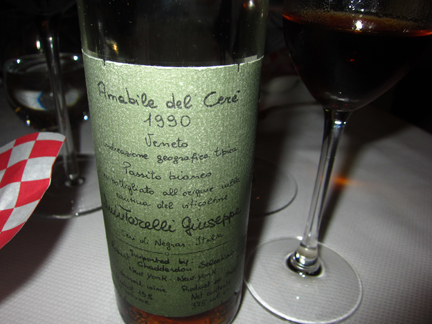
And dulcis in fundo, Tony had selected a wine that he had seen me covet. A few months ago, a collector and frequent guest of Tony’s poured me a taste of the rare 1990 Quintarelli Bandito (I wrote about it here). Knowing that I longed to “drink” this wine in the context of a meal, he surprised us at the end with a 375ml bottle. This wine — last bottled by Quintarelli for the 1990 vintage — is one of the greatest expressions of Garganega I’ve ever tasted: rocks and fruit, minerality and stone and white stone fruit, dancing around a “nervy backbone of acidity” as the Italian say.

This was paired with some housemade zeppole and a dose of playful nostalgia.

Carissimo Tony, ti ringrazio di cuore per questi vini straordinari!

Remembering Giorgio Bocca: Bartolo, pop open a bottle!

The following is my translation of Franco Ziliani’s tribute to the great Italian partisan, journalist, anti-globalizationist, lover and connoisseur of Nebbiolo, Giorgio Bocca, who died Sunday in Milan…
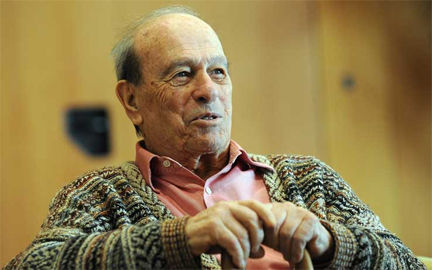
Photo via Il Journal.

He was allergic to any form of rhetoric and he was truly un-Italian in his respect: Italian journalist, partisan, and essayist Giorgio Bocca, 91 years old, died in Milan on Sunday. He deserves to be remembered with a dry eye and not without a touch of irony.

For this reason, I’ve decided to remember this surly, free-thinking, independent man from Piedmont not as a maestro of Italian journalism (which he was, indisputably, regardless of your political leanings) but rather as the great (and demanding) connoisseur of wine whom I had the pleasure to interview twice in his home on Via Bagutta in Milan.

One wine, above all others, was often cited in his books: Barolo, a wine for which he reserved great passion, a wine he drank only when produced by a few carefully selected and trusted producers.

And so, as I think of how Bocca has left us, it’s only natural to evoke the name of another great man from Langa, whose dry, ironic personality was intimately familiar to Bocca. When ever the writer was in the area, he’d go visit this man and they had much more in common than their love of wine: they shared a keen interest in culture, politics, and, of course, in Barolo.

I’m thinking of Bartolo Mascarello, an indisputable leftist like Giorgio Bocca, leftist but not sectarian, enlightened and enlightening, rigorous in his being in favor or against something or someone but not intolerant, perhaps not open to dialog with those whose ideas he opposed but always willing to listen.

And so as I reflect on this goodbye to the great journalist from Cuneo, Giorgio Bocca, I’d like to think that somewhere — in some corner of the imagination, I don’t know where — Bartolo Mascarello is waiting for Giorgio. He’s sporting one of his ironic, amused smiles and of course, he’s speaking in the noble dialect of Langa. He’s opening a buta — a bottle — of a special wine intended to welcome Giorgio to this truly special parlor…

Bartolo, pop open a buta! Giorgio is here!

—Franco Ziliani

The following profile appeared yesterday on the English-language version of the ANSA website.

(AGI) Milan – Giorgio Bocca died on Christmas day in Milan at 91 years of age. He had been a wartime partisan, journalist, founder of the newspaper ‘La Repubblica’ and a long-time collaborator of the Fininvest TV networks. News of his death was released by Feltrinelli, a publishing company who published several of his books and that recalled him as “a great journalist, a great combatant and a great friend”. “Since the partisan war of resistance up to these last few days of the Italian and global crisis – the publishing company continues in a note – he witnessed, observed and told the history of our Country through seven decades. Giorgio Bocca’s enquiries, short polemic articles and books have accompanied and nourished the building of civil society through many generations of Italians”. In January, Feltrinelli will pubish his latest book: ‘Grazie no, 7 idee che non dobbiamo piu’ accettare’ (‘No, thanks: 7 ideas we can no longer accept’). In the past, in addition to his journalistic activities, Bocca – who was born in Cuneo on the 28th of August 1920 – wrote several essays and his having fought with the “Giustizia e Liberta'” Partisan division often led him to tackle the issue of fascism and resistance although he also wrote books on terrorism during the ’70s, on journalism and on the problems of the South of Italy.

During the last few months, some of his comments on the ‘Meridione’ had placed him at the center of controversy after he defined Naples as ‘flea-bag’ with ‘unhealable areas’ or Palermo as a city “stinking rotten, with monstruous people gushing out of slums”. A skilled polemicist, during the last few years, he had often delved into the condition of journalism in Italy: in 2008, in an interview on the ‘Le invasioni barbariche’ TV show, he said that while the journalists of his generation “were driven by ethics” today “truth is no longer of interest” and “publishers are always on the payroll of advertisers”. Among the last recognitions awarded to him was the 2008 Ilaria Alpi Prize for his Life-Long Achievements: “All those that go into journalism do so because they hope they might reveal the truth: even if it’s difficult, I call on them and encourage them to continue along this road”.

Best meals 2011: Boutari winery Crete

I’ll never forget this June night in Crete, the eve of the first Greek austerity vote and one of the defining moments of the European debt crisis. In Athens, that same evening, protesters fire-bombed one of the luxury hotels in Syntagma Square. But in Crete, just outside the village of Skalani, the air was still and the food was delicious…

Many great meals were thoroughly relished by a wine blogger last week in Greece but the one that he cannot stop thinking and dreaming about was a dinner prepared by Maria Constandakis, who — together with her husband and agronomist Yannis — oversees the Boutari winery in Crete.

The meal began with a Cretan dakos, a wholewheat rusk, a bit larger but similar to the frisa of Apulia, where they top it with diced mozzarella, tomatoes, and tuna. Here, tradition calls for fresh tomato purée and crumbled feta. And while the Apulians gently soak their frisa before dressing it, the Cretans use the water naturally purged by the tomato when it is tossed with the salty cheese.

Next came the classic Greek zucchini “meatballs,” the kolokithokeftedes. The wine blogger had experienced this dish before but in his own words, “to have Maria’s, made from zucchini she grew herself in the winery’s garden, is a game-changer.”

The next morning, said wine blogger photographed Maria’s zucchini.

When you travel in Greece during summer, horiatiki — the classic village or summer salad — is served at nearly every meal. But there was something different about Maria’s. Upon further inquiry, the blogger discovered that Maria included freshly torn glistrida or purlane in her salad, also grown in her garden.

Still used as an effective folk remedy for certain ailments of the mouth, purlane grows wild in Greece (the blogger even found it along the sidewalks of one of the small towns he visited in Northern Greece). Like nettles, it slightly stings the tongue and according to legend, those who consume it are prone to loquaciousness. (Said blogger has never been accused of being long-winded! But true to legend, he stayed up late into the night discussing philosophy and politics with his companions over many glasses of raki.)

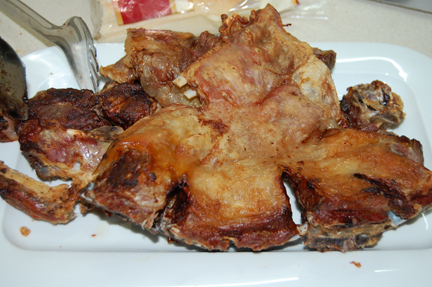
The pièce de résistance, however, was Maria’s slow-roasted lamb. Even though, technically, the meat had not been smoked, the effect was the same: the bones were so tender that that crumbled gently in the blogger’s mouth, rewarding him with their sweet marrow.

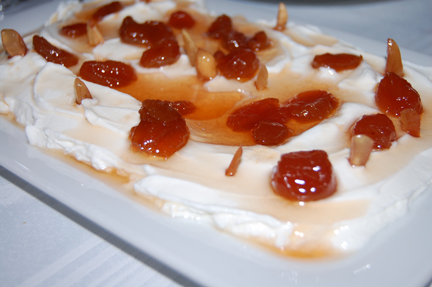
Said blogger is rarely said to eat dessert but there was no way for him to resist Maria’s yogurt topped with cherries she had stewed herself.

Said blogger enjoyed many great meals in Greece but none came close to that prepared by Maria.

In other news…

In the days that followed, said blogger, an accomplished linguist, learned that he had been incorrectly pronouncing the name of the most noble red grape variety in Greece, Xinomavro.

Click here to listen to the correct pronunciation.

Parzen family Christmas and Best meals 2011: Le Zie (Lecce) @PaoloCantele

Above: Georgia P’s first Christmas! We stayed in, munched on Chinese take-out, watched Woody Allen’s Midnight in Paris, and toasted with Champagne before opening our presents. So much fun (even though Georgia didn’t really seem to understand what was going on!)…

Where meat is king in the cuisines of Northern Italy, vegetables reign supreme in Apulian gastronomy. The meal I shared with friends in Lecce this summer at Le Zie was a revelation for me. Photographs don’t do the food justice: you simply have to experience the materia prima and the ars coquinaria to understand its alchemy — like a vegetable stock so rich in flavor that I could have sworn it was made with meat.

Rereading this post in the days that led up to the Christmas holiday, I remembered the wish I made that June night in Lecce. I’m happy to report that it did come true! :)

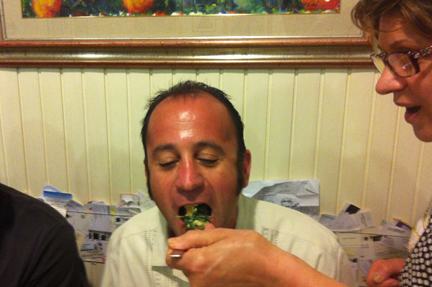
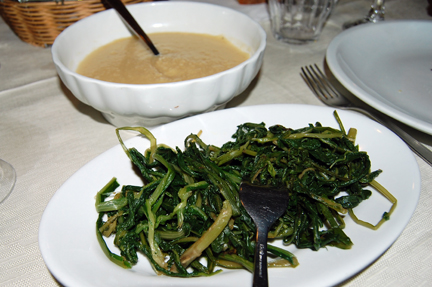
I joined Paolo and his crew last night for dinner at the famous and homey Lecce restaurant Le Zie, where owner Carmela Perrone insisted on showing me how to dress my fave e cicorie (puréed favas and sautéed chicory) and fed me my first bite, telling me to make a wish (I’ll tell you if it comes true this Christmas).

However simple, her rendering of this dish was no less than a masterpiece.

La tiella (taieddhra in Leccese), named after the teglia or earthenware pot it’s cooked in — baked mussels, potatoes, and zucchine. Unbelievably delicious… Life-changing, really.

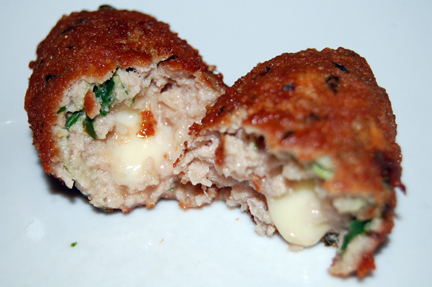
We had sat down for dinner at around 10 p.m. and by the time we arrived at the second course, there were no more of the white-wine braised meatballs. And so Carmela breaded and fried some of the meatballs reserved for the next day. This was perhaps the mother of all meatballs…

I don’t have time to post properly on the amazing meal we had there but I will in upcoming weeks… Today, I’m headed over to Manduria on the west coast of Apulia for the preview tastings for the Radici Wines festival… Stay tuned and thanks for reading!