
loving you Sunday morning

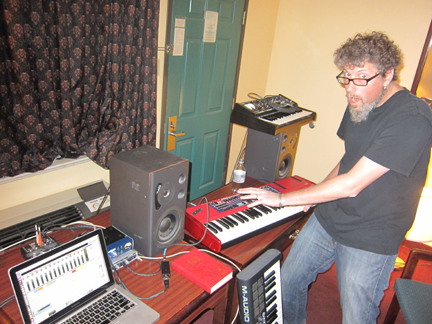
There were still sex workers on Van Buren St. when the airport shuttle rolled up to my flophouse motel near Sky Harbor airport in Phoenix yesterday morning at 8 a.m.
After tumbling out of bed at 4 a.m., I had jumped on an early commuter flight from Austin and was joining my bandmate, keyboardist Ryan Williams, for a session in a make-shift recording studio we set up for a day on the Boulevard Périphérique of Western civilization.
Note the Gideon’s Bible on our recording console (our “desk,” as we say in recording arts parlance).
We were energized by the fact that our band Nous Non Plus had been featured as “band of the day” on the now ubiquitous Band of the Day App.
But the greatest counterpoint to the bleak glimmer of sun-burnt, crystal meth-tinged Phoenix was the fact that both of us would be home in time to kiss our kids goodnight: Ryan, dad to two beautiful boys, had driven down from Flagstaff for the morning, and I had flown in especially for the session. We began tracking at 8:30 a.m. and I was on an Austin-bound 2:40 p.m. flight that got me home in time for dinner.
When I dreamed of a career in pop music as a child, this isn’t exactly what I had in mind.
But when you’re a new dad, you don’t need late-night, smoke-filled rock clubs to make the jams flow…
Ryan’s playing was fantastic, the sounds groovy and warm, and Tracie P’s cooking never tasted better (shredded chicken and roast poblano pepper tacos and cilantro rice paired with bright, fresh Schiava)…
The working title of our forthcoming album (fall 2012) is “Le Sex et Le Politique”…
If you learned Italian as a second language then you surely know the joke I’m talking about.
For those who haven’t studied Italian, I thought I’d share this extremely cute post that Tracie P composed for one of our clients…
Buon weekend, yall! :)

Above: If you ask for “passato di pomodoro” without “preservativi” you might be greeted with a a funny stare…
We want you to be able to speak like an Italian, but we must warn you that there are some pretty easy ways to stick your foot in your mouth if you’re not careful.
Today’s Italian lesson is on false cognates, or “false friends.”
Cognates are words that basically sound the same in both languages in question. For example, there’s intelligente (intelligent) and farmacia (you guessed it, pharmacy). But don’t get caught asking for pepperoni on your pizza if what you want is cured sausage because what you’ll end up with is bell peppers. This is why it’s called a false cognate.
We don’t want you to get caught in a sticky situation where either hilarity or calamity can ensue, so here’s our top ten list of false friends:
1. Sensibile: it means sensitive, not sensible.
2. Preservativi: condoms (Watch out for this one! You don’t want to have a conversation about why condoms are bad for human consumption. Conservanti are preservatives in Italian.)
3. Baldo: courageous (You can describe to the local authorities that the taxi driver who ripped you off is baldo, but you won’t be referring to his head.)
4. Collegio: boarding school or dormitory (Explaining your educational background might make your new Italian friends think that you are very rich.)
5. Morbido: soft (Your little brother’s obsession with horror movies is… soft? I don’t understand!)
6. Genitori: This means parents. Get your mind out of the gutter.
7. Fabbrica: factory (Farm is fattoria and fabric is tessuto. Confused yet?)
8. Camera: room (Want to take a picture with your… room? Instead, make sure and ask for the macchina fotografica.)
9. Romanzo: novel (No, you do not want to have a great novel on your vacation, you want a storia d’amore.)
10. Educato: polite (Telling someone that their children are so educated when you mean polite is not an insult, but it may be confusing when referring to a toddler.)
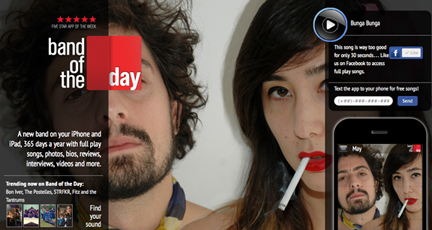
It’s pretty much the coolest feeling in the world when you know that kids across America are rocking out to your music…
Especially when the jam in question was tracked right here in Austin, Texas at Baby P Studios (chez Parzen)!
Today, Bunga Bunga (the single from our latest release, Freudian Slip, Aeronaut 2011) is featured on the new iPhone and iPad Band of the Day App.
Life could be worse… :)

Photo via ControLaCrisi.org.
According to a report by the Italian news agency ANSA, Parmgiano Reggiano producers lost up to 10% of their production in Sunday’s 6.0 magnitude earthquake in the Province of Ferrara.
Last night, I learned (via Facebook friend, Chiara Rich) that a number of the cheese makers are offering the damaged wheels to consumers at discounted prices.
According to a post by Arci Modena:
– 14-month old in vacuum-packed pieces weighing 500 grams or 1 kilo at €11.5 per kilo.
– 27-month old in vacuum-packed pieces weighing 500 grams or 1 kilo at €13 per kilo.
– spreadable cream in 250 gram packages at €11 per kilo.
If you’ve never had fresh, creamy “spreadable” Parmigiano Reggiano, I can assure you that the airfare to Bologna and the short drive to Modena would be worth the price of admission and then some…
From the department of “par condicio”…

Last week I received the following message from Alan Tardi, one of the Italocentric wine writers I admire most. He was responding — however serotinely (no paronomasia with his name intended but if ever there were a case for the Latin adage nomina sunt consquentia rerum, this could be it) — to my post Prosecco, lies, and videotape: the real story behind the new wave Prosecco (published January 11, 2012) wherein I cited his New York Times article “Prosecco Growers Act to Guard Its Pedigree,” published that day. I have posted his message in its entirety below and recommend it to you….
*****
About a month ago I came across your piece about my article in the Times and wrote you a note but I’m afraid you might not have received it (I seem to have been having some trouble with one of my email accounts lately). Here it is:
Hi Jeremy,
Thanks for taking the time to read and comment on my article in the New York Times. I believe you posted your blog just after the article was published on January 11th but I didn’t see it until the other day when somebody sent me a copy of it. Otherwise I would have responded sooner.
One of the things I love most about wine is that there is always something to learn and discover, plus it’s always changing. With all this stuff in motion, it’s totally possible for someone to “get something wrong.” However, in this case it didn’t happen.


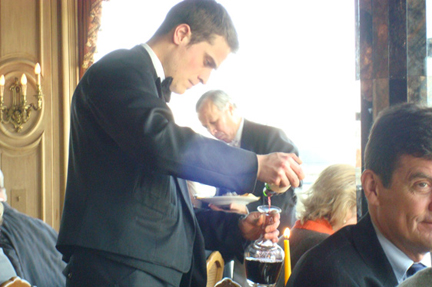
Above: I spent an obscene amount of money taking Tracie P out to dinner at the Tour d’Argent in Paris three years ago. But when you consider the fact that we still talk about it and how much fun we had, there’s no doubt that it was worth every penny — one of the most memorable meals of our lives. Here’s the link to my post on the lunch.
When I was an undergrad at U.C.L.A. in the late 1980s, my great uncle Ted, a Beverly Hills commercial developer (motels were his thing), loved to take me to his favorite “continental cuisine” dining spot. The only catch was that we had to finish dining by 6 p.m. so that we could take advantage of the “early bird special” (think beef Stroganoff and baked Napoleon). I’ll never forget his anxiety when the bill arrived: did the server already include the gratuity? did he charge us the correct amount? had he cheated us for a dish that didn’t arrive? I was too young at the time to drink legally but there was no way that uncle Ted was going to spend money on a bottle of wine. The prices for wine were “highway robbery,” I remember him saying to grandma Jean (his sister).
I loved uncle Ted a lot, especially for his humor and his loud snorts when we would eat at his favorite Chinese restaurant. “The mustard really helps to clear your sinuses,” he would say to my delight as he wiped the sweat from his brow.
He was from a generation that believed — across the board — that the restaurateur was going to try to swindle their patrons.
It’s important to remember that he was the child of people who never went to restaurants: he was born in the first decade of the twentieth-century in New York to Jews who had fled antisemitism in Austria (and the limited opportunities of their station in society). Even when they landed in the U.S., the thought of spending money in a restaurant was abhorrent in their view.
Today, the culinary landscape has changed drastically. When, in the late 1990s, our enogastronomic culture shifted from Julia Child and James Beard to Molto Mario, Lidia’s Italy, Kitchen Confidential, and Bobby Flay, our food “writers” and taste-makers had become themselves restaurateurs. And a new restaurant culture was born in our country: instead of being taught what we could make at home, they began to teach us how to make the dishes that they made in their restaurants. And they also opened a window on to the inner workings of restaurants.
For my generation (and for yours as well if you’re reading this), the thought of not going to restaurants would be abhorrent. Just contemplate what Sex and the City would have been without restaurants as a backdrop for the soap opera (where a diner was the backdrop for Seinfeld. a show that ended in 1998, the same year that Babbo opened).
This is just one of the reasons that I’ve been surprised and frankly upset by the reaction to my recent post on Corkage, a Privilege not a Right for the Houston Press.
Today, I followed up with a post on Why Restaurants Matter (and Why You Should Tip Generously). One of the things that occurred to me as I wrote it was that for the first time in history, the patrons and servers in the social compact of restaurateurship are social equals and intellectual peers. In other words, where the servers were once proletariat and the patrons bourgeoisie, today both are members of the bourgeoisie.
Here’s the link to the post, which includes some notes on how the Industrial Revolution shaped the restaurant experience as we know it today.
In other news…

Our hearts and prayers go out to the victims of Sunday’s earthquake in Emilia-Romagna, which had its epicenter in Finale Emilia (above).
Here’s the NY Times coverage.
As I was looking around the internets this morning looking for information about the tragedy, I was reminded of the terrible 1976 earthquake in Friuli and I found this chilling YouTube video.
In it, a young man, who was taping a Pink Floyd album using a microphone, captures the terror of his family as they react to the shaking of the earth.
Originally published in January 2008, this post is one of my favorites.

Above: spaghetti alla puttanesca. There’s one thing we can all agree on: “sugo alla puttanesca” (literally “whoreish sauce”) is made with tomatoes, olives, capers, salt-cured anchovies, garlic, and chili flakes (give or take an ingredient or two). There’s no questioning that it tastes good.
In the wake of my post-new-year’s eve post “Taittinger alla puttanesca”, fellow bloger Marco wrote me, collegially questioning my belief that “sugo alla puttanesca” should not be attributed to prostitutes or their culinary preferences. I promised Marco that I would do some more research and another post. Here’s what I found:
1) the earliest text to reference pasta “alla puttanesca” cited by the Grande dizionario della lingua italiana (edited by Salvatore Battaglia) is Raffaele La Capria’s 1961 novel Ferito a morte (translated as The Mortal Wound, 1962).
2) according to a study commissioned by the Unione Industriali Pastai Italiani (Italian Pasta-Makers Union), pasta “alla puttanesca” first became popular in Italy during the 1960s.
3) a search in The New York Times electronic archive revealed that the first mention of “puttanesca” sauce in the paper was made on January 28, 1972 by restaurant reviewer Jean Hewitt in her review of Trattoria da Alfredo (then located at 90 Bank street): “spaghetti Puttanesca [sic], which has a tantalizing tomato, garlic, anchovy and black olive sauce.”
4) in her landmark tome on Neapoitan cuisine, La cucina napoletana (1977), Jeanne Carola Francesconi attributes the creation of sugo alla puttanesca to Ischian painter Eduardo Maria Colucci (1900-1975) who — according to Francesconi — concocted “vermicelli alla puttanesca” as an adaptation of alla marinara or “seaside-style” sauce.
But the definitive albeit anecdotal answer to this conundrum may lie in an article published by Annarita Cuomo in the Ischia daily, Il golfo, in February, 2005: “Il sugo ‘alla puttanesca’ nacque per caso ad Ischia, dall’estro culinario di Sandro Petti,” “Puttanesca sauce was born by accident in Ischia, the child of Sandro Petti’s culinary flair.”
According to Cuomo, sugo alla puttanesca was invented in the 1950s by Ischian jet-setter Sandro Petti, co-owner of Ischia’s famed restaurant and nightspot, the “Rancio Fellone.”* When asked by his friends to cook for them one evening, Petti found his pantry bare. When he told his friends that he had nothing to cook for them, they responded by saying “just make us a ‘puttanata qualsiasi,'” in other words, “just make us whatever crap” you have (see my original post for a definition of the Italian puttanata).
“All I had was four tomatoes, a couple of capers, and some olives,” Petti told Cuomo. “So I used them to make the sauce for the spaghetti.” Petti then decided to include the dish on the menu at the Rancio Fellone but “spaghetti alla puttanata didn’t sound right. So I called it [spaghetti] alla puttanesca.”**
Petti’s anecdote is probably tenable but is by no means exhaustive (from a philological point of view). To make matters worse, Colucci was Petti’s uncle and it’s unclear why Francesconi attributes the dish to the painter. But philology is an inexact science: the origin of sugo alla puttanesca probably lies some where between the isle of Ischia and the Amalfitan coast, where tomatoes, capers, olives, anchovies, and garlic are ingredients of choice. It’s clear that the dish emerged sometime after World War II when tomato-based sauces grew in popularity among the Italian middle class. My philological sensibility leads me to favor the “puttanata/puttanesca” theory over any other and there is no evidence — at least that I can find — that points to prostitution as the origin of the dish.***
There’s one thing we can all agree on: sugo alla puttanesca tastes good.
* A rancio fellone is a sea spider or spiny crab, a common ingredient in Mediterranean cuisine.
** Like the French à la, the Italian expression “alla” (the preposition a + the definite article la) denotes “in the style of” or “after the fashion of” and is always followed by an adjective (not a noun); alla puttanesca sounded better to Petti because puttanesca is an adjective (while puttanata is a noun).
*** In his Naples at Table (1998), the otherwise venerable but hardly philologically minded Arthur Schwartz reports a number of apocryphal etymologies whereby Neapolitan prostitutes are indicated — in one way or another — as the originators of this dish. He even goes as far as to write that a seemingly celebrated nineteenth-century courtesan, Yvette “La Francese” (Yvette the French [prostitute]), a native of Provence, may have created the dish to assuage her homesickness. The fact that the dish emerged during the 1950s would seem to dispel any romantic notions of pasta alla puttanesca in nineteenth-century Neapolitan bordellos. Brothels were outlawed in Italy in 1958.
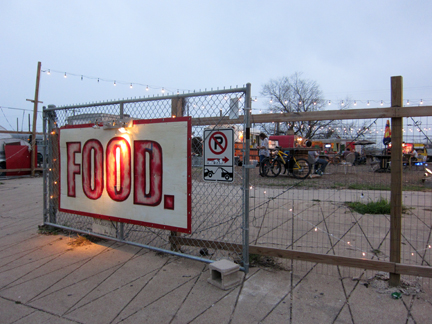
“Enchiladas and barbeque, oh baby whatcha gonna do?” sang the legendary father of Tex-Mex music Doug Sahm. The line comes from the title track of his 1974 release, “Groover’s Paradise,” an ode to the River City — Austin, Texas.
Today, in keeping with a long-running tradition of musician-friendly victuals, Austin has become the sui generis trailer park eatery capital of the world.
A few months ago, I visited the East Side Drive-In park (above) with liquid editor for our city’s paper of record, The Austin American-Statesman, Emma Janzen and her beau Zach Rose.
She posted this account of a wine tasting and pairing that I conducted for them.
What do loved balls and unicorns have to do with all of this? Watch the video and you’ll see…
Thanks again Emma and Zach! :)
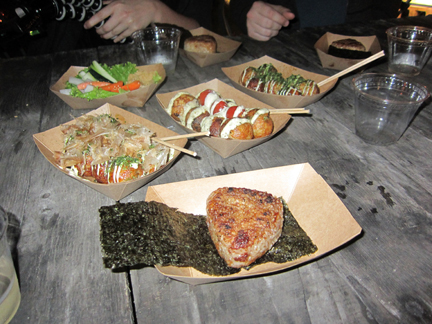
 Do Bianchi