Love balls & unicorns in the Groover’s Paradise @emmajanzen

“Enchiladas and barbeque, oh baby whatcha gonna do?” sang the legendary father of Tex-Mex music Doug Sahm. The line comes from the title track of his 1974 release, “Groover’s Paradise,” an ode to the River City — Austin, Texas.

Today, in keeping with a long-running tradition of musician-friendly victuals, Austin has become the sui generis trailer park eatery capital of the world.

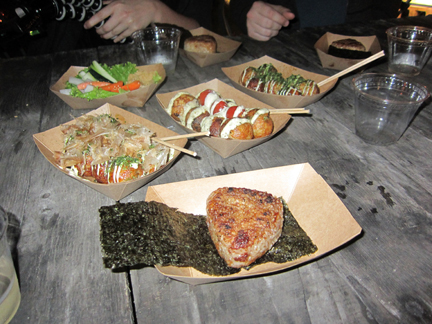
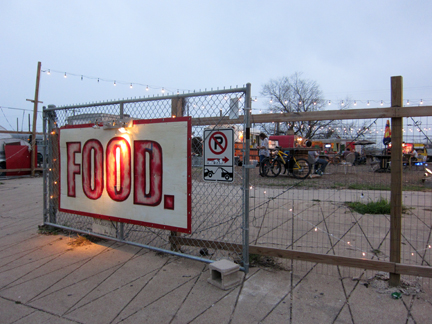
A few months ago, I visited the East Side Drive-In park (above) with liquid editor for our city’s paper of record, The Austin American-Statesman, Emma Janzen and her beau Zach Rose.

She posted this account of a wine tasting and pairing that I conducted for them.

What do loved balls and unicorns have to do with all of this? Watch the video and you’ll see…

Thanks again Emma and Zach! :)

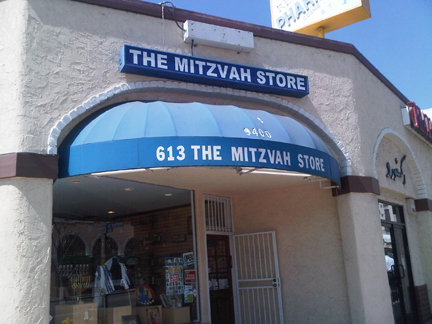
The Mitzvah Store

From the department of “money doesn’t buy everything”…

The Mitzvah Store (across the street from Sotto).

If only it were that easy!

Good shabbos, yall…

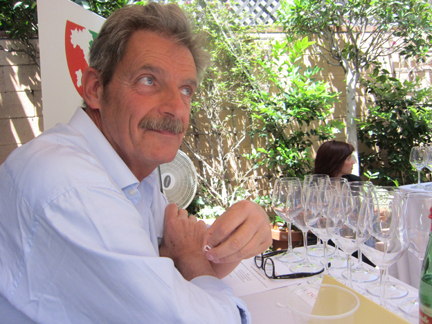
Carlo Ferrini and me (so many great wines & so little time)

Love him or hate him, legendary and often controversial Tuscan enologist Carlo Ferrini and I sat next to each other on the Sparkling Wine panel at the Viva Vino conference yesterday in Los Angeles.

We had a chance to speak for a few minutes before the panel and he was exceedingly forthright in his answers when asked about Montalcino, his association with Casanova di Neri, and what he considers his legacy and contribution to the history of Italian wine over the last few decades.

I don’t have time to post notes from our conversation today but will offer the following nugget.

When I asked how he feels about the fact that so many in Italy and beyond associate him with Merlot (many in the industry call him “Mr. Merlot,” using the English title mockingly), he said, quite frankly, “I don’t understand why people say that of me, when, in fact, it’s Cabernet [Sauvignon] that I like so much.”

I have to say that I admired his friendliness, style, and earnestness and I plan to visit with him this fall when Tracie P, Georgia P, and I head to Tuscany.

In other news…

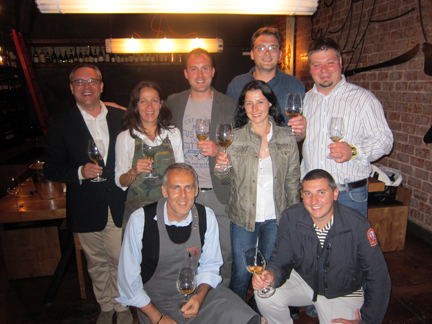
It was a blast to connect with the newly formed consortium of Oslavia (Collio, Friuli) producers who visited Los Angeles for the conference and trade events (after stopping for two days in Vegas where they partied their asses off).

That’s Max Stefanelli of Terroni (kneeling, left) and his wife Francesca behind him with six of the seven producers from the village (can you guess the single producer who didn’t come? I’m buying a glass of wine tonight at Sotto for anyone who can!).

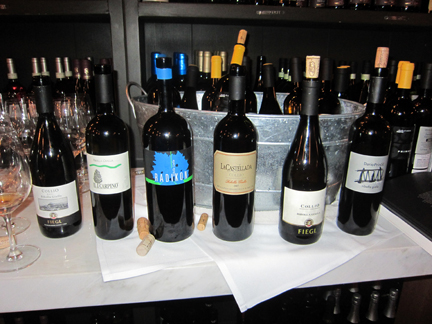
Here are the wines they poured for me and a handful of industry folks who attended a late night dinner and tasting at Terroni.

In other other news…

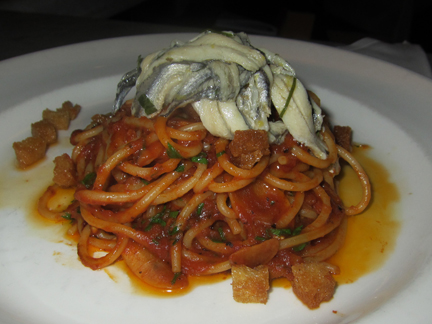
I connected yesterday with Lou (who needs no introduction here) and my new BFF Taylor Parsons, wine director at Osteria Mozza and Tuesday night I had dinner with Anthony and David at Mozza, where the conversation spanned an arc of Mel Brooks Hitler humor, the art of mixing (records), Anthony’s father’s incredible musical legacy (“he’s conducting better than ever at 93,” he said), burrata, anchovies, and Verdicchio.

So many great wine and so little time… So much more to tell but I have another slamming day and evening ahead of me here in Los Angeles.

If you happen to be in town, please come and see me at Sotto where I’ll be pouring wine on the floor from 6 until 9 or so…

Radikon, my visit to Oslavia

Heading to Los Angeles today where I’ll be working the floor (introducing our summer wine list) at Sotto Wednesday and Thursday nights and speaking tomorrow on a panel at the Italian wine fair for consumers and trade, Viva Vino. LA is buzzing right now with the arrival of the group of winemakers from Oslavia (Friuli) led by the young Saša Radikon, whom I’ll be meeting tonight. So I thought I’d post my photos from my visit to the winery a few years ago. Look for Saša and the Oslavia producers at DomaineLA on Thursday.

The skin-contact Ribolla of Radikon first came to my attention in the late 1990s in New York in an era long before the terms “orange wine” or “natural wine” were in vogue. Stanislao Radikon (above with wife Suzana) was the first to experiment with skin-contact starting in the mid-90s. (I highly recommend this profile from the recent Raw Wine fair in London devoted to the Radikon family and story.)

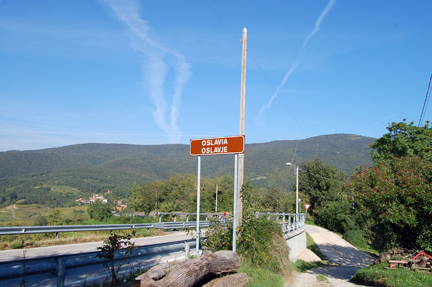
The village of Oslavia lies literally on the edge of the western world, just across the border from Slovenia in the province of Gorizia (in the Collio appellation).

One of the first things that Stanko (Stanislao) wanted to show me was the hill where then Colonel (later General) Badoglio fought the battle of Oslavia, one of the last and most bloody assaults of the First World War (just Google Badoglio and Oslavia to get a sense of the horror evoked by the toponym for a generation that came before us).

Today it is a place of immeasurable beauty, although many of the battle scars remain — topographical and emotional.

Stanko was perhaps the first to recognize the immense tannic potential of Ribolla (above), which, until that time, was used only to make light, white quaffing wine (in much of wine-making Friuli and Slovenia, it is still applied as such, although sparkling wine from Ribolla is becoming increasingly popular).

Stanko’s dense, cloudy, tannic, salty expressions of Ribolla changed the way the world viewed the variety and opened many’s eyes to the potential of “orange” (skin-contact) and “natural” wines ante litteram.

Open vat fermentation and extended skin contact are among the techniques applied to create Radikon’s long-lived, powerful, yet delicately nuanced bottlings of Ribolla.

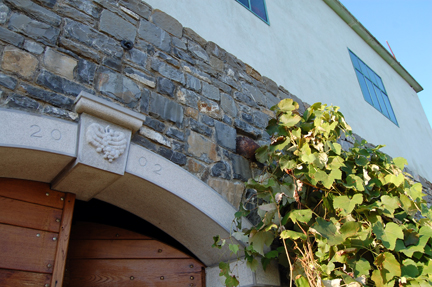
Note the unexploded bomb from the First World War in the abandoned farmhouse where Stanko built his new cellar in 2002.

One of the things that impressed me the most was the contrast between ineffable rural beauty and the memory of carnage and senseless sacrifice that linger there. Stanko is a quietly intense man whose soulful winemaking is as much an expression of ideology as it is a pure and natural product of his land.

I’ll be meeting with Saša and his group tonight for dinner and I’m sure I’ll have much to report tomorrow… Stay tuned…

The Story Behind Nascetta (and Anascetta)

I get so many emails from folks saying how much they appreciate this post on the story behind the ampelonym Nascetta that I thought I’d repost it today. Buona lettura!

*****

Romeo, doff thy name!

Above: Valter Fissore of Elvio Cogno (Novello) single-handedly delivered the Nascetta grape from oblivion after he tasted a wine made using this once highly praised grape in 1991. The wine had been bottled in 1986.

It’s regrettable that when I tasted the Nascetta grape for the first time last year, it was served to me ice cold and was described as a “light-bodied white wine.”

While in Piedmont in March of this year, I happily learned that Nascetta is actually a noble white grape variety that can produce long-lived, structured wines. And I had the great fortune to taste Valter Fissore’s excellent 2001 bottling — a nearly decade-old expression of this grape. In my notes, I wrote “rosemary, sage, petrol,” and was blown away by the structure of the wine, its lively acidity, and most of all its gorgeous, unctuous mouthfeel.

Yesterday, in a wonderful post on drinking the last extant bottling of a vintage, Cory nudged me to fulfill a promise to explore the origins of the name. And so here it is.
First of all, a little history.

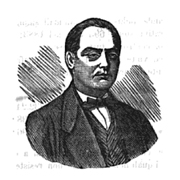
The name Nascetta was coined by 19th-century Piedmontese enologist Giovanni Gagna (left, 1833-1881), who believed erroneously that the grape was related to the Sardinian grape Nasco (from the Sardinian nuscu, from the Latin muscus, meaning moss). Remember: for the better part of the 18th and 19th centuries, Sardinia, Nice, Savoy, and Piedmont were ruled by the House of Savoy (the Kingdom of Sardinia), with its court in Turin and so commerce between Sardinia and Piedmont was fluid during that period.

In 1877, Count Giovanni di Rovasenda listed the grape using its dialectal name, Anascetta, in his landmark Saggio di una ampelografia universale (Essay on Universal Ampelography). The fact that he uses the dialectal inflection of Gagna’s name for the grape is an indication of how popular the grape was in Piedmont at that time, when it was commonly blended with Favorita (Vermentino) and Moscato. (In Piedmontese dialect, an initial a is added to certain words to compensate for syncopated, i.e., lost vowels; in this case, the acquisition of the initial a would appear hypercorrective, a phenomenon not uncommon in the morphology of Piedmontese.)

Here’s where it gets a little complicated.

Above: The confusion regarding the name of this grape was created in part by Valter’s frustration with labeling requirements. In 2001, he bottled the wine as a non-vintage vino da tavola (table wine) because the grape was not yet authorized for the Langhe Bianco DOC appellation.

Let’s start with some chronology:

1991 – Valter tastes a bottling of 1986 by farmer Francesco Marengo (Novello).
1994 – Valter produces 800 bottles from his own planting of the grape, labeled as Nas-cetta; following this vintage, Valter is forced to stop labeling the wine as Nas-cetta after he is fined for listing an unauthorized grape variety name on the label.
2000 – Nascetta (the grape) is added to the catalog of authorized grape varieties for Langhe.
2004 – Valter bottles the wine as Langhe Bianco DOC but cannot list the grape variety on the label; he labels the wine “Anas-cëtta” using a “fantasy” name because the grape is not authorized for the Langhe Bianco DOC labeling (it’s authorized for the blend but not the label).
2010 – After Valter’s successful lobbying, the 2010 vintage will be first labeled as Langhe Nascetta [sic] DOC.

Above: Valter’s Nascetta is an excellent value for a structured, age-worthy white. Be sure to serve it at cellar or room temperature.

When I asked Valter directly about his use of diacritics (in this case the umlaut and the hyphen), he told me flatly that he introduced them in the labeling for purely proprietary reasons. The mutation of the grape names Nascetta and Anascetta was inspired by his frustration with labeling requirements. The good news is that the confusion has been resolved and this noble white grape will be labeled as “Langhe Nascetta DOC” beginning with the 2010 vintage.

While in Piedmont in March, I also tasted another excellent bottling of Nascetta by Rivetto.

Be sure to read Cory’s post on the last bottle of 2001 and Whitney’s post, too.

… O, be some other name!
What’s in a name? that which we call a rose
By any other name would smell as sweet;
So Romeo would, were he not Romeo call’d,
Retain that dear perfection which he owes
Without that title. Romeo, doff thy name,
And for that name which is no part of thee
Take all myself.

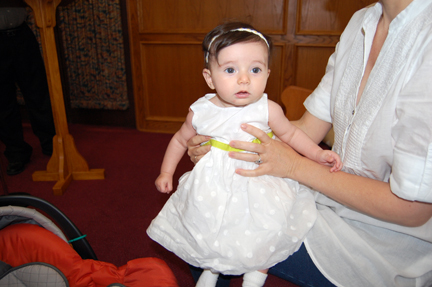
Georgia P’s new dress

Rev. B baptized little Georgia P yesterday at his church in Orange, Texas. And so she got to get dressed up for the first time (she was five months old on Saturday).

Isn’t she adorable? :)

Drinking problem…

Parzen family

Earlier this morning, when I filed my Mother’s Day brunch recommendations for the Houston Press, I started thinking about what a special Mother’s Day this is for our family.

Tomorrow, in Orange, Texas, we’ll be celebrating Mother’s Day with four generations: memaw, who is 90 and is a greatgrandmother many times over now; Mrs. B (my mother-in-law and grandmother to four), and Tracie P, above with our nearly five-month old Georgia P.

Tracie is such a wonderful, sweet, gentle mother to our baby and I’d like to honor her today by talking about a “drinking problem”… No, not the one you’re thinking!

No, the drinking problem I’m referring to is how the pressures of consumerist hegemony and bourgeois society drive mothers away from breast-feeding.

Continue reading