My Thanksgiving 2012 wine picks

best red wine thanksgiving

My wine club’s Thanksgiving Six-Pack went live today, including Zanotto Col Fondo (Prosecco), Cornelissen Contadino #9, and my number-one wine pick for Thanksgiving this year, the Laimburg Lagrein (above).

Click here to view the offer… And thanks for your support!

Georgia P’s first election & why her parents vote for Obama

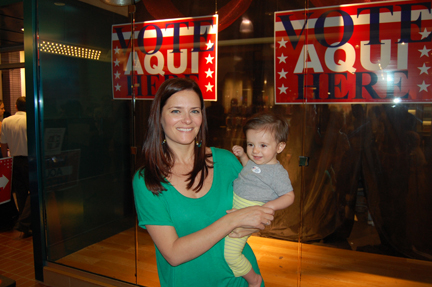
On Friday, we took Georgia P to vote at a nearby mall in early voting.

She’s a very social little girl and she loves being out and about and people watching (especially when the people are standing in line; she loves lines).

As owners of a small business (my wine and restaurant industry marketing consulting gigs) and parents of a ten-month old girl, the result of this presidential election will have a greater (and more direct and more immediate) effect on us than any before.

As long as I live, I’ll never forget the day that the Supreme Court upheld the Affordable Care Act and Georgia P, Tracie P, and I watched the president address the nation on television.

I wrote in my blog:

    From the time I became an adult in the eyes of the law to the time I filed my dissertation at UCLA in 1997 at thirty years of age, I was a student and was covered thanks to my affiliation with the university. But when I moved to New York and ultimately became a freelance translator and writer, affordable health insurance became a challenging personal issue for me: even in the toughest of times (like the years that followed the tragedy of the World Trade Center and the more recent financial crisis), health insurance was a luxury that I simply could not do without, lest my family be burdened with the cost of my care in the case I fell ill.

    I’m fortunate to enjoy good health. And thanks be to G-d, Tracie and Georgia P are both healthy as well.

    But now that I am a father and a business owner who insures his whole family, including our dear Georgia P, the news of the Supreme Court decision bolsters my hope that our daughter will grow up in a more “human” United States of America.

    I thought that I was going to cry when the president said that insurers will no longer be allowed to deny coverage to children with pre-existing conditions and that they will no longer be able to charge women more for coverage simply because they are women.

Affordable and guaranteed health care and women’s reproductive rights are among the top issues being decided in today’s votes. Both will affect our daughter as she adolesces and becomes an adult American.

But the greater and over-arching issue that makes me a democrat is my desire for our daughter to grow up in a country where humanity and human dignity are paramount in our nation’s ethos.

Do we personally need affordable health care? No, we don’t: every month we pay for health insurance that provides us with excellent care. Do we need government entitlements? No, we don’t: even in leanest times, we live comfortably thanks to our ability to make a living.

No, we don’t need any of those things. We’re doing great.

But our country does. Our nation — our fellow citizens who share our birth right — does.

And as Georgia P smiles, laughs, plays, hugs, eats, and farts, unaware that we have been blessed by a family who loves us and our modest prosperity, she needs to grow up in a country where taking care of our less fortunate sisters and brothers is a civic duty embraced by every citizen for the greater good of all — including a little Texan who came into this world ten months ago.

Thanks for reading and please vote for Barack Obama for President.

@EricAsimov teaches our generation “how to love wine”

best wine book 2012

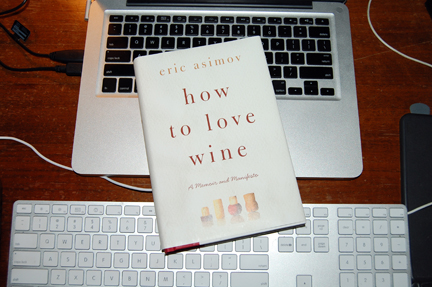
“Instead of a joy,” writes Eric the Red (Eric Asimov) in his newly released “memoir and manifesto,” How to Love Wine, “for many people wine has become a burden.”

“The United States,” he observes, “has become the largest single consumer of wine on the planet, yet what’s missing in many people’s experience of wine is a simple sense of ease. Instead, choosing a wine becomes an exercise in anxiety. Many people have come to believe that they cannot enjoy wine unless they are already knowledgeable, and so deny themselves the pleasurable experiences that would allow them to gain confidence.”

(His column last week for The New York Times, also addresses this phenomenon and the misunderstood role of the sommelier.)

As I read Eric’s new book over the weekend, I couldn’t stop thinking about how our generation (he’s my eldest brother’s age) is the first American generation to approach wine in demotic terms.

Like him, I grew up in a Jewish household where wine was considered a luxury (if it was considered at all). He notes his (our) parents were among the first American generation who could afford to travel to Europe. They went made a first trip in 1971: “Perhaps most interesting of all to them, they ate in French restaurants and drank wine.” (Around the same time, my parents went to Russia and drank vodka.)

He talks about drinking “bland and boring” beer and smoking weed in high school and college, not “turn[ing] up my nose at the sort of things that typically found their way to dormitory parties back then.”

And then, in 1982, while a grad student in Austin, Texas, an epiphany is delivered by an $8 bottle of Giacomo Conterno Barbera d’Alba (my epiphany bottle was a literally homegrown Sangiovese in Montalcino in 1989).

The parallels in our lives are uncanny as they are common among our generation. (For our mutual friend Alice Feiring, another one of my favorite wine writers, it was a bottle of Nebbiolo in 1980; the fact that we’re all Slavic Jews and the role that Italian wine has played are also unheimlich.)

As Georgia P played with her toys on the floor and I devoured Eric’s book, I realized that she will grow up in an America that is aware (and self-aware) of its application of wine. And I also thought deeply about how our generation’s “anxiety” in approaching wine is probably what has fueled the enoblogosphere’s explosion, the vitriol that often sullies the discusion of wine, and the joy that so many of us find in the wine blogging community.

I plan to write a proper review of the book for the Houston Press.

In the meantime, I highly recommend it to you.

O, and why is Eric called “Eric the Red” here on my blog, you ask?

He took the name himself inspired by my brush with Dany Le Rouge.

Support New York City restaurants (lunch at SD26)

Above: The signature dish at SD26, a large raviolo stuffed with cheese and a gently poached egg yolk. Prix fixe lunch at SD26 is just $28.

As my friends and I ate our way through Manhattan last week, I heard a lot of people say that the restaurant scene there has begun to “pick up” again in the wake of the financial crisis “reset.”

I left the city on Friday: on Monday, Manhattan saw its worst flooding in a generation, a catastrophe that has already impacted New York’s struggling restaurateurs.

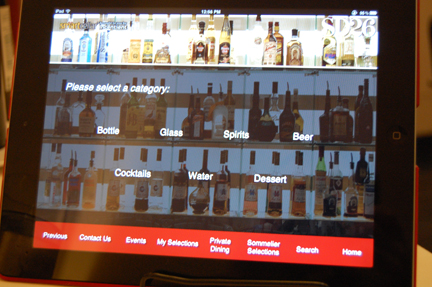
Above: The wine list at SD26 is presented on an iPad. I was thrilled to discover that the restaurant has an open network and that I could get online at the bar as I waited for my good friends Michele and Charles Scicolone who treated me to lunch.

Gastronomic culture in Manhattan and Brooklyn plays such an important role in our country: many of our nation’s best chefs and top sommeliers pay their dues and make their names there. When restaurants in New York thrive, restaurateurship throughout our country prospers as well.

Now, more than ever, the New York restaurant scene needs our support.

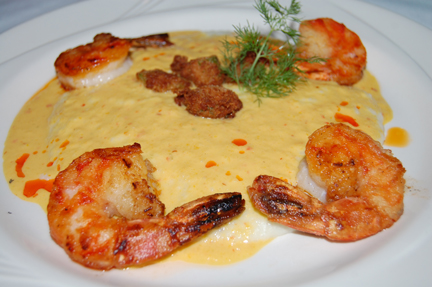
the best shrimp and grits I’ve ever had

Today at Charivari in Houston, lunch with the inimitable Bear Dalton (who told me they’re his favorite shrimp and grits “in town”).

The grits weren’t overly buttered and their mouthfeel was even and substantive without seeming heavy.

Just enough spice on the shrimp and fried okra in the middle took it over the top.

Thanks again, Bear!

Terroir, Soldera, Barthes, Derrida, and St. Augustine

deconstruction derrida barthes eco

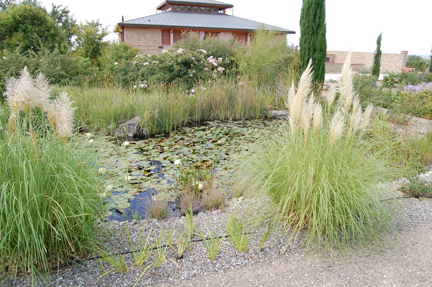
Above: In the late 1970s, Gianfranco Soldera created a “terroir” by building a series of botanical gardens in Montalcino, including this mini swamp.

My entry today for the Houston Press is an intro to the concept of terroir.

As I was writing it, it occurred to me that many wine writers omit bacteria as one of the defining elements of terroir. In the light of the dialectic over native yeast in recent years, I was surprised not to find bacteria or yeast mentioned in the online edition of the Oxford Companion to Wine.

I wasn’t surprised to discover that few wine authorities discuss the human contribution to terroir through culture, history, and tradition. Would we have a notion of terroir, I asked myself, if the friars of Burgundy hadn’t manicured and monitored their cloistered vineyards with maniacal care?
terroir montalcino brunello

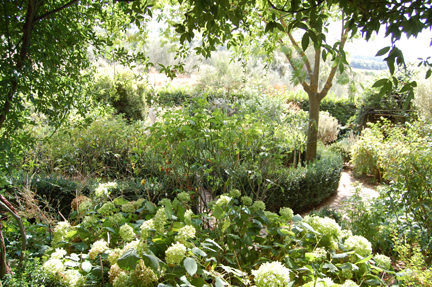
Above: Soldera’s white garden is his biggest source of pride.

My thoughts led me to a memory of walking through Gianfranco Soldera’s botanical garden for the first time in 2008. Anyone who’s ever visited the estate knows that his biggest point of pride is the garden and in particular the white-flower garden and the mini swamp (above). In the 1970s, he created his own terroir on barren land, including the yeast colony that rose from his earthly handiwork.

If humankind can create terroir by reinterpreting landscape, I wondered, does humankind’s perception of terroir influence terroir itself?

At first, Barthes, Derrida, and deconstruction came to mind. Could Eco’s notion of the “open work” be applied to wine connoisseurship? Is the winemaker dead (to quote Barthes)? Every bottle of wine is an expression of a moment and a fabric — a text — of elements that converge between harvest and vinification. And each bottle of wine tells a different story depending on how and when it is handled and opened and by whom.

Yes! I thought: a bottle of wine is an “open text” whose meaning is interpreted and ultimately defined by the reader/drinker.

But can terroir — the quasi-mythical concept of site and vintage specificity — be influenced by the reader/drinker?

Surely it can. To apply Kantian absolutism to terroir would be to negate the very ethos of terroir.

Ultimately, my thoughts led my back to my beloved St. Augustine and his reflections on the nature of memory.

Our concept and conception of terroir could not exist unless we remembered our previous perception of terroir.

In other words, if you only tasted Bonnes Mares or Monprivato once in your lifetime and tasted no other expressions of Pinot Noir or Nebbiolo, you’d have no sense of their uniqueness.

I arrived at the conclusion that terroir could not exist if we were not there to perceive it (in many ways St. Augustine was a precursor of the proverbial tree that falls in the forest but doesn’t make a sound).

If terroir cannot exist without humankind, then humankind does, indeed, wield influence over it. And if perception of terroir cannot exist without humankind’s memory of terroir, then it follows that even the end user of a bottle of wine play a role in terroir.

Whether you taste a bottle of Soldera on his estate (where he built a terroir ex novo), whether you taste it on the hilltop where he regularly dines, or whether you taste it in New York City or Houston, Texas, you play a role in the terroir by perceiving it.

Wine for thought…

Carbonara, a new theory for its origins and name

origin name carbonara

Above: Tracie P adds onion to her Carbonara, just another idiosyncratic — and delicious — interpretation of this recipe (the above was one of the dishes in last night’s dinner at our house).

Premise

Perhaps more than any other recipe in the Italian gastronomic canon, spaghetti alla carbonara and its origins have perplexed and eluded gastronomers for more than five decades.

Most food historians group the currently and popularly accepted theories of the etymon into three groups: the origin of the dish can be ascribed to 1) coal miners; 2) American soldiers who mixed “bacon and eggs” and pasta after occupying Italy in the post-war era; and 3) Ippolito Cavalcanti, the highly influential nineteenth-century Neapolitan cookery book author, whose landmark 1839 Cucina Teorico-Pratica included a recipe for pasta with eggs and cheese.

There is also a fourth theory that points to the restaurant La Carbonara, opened in 1912 in Rome. According to its website, it was launched by “coal seller” Federico Salomone. But the authors of site do not lay claim to the invention of carbonara nor do they address the linguistic affinity (even though they mention that their carbonara was included in a top-ten classification by the Gambero Rosso).

Origins and historical meaning of the word carbonara

The “coal miner” hypothesis is highly unlikely in my view. Carbonari are not coal miners but rather makers of [wood] charcoal (colliers in archaic English). If we agree that carbonara (the dish) began to appear in industrialized Italy (see below), we also have to take into account that the word carbonaro/a also had a different and more prevalent meaning for Italians at that time. The carbonari were members of a Neapolitan secret revolutionary society (similar to the Free Masons) called the Carboneria. The nineteenth-century group took their name from a fifteenth-century Scottish group of rebels who masked their subversive activities by pretending to be colliers.

Continue reading

@Levi_opens_wine visits Romano Levi distillery

levi dalton

Once again, I feel compelled to direct your attention to a superb and extraordinary post by Levi Dalton — the “dude of dudes of wine blogging.”

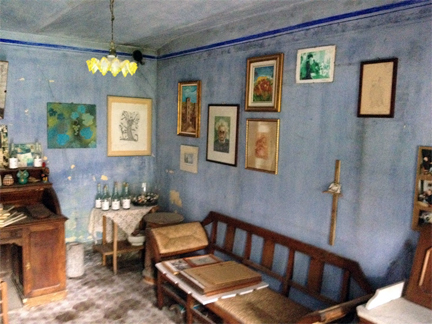
In it, the Philip Marlowe of the international wine scene visits the Romano Levi distillery in Piedmont.

Buona lettura e buona domenica a tutti!