Mario Batali’s joke on Bill Clinton (and great charcuterie in La Jolla @ArriciaMarket)

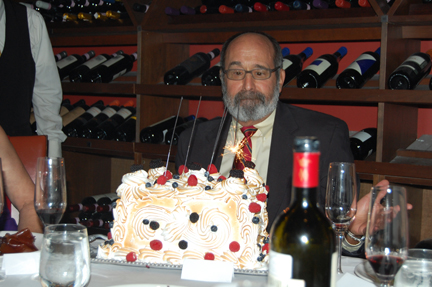
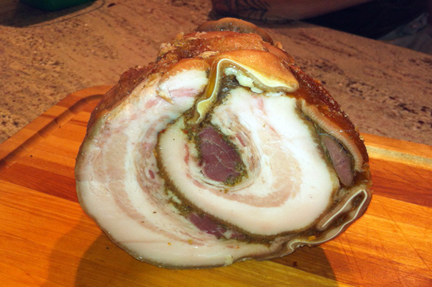
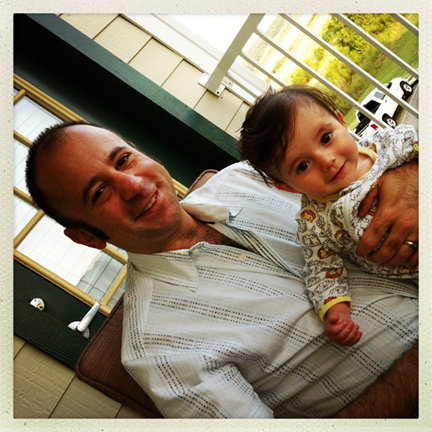
Yesterday, Bobby Pascucci (above) shared some of his excellent porchetta di testa (below) with me at his new Ariccia Italian Market in La Jolla.

His testa (pig’s head) brought to mind a salacious tale often retold in New York restaurant circles about President Clinton’s first visit to Babbo.

It’s a little too racy for Do Bianchi but my editors at the Houston Press didn’t bat an eye when I asked them if I could post it there.

Here’s the link (WARNING CONTAINS ADULT CONTENT).

Mysterious case of the yellowed corks (SOLVED)

From the department of “keeping the world safe for Italian wine”…

Yesterday, Fabien Jacob, a good friend and one of the top wine professionals in San Antonio, sent me the following message via the Facebook.

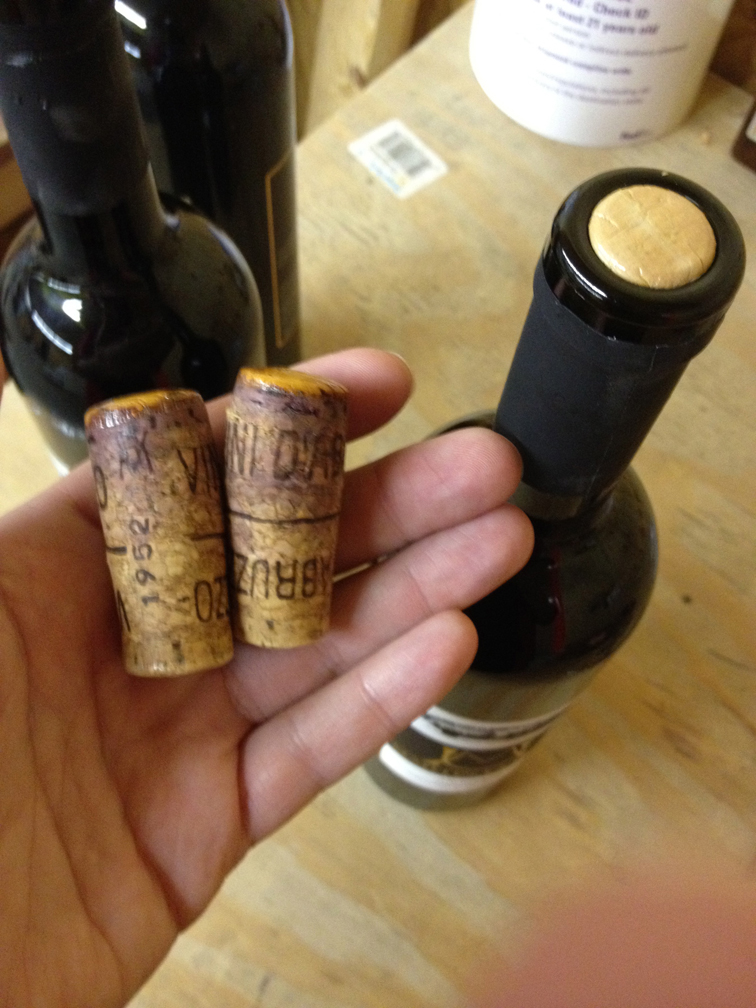
“I need your help,” he wrote. “Have you ever encounter corks that are glazed and turned yellow at the bottom of it? This is happening with a wine from Abruzzo, the wine itself is not bad or faulty but the cork is very fragile and became glazed and yellow. Any help would be appreciated. Thank you.”

Nonplussed by the mysterious case of the yellowed corks, I asked Fabien to send me a photo (click the image above to enlarge) and then reached out to Giovanni, who swiftly answered (and I have translated here):

    It’s a silicon film that is applied to the top of the closures in order to stop the wine from coming into direct contact with the cork. It helps to ensure that the wine isn’t affected by cork taint.

    It has been applied to both the top and the bottom of the cork. In this case, it has yellowed because the bottle contains [wine made from] Montepulciano [grapes] or similar, a grape variety that that has a strong tendency to tinge. The film has been applied to the top as well but it’s still transparent.

Tonight I’m giving a seminar on social media and wine for the San Diego association of women wine professionals. I can’t think of a better example of how social media makes the wine world a better place.

Grazie, Giovanni! Evviva il bromance!

98 & 03 B. Mascarello, 85 Tignanello, 90 Quintarelli Recioto Riserva @TonyVallone

Where do we go from here?

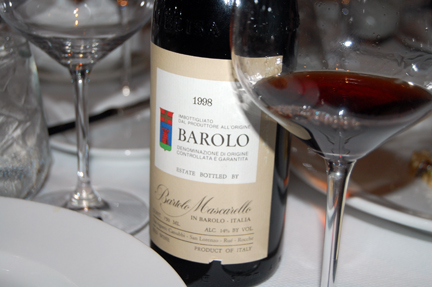
When my friend and client Tony Vallone opened last Thursday’s dinner (at Tony’s in Houston) with 1998 Bartolo Mascarello Barolo, I wondered how the subsequent wines could possibly compete with such a stellar entry.

Tony paired this extraordinary bottle with a porcini mushroom risotto, made with Acquerello rice and prepared rigorously all’onda — an indisputably traditional and ideal match.

Even though the wine had begun to disassociate slightly (i.e., some light solids had begun to form in it), this bottling was the apotheosis of Barolo: earth, tar, and mushrooms on the nose, rich ripe red fruit in the mouth, all “supported” (as the Italians say) by Mascarello’s signature acidity. I was surprised by the solids in this wine (and will revisit the 98 in my cellar) but was nonetheless thoroughly impressed by the balance and nuance of this superb wine.
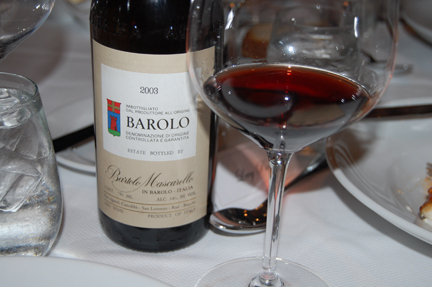
When I had breakfast with Angelo Gaja last month in New York, we talked about how the warm 2003 Langa vintage was such a great restaurant wine inasmuch as the wines are already showing very well (he declassified nearly 50 percent of his crop that year, he said, noting that it was an “honorable” but not “great” vintage). For producers with great growing sites (like Mascarello and Gaja, however divergent in style), it was still possible to deliver excellent wines from the early and very small harvest. Tony paired with halibut (yes, fish!) dressed with an Amatriciana sauce — a creative and decadent match that worked surprisingly and brilliantly well. I loved the way the richness and ripe fruit in this expression of B. Mascarello worked with the acidity and savory of the sauce and creamy flakiness of the fish. While I don’t think that the 03 will be a thirty-year wine, I was taken with how fresh it was and how nervy its acidity. How can you not love Bartolo Mascarello? Always a great.
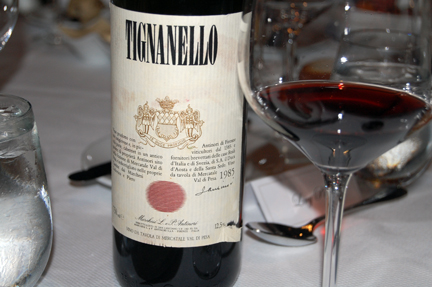
The last time I tasted 85 Tignanello was in 2005 in New York. I was blown away by how different this wine was from the 1990 we tasted in 2009 at Alfonso’s. I might be wrong about this but I ascribe the difference in style to the change in winemaker that came about in that era: although the wine was conceived by Giacomo Tachis, who made its early vintages, Riccardo Cotarella took the reins at the winery in subsequent years and he nudged the wine toward a bolder and more American friendly expression.
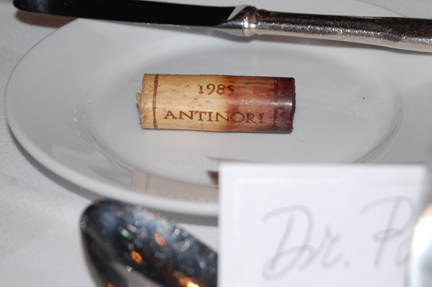
The wood was perfectly integrated in this wine and it was vibrant and remarkably fresh. Not only was I impressed by its fitness, I also thoroughly enjoyed it.
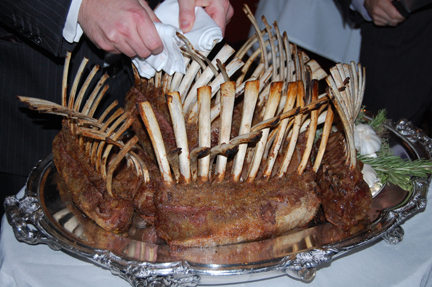
Tony’s general manager Scott Sulma has every right to tease me about my across-the-board disdain for Super Tuscans, given my request for a second glass of this wine with my rack of lamb. A truly original wine — in its twilight but not in decline.
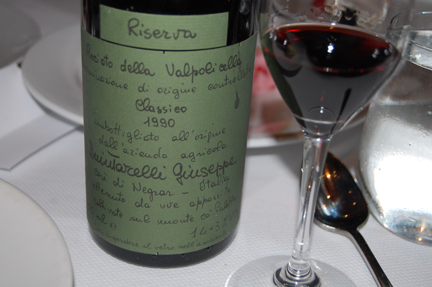
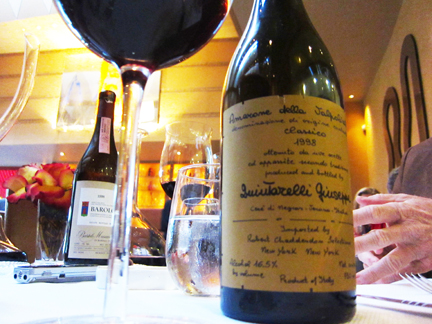
Quintarelli was at the peak of his genius in 1990 when he made this wine… an extraordinary vintage by one of the greatest winemakers of the twentieth century (he even made his rare white Bandito in 1990).

What an incredible bottle and what an unforgettable experience! The 14.3 alcohol in this wine was perfectly balanced by its acidity and freshness and its unlabored, subtle notes of ripe red and stone fruit were answered in counterpoint by a gentle hint of bitter almond. Absolutely brilliant, unique, and thrilling… One of the most memorable wines I’ve ever had the chance to taste…

And dulcis in fundo

For his birthday, Tony surprised cousin Marty with Baked Alaska. I love Tony’s playfulness and his love of baroque presentation, especially when it comes to nostalgic desserts like this one.

Cousin Joanne, Marty, and I were still talking about the dinner when we got back to their place in Houston. And we were STILL talking about it over breakfast the next morning.

Tony, thanks again for a night I’ll never forget.

This woman made me drink Merlot

I profiled Houston wine professional Marcy Jimenez today for the Houston Press. Here’s the link (and the story about the Merlot is true; it was a Merlot and Dolcetto blend by Trinchero, one of my favorite Natural winemakers).

In other news…

So many wines and so little time… I haven’t had a chance to write up my notes from last night’s dinner at Tony’s: 98 and 03 Bartolo Mascarello, 85 Tignanello, and 90 Quintarelli Recioto Riserva. Each one of the wines was fascinating in its own right and I’ll post my impressions early next week.

In the meantime, buon weekend yall!

My photo in Forbes and 90 Quintarelli Recioto Riserva tonight @TonyVallone

Stranger things have happened: last week Forbes contacted me asking if they could use a photo (above) from the blog for the magazine.

Here’s the link to the piece.

The image comes from my of the “most memorable meals” of 2011, a dinner in the restaurant of my friend and client Tony Vallone.

Here’s the link to my post on the repast, wherein 98 Bartolo Mascarello Barolo, 98 Quintarelli Amarone, and 90 Quintarelli Bandito (!!!) were all consumed with great joy.

Tonight at Tony’s, we’ll be opening the 90 Quintarelli Recioto Riserva: I’ll be speaking about the wines at a dinner for forty persons.

Stay tuned…

With @LouAmdur @SottoLA next week (and helping Italian earthquake victims)

Tracie P and I cried the day that Lou (above) announced the closing of Lou on Vine earlier this year.

Lou will be joining me (again) on Thursday, July 26 for tasting and conversation at Sotto where I curate the wine list (and Tracie P will be there, too).

Here are the details.

It should be a super fun night.

In other news…

The Non Ci Fermiamo (We’re Not Stopping) project came to my attention via Giovanni’s blog.

Based in the province of Mantua (Lombardy), in one of the areas most severely affected by recent earthquakes, the initiative seeks to connect donors with scores of families left homeless by the catastrophe.

As part of the campaign, the young people of the town Quistello (one of the worst hit) are also selling Mantuan foods like mostarda, local rice cultivars, and torta sbrisolana, the classic (and extremely delicious) almond cake.

Check out the site here.

Clos Cibonne & fried green tomatoes, a sublime pairing (TY @RandallGrahm)

“What would Freud say if he were alive today?” goes the set-up for a joke by one of my favorite Italian comedians, Alessandro Bergonzoni. The punchline: “I sure have lived a long life.”

In my own jejune stab at comedy, I ask: is it a stretch for me to call a pairing of Clos Cibonne oxidative rosé from Tibouren and fried green tomatoes sublime? What would Longinus say if he were alive today? There’s no doubt in my mind that he’d answer: “I sure have lived a Longinus life.”

In many ways, the thought of pairing this fantastic old world wine — made in large, old casks using film-forming yeasts — with a staple of East Texas cooking seems a stretch. But at the same time, no two notions could be more aligned: the sweet and sour flavors of summer (via our CSA and Grandma Georgia’s cast-iron skillet) plucked our palates in perfect harmony with the marine notes of this quintessentially Provençal wine.

The master of paronomasia (“waiting for Godello”) Randall Grahm first turned me on to this wine over lunch in Los Angeles last year and when I saw it in our market here in Austin, I grabbed as many bottles as I could and ran right home to Tracie P (whom, I knew, would love this wine).

When she breads and fries summer tomatoes in Georgia P’s namesake’s cast-iron skillet, the centers of the rounds become gelatinous and when you bite into them, summer wraps around your tongue. The dry flavors of the Tibouren rosé were the perfect counterpoint.

Thank you, again, Randall, and thank you, Longinus, for giving us the sublime!

It is a law of Nature that in all things there are certain constituent parts, coexistent with their substance. It necessarily follows, therefore, that one cause of sublimity is the choice of the most striking circumstances involved in whatever we are describing, and, further, the power of afterwards combining them into one animate whole. The reader is attracted partly by the selection of the incidents, partly by the skill which has welded them together. For instance, Sappho, in dealing with the passionate manifestations attending on the frenzy of lovers, always chooses her strokes from the signs which she has observed to be actually exhibited in such cases. But her peculiar excellence lies in the felicity with which she chooses and unites together the most striking and powerful features.

—[Pseudo-]Longinus, On the Sublime