Stunning Friulian Chardonnay & decadent Valdostana @TonyVallone

best friuli chardonnay

There are a handful of white wines from Friuli that I like to call my “guilty pleasure” bottles: high-end, international-styled expressions of bacca bianca viticulture from some of the region’s most manicured and pedigreed estates.

I’m talking about labels like Vie de Romans, Jermann, Miani… These producers often deliver bottles that step outside the parameters of strictly traditional Friulian winemaking, leaning toward a richer and more opulent style.

After dinner on Friday night at Tony’s in Houston (where I curate the restaurant group’s media), I’m adding a new winemaker to that list: Vignai da Duline.

I have known and followed these wines and I love their more traditional labels.

But this gently maloed Chardonnay blew me away with its depth and stunning balance of minerality and fruit.

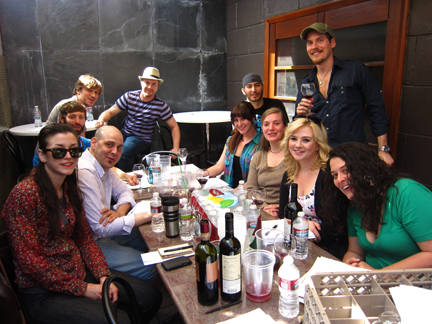
It was so thrilling that our party of six ordered a second bottle.

The wine’s not cheap (importer David of AI Selections told me this morning that srp is $50) but worth every penny.

asian italian fusion

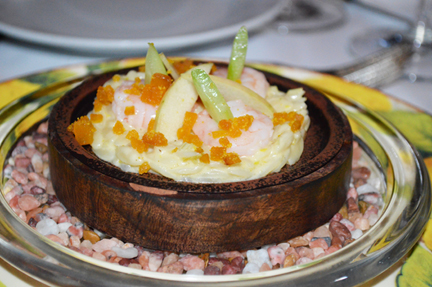
The wine was an ideal pairing for the Laughing Bird Shrimp topped with red-mullet (Sicilian) bottarga, one of the delightful “fusion” dishes that my friend Tony has been featuring on his tasting menu.

best valdostana recipe

But the dish I can’t stop thinking about three days later was the Valdostana, stuffed with Fontina and Prosciutto di San Daniele. The veal melted in my mouth…

I love the way that Tony uses the Italian culinary canon as a paradigm. He constricts his chef de cuisine, the extraordinarily talented Grant Gordon, within Italian tradition. But then he hands him the keys to a Maserati loaded with the best materia prima available.

This dish was transcendent… Paired with a Monsecco 2006 Gattinara, a new addition to the Rosenthal book…

Upcoming dinners with @TonyVallone @CiaoBelloHou & @DonkeyAndGoat @SottoLA

barolo villero brovia

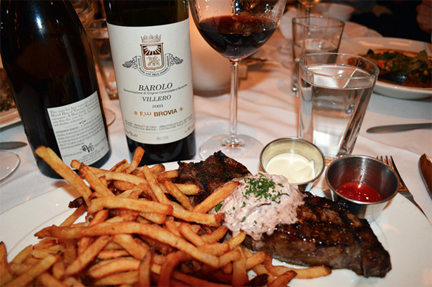
Above: I paid less than $100 “on premise” for this 2003 Barolo Villero by Brovia at a restaurant in Houston. Unbelievable.

The Houston food and wine scene continues to amaze me. In part because of how disappointing, uninformed, and naive it can be at times. In part because of the unbridled talent and the extreme value that you find there in the most unlikely places.

A few weeks ago, I had a superb bottle of wine from one of my favorite producers, the 2003 Barolo Villero by Brovia, one of the few growers who released their crus from the 2003 vintage. The wine was simply stunning.

But the most incredible thing about the experience was that I paid less than retail for it. Even more more unbelievable was how difficult it was to navigate the restaurant’s tablet-based wine list, out of date and poorly organized.

I wrote about the frustrating but rewarding experience today for the Houston Press.

There are some Houston restaurateurs and wine professionals who never seem to leave the Houston bubble and they sadly remain unaware of what’s going on in the world beyond.

And then there’s my friend and client Tony.

tony vallone houston

Above: Tony Vallone is one of the most dynamic Italian restaurateurs in the country imho. I’m so proud to call him my friend and client.

In the words of one Houston food critic, he’s the dude who “virtually defined” fine dining in Houston over the last four decades (his first Tony’s opened in 1965).

I’ve enjoyed some amazing meals in his restaurants and I’m excited to share the news that he and I will be speaking at a Sicilian Regional Cuisine dinner on June 26 at his Tony’s casual restaurant Ciao Bello.

Tony’s half Sicilian and half Neapolitan and he travels to Italy every year (he just got back from a trip to Chicago for the Fancy Food festival, Sicily, and Paris).

I’ve spoken about Italian wine at a number of dinners in Tony’s restaurants but we’ve never presented together. I couldn’t be more thrilled.

tracey brandt donkey goat

Above: Tracey Brandt of Donkey & Goat recently came to Austin to present her family’s wines.

Another event I’d like to bring to your attention is a wine dinner at Sotto in Los Angeles where I co-curate the wine list.

On June 25, Tracey Brandt (above) of the Donkey & Goat winery will be presenting her family’s wines.

I’m super bummed that I won’t be able to be there (I’m grounded until Baby P 2013 gets here in mid-July).

But I highly recommend the dinner and the wines to you. Donkey & Goat is one of the Parzen family’s official wines: we drink them regularly at home, mamma Judy (my mom) drinks them in La Jolla (the rosé is her favorite), and Rev. B (my father-in-law) loves him some Donkey & Goat Helluva Pinot Noir.

I’m very proud that we feature the wines at Sotto.

That’s all the news that fits today… Have a great weekend, yall! Buon weekend!

Mothers aided by @WWF in pesticide battle in Proseccoland cc @Bele_Casel @ZanottoColfondo

baby in the vineyards

Above: We took Georgia P to Proseccoland for the first time in September 2012 when she was about nine months old. The grapes were still on the vines and about to be harvested. She loved playing in the vineyards and Tracie P and I felt good about it because the two vineyards we visted — Bele Casel and Zanotto — are both organically farmed.

On Friday of last week, a friend of ours from mainland Venice, Paola, alerted me to a report in Oggi Treviso (Treviso Today) about daycare mothers protesting the use of pesticides and herbicides in Proseccoland.

According to the author of the article, the local chapter of the WWF has helped them to organize an assembly (this coming Friday) to address their concerns about chemicals being sprayed in vineyards that lie adjacent to a preschool daycare center.

Yesterday, I wrote about the event for the Bele Casel blog, a site devoted to the Veneto and viticulture in Proseccoland.

pesticide protest

Above: During the “Prosecchissima” festival in the village of Miane in April of this year, the WWF Altamarca displayed signs calling for the abolition of chemical-based farming in the Prosecco DOCG appellation (source: PDQNews.it). The signs were removed by thieves.

But this morning, as I poked around the internets looking for more info about the situation “on the ground” in Proseccoland, I learned that similar protests, assemblies, and impassioned calls for a chemical-free Prosecco DOCG have been going on since 2011 when the WWF opened a local chapter, WWF Altamarca (no website).

I also discovered a video feed by European parliament deputy Andrea Zanoni, a Treviso resident and native, who has been documenting his battle with “big Prosecco” to curb the use of chemicals and to stop the deforesting of woods in the appellation.

Here’s a video from his YouTube page:

The video was shot in the township of Tarzo, not far from the preschool where mothers first raised concerns about pesticides being sprayed.

Like the WWF Altamarca, Zanoni has also called for a halt to helicopter spraying.

In another of his videos, he notes that restaurant-diners were recently affected by pesticide-spraying aircraft. Such spraying, he says, is only allowed in extreme cases and he believes that recent airborne spraying is in direct violation of EU regulation.

Before his passing, even the great Veneto poet Andrea Zanzotto lent his gravitas to the cause, publicly aligning himself with the WWF mission.

I first traveled to Proseccoland in 1989 (playing music) and I think it’s safe to say that no other Italian appellation has been transformed so radically by “big wine.”

The Prosecco boom of the last two and half decades and the ever growing demand for grapes are so enticing that chemical-farming and the clearing of land has become a way of life there.

I’ll be following these stories and will continue to report on them here and on the Bele Casel blog.

Please tweet or share this on Facebook if you feel so inclined.

Carbonara & more thoughts on its origins, a pairing inspired by Brooklyn Guy

best carbonara recipe

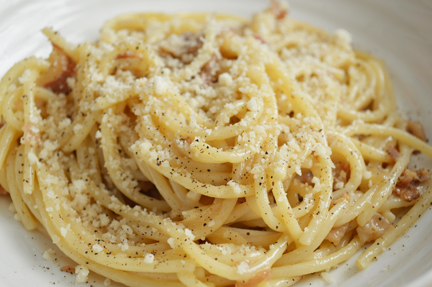
Above: Tracie P’s Carbonara last night. To borrow an expression from Charles Scicolone, “I am blessed.”

“One of the things that is endlessly appealing about New York, for anyone with more than a passive interest in food,” wrote Craig Claiborne in the New York Times in 1965, “is a continual sense of discovery either in products or the environment in which they are sold. It may be a spice or a bread or a cheese in Brooklyn, Greenwich Village, the Lower East Side, but there is always the prospect of the unexpected.”

His words ring as true as if they were written yesterday, don’t they?

In this instance, he was writing about the pancetta at the “Salumeria Italiana, known in the neighborhood as Frank’s Pork Store, at 26 Carmine Street (near Bleecker Street and the Avenue of the Americas).”

Pancetta “is designed to be sliced paper thin and eaten as part of an antipasto or scrambled with eggs. The closest thing it may be said to resemble is prosciutto, and like prosciutto, it is delicious when draped over melon or figs and served as a first course. Mrs. Bocassi, the owner’s wife, commented recently that many Italians used pancetta to make spaghetti carbonara.”
cesanese del piglio

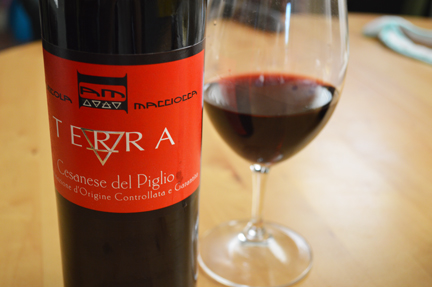
Above: We paired with this Cesanese del Piglio by Cantina Macciocca, sent to us as a sample by importer Katell Pleven of the Vine Collective. In my experience, the Cesanese grape has the right spice to stand up to the intense flavors of Carbonara. I loved this wine by organic farmer and native yeaster Macciocca. Although a little hot with alcohol, it was fresh and meaty and its peppery notes sang with the Carbonara.

Carbonara has been on my mind after reading Brooklyn Guy’s recent and superb post and reflections on wine pairings and recipes.

(Here’s a link to my last post on Carbonara and its origins.)

The Claiborne passage above is significant not only because “Mrs. Bocassi, the owner’s wife, commented recently [in 1965] that many Italians used pancetta to make spaghetti carbonara,” but also for his observation that pancetta “is designed to be sliced paper thin and eaten as part of an antipasto or scrambled with eggs” (italics mine).

By the time he wrote this piece, Carbonara was already an immensely popular dish in the U.S., in part thanks to opera singers who mentioned it as their one of their favorite Italian dishes.

In an article published in 1962 entitled, “A Diva’s Proper Interest in Pleasures of the Table,” Claiborne wrote of soprano Eileen Farrell that “Miss Farrell speaks with warmth, however, of spaghetti carbonara.” It’s one of the earliest mentions of Carbonara, the dish, that I can find in the Times.

I’ve also found an instance where soprano Birgit Nilsson mentions it as a favorite Italian dish.
passerina frusinate

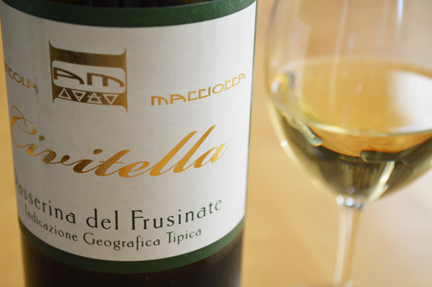
Above: Most Passerina comes from Abruzzo but this one, a 2011 by Macciocca, is raised in Latium (Lazio) in the township of Frosinone (Frusinate in dialect). It’s an example of the viticultural connection between Abruzzo and Latium, a relationship that’s even more evident in the regions’ gastronomic ties. This wine took a moment to open up and show its true colors but we both thought it was delicious once it did. Great acidity, balanced fruit, and a nice minerality that you don’t expect in Passerina.

I’ve never met an Italian who scrambles eggs with pancetta. And I was surprised by Claiborne’s observation.

Is it possible that Carbonara could be the child of American influence not via American soldiers (as some have speculated) but via opera singers who wanted eggs and bacon when they traveled to Rome to perform?

(Pancetta is Italian for cured pork belly, the equivalent of bacon.)

Browsing the Times archive for the word carbonara, I also came across a number of obituaries for persons named Carbonara.

It occurred to me that Carbonara, while not among the most common, is a relatively common surname, probably originating in Apulia (Puglia).

Then I started thinking about the wave of Apulian immigrants who came to New York in the 1950s and 60s (hence the prevalence of the surname in New York during those decades).

Could this be one of the elements that will help us to unfold the mystery of the origins of Carbonara?

One thing is for certain, the dish Spaghetti [alla] Carbonara appears for the first time in the post-war era (see my research here), when dried pasta became a popular dish in Rome and later throughout Italy (yes, it’s that recent).

Could the dish be the result of migratory influence and contamination coupled with the influx of American celebrities in the years after the second world war?

Either way, I’m glad that Brooklyn Guy got us thinking about it because Tracie P’s Carbonara is always delicious.

This is what we do at our house after Georgia P goes to bed: we make food, we open wine, and then we spend the better part of the evening talking about it. I am truly blessed.

Dulcis in fundo: yesterday, Italian wine maven Charles Scicolone posted about his recent trip to Italy, calling the Carbonara at Roscioli “the best in Rome.” His post includes a photo.

@SottoLA wine list named one of “best in LA” by @SIreneVirbila @LATimes #DreamComeTrue

sotto los angeles

Above: Our very first staff wine training at Sotto in Los Angeles when the restaurant opened more than two years ago.

What a thrill for me and Tracie P to learn that S. Irene Virbila has named the wine program at Sotto, where I co-curate the list, one of the “best” in Los Angeles!

It means even more to me because I grew up in Southern California and went to U.C.L.A. for both undergrad and grad: like it was yesterday, I remember my first starry-eyed meals at Valentino and Spago, two restaurants also named in this shortlist of top wine programs in Los Angeles. And now my name is up there with theirs! Wow…

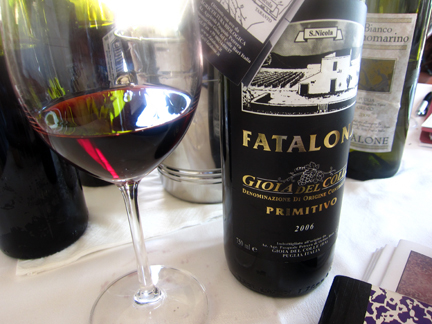
fatalone primitivo

From day one, my co-curator and bromance Rory Harrington and I have taken a very radical approach to the list at Sotto and we’ve never strayed from that course. We have always featured food-friendly wines that truly reflect the grapes with which they are made, the place where those grapes are grown, and the people who grow them.

But like a tree that falls in the forest when no one is there to hear it thump, our wine list wouldn’t have any meaning if guests didn’t enjoy our selections. More than two years into this project, I never stop being thrilled by watching someone taste an old Taurasi, Gaglioppo, or Gioia del Colle Primitivo for the first time. Of all the rewards that this experience has delivered, this has been the greatest by far.

I’m currently on paternity leave from my monthly visits to the restaurant. But I’ll be back again in September and we already have some interesting wine events lined up for the fall.

Thanks SO much to everyone for supporting me and the restaurant in this adventure. And thanks from the heart to Ms. Virbila for taking the time to enjoy the wines that we love so much…

Grignolino & bbq tomorrow @StilesSwitchBBQ @VinoVinoWine & please read @EricAsimov

stiles switch

Above: Barbecue from Stiles Switch in Austin. Image via Fed Man Walking, a blog authored by former Austin American-Statesman folklore and food columnist Mike Sutter. Click here for his review of the restaurant.

When I first moved to Austin at the end of 2008, there really weren’t a lot of great bbq options in town. You had to drive out to Driftwood (Salt Lick), down to Lockhart (Kreutz et alia), or up to Llano (the original Cooper’s) for the real deal (although Sam’s on East 12th was always good in a pinch).

Then, in 2011, the Austin bbq war happened. A number of new and highly competitive places opened, including the highly praised Franklin’s. The not-so-collegial conflict was punctuated by thieves stealing raw brisket from the local supermarket chain H-E-B by stuffing them in their pants.

Although Franklin’s remains the darling of the national media, Stiles Switch (on the north side of town) emerged as one of the winners of the conflagration and was recently voted one of the top 50 bbq destinations in Texas by Texas Monthly.

It’s where Tracie P and I get our bbq and it’s also where my client Vino Vino will be hosting a dinner tomorrow night with the wines of Marchesi Incisa della Rocchetta — Grignolino and Barbera. $35 for bbq and Grignolino sounds pretty good to me

Tomorrow afternoon, Vino Vino will also be hosting its annual rosé wine festival, Pink Fest, one of the best wine events in town.

I’ll be at both happenings. Come out and taste with me if you’re in town!

In other news…

Please read Eric the Red’s EXCELLENT article today in the Times, “If Only the Grapes Were the Whole Story.”

“Think of wine as food,” he writes. “Concerns about where food comes from and how it’s grown, processed or raised ought to be extended to wine. If we ourselves don’t set standards for quality and authenticity, who will?”

Buon weekend e buona lettura, yall!

Confessions of a Natural wine addict (all is fair in love)

“A writer takes his pen and writes the words again/all is fair in love.”
—Stevie Wonder

dettori bianco

Above: Four of six bottles of Dettori 2010 Romangia Bianco have been fizzy and slightly sweet.

Dettori Romangia Bianco, a skin-contact wine from Sardinia made from 100% Vermentino grapes, is one of our all-time favorite wines.

Tracie P and I have a mini-vertical of the wine in our cellar and we buy a case of every new vintage to put down each year.

That’s just one of the reasons that I was so thrilled to see the wine finally make it to the Texas market (until now, I’ve bought the wine in California where I keep my cellar).

But the number-one reason was that we love drinking it.

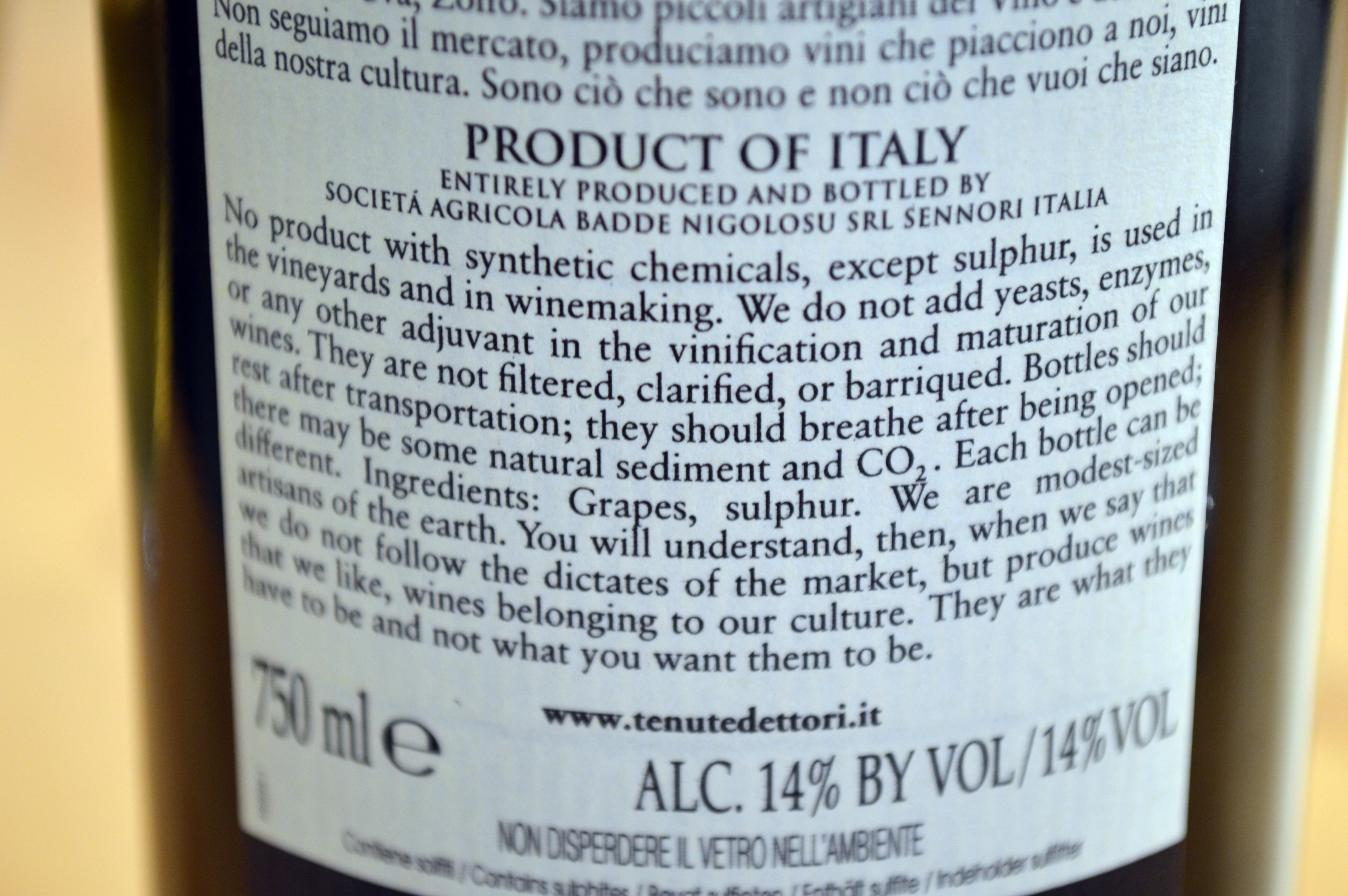
dettori back label

Above: The Dettori back label with a note on the winery’s approach to vinfication. Click image for high-resolution version.

I can’t imagine that anyone, even the greatest Natural wine skeptic or detractor, would deny that Dettori’s wines are Natural wines.

As Alessandro Dettori writes on the back of each bottle, the only ingredients are grapes and sulfur. And no enzymes or additives (he calls them adjuvants) are used in vinification.

In my experience, the wines can be radically different from vintage to vintage. But their intense tannic component seems to keep the wines relatively stable although never homogenous.

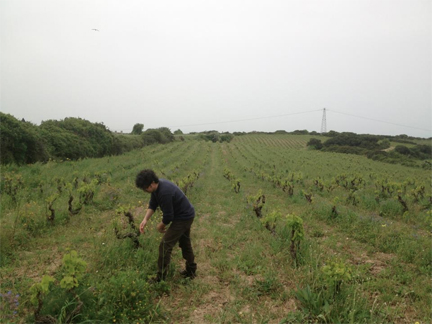
dettori vineyard

Above: Alessandro Dettori in his “oldest vineyard.” I’ve never been to the winery but my friend Georgios Hadjistylianou graciously let me use these photos from his recent visit there. Here’s the photo album. Thanks again Georgios!

I won’t conceal my disappointment when four (so far) of six bottles turned out to be fizzy and slightly sweet.

When the importer came through town and tasted the wine with me earlier this month, the 2010 seemed to align with my previous experience. It was tannic and rich, very youthful in its evolution. I couldn’t wait to buy some.

And when my local wine merchant told me he was holding the last six bottles for me, I hurried to the shop to pick them up.

But I’m sad to report that somewhere along the way — probably due to the extreme and often capricious Texas heat — the wine underwent a secondary fermentation in bottle.

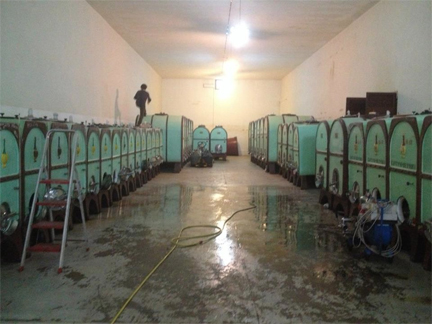
dettori cellar

Above: Cement vats at Dettori.

As Tracie P noted, they taste like vino paesano, the “country wine” that is often sold in demijohns in proletarian Italian wine shops. It’s fresh and bright, the alcohol and tannin are tame, the acidity is zinging, and the gentle spritz makes it even more food-friendly.

I’m a wine professional and am well aware that a flawed or corked bottle here and there are variables in the vinous equation. But four out of six bottles and counting could be grounds to ask for my money back.

But, no, I would never do that.

I’m a Natural wine addict and if nature — including the moody temperatures of my adoptive state — has delivered the wine in this condition, it’s my bitter sweet pill to swallow.

“We are artisans of the earth,” writes Alessandro on the back of his bottles. The wines are “what they have to be and not what you want them to be.”

We’ve been drinking the flawed but wholesome wine as an apertif and pairing it with early summer pesto and pasta al pomodoro. Not as cheap as a vino paesano but equally enjoyable.

It’s a wine that reminds us that all is fair in nature and in love…

Sergio Esposito acquires Biondi-Santi library in $5 million purchase (the blue chipization of wine)

sergio esposito italian wine

Esposito’s Italian Wine Merchants on 16th St. in Manhattan. Image via Google Places.

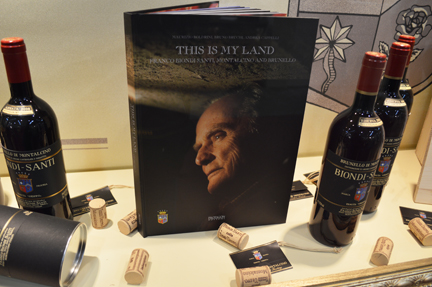
According to a press release issued last week by PRWeb, Italian wine merchant Sergio Esposito has purchased the Biondi-Santi library for $5 million.

The “7,000-bottle” archive stretches back to 1945.

A wine industry observer, who spoke to Esposito about the acquisition, told me that the winery’s owner Jacopo Biondi-Santi was facing financial pressures in the wake of business investments gone awry.

Jacopo is the son of Brunello patriarch and patrician Franco Biondi-Santi, who died less than two months ago at age 91.

The sale of the wine is significant because it is “the largest vertical collection sale in history of ‘blue chip’ Italian wines.” It also represents Esposito’s latest move in his quest to amass a behemoth-sized collection of investment-worthy Italian wines.

Esposito is the director of the Bottle Asset Funds, “a $50 million investment fund” founded in 2008 that invests in “‘blue chip’ wines in inefficient markets.”

franco biondi santi

Above: Brunello patriarch and patrician Franco Biondi-Santi died in early April 2013.

I worked as the media director at Esposito’s Italian Wine Merchants in Manhattan when it was still co-owned by celebrity chef Mario Batali and celebrity restaurateur Joe Bastianich, who pulled no punches in his brutal account of their business dealings.

In my view of the Italian wine world, the acquisition marks yet another milestone in the big-businessization of Italian wine.

Is that a good thing?

In the New Testament “Parable of the Talents,” the master praises his servants for investing well. No one can fault Esposito and his group of investment bankers for wanting to augment their business and increase their earnings.

But the moment a bottle of wine — the fruit of the vine — becomes a “blue chip,” it ceases to be an expression of a place and of the persons who tended that vine. It’s no longer the child of tradition and culture but a mere object to be traded among the world’s elite.

It’s the ultimate reification of agriculture. And the moment that we forget where that bottle comes from, we lose sight of the humanity that produced it. In that estrangement, we lose sight of ourselves.

eddy murphy trading places

Image via The Escapist.

What it means to be a Texan & remembering Melvin on Memorial Day

melvin croaker

Above: Melvin (above, right) taught me a lot about what it means to be a Texan.

Especially when I revisit the North American coasts where I used to reside, friends often ask me, so how do you like living in Texas?

When I tell them that I love living here, they sometimes respond with skepticism.

But you live in Austin! I love Austin. But that’s not really Texas.

To that, I answer quoting my cousin Jonathan Levy, a professor at Princeton and a native Houstonian.

“What a lot of people don’t realize,” he likes to say, “is that a lot of what they like about Austin is actually Texan.”

Great music? Texan.*

Barbecue? Texan.

Tex Mex? Texan.

Politeness, dignity, consideration, and humanity in personal interaction? Texan.

Continue reading

Ribolla just plain Ribolla & cafeteria penne al pomodoro

bastianich adriatico

My goodness! Tracie P and I have almost four cases of wine stacked up in our samples corner!

That’s not a bad thing: I’m always game to taste wines I’m unfamiliar with and always geeked to taste new vintages of wines that I know and follow.

Luckily for us, the Texas summer is already here and it’s too hot to ship wine. And we have plenty of bottles that I need to sort through and taste in coming months.

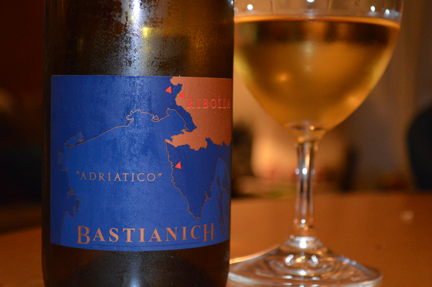
The other night we opened the Bastianich Adriatico Ribolla, sent to us by my friend Wayne who works as the Bastianich “special ops” man in Friuli.

Continue reading