Branchini Reno Pignoletto, great value and great wine from an appellation I’d never tasted

From the department of “just when you thought you knew everything about Italian wine, think again”…

best pignolettoWhile visiting my new restaurant client in Austin last night, Al Fico, I was thrilled to discover this super Pignoletto by Branchini from the Reno DOC, which lies northwest of Bologna overlapping the provinces of Bologna and Modena (check out the Google map screenshot below).

Most of the Pignoletto I’ve tasted this year comes from the Colli Bolognesi (southwest of Bologna), where I visited in June of this year for the first time.

It’s one of the most exciting appellations in Italian wine right now imho.

If the selection in the wine shop at Amerigo dal 1934 in Savigno in the heart of the Colli Bolognesi DOC is any indication, this designation is brimming with organic and biodynamic growers who are churning out super groovy, value-driven wine.

So when I saw the above Pignoletto on Al Fico’s list, I just had to order it and I assumed it would be from the Colli Bolognesi.

But when it arrived, I realized it’s from a DOC I’d never heard of before: Reno (here’s a link to a description of the DOC in Italian).

reno doc mapThis wine was fresh and bright on the nose and in the mouth it delivered surprising minerality and white fruit with a hint of citrus.

Gauging from the on-premise price, this wine is a fantastic value for the quality. I really loved it and if I can find it retail, it’s going to enter into rotation in the Parzen family’s “Monday through Thursday” wines (with an occasional appearance, I’m sure, on Sunday afternoons thanks to its restrained alcohol and lovely freshness).

al fico new italian restaurant austinO and Al Fico, you ask?

I’m kinda jazzed about the above photo I snapped of Chef Clinton Bertrand’s linguine al nero di seppia, which he tosses with cherrystone clams.

Pretty cool, right?

The restaurant’s still working out some of its kinks but both Chef Clinton and wine director Tom King have really been nailing it. I’ve only eaten there twice now but both meals have been spot on. The housemade pasta, in particular, has really impressed me, as has the ambitious all-Italian wine list.

The funniest thing is that Chef Clinton, an A16 alumnus, went to high school with Tracie P in Orange in southeast Texas!

It’s a small world, after all… but my wonderful world of Italian wine just keeps getting bigger and bigger.

Post scriptum: check out Alfonso’s excellent post in which he reflects on that expanding universe of Italian wine in the U.S.

Boulder, mon amour! Thank you! And my new career as a culture wars blogger

boulder wine merchant franciacortaI’m kinda getting blue as my year-long project blogging about and pouring Franciacorta wines as the Franciacorta Consortium trade ambassador for the U.S. comes to its end.

Just one more tasting (Seattle) and a few more weeks of blogging to go. But, man, what a way to go out!

That was my tasting (above) at the Boulder Wine Merchant on Wednesday, where the store now carries four skus from Franciacorta (previously none).

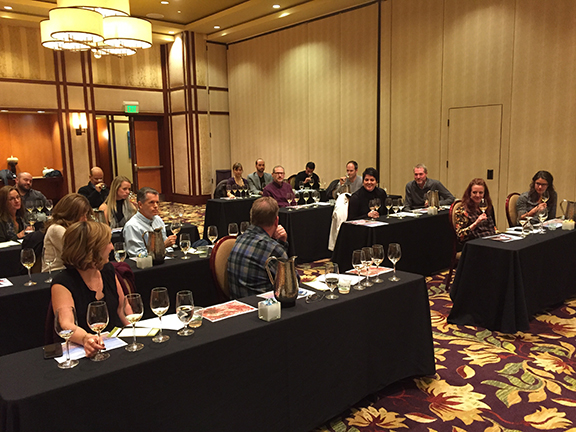
And yesterday, I led a seminar and tasting of 11 wines (below) for one of the most engaging and enthusiastic groups I’ve encountered all year.

st julien hotel conference event roomI’ll never forget the moment when my good friend, Master Sommelier and Boulder Wine Merchant owner Brett Zimmerman, talked to our group about how he feels that Franciacorta is going to be one of the next big things in the U.S.

It was a truly magical moment for me: in part because I love these wines so much and in part because I’ve put some real blood, sweat, and tears into this campaign this year (more blood and tears than I had imagined).

And dulcis in fundo, Master Sommelier Bobby Stuckey is about to add a Franciacorta by-the-glass to his stellar list at Frasca, one of me and Tracie P’s favorite restaurants in the world.

It’s really too bad that the project has to come to an end. Mishegas aside, I’ve really enjoyed it.

tuna crudo frascaThe food and wine community and culture in Boulder are among the most sophisticated and engaged in the U.S. today in my experience.

That’s the tuna crudo at Frasca (above) btw. Can you think of a better pairing for Franciacorta?

It was remarkable to interact with the team members at the Boulder Wine Merchant and Frasca over these two days that I’ve been working here. I can’t think of anywhere else in the country where young people are more excited about enogastronomy or more motivated to deliver the highest level of service.

Thank you, Boulder! You really made my year with your warm reception and your embrace of the wines I was showing. Thank you!

In other news…

In a first for me, I’ve been published in the Arts and Culture section of a major urban weekly.

Today, the Houston Press, where I usually blog about wine, published my recent post about my bizarre predilection for using women’s bathrooms in Houston.

I’m wedged in between a review of a “bodacious” cabaret performer and another of a locally produced opera.

My post on how so many Americans look down on Houstonians and this more recent post (which is actually about Houston’s horrific repeal of its equal rights ordinance) have had such an overwhelming response that I’m thinking of becoming a culture wars blogger.

That’s all the news that’s fit to print blog about. Now it’s time to get my ass on a plane in Denver and get back to the Parzen womenfolk down on the bayou where I belong. Thanks for reading and buon weekend a tutti!

Can you be Cannubi? A great post on how the subzone designations are applied in Barolo Cannubi

best barolo cannubiPosting from the road today in Boulder, Colorado, where I spoke at an in-store Franciacorta tasting yesterday at the Boulder Wine Merchant and where I’ll be leading a formal seminar and tasting of 11 Franciacorta wines today for trade and consumers.

But I just had to share this post by my new client in Piedmont, Tenuta Carretta: “The importance of being Cannubi (and its subzones).”

In it, the winery’s CEO (and my friend) Giovanni Minetti shares his insights into why it is virtually impossible to determine how many bottles of Cannubi and subzone-designated Cannubi are produced each year.

Alfonso had written a fantastic post on this very subject a few months back and now we’ve published Giovanni’s take on the situation.

Giovanni is a former president of the Barolo consortium and you might be surprised at what he had to share and say about the situation (one of the most hotly debated issues in Barolo today).

It’s a must-read for anyone trying to wrap their mind around Cannubi.

Check it out here.

Will “big” marijuana go the way of “big” wine?

This just in:

Please have a look at Alfonso’s provocative post on Franciacorta here.

Details for my Franciacorta tastings this week in Boulder (Weds. and Thurs.) here.

marijuana ohio ballotImage by Ryan Williams Photography.

When I read this New York Times article about a ballot measure in Ohio that would create a marijuana growing monopoly, it hit me like a brick of weed: will “big” marijuana in the U.S. go the way of “big” wine?

In the era following the repeal of Prohibition in 1933, the U.S. federal government basically told states that they could decide internally how they wanted to regulate the production, distribution, and sale of wine and alcohol.

Intended to hamper monopolistic and unfair business practices in our country, the Interstate Commerce Act (1887) would continue to apply to nearly every other commercial category. But alcohol would remain a matter for states to decide.

As a result, every state of the union has its own laws regulating the distribution and sale of alcohol.

More than 80 years after the end of Prohibition, this anti-system had led to the rise of virtual monopolies in many states. Just last month, a new merger of family-owned wine distribution companies in the U.S. created yet another behemoth among behemoths of wine sales. According to Tom Wark, a California-based marketer and wine blogger who has devoted much of his career to battling the forces of “big” wine in this country, “five companies (families) [now] control well over 50% of the alcohol box moving business in the United States.”

Today, as I write this, voters in Ohio are deciding whether or not to pass an amendment that was “bankrolled by wealthy investors [who have spent] nearly $25 million to put it on the ballot and sell it to voters. If it passes, they will have exclusive rights to growing commercial marijuana in Ohio” (New York Times).

The parallels are uncanny.

As more and more recreational marijuana comes online in this country, the wine and spirits industry has been paying close attention.

In September of this year, Republic National Distributing Company, one of the biggest distributors in the U.S., published a report on marijuana’s effect on wine sales in Colorado (recreational marijuana became legal there on January 1, 2014).

According to the author of the study, marijuana sales have had a positive effect on wine sales.

Republic (as it is known in the trade) isn’t the only “big” wine company to look carefully at marijuana sales. I know of least one other major U.S. wine and spirits distributor who has received state funding for marijuana sales feasibility studies (you might be surprised by the state government that funded the research but that’s a story for another day).

Currently, marijuana is completely legal in Alaska, Colorado, Oregon, and Washington. Today, Ohio could become the fifth state to legalize marijuana and at least six other states — including California — are considering legislative paths to legalization.

However you feel about the issue, there’s no getting around the fact that marijuana prohibition is rapidly coming to an end in our country.

When Prohibition was repealed in 1933, Americans were still a long way from the current fine wine culture.

During Prohibition, wine and spirits were produced and sold legally in the U.S. as tonics, in other words, medicine — another uncanny parallel with historic marijuana in this country.

In the more than 80 years since the end of Prohibition, the wine and spirits industry has grown into a major force in the luxury product industry. It’s possible — and in my view likely — that marijuana will follow the same path.

Will “big” wine be the model for “big” weed? We’ll see…

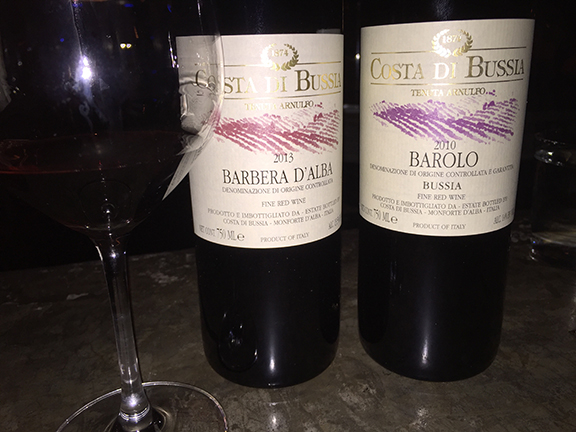
Costa di Bussia, a sleeper Barolo and a child-of-a-lesser-god Barbera

costa di bussia baroloNearly every week, I get an email from an importer, export manager, or publicist asking me if I can meet and taste with a traveling sales rep from Italy who will be visiting Texas. I try to accommodate as many as I can when my schedule aligns with the rep’s and I always try to post my notes somewhere.

After all, even though there are those who have proclaimed that wine blogging is dead, the rest of us regular punters continue to slog through the workaday toil of posting our tasting notes.

In the spirit of such resilience, I’m happy to report that the 2010 Barolo by Costa di Bussia (above, rigth) was showing gorgeously the other night when I tasted it with a rep who insisted that we meet at 10 p.m. (because that was the only time convenient for him).

Honestly, I’d never tasted the wines before and was super geeked to discover that they were old-school (almost) all-the-way.

Costa di Bussia (literally, Bussia slope) lies, as you can probably imagine, in Monforte d’Alba, a literal stone’s throw from Aldo Conterno’s famous rows in Bussia (which is pronounced boos-SEE-ah, btw). This is Serravallian Nebbiolo, austere and umami-driven.

The wines are aged in large-format cask: this is the Nebbiolo that I’m looking for, in part because the earthy style appeals to me; in part because at around $50 a bottle (at least according to what I can see on WineSearcher.com) makes the wine accessible to me.

The wine is very young and still very tight but I thought it was great and it will make for a fantastic wine to enjoy readily in another five years or so.

The Barolo was a winner in my book but the traditional-style Barbera was a champion. This is the Barbera that Tracie P and I crave: zinging acidity, brilliant fruit, restrained alcohol. I really, really loved this wine and although I can’t find any pricing on it, I image that it weighs in for less than $25 — ideal for a Saturday night wine at our house (at around $50, the Barolo is a nicely priced special occasion wine at the Parzen household).

The only disappointment was the winery’s “important” Barbera, which, as you can imagine, is aged in barriques. It’s perfectly understandable that wineries like this continue to make “modern” style, “big” Barbera. After all, many fat markets, like the U.S. and Germany, for example, love these wines. Very well made wine and very focused in terms of its raisin d’être (excuse the pun). But not for me. These wines, with their restrained acidity, always taste flat to me and lack in varietal expression. But I can see the appeal for drinkers and the allure for producers.

Whenever a rep tells me that this is our “important” Barbera, it makes me think that the “other” Barbera must be a child of a lesser god. Almost invariably, I like the “unimportant” wine more.

So there you have it. Another wine blog post by a lesser, average punter wine blogger who happens to like logging, slogging, and sharing his tasting notes.

Bitter pills: a note on recent coverage of Franciacorta by Alice and Walter

From the department of “all views expressed here are my own”…

walter speller franciacortaAbove: Lake Iseo in the heart of Franciacorta (Brescia province, Lombardy).

As a freelance contractor working for the Franciacorta consortium and as the author of its English-language blog, it would have been counterproductive for me to ignore recently published coverage of the appellation by two high-profile wine writers who leveled stinging criticism at its members.

It wasn’t easy for me to write a post about their articles. But my silence would have run counter to the spirit of my work.

*****

When the Franciacorta Consortium first asked me to take on this year-long project, I decided to call it “Franciacorta: The Real Story.”

I was so tired of seeing so much misinformed coverage of the appellation and the wines that I set out to tell the real story of the place, the people, and the wines as I have come to know them over the seven years since my first trip to Franciacorta in September 2008.

With the title “real story” comes the obligation and the responsibility to tell the whole story.

Click here to continue reading…

WINE CLUB ALERT: Do Bianchi HOLIDAY SIX-PACK is LIVE!

Drink what Tracie P and I will be drinking for Thanksgiving this year.crivelli ruche castagnole monferratoAbove: the Crivelli Ruché (different vintage) is one of the wines I selected for this year’s holiday six-pack. Italian wine lovers will geek out on it and the non-Italophilic folks will be surprised by its freshness and unique character. Such a great wine.

Do Bianchi Holiday Six-Pack 2015

Struzziero 2014 Falanghina (white)
Nanfro 2013 Insolia (white)
Caprari NV Lambrusco Colcer (red sparkling)
Carbone 2011 Aglianico del Vulture (red)
Crivelli 2014 Ruché (red)
Camossi NV Franciacorta Rosé (rosé sparkling)

$130 (including tax) plus shipping & handling
($22 average bottle price)

PLEASE CLICK HERE TO ORDER.

Wines will ship via FedEx on Monday of next week,
in plenty of time for delivery before the holiday.

California residents only.

I regret that I no longer accept AMEX.
But you can pay by Visa, MC, check (preferred) or Chase QuickPay.

Struzziero 2014 Falanghina

As always, I conceive and list the wines in my recommended pouring order as if for a dinner party for six persons. I’ve been loving everything I’ve tasted this year from the Struzziero winery in Taurasi and this Falanghina is fresh and bright in the glass, a perfect wine to get things started. My favorite pairings for this would be real buffalo-milk mozzarella (a classic) and olive-oil cured raw anchovies (my mouth just watered as I wrote this). One-word tasting note: sexy.
Continue reading

“We are here to serve the place”: Jean-Charles le Bault on the legacy of Corton-Charlemange

jeremy parzen wine blog“We are here to serve the place,” said winemaker Jean-Charles le Bault of Bonneau du Martray (above, far right) at a sold-out dinner celebrating his wines at Frasca on Saturday night.

On Sunday morning, before a sold-out crowd of more than 80 people at the Boulder Burgundy Festival, he talked at length about how he sees himself as just one the many “stewards” of Corton-Charlemagne, a cru and a hill that produces one of Burgundy’s most coveted wines.

He’s just one chapter, he explained, in a legacy that spans more than 1,200 years.

“I am just a small part” of the story, he told the rapt audience who tasted seven vintages of the wine: 2013, 2011, 2009, 2007, 2005, 2003, and 2001.

burgundy best bookWhat a thrill for me to share the podium with Jean-Charles (the sweetest man!) and friends and colleagues Ray Isle and Paul Wasserman!

In coming days, I’ll be posting notes from all the tastings and events (including the seminar with Jean-Charles) over on the festival blog.

Right now, Tracie P and I are just catching our breath and catching up with our girls, whom we’ve missed terribly over the long weekend.

Today’s a day for butterfly wings, tutus, and crayons… Corton-Charlemange will just have to wait.

best wine burgundy

Tracie P, beautiful wife and life partner, I love you…

jeremy parzen wife blogTracie P, you looked so lovely last night when we sat down for the Bonneau du Martray wine dinner at Frasca in Boulder (one of our favorite restaurants in the country).

At the end of a spectacular meal, I said to winemaker Jean-Charles le Bault that the only thing more wonderful than tasting a vertical flight of his Corton-Charlemagne was watching my wife enjoy the wines and sharing them with her.

One of the wines last night was the 2008. This morning, when I awoke next to you with the best kind of hangover (yes, there is such a hangover, as I’ve discovered since I met you), I thought about how that wine was harvested the same year that we met and came together.

best burgundy wine valueSo much has happened, has changed in our lives since you and I first commented on each other’s blogs back in the summer of 2008.

Our e-mance, our long-distance relationship, my move to Texas, our engagement, our marriage, our beautiful daughters, our business…

What a lucky and blessed man I am! I couldn’t have asked for more loving, gentle, and beautiful partner in life and in love.

At every step of the way, you have believed in me and supported me in my aspirations, hopes, and dreams as we have built a life and family together.

This long weekend at the Boulder Burgundy Festival marks the longest period (four nights) we’ve been away from our girls and alone together the way we were before they came into our lives.

It’s been fantastic to get away with you and to watch you draw that precious wine to your lips.

I love you…

Hubert Lignier 2000 Clos de la Roche, wow what a wine!

richebourgWhat a thrill for me to get to taste the above flight of “old and rare” Burgundy that Master Sommelier Jay Fletcher had selected from the Guild of Sommeliers for the Boulder Burgundy Festival 2015! Check out the wines and the vintages in the image below.

Even with such an embarrassment of riches, I still had some favorites in the line up: the Hubert Lignier 2000 Clos de la Roche and its layers of fruit and spice really blew me away.

Not much time to post this morning as I head out to yet another day of tastings and meals. Today starts with a “Paulée-inspired” lunch at the Flagstaff House and ends with dinner at Frasca and a vertical of Bonneau du Martray.

Stay tuned…

jay fletcher master sommelier aspen