Brunello, for better or worse (or how I learned to love the fruit bomb)

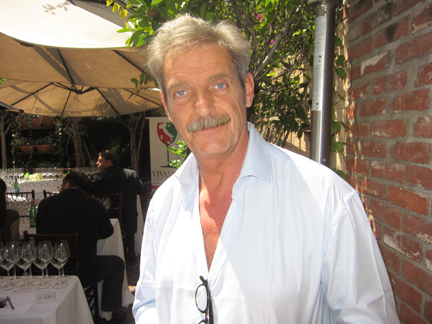
Above: I recently asked legendary Tuscan enologist Carlo Ferrini (and historic consultant at Casanova di Neri) what he considered his great contribution to Italian wine. “I took the traditional role of the Tuscan enologist from the cellar to the vineyard,” he told me.

My brother-in-arms and close friend flying winemaker Giovanni Arcari often asks rhetorically: “How many of the winemakers in Franciacorta actually make their living — their main source of income — from growing grapes and making wine?”

I’ve been thinking about Giovanni and his bleeding heart this morning after reading Alfonso’s superb post on Brunello di Montalcino wherein the latter applies his more than three decades of experience, observation, and wisdom to the situation on the ground in the ilcinese.

Even spanning back to Brunello’s ante litteram era, we discover that even for its founding father Biondi Santi, winemaking was not the primary source of income. In fact, Ferruccio Biondi Santi — Brunello’s nineteenth-century “inventor” — was the scion of a noble family with vast land holdings and immense financial resources. His ground-breaking experimentation in massal selection redefined the appellation. But, in turn, that appellation was defined by a handful of landowners who began to produce a “fine” as opposed to “table” wine following in his footsteps.

It wasn’t until the late 1970s that wealthy northern Italians began to buy property there (and they probably wouldn’t have seen Montalcino as such a choice spot had the British not planted roots there and “manicured” the Tuscan countryside, giving it its idyllic patina that we know today; just ask anyone old enough to remember the second world war what it was like in Montalcino from 1945 through the 1960s when the British began to arrive).
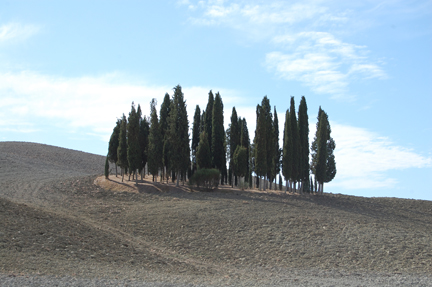
Above: Ask any ilcinese over 50 and they will tell you that it was the British who planted the cypress trees in Tuscany in the 1960s.

Today, just scan the names that define the arc of contemporary Montalcino winemaking: Soldera, an insurance magnate originally from the Veneto via Milan; Illy (Mastrojanni), a coffee mogul from Friuli; Parsons (Il Palazzone), U.S. CEO extraordinaire… and of course, Mariani (Banfi), one of the leading importers of fine wine in the U.S. who went to Montalcino in the hope of creating a sparkling wine legacy and ultimately turned Brunello di Montalcino into a super market brand.

Where there were less than 20 bottlers of Brunello in the 1960s, today there are more than 250 members of the Brunello bottlers association.

To Giacomo Neri’s credit — whether you like the style of wine or not — his family started out with humble farm that Giacomo took over when he returned from his mandatory military service. I know this because I met Giacomo for the first time in 1989 on my second visit to Montalcino, when his wines tasted a lot different from the way they do today. Since his collaboration with enologist Carlo Ferrini began in 1993, his Casanova di Neri label has become one of the most sought-after wines in the world, winning impossibly perfect scores from some of our country’s greatest wine writers (what do Nadia Comăneci, Bo Derek, Ann Colgin, and Giacomo Neri have in common? Hint: it’s not their good looks).

I recently met Carlo Ferrini for the first time in Los Angeles, where he and I spoke on a panel together. I asked him what he felt, over the arc of his career, was his greatest contribution to winemaking in Tuscany.

“Before I began working as a consulting enologist,” he said, “enologists were traditionally tasters.”

“Like Gambelli?” I asked.

“Yes,” he answered. “I was among the first to convince growers to replant their vineyards and to adopt more contemporary farming practices.”

And on the subject of Brunellogate?

“I’ve never believed that Merlot or any other grape should be added to Brunello,” he told me. “In Chianti, I’ve followed a Bordeaux model, using different grapes, grown in different sites, to create blends in line with modern tastes. In Montalcino, the wines have always been 100% Sangiovese. It’s my work in the vineyard that has made the difference. Not in the cellar.”

Whatever Ferrini claims and whatever we believe (and for the record, looking Ferrini in the eye, I believed him), the predominate and guiding style of Brunello has changed in Alfonso’s lifetime and my lifetime.

In the beginning, was the style of Brunello guided by a handful of wealthy families who saw big business opportunities in producing wines that could rival their French counterparts? Is it guided today by a small group of wealthy families who see financial opportunity (and tax-shelter vacation homes) in America’s thirst for wines in the global style?

The answer to these questions lies somewhere in between an alpha, an omega, and a brief window (1975-1993?) when Italy’s cultural prosperity delivered an optimism and fostered a belief that even luxury products should be the expression of the land where they were grown and the people who made them. It just so happens that that’s when Alfonso and I had our first contact with the wines.

If you following along here at Do Bianchi, you already know the Brunello that I like to drink (Il Poggione, Brunelli, Soldera are my top three, whether I can afford them or not). And there will be plenty of time to write and discuss the wines that we love at our house…

Instead, please read Alfonso’s post: The Battle for Brunello. I’m just adding my two cents here…

In other news…
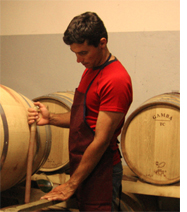
Today, Italian wine blogger Andrea Petrini, author of Percorsi di Vino, reposted this offer from Albana di Romagna producer Gabriele Succi (left): if you make a donation to one of the officially sanctioned channels for donations for Emilia-Romagna earthquake victims, you can send him a scan of the receipt via email and he will ship you the same value’s worth of his wine. He sweetens the deal by discounting each of his labels by Euro 1 ex cantina. He’s not giving a portion of proceeds to earthquake victims; he’s giving you the wine for donating.

Click here for the offer (in Italian) and links to official donation sites.
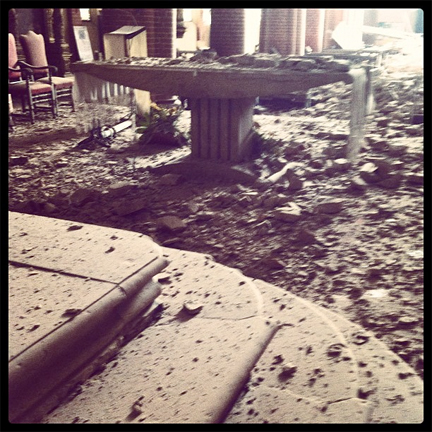
A second earthquake devastates Emilia (remembering the Emilian Renaissance)

Above: The Duomo in Mirandola had withstood the earthquake of May 20 but crumbled this morning in a 5.8 magnitude earthquake. Photo by Cris Provenzano via Instagram.

According to the reports I’ve been seeing this morning in the Italian news feed, there were at least 39 tremors in the region of Emilia this morning beginning at around 9 a.m. At 11:24 a.m., a 5.8 magnitude earthquake struck in the town of Mirandola (which lies at the center of a triangle formed by Ferrara, Modena, and Mantua).

The New York Times reports that at least eight persons died this morning. Thousands of people have been left homeless and scores of factories have collapsed or been closed because of structural damage.

Photo via AGI.it.

In an uncanny twist of fate, the township of Mirandola had planned a town hall meeting this evening with earthquake experts who had hoped to calm local residents (the Mirandola township has a great website, btw, an indication of the industriousness and uprightness of the people who live there).

Of all of Italy’s regions, Emilia and its beauty are perhaps the most challenging for foreigners to understand. Emilia is a land of intellectual and sensual pleasures and partly because it is not a producer of fine wine (aside from a few exceptions like La Stoppa in the province of Piacenza), most enogastronomic travelers tend to gloss over its cultural patrimony after they’ve dined at one of the regions many culinary meccas. (My favorites are Trattoria Bianca in Modena and Ristorante Canossa in Reggio Emilia.)

Whereas the Venetian and Florentine Renaissances produced iconic works of figurative art that continue to attract tides of tourists each year, the Emilia Renaissance delivered the great epic poems of the sixteenth century (think Ariosto and Tasso), wildly popular intellectual hits of their day but sadly forgotten in comparative literature curricula today in Anglophone countries.

To contemplate [historic] Humanism without one of its greatest voices, Giovanni Pico della Mirandola (whose family hailed from the town where the epicenter of today’s earthquake occurred) would be to disregard one of the greatest chapters in humankind’s intellectual development.

Our thoughts and prayers go out to the people of Emilia…

Parmigiano Reggiano producers selling earthquake-damaged cheese

Photo via ControLaCrisi.org.

According to a report by the Italian news agency ANSA, Parmgiano Reggiano producers lost up to 10% of their production in Sunday’s 6.0 magnitude earthquake in the Province of Ferrara.

Last night, I learned (via Facebook friend, Chiara Rich) that a number of the cheese makers are offering the damaged wheels to consumers at discounted prices.

According to a post by Arci Modena:

    the distribution can take place within 20-30 days without the cheese having problems… The following products can be ordered:

    – 14-month old in vacuum-packed pieces weighing 500 grams or 1 kilo at €11.5 per kilo.
    – 27-month old in vacuum-packed pieces weighing 500 grams or 1 kilo at €13 per kilo.
    – spreadable cream in 250 gram packages at €11 per kilo.

If you’ve never had fresh, creamy “spreadable” Parmigiano Reggiano, I can assure you that the airfare to Bologna and the short drive to Modena would be worth the price of admission and then some…

Click here for more info…

Why Restaurants Matter (the bourgeois social compact) @EatingOurWords

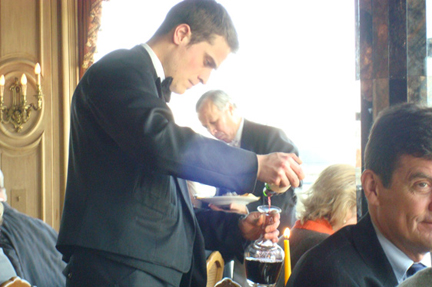
Above: I spent an obscene amount of money taking Tracie P out to dinner at the Tour d’Argent in Paris three years ago. But when you consider the fact that we still talk about it and how much fun we had, there’s no doubt that it was worth every penny — one of the most memorable meals of our lives. Here’s the link to my post on the lunch.

When I was an undergrad at U.C.L.A. in the late 1980s, my great uncle Ted, a Beverly Hills commercial developer (motels were his thing), loved to take me to his favorite “continental cuisine” dining spot. The only catch was that we had to finish dining by 6 p.m. so that we could take advantage of the “early bird special” (think beef Stroganoff and baked Napoleon). I’ll never forget his anxiety when the bill arrived: did the server already include the gratuity? did he charge us the correct amount? had he cheated us for a dish that didn’t arrive? I was too young at the time to drink legally but there was no way that uncle Ted was going to spend money on a bottle of wine. The prices for wine were “highway robbery,” I remember him saying to grandma Jean (his sister).

I loved uncle Ted a lot, especially for his humor and his loud snorts when we would eat at his favorite Chinese restaurant. “The mustard really helps to clear your sinuses,” he would say to my delight as he wiped the sweat from his brow.

He was from a generation that believed — across the board — that the restaurateur was going to try to swindle their patrons.

It’s important to remember that he was the child of people who never went to restaurants: he was born in the first decade of the twentieth-century in New York to Jews who had fled antisemitism in Austria (and the limited opportunities of their station in society). Even when they landed in the U.S., the thought of spending money in a restaurant was abhorrent in their view.

Today, the culinary landscape has changed drastically. When, in the late 1990s, our enogastronomic culture shifted from Julia Child and James Beard to Molto Mario, Lidia’s Italy, Kitchen Confidential, and Bobby Flay, our food “writers” and taste-makers had become themselves restaurateurs. And a new restaurant culture was born in our country: instead of being taught what we could make at home, they began to teach us how to make the dishes that they made in their restaurants. And they also opened a window on to the inner workings of restaurants.

For my generation (and for yours as well if you’re reading this), the thought of not going to restaurants would be abhorrent. Just contemplate what Sex and the City would have been without restaurants as a backdrop for the soap opera (where a diner was the backdrop for Seinfeld. a show that ended in 1998, the same year that Babbo opened).

This is just one of the reasons that I’ve been surprised and frankly upset by the reaction to my recent post on Corkage, a Privilege not a Right for the Houston Press.

Today, I followed up with a post on Why Restaurants Matter (and Why You Should Tip Generously). One of the things that occurred to me as I wrote it was that for the first time in history, the patrons and servers in the social compact of restaurateurship are social equals and intellectual peers. In other words, where the servers were once proletariat and the patrons bourgeoisie, today both are members of the bourgeoisie.

Here’s the link to the post, which includes some notes on how the Industrial Revolution shaped the restaurant experience as we know it today.

In other news…

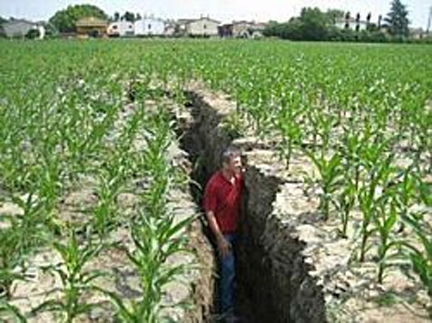
Our hearts and prayers go out to the victims of Sunday’s earthquake in Emilia-Romagna, which had its epicenter in Finale Emilia (above).

Here’s the NY Times coverage.

As I was looking around the internets this morning looking for information about the tragedy, I was reminded of the terrible 1976 earthquake in Friuli and I found this chilling YouTube video.

In it, a young man, who was taping a Pink Floyd album using a microphone, captures the terror of his family as they react to the shaking of the earth.

Radikon, my visit to Oslavia

Heading to Los Angeles today where I’ll be working the floor (introducing our summer wine list) at Sotto Wednesday and Thursday nights and speaking tomorrow on a panel at the Italian wine fair for consumers and trade, Viva Vino. LA is buzzing right now with the arrival of the group of winemakers from Oslavia (Friuli) led by the young Saša Radikon, whom I’ll be meeting tonight. So I thought I’d post my photos from my visit to the winery a few years ago. Look for Saša and the Oslavia producers at DomaineLA on Thursday.

The skin-contact Ribolla of Radikon first came to my attention in the late 1990s in New York in an era long before the terms “orange wine” or “natural wine” were in vogue. Stanislao Radikon (above with wife Suzana) was the first to experiment with skin-contact starting in the mid-90s. (I highly recommend this profile from the recent Raw Wine fair in London devoted to the Radikon family and story.)

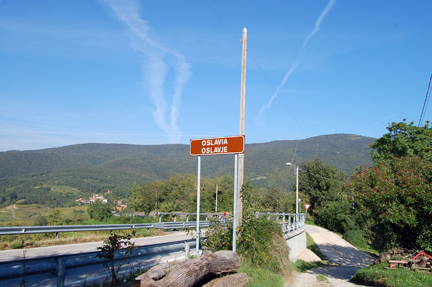
The village of Oslavia lies literally on the edge of the western world, just across the border from Slovenia in the province of Gorizia (in the Collio appellation).

One of the first things that Stanko (Stanislao) wanted to show me was the hill where then Colonel (later General) Badoglio fought the battle of Oslavia, one of the last and most bloody assaults of the First World War (just Google Badoglio and Oslavia to get a sense of the horror evoked by the toponym for a generation that came before us).

Today it is a place of immeasurable beauty, although many of the battle scars remain — topographical and emotional.

Stanko was perhaps the first to recognize the immense tannic potential of Ribolla (above), which, until that time, was used only to make light, white quaffing wine (in much of wine-making Friuli and Slovenia, it is still applied as such, although sparkling wine from Ribolla is becoming increasingly popular).

Stanko’s dense, cloudy, tannic, salty expressions of Ribolla changed the way the world viewed the variety and opened many’s eyes to the potential of “orange” (skin-contact) and “natural” wines ante litteram.

Open vat fermentation and extended skin contact are among the techniques applied to create Radikon’s long-lived, powerful, yet delicately nuanced bottlings of Ribolla.

Note the unexploded bomb from the First World War in the abandoned farmhouse where Stanko built his new cellar in 2002.

One of the things that impressed me the most was the contrast between ineffable rural beauty and the memory of carnage and senseless sacrifice that linger there. Stanko is a quietly intense man whose soulful winemaking is as much an expression of ideology as it is a pure and natural product of his land.

I’ll be meeting with Saša and his group tonight for dinner and I’m sure I’ll have much to report tomorrow… Stay tuned…

Lidia Bastianich, portrait of an Italian-American mother

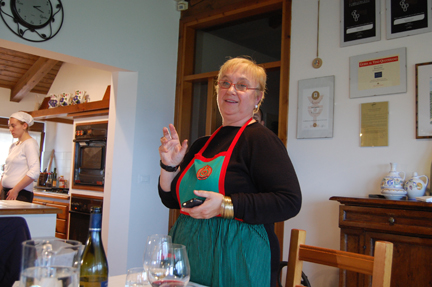
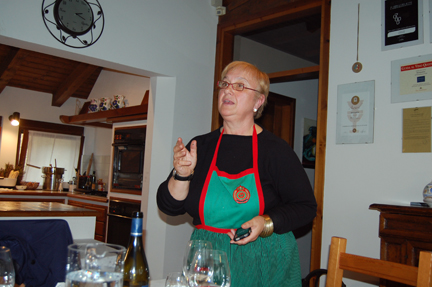
Preparations for Mother’s Day at our house got me thinking about one of the most famous Italian-American mothers, Lidia Bastianich. Here are some notes from a recent lunch hosted by her at the Bastianich summer home in Friuli for the Colli Orientali del Friuli blogger project.

It’s difficult to overestimate the impact that Lidia Bastianich has had on gastronomic culture in the United States and on the renaissance of Italian cuisine throughout the world.

She is to our generation what Julia Child and James Beard were to my mother’s generation (my mother was a James Beard devotee, for the record).

And to her credit, she has never wavered from her devotion to regional Italian cuisine. Long before “peasant” food (what an awful and despicable term!), “rustico” cuisine, or even “Northern vs. Southern” Italian cooking ever appeared in the American gastronomic lexicon, Lidia championed regional culinary traditions from Italy, first in the Croatian neighborhood in Queens where she and her family got their start and then later at Felidia in Manhattan (a restaurant where I used to regularly take my mother during the decade that I lived in New York).

In 1998 — the year that Babbo opened and the year that “regional Italian” became bywords of food culture in America — Lidia launched her first cooking show, “Lidia’s Italian-American Kitchen” on PBS. To this day, Tracie P’s Saturday morning ritual is not complete without watching a DVR’d episode.

I asked Lidia to share her thoughts about the renaissance of Italian gastronomy and her role in Italy’s culinary conquest of the U.S. palate and hedonist imagination.

Her response, I must say, surprised and inspired me.

“When you look at the great beauty of Italy,” she said. “It’s easy to understand why the Italians are such creative people. From the [historic] Renaissance to this day, Italians have made so many contributions to the arts and culture. It was only natural that Italian cooking would do the same.”

“I don’t know if I’ve been an architect of the Italian culinary renaissance as you put it,” she added graciously. “But when I am surrounded by this beauty and the goodness of the ingredients I find here, I know that I am inspired by them.”

Lidia also told me that she has been asked to be the madrina (i.e., the grand marshal) of the first-ever “Biennial of Cuisine” in Venice. I wasn’t surprised by this news: her celebrity and her contributions to the dissemination of Italian cuisine and culture in the U.S. is not lost on Italians — at least, gauging from my Italian colleagues and counterparts.

“But it’s really Joe [Bastianich, her son] who’s become a celebrity here,” she told me. His appearances on “MasterChef Italia” (the number-one rated show in Italy this year, I was told by a journalist at our luncheon) have made him a megawatt star there.

“Just the other day, we were stopped by school children in Venice who wanted his autograph,” she said.

Whether or not her celebrity is or will be eclipsed by her son’s is irrelevant, really. After all, if it weren’t for Lidia, there would be no Joe, would there?

As a proud new father myself, I couldn’t resist the urge to share a photo of Georgia P with Lidia.

“Don’t take this the wrong way,” she said, “but she’s a prettier version of you.”

Words only a mother could utter.

Di mamme, ce n’è una sola… You only have one mother…

Here’s a link to some photos of what Lidia made us for lunch that day.

Cuttlefish risotto and the “last taboo” of Italian gastronomy @TonyVallone @AldoFiordelli

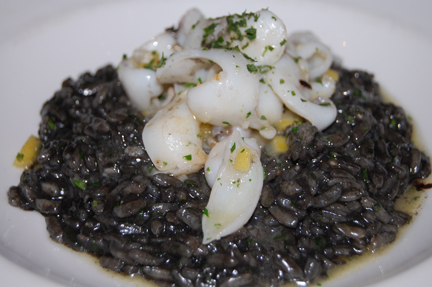
The Cuttlefish risotto at Ciao Bello in Houston the other night was so good that it nearly made me cry.

And it inspired a conversation about the “last taboo” of Italian gastronomy: the pairing of dairy and seafood.

I was at the restaurant doing a media dinner for my friend and client Tony Vallone, who shared the following anecdote about a luncheon in Naples a few years ago.

One of the guests, he said, an Italian-American, asked for grated Parimigiano Reggiano with his seafood pasta. The waiter politely responded that the restaurant didn’t serve cheese with seafood dishes. When the guest insisted, the waiter acquiesced, telling the patron that he would bring him the cheese. He disappeared, only to return after the gentleman had finished eating his pasta. “You see,” he said, “the dish didn’t need the cheese,” adding “in Italia si fa così,” this is how we do things in Italy.

The Italian taboo of mixing dairy and seafood stretches back to the Renaissance, when widely embraced Catholic customs required abstinence from dairy and meat on the numerous Lenten — di magro — days in the religious calendar. The bottom line: when seafood was consumed, dairy and meat were not. (I don’t have time to post about this today but this element of Renaissance cookery came to mind when I read Mark Bittman’s recent NY Times editorial on faux chicken; Renaissance cooks were obsessed with creating faux food, a gastronomic phenomenon that I called “culinary anamorphism” in a piece I wrote for Gastronomica some years ago.)

Of course, Tony’s cuttlefish risotto was made without the use of cheese (even though so many chefs in Italy and the U.S. discreetly fold some grated Parmigiano Reggiano into their seafood dishes). The secret to its creaminess? Tony had his chef caramelize and emulsify onions and then add them a few moments before the rice (Carnaroli) had cooked through. The viscous liquid gave the dish the all’onda texture that Tony likes in his risotto (whether sea- or landfood).

And it seems that we weren’t the only ones thinking about the “last taboo” of Italian gastronomy this week.

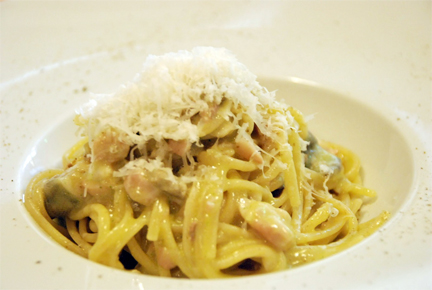
Today, Aldo Fiordelli, one of my favorite Italian-language food and wine bloggers and writers, posted this photo of “Linguine limone sgombro capperi essicati e parmigiano vacche rosse di Cristiano Tomei dell’Imbuto di Viareggio” (linguine tossed with lemon, mackerel, dried capers, and Red Cow Parmigiano Reggiano by Cristiano Tomei at the restaurant Imbuto in Viareggio).

Aldo notes that more and more Italian chefs are taking the bold step of using cheese in their seafood dishes, calling it their “last prejudice.”

Tony always says that for Italian cuisine to be authentic, it must also be creative. But I don’t think he would ever serve a dish like the one described by Aldo.

But hey, when in Viareggio, why not take a walk on the wildside?

Venetian Origins of Mardi Gras

Did you know that the condom was invented in Renaissance Venice, then the European prostitution capital, to stop the spread of syphilis that the Conquistadores brought back with them from the New World?

My post today for the Houston Press on the Venetian origins of Mardi Gras.

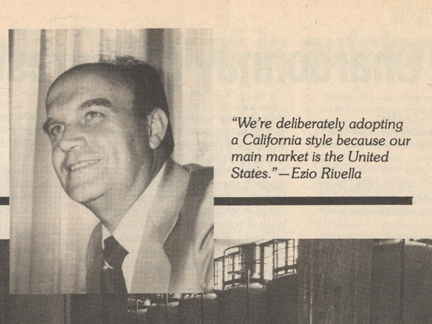
Ezio Rivella: “Tradition is a ball and chain.”

Above: Remember this image? Scanned from a 1982 edition of Wine Spectator (via Alfonso). I posted about it here.

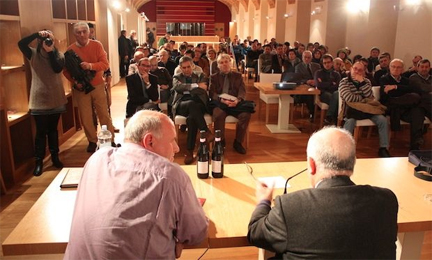
On Monday, Ezio Rivella — Brunello’s deus ex machina and futurist of Italian wine, creator of the Brunello brand and propagator of the California dream — spoke before a group of Langa’s top winemakers in Piedmont. He had been invited their by the government-funded body Strada del Barolo (Barolo Wine Roads) to speak about the current crisis in Italian wine (the five-part series is entitled — and I’m not kidding here — “Feel Sorry for Yourself or React to the Crisis?”).

According to wine blogger Alessandro Morichetti, who attended the seminar, nearly the entire arc of Barolo was there: Maria Teresa Mascarello, Giuseppe Rinaldi, Angelo Gaja, Enzo and Oreste Brezza, Cristina Oddero, Federico Scarzello, Lorenzo Tablino, Eleonora Barale, Davide Rosso, Enrico Scavino, and Michele Chiarlo, among others.

I’ve translated the following quotes from Alessandro’s report on the talk…

“Tradition is a ball and chain. At best, it serves as historical anchor.”

“The market fluctuations following Brunellogate? Rants by masturbating journalists.”

“Quality is what people like. Those who sell [their products] are right. There is nothing to learn from people who[se products] don’t sell.”

“Blogs are [a form of] self-flattery. The people behind them are incompetent.”

And all this time, I thought that Rivella didn’t read blogs! Go figure!

Reacting to Alessandro’s account of the event, Italy’s top wine blogger Franco Ziliani wrote: “Rivella chooses the path of insults…”

If you don’t know the backstory, here’s the thread of my posts devoted to Rivella and his self-appointed mission to refashion authentic Italian wines as expressions of Californian winemaking for the U.S. market.

As a manager and winemaker at Banfi from the 1960s through the 1990s, he credited Robert Mondavi as one of the inspirations for the behemoth Brunello brand that he created with the backing of the Mariani family, the Long Island-based importers who decided nearly 50 years ago that they would make Montalcino a household name in the U.S. (initially by producing sparkling white wine, btw).

Since returning to Montalcino to gerrymander his second coming as Brunello growers association president in 2010, he has patently conceded that “80% of Brunello was not pure Sangiovese” (an egregious transgression of appellation regulations and Italian law). And in doing so, he tacitly expressed his support for using “improvement” grapes like Merlot in traditional Italian wines made historically with indigenous varieties. He has repeatedly attempted, unsuccessfully, to lobby for the passage new appellation regulations that would allow for the blending of international grape varieties in Brunello and Rosso di Montalcino. Twice he has called votes and both times the body governed by him has remained unswayed by his industrial Brunello complex.

My friends who live and work in Montalcino tell me that he doesn’t even reside there. He lives full time in Rome, governing from afar, uninterested in the workaday lives of the homegrown montalcinesi.

He is also the author of Brunello, Montalcino and I: The Prince of Wines’ True Story (2010).

What will come of the legacy of the self-proclaimed Prince of Brunello?

Perhaps he should take the advice of a Tuscan, Niccolò Machiavelli, who wrote (chapter 3, “On Mixed Principalities”): “It is quite natural and ordinary for a Prince to want to expand his rule, and when [Princes] do, if they can, they are praised and not blamed. But when they are unsuccessful, but still want to do it, here lies the error and the fault.”

An acre of Prosecco worth more than Napa (equal time for the Prosecco consortium)

Above: I took this photo a few years ago on one of the highest peaks in Cartizze, the top growing zone for Prosecco.

According to Bloomberg.com (March 7, 2010), in California’s Napa Valley, “average prices are $150,000 to $200,000 an acre for a vineyard planted with red varietals such as Cabernet Sauvignon and $115,000 an acre for white grapes such as Chardonnay… The most desirable sites in Rutherford and Oakville can fetch $250,000 an acre.”

And that was in 2010 at the peak of the financial crisis (the title of the article is “Vineyard Defaults Surge as Lost Land Values Undermine Napa Wine”).

When I visited Cartizze in April 2009 with the scion of one Prosecco’s leading and oldest families, who owns more acreage in Cartizze — the top growing zone for Prosecco — than any other, he told me that the average price of an acre in Cartizze is greater than in Napa. And frankly, he would know: his family’s holding in Cartizze is the cornerstone of its winery and the wines produced from fruit grown there are among the highest priced Prosecco bottlings on the market today.

Whether accurate or not, these factoids give you a sense of the “big business” interests that have come to dominate the cultural and topographic landscape of Conegliano-Valdobbiadene — one of the most beautiful swaths of wine country and one of my favorite places in the world because of my deep connection to the land, people, and wines of Prosecco.

In the wake of last week’s post “Prosecco, lies, and videotape: the real story behind the new wave Prosecco,” I was contacted by public relations firm representing the consortium of Conegliano Valdobbiadene Prosecco superiore DOCG growers and bottlers.

“We don’t agree with your position and we would like to explain to you why,” wrote the publcist. I wrote her back immediately and she set up a call between me and the consortium’s director, Giancarlo Vettorello (above, photo via Oggi a New York).

When we spoke the next morning, Giancarlo took issue with what I had written about the Prosecco DOCG:

    This DOCG was just one of many that were created before Common Market Organization reforms went into in 2009, shifting the power to create new designations from Rome to Brussels. It’s one of the many examples of political spoils that [then agriculture minister] Zaia lavished on his hometown…

“Does a humble wine like Prosecco — and by its very nature, Prosecco should be a humble wine — deserve to be elevated to the status of wines like Barolo and Brunello di Montalcino?” I asked paraphrasing a chorus of Italian wine writers who wrote disapprovingly of the new classification at the time (2009).

Giancarlo contended that while the origins of Prosecco may be humble, it has become one of the world’s most “recognizable wines” and is sold today in mind-boggling volume.

He also pointed out that the Centro di ricerca per la viticoltura (Center for Viticultural Research) was founded in Conegliano — Prosecco’s historic epicenter — in 1923, an innovative and ground-breaking institution and a leader in enology that predates the emergence of the sparkling wine industry in Franciacorta, Trentino, and Oltrepò Pavese. In particular, he noted, Professor Tullio De Rosa, who came to the center in 1966, developed techniques for the vinification of white and sparkling wines that reshaped Italian viticulture for the generation that followed (it’s also worth noting the pantheon of Italian wine luminaries who worked at the center, like Michele Giusti, Giovanni Dalmasso, and Luigi Manzoni).

In all fairness, he has a point. Prosecco is one of Italy’s leading brands and exports — like Campari, Perugina, Barilla, De Cecco. And in a relatively short arc of time, the architects of its success have created an interest and awareness of the brand that was unimaginable in the late 1990s when they began to market Prosecco aggressively to U.S. consumers. I think it’s safe to say that U.S. consumers are more likely to know the name of two Prosecco producers than they are to know the names of two wineries in Chianti (a brand that emerged three centuries ago).

Giancarlo was one of those architects. “I worked for fifteen years,” he said, “for the creation of the Prosecco superiore DOCG.”

Well, more power to him, I say. I was happy to share his point of view here and I appreciate that his office reached out to me.

Me? I’ll leave the Prosecco brand to the powers that be.

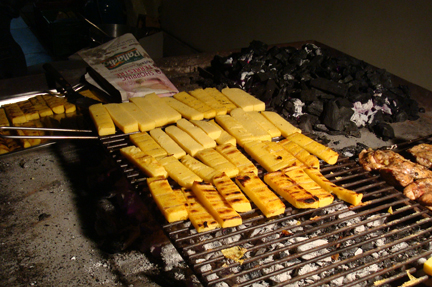
Just give me some grilled polenta, maybe some grilled sausage or bacalà, and do prosechi colfondo — two glasses of salty, crunchy, cloudy lees-aged Prosecco… one for me and one for Tracie P