Produttori del Barbaresco 89 (and Mafioso)

Every once in a while you come across one of those truly special bottles, like this 1989 classic Barbaresco by Produttori del Barbaresco,* at a price you can afford. I found it the other day in a wine shop in San Antonio (where I’ve been spending a lot of time these days) and although it gently pushed the envelope of my pricepoint ceiling (sorry for the mixed metaphors), I just couldn’t resist.

The 1989 harvest in Langa was one of the greatest in contemporary memory and I’ve had the great fortune to taste a lot of Nebbiolo from both 1989 (a classic, slow-ripening vintage) and 1990 (also a classic, but with slightly warmer temperatures). This gorgeous wine is still very young: the nobility of its tannin and earthy flavors were adorned by delicate notes of berry and red stone fruit, the way Laura’s noble, alpine beauty is dressed by her golden hair and her delicate veil as she sits by the stream in Petrarch’s songs.

Many would fetishize a wine like this but we always open them with food. After all, the people who made them intended them to be consumed with food.

At the urging of our friend Howard, Tracie B had Netflixed Alberto Lattuada’s 1962 social-commentary/thriller/comedy Mafioso, starring one of the all-time greatest Italian actors, Alberto Sordi.

Lattuada doesn’t make it as often into the syllabuses of Italian film studies in the U.S. as does, say, Pietro Germi (with 1960s classics like Sedotta e abbandonata), but he should. His Mafioso is 1960s social-commentary comedy at its best, at once poignant and hilarious, bridging the Messina Straits of the paradox of the country that never was — Italy. Alberto Sordi is a Sicilian who’s moved to the industrial north and has made a life for himself and his beautiful blond alpine wife. Lattuada’s camera follows him has he fulfills his peripeteia in a journey home to visit his family. The backdrop is the “economic miracle” of the 1960s in Italy, where the north flourished while the south continued to languish. I won’t spoil it for you but the final thriller scenes had us on the edge of our seats as we sipped the last drops of that gorgeous wine.

Here’s the great scene where Sordi’s character’s family welcomes him home with a classic Sicilian luncheon. Coppola ain’t got nothing on this baby!

* Many erroneously distinguish the “cru” or single-vineyard bottlings of Produttori del Barbaresco Barbaresco from the classic Barbaresco (made with fruit sourced from multiple vineyards) using the ignominious qualifier normale. Produttori del Barbaresco Barbaresco that has been made by blending wines sourced from different vineyards is classic Barbaresco or Barbaresco classico.
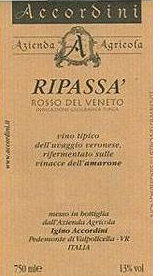
Another clarification on ripasso/ripassa

accordiniYesterday, I messaged the VinoWire group on Facebook, asking if anyone knew of a Valpolicella producer besides Zenato who used the term ripassa on its Valpolicella label. (Btw, if you’re not a member of the VinoWire FB group, please join!). Colleague, friend, and fellow blogger Tom Hyland weighed in with Accordini’s Ripassà (or Ripassa’ depending on whether your looking at the label or the winery’s website. Ripassa’ is a Veneto dialectal form of the Italian ripassato, literally passed again or refermented in this case. (I am reminded of Giacomo Leopardi’s famous observation that French is a language of terms while Italian is a language of paroles: like so many lemmae in the Italian lexicon, passare can assume a wide varieties of meanings depending on the context.) Thanks, Tom, for sharing the info and thanks also to Devon Broglie and Angelo Peretti who pointed out that Zenato’s “Ripassa” — without the accent grave or inverted comma — is indeed a trademarked proprietary name.

Has anyone tried the Accordini? Is it good?

In other news…

Just in the from the “unbelievable but true” department: Franco and James Suckling are in the midst of a cordial, collegial, and amiable exchange in a comment thread at James’s blog on the Wine Spectator site.

Here’s the link to the post and thread but since you have to subscribe (as I do) to view the blog, I’ve copied and pasted the exchange below.

User Name: James Suckling, Posted: 03:36 AM ET, May 28, 2009

    Guiseppe Mascarello & Figlio doesn’t send but we buy bottles normally for review. I find the wines very up and down. Some are amazing but others have flaws like volatile acidity.

User Name: Franco Ziliani, Italy Posted: 12:13 PM ET, May 29, 2009

    I know very well, and I’m a great fan, of Giuseppe (Mauro) Mascarello wines, but I confess that I don’t find any traces of “volatile acidity” that Mr. Suckling find…

User Name: James Suckling, Posted: 12:26 PM ET, May 29, 2009

    Franco. Some people have a high tolerance for VA. Have you ever been to their cellars? Anyway, it’s only been with a few wines. I generally like the wines as you do. Thanks for the comment.

User Name: Franco Ziliani, Italy Posted: 04:21 PM ET, May 29, 2009

    Mr. Suckling, apologies in advance for my poor English. I know very well the Giuseppe Mascarello cellars and I don’t think that is this kind of old, and very fresh in every season, cellar that create the problem of “volatile acidity” that you find in Giuseppe Mascarello wines. And I don’t think that a case of “high tolerance for VA” don’t allow me to find in Mascarello wines the “VA problem” that you find in few wines. Can you tell in what wines, Barolo, Barbera, Dolcetto (what vintages?) have you find VA “flaws like volatile acidity”? Thanks for your kind answer f.z.

We’ll have to wait for James’s next move!

Poetry for Sunday: my favorite Pasolini (and Orson Welles)

The embedded video below is one of my all-time favorite movie clips. It’s from an episodic movie called RoGoPaG (1963), to which Pasolini contributed the segment La Ricotta. In Pasolini’s segment, Orson Welles plays an American director making a movie about the life of Christ in Rome.* It is simply brilliant, on so many levels (I love the music and the dancing). It is rivaled only by the sequence where Welles recreates Pontormo’s Deposition in the Church of Santa Felicita in Florence.

In the clip, Orson Welles reads a poem by Pasolini, “I am a force of the past.” In thinking about culinary tradition, pizza paired with wine, and the recent censoring of “ethnic” food in Italy, I realize that the poem is actually and entirely topical (even more so when considered in the context of the entire Welles sequence).

I am a force of the Past.
My love lies only in tradition.

Here’s an as-of-yet unpublished translation by the Italian translator I admire most, my friend Stephen Sartarelli, who has also translated the Montalbano detective series. I wrote to Stephen who graciously shared his excellent rendering.

I am a force of the Past.
My love lies only in tradition.
I come from the ruins, the churches,
the altarpieces, the villages
abandoned in the Appennines or foothills
of the Alps where my brothers once lived.
I wander like a madman down the Tuscolana,
down the Appia like a dog without a master.
Or I see the twilights, the mornings
over Rome, the Ciociaria, the world,
as the first acts of Posthistory
to which I bear witness, for the privilege
of recording them from the outer edge
of some buried age. Monstrous is the man
born of a dead woman’s womb.
And I, a fetus now grown, roam about
more modern than any modern man,
in search of brothers no longer alive.

Io sono una forza del Passato.
Solo nella tradizione è il mio amore.
Vengo dai ruderi, dalle chiese,
dalle pale d’altare, dai borghi
abbandonati sugli Appennini o le Prealpi,
dove sono vissuti i fratelli.
Giro per la Tuscolana come un pazzo,
per l’Appia come un cane senza padrone.
O guardo i crepuscoli, le mattine
su Roma, sulla Ciociaria, sul mondo,
come i primi atti della Dopostoria,
cui io assisto, per privilegio d’anagrafe,
dall’orlo estremo di qualche età
sepolta. Mostruoso è chi è nato
dalle viscere di una donna morta.
E io, feto adulto, mi aggiro
più moderno di ogni moderno
a cercare fratelli che non sono più.

A little Sunday poetry. Thanks for reading…

Buona domenica a tutti…

* Pasolini was a deeply religious man and he made a beautiful film about the life of Christ, Il vangelo secondo matteo (The Gospel According to St. Matthew, 1964).

Eating tripe with Baron Ricasoli

Above: From left, Francesco Ricasoli and his father Bettino Ricasoli, the great-great-grandson of Iron Baron Bettino Ricasoli (in the oil on canvas), an architect of Italian unification, Italy’s second prime minister, and winemaker who reshaped the history of Tuscan winemaking by replanting the vineyards of his Castello di Brolio estate with Sangiovese.

As I write this, the world of Italian wine mourns the loss of Baron Bettino Ricasoli, the namesake and steward of one of Italy’s most illustrious winemaking families. He was 87 and his funeral is being held today in the church of the Santa Trinita in Florence (the name of the church is pronounced TREE-nee-tah, btw, with the tonic accent on the first syllable, because the Florentines use Latinate pronunciation in this and similar instances, e.g., Santa Felicita pronounced feh-LEE-chee-tah).

Above: The library at the Castello di Brolio.

Six years ago I went to visit Baron Bettino, who was one of the nicest, most generous, and most gracious hosts who has ever received me. I wanted to browse the library at the Brolio Castle and leaf through the reprinted, bound collection of his great-great-grandfather’s letters and thanks to my connections in the wine trade, I was able to contact him. I visited in January when the castle was closed and he traveled expressly that day from Florence to spend the day with me. He, personally, led me on a tour of his family’s castle and then let me spend the afternoon in the library there. It was an amazing and truly unforgettable experience.

His ancestor and namesake, the Iron Baron Bettino Ricasoli, reshaped the history of Italian winemaking when he replanted his vineyards “exclusively” with native Italian varieties in the second half of the 19th century. Franco and I have published my translation of the famous letter in which he describes his experiments and his decision to replant at VinoWire.

Many uninformed wine writers claim that the Iron Baron composed a “recipe” or “formula” for Chianti with exact percentages. This is simply not true. What he did do was to establish that fine wine could be made in Tuscany using native Italian grape varieties (viz., Sangiovese or Sangioveto, Canaiolo, and Malvasia). He replanted his estate with those varieties (inspiring other winemaking estates to abandon international varieties), and he developed techniques (modeled after what he had seen in Bordeaux) for stabilizing his wines and thus making them suitable for shipping. The culmination of his efforts and achievements was that Tuscany and a newly unified Italy established themselves for the first time as a world-class producer of fine wine that could be shipped beyond its borders.

Here are a few anecdotes from the day I spent with Baron Bettino…

We ate stewed tripe in the Florentine style at a wonderful little trattoria called Carlino d’Oro near the Brolio Castle. I highly recommend it.

He told me a story of how the Iron Baron decided to leave Florence after another man asked his fiancée to dance at a ball. Evidently, the Iron Baron was prone to jealously and so he swept his betrothed away to the Brolio Castle and began his studies on winemaking. In the end, it was a woman behind the first renaissance of Italian winemaking!

I sat at the edge of my seat as he told me about the German occupation of the castle in the last years of the second world war. The German soldiers used its turrets as mounts for their artillery and Baron Bettino was among the Allied soldiers when they liberated his family’s castle. Because he knew the terrain so well, he was able to help mount their attack. How cool is that?

It was thanks to Baron Ricasoli that I met Darrell Corti, who became an unwitting mentor to me. But that’s another story…

To be continued…

In other news…

I’m picking up the pieces after ten days on the road and ten different cities between wine, one fine woman, and song. Starting a week ago last Thursday, I have visited and eaten meals in San Francisco (twice), San Jose, Los Angeles, Austin, San Antonio, Dallas, Sedona (AZ), Jerome (AZ), Napa Valley, and Sonoma.

It’s good to be home where I belong and I have lots to post about so please stay tuned…

If you’re planning your vacation in Italy…

If you’re planning your vacation in Italy this summer, think about Abruzzo…

After breaking away from the phalanx of wine professionals with whom I was traveling on my last day at Vinitaly in April, I had the great fortune to taste with Abruzzo winemakers Sofia and Emidio Pepe. The next morning, the earthquake struck the region in the hours before dawn, taking the lives of nearly 300 people and leaving 28,000 homeless.

You may remember Eric’s post “Aftershocks” which appeared on The Pour in the days that followed the tragedy in L’Aquila. As Eric pointed out, even though the Abruzzo wine industry wasn’t affected directly by the earthquake, the long-term impact will be drastic because 10-50% of the wine produced there is sold and consumed locally.

Above: I have always loved Emidio Pepe’s Montepulicano d’Abruzzo, made in a totally natural style. “Emidio Pepe may be even more of purist than Valentini [another one of Italy’s iconic natural winemakers],” wrote Burton Anderson in his landmark book Vino. “He crushes his grapes by foot” and “possesses not a single piece of modern equipment in his rustic winery.” Drinking these stinky elegant wines is like listening to Thelonious Monk’s “Ugly Beauty.”

Abruzzo is a pristine region of immense natural beauty. Its hills are dotted with wonderful medieval villages where life was never contaminated by the industrial progress forged during fascism.

L’Aquila (where the epicenter hit) was so named (“the eagle”) by 13th-century emperor Frederick II of Swabia who was one of the greatest falconers of his time. Dante condemned Frederick to his Inferno for being an epicurean.

If you’re considering/planning a trip to Italy this summer, think about Abruzzo.

In other news…

You can find info for Nous Non Plus shows in San Francisco (tomorrow), San Jose (Friday), and Los Angeles (Saturday) here. Hope to see you at the shows. Tracie B will be Tracie B there too! (well, just in LA)

Double-take: Italy, Texas

From the “double-take” department…

Given my chronic case of Italophilia, “my new life Texana,” and my philological (and toponomastic) leanings, it was inevitable that sooner or later I would have to investigate and address the origins of the toponym Italy, Texas (the “two boots” of Italy and Texas, left, reside side-by-side on a shop-window on main street, right next to the Uptown Café in Italy, Texas). Tracie B and I stopped there yesterday on our way back from Dallas (where our dear friend Alfonso hosted us for dinner and opened a few truly unforgettable bottles — but you’ll have to wait for Tracie B’s post for more detail). Italy lies about 40 minutes south of Dallas along I-35 (which leads south from Dallas to Waco, Waco to Austin).

In his lectures and essays on memory, the contemporary Italian philosopher Remo Bodei loves to cite another noted homonymous place name in Texas — Paris, Texas, celebrated in film by the great director Wim Wenders. Why, he asks in his lecture “The Traumas of Memory,” have European emigrants named their settlements in the New World after their place of origin? “To create a transitional object? A soft landing in the flight from the known to the unknown? I believe that something analogous happens even in traumas connected to loss. In effect, monuments and burial rituals are carried out to remember and forget simultaneously. When objectified, pain hurts less.”

Above: The water tower in Italy, Texas.

As it turns out, Italy — locally pronounced IT-lee — was not named after its settlers’s country of origin but rather — at least, according to local legend — by a late-nineteenth-century post master who believed the climate of Texas was similar to Italy’s.

Above: The picturesque main street of Italy, Texas has remained virtually unchanged since the 1930s.

One of the reasons we wanted to stop there was to eat at the Uptown Café, an eatery called one of the “best small town Texas cafés” by Texas Monthly Magazine. But when we got there the proprietor, a very nice lady, told us “Ever’ Tom, Dick, and Harry dun’ came in here and ate everythang.” So we ended up eating at the Texas Best Smokehouse, the flagship restaurant and novelty store of a small, locally owned chain. They smoke their own jerky there (for all of their locations, I was told) and they also make pistachio pudding. The Texas Best Smokehouse is located on Dale Evans Dr., in turn named after one of Italy’s most famous daughters.

Above: I couldn’t resist the pistachio pudding, which is made — I believe — with Cool Whip, Jello mix, and pistachios. Metabolically, it was probably a bad decision, as was the bbq sausage sandwich. But, what the hay? You only live twice, right?

Double-meanings, paronomasia, puns, and — in this case — a homonymous place name, are the source of endless fascination for me. (One of these days, I’ll do a post on the origins of the place name California. I know of at least two towns in Italy named California.)

The other day, Franco sent a wonderful photo, snapped in the Alps, of the Italian and Texan flags flying together. As it turns out, there’s a little bit of Italy in Texas, too.

Call me crazy: white clam pizza and Nebbiolo

From the “life could be worse” department…

Above: Call me crazy but I paired cherry stone clam pizza and Nebbiolo the other day at Nonna in Dallas. It was delicious. The fruit in the 2005 Produttori del Barbaresco is showing beautifully right now and shows no signs of wanting to close up.

The San Diego Kid (that’s me, your resident wine cowboy) found himself in Dallas the other day, dusty and tired after a day of showing wine, with a six-pack of wine still slung around his back, his trusty companion Dinamite (the Silver Hyundai) beaten but not broken, and a bottle half-full of 2005 Produttori del Barbaresco still to be drunk. So he moseyed on over to the nearest saloon and parked his chaparreras at the bar at Nonna, where owner Julian Barsotti insisted he have the white pizza with cherry stone clams.

Above: Rock star owner and chef Julian Barsotti of Nonna makes some of the best pizza in Texas. He spent a season in Naples where he studied at the Associazione Verace Pizza Napoletana.

Julian opens the cherry stone clams first, reserves the juices, and then slowly wilts Vidalia onions with their juice and some cream until the onions literally melt and the cream and clam juice reduce to a thick sauce which he seasons with a mix of finely chopped herbs. Before firing the pizza in a wood-fired oven, he dresses the pizza with the clams, sauce, and a sprinkle of Parmigiano Reggiano. I’m still a big fan of his Margherita but the white clam pizza was the best I’ve ever had this side of New Haven, Connecticut.

The pairing was as decadent as it was delicious. In Italy, I still pair my pizza with beer (as tradition dictates) but here in the Wild West, crazy things can happen.

In other news…

I couldn’t be there this year (but I was last year): the first couple of Italian-American food and wine Michele and Charles Scicolone hosted their second “bygone wines” dinner in New York. Check out Eric’s post here.

In other other news…

Today (April 25) is Liberation Day in Italy, commemorating the partisans’s triumph over fascist and Nazi rule in 1945 (Milan and Turin were liberated on this day).

Angelo Gaja, please call me!

From the “just for fun” department…

I like to call him the Giuseppe Baretti of Italian wine writing: my friend and colleague Franco Ziliani (pictured above holding two bottles of would-be [wood-be] Nebbiolo by Giorgio Rivetti) is one of the Italian wine writers I admire most and the feathers he ruffles with his excellent blog, Vino al Vino, often belong to the princes and princesses of Italian wine.

He reminds me of yet another great Italian writer, a Renaissance master of satire, Pietro Aretino: if anyone deserved to borrow Aretino’s motto flagellum principum (flagellator or flogger of princes) it would be my dear friend Franco.

Franco recently posted the above photo together with a post in which he lampoons a Nebbiolo producer (well, should we call him that? his wines don’t really taste like Nebbiolo at all) who — for Franco and for me — represents everything that is wrong with the world of Italian wine today: Giorgio Rivetti is a “wine wizard” and master of marketing who created wines expressly for the American market with little consideration for the great tradition and great people of the place where he makes wine. (You may remember my post on the Spinetta Affair.)

Not long after he posted the photo and satire, he received a phone call from the “bishop of Barbaresco” (who, incidentally, had recently anointed his disciple Rivetti as a member of a putative “national team” of winemakers who will lead Italy into the world cup of the future). Evidently, messer Gaja has forgotten the meaning of irony and satire — notions and literary figures cherished by the ancients and rediscovered during the renewal of learning and then again in the age of enlightenment.

This week, my partner Alfonso Cevola (aka Starsky) and I had some fun with it: Angelo, please call me!

In other news…

Yesterday, Franco sent me this photo, snapped in Maroggia, at the foot of the alps in the Valtellina, where Nebbiolo finds one of its finest expressions.

I moved to Texas for one very special lady only to discover there’s a little bit of Texas in everyone… Thanks, Franco!

Labor amoris and a dedication

Above: This labor amoris is dedicated to the one I love.

The first exam I took at the University of Padua in 1988 was History of the Italian Language, with Professor Gianfranco Folena (1920-1992), one of the great linguists and philologists of the twentieth century. (The exam was on Parini’s Il giorno and 18th-century Italian neologisms.) He was the first to encourage me to continue my studies in philology and he wrote me the reference letter that ultimately won me my fellowship and teaching position in the graduate studies program at the Department of Italian, U.C.L.A.

Professor Folena was a delightful, gentle, and generous man, he loved to laugh, and he loved to remember how he sold turpentine for a living when he returned to civilian life from the concentration camp where he had been imprisoned (as a political undesirable) during the war.

I could never aspire to the greatness Professor Folena achieved while on this earth (nor have I suffered the way that he and his generation did). But I do think of him often and how his turpentine is my wine. I am so very fortunate to make a living doing something that I enjoy, a career that brings me into contact with interesting people and takes me to interesting places.

I hawk wine for a living because translating and writing a blog doesn’t pay the bills. But I have never abandoned my labor of love and I am very proud to share the news that my translation of Professor Gian Piero Brunetta’s The History of Italian Cinema has been published by Princeton University Press. Professor Brunetta still teaches at the University of Padua (where I also studied Italian cinema) and we both remembered Professor Folena fondly in our email correspondence on queries I had for him regarding the translation. The book arrived yesterday in the mail and is my third hard-cover university press translation.

I’d like to dedicate it to the woman I love, Tracie B.

you are more brilliant than Lina Wertmüller
more sexy than Stefania Sandrelli
and more beautiful than Monica Vitti in any frame by Michelangelo Antonioni

This labor amoris is for you…

Brunello, a peculiar form of wine writing, and Antonioni’s surface of the world

The mere exposure to the visible surface of the world will not arouse ideas unless the spectacle is approached with ideas ready to be stirred up.
—Rudolf Arnheim

For now we see through a glass, darkly…
Corinthians 13.12

Above: Alfonso took this Antonioni-inspired (Blow up?) photo of me while he and I were traveling in Italy last week with a group of wine professionals following the wine trade fairs, visiting wineries and tasting together. In reading the “signs” of the Brunello affair, I must employ my sensibilities as semiotician and see beyond the “surface of the world.”

Last Wednesday, two days after the conclusion of Vinitaly (Italy’s annual wine trade expo), the Italian daily La Nazione reported that 1) Biondi Santi and Col d’Orcia have been cleared of any wrong doing in the Siena prosecutor’s Brunello inquiry; 2) other wineries implicated in the investigation have declassified their wines and have reached agreements with the prosecutor, avoiding further action against them; 3) “preservation of evidence” hearings were to be held (on Friday) for Argiano, Frescobaldi, and Valdicava. (You can read my translation of the article at VinoWire.)

One of things that has kept many — or at least some — of us rapt in the imbroglio of the Brunello controversy has been the Sciascia-esque twists and turns it has taken. Even though Nino Calabrese, the Siena prosecutor, has never spoken directly about those implicated in the investigation (and although he has claimed to be “abstemious” when it comes to the media), he has used ciphered leaks and statements to the press to move his agenda along. He has never directly addressed the question of who was investigated but he did issue a statement in which he claimed that:

    Many of the companies implicated have violated the appellation regulations for Brunello di Montalcino DOCG and Rosso di Montalcino DOC… 6,500,000 liters of Brunello di Montalcino and 700,000 liters of Rosso di Montalcino were impounded. Roughly 1,100,000 liters of Brunello di Montalcino have been declassified to IGT Toscana Rosso. Roughly 450,000 liters of Rosso di Montalcino have been declassified to IGT Toscana Rosso.

The article published last Wednesday does not cite its source but it would appear that the information came from the prosecutor’s office.

There is certainly some significance to the fact that the prosecutor waited until the day after the conclusion of Vinitaly to release this information. It’s not clear to me why he has singled out Argiano, Frescobaldi, and Valdicava — especially when Argiano opted to declassify voluntarily shortly after news of the inquiry broke.

Calabrese claims to be “abstemious” when it comes to the media (what an apt word choice!) but beyond the surface, he has certainly indulged in a peculiar form of wine writing!