1970 Sassicaia (no, I didn’t drink it)

Above: One of the very few things I miss about living in New York City is the availability of good smoked fish and New York bagels. We get frozen H&H bagels at our local Central Market. Scrambled eggs and bagels and lox have become a happy Sunday habit.

Kermit is coming to town and I’m prepping today (following our now traditional late-morning breakfast of toasted H&H bagels, cream cheese salmon, thinly sliced tomatoes and red onion, salted capers, brined olives, and eggs scrambled with Parmigiano Reggiano and an onion soffritto, a casa della bellissima Tracie B) for my presentation of the wine-industry great and singer-songwriter tomorrow night at Vino Vino in Austin.

I’ve been rereading his most recent book, Inspiring Thirst, an anthology of his newsletters stretching back to the beginnings of his career in the wine industry in the early 1970s (the first newsletter in the collection is dated 1974). In many ways, the gathering of glosses and notes is an excellent primer on how to sell wine. I don’t think its unfair to say that Kermit essentially invented wine blogging with his “little propaganda pieces,” as he called them.

The corpus of his blurbs is also an amazing historical document with fresh tasting notes and observations on now-nearly-forgotten vintages, like his take on 1970 Sassicaia, penned in 1975:

    1970 Sassicaia

    Unlikely, perhaps, but here we have a very impressive Cabernet Sauvignon made in Italy. It shows a pronounced varietal nose, while the effect upon the palate is akin to Bordeaux, explained by the fact that the winemaker is French and is using Bordeaux barrels. Regardless, the wine is extremely well made; to my taste it compares easily with over-$8 California Cabernets. Highly recommended! $5.50 per bottle $59.40 per case

The first commercially released vintage of Sassicaia was 1968. Darrell Corti told me that he sold it at Corti Brothers in Sacramento for $6.99 (Kermit was selling it for more than 20% less!).

Kermit talks a lot about how the 1970s recession led a lot of importers to “advance” their inventory to him. “Pay me when you sell it,” they would tell him, and he would pass the excellent pricing on to his customers. His description of the economic climate sounds a lot like the situation today and his blueprint for selling (and marketing) wine is good advice for anyone involved in the wine industry today — on any level, be it importing, wholesale, on premise, or retail.

Tomorrow night Kermit, Ricky Fataar (his producer), and I will be talking about Kermit’s new record, Man’s Temptation (and the event is already sold out) but I hope to get a chance to ask him about Sassicaia at $5.50 a bottle. The wines sells for $599.00 a bottle today.

In other news…

The fall weather’s been fantastic here in Texas and the sunsets and the Texan sky are amazing, as always. I took this photo yesterday evening before Tracie B and I headed out for the night. Happy Sunday, ya’ll!

The “intense delicacy” of the last of the Mohicans in Texas

heredia

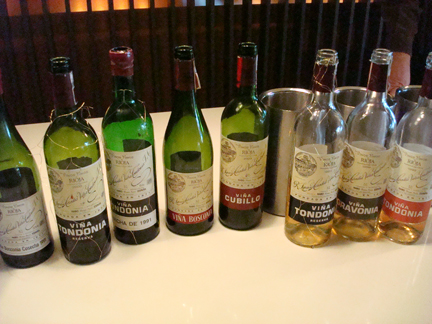
Tasting through the current releases of López de Heredia the other day in Austin made me feel like Big Joe Turner’s Mississippi bullfrog in “Flip, Flop, and Fly”: I’m like a Mississippi bullfrog sittin’ on a hollow stump/I got so many good bottles of wine, I don’t know which way to jump.

I was thrilled to see that the wines have returned to Texas, in the hands of a smaller distributor who seems to be treating the bottlings with the respect and care they deserve.

My friend Alice Feiring put it best when she wrote about the “intense delicacy” of these wines, using a Petrarchesque oxymoron. They are at once intensely aromatic and flavorful but show that unbearable lightness that I find so alluring in great wine.

Some of the most inspired prose in Alice’s The Battle for Wine and Love or How I Saved the World from Parkerization is devoted to the López de Heredia winery. But it was owner Maria José López de Heredia who called the winery the “last of the Mohicans”:

    When López de Heredia buckles — if ever — that style of wine is gone and cannot be replaced. I asked Maria José, “Are you sad about the way things are going right now?” Her answer shocked me. “Wine has been worse in Rioja. It’s not so bad now. There are good wines being made, but we are ‘the last of the Mohicans,'” she said, with tremendous pride. She actually liked being the last one.

I love the wines of López de Heredia and try to taste and enjoy them at any chance I get.

The 1989 Tondonia white was showing beautifully, even if it inspired a lively debate among the wine professionals gathered that day as to whether it was “off” or not. (“The release of a López de Herdia white,” writes Alice, “is always a love-it-or-hate-it affair. No matter what a drinker’s preferences, the wine always gets attention.”) I’ve tasted that wine maybe 10 times over the last year and I think that the bottle we tasted was right on.

I was also really impressed with the entry-level 2003 Cubillo (red), which showed uncommon grace for this wine. The 1991 Tondonia and Bosconia (reds) were simply stunning.

The wines won’t be an easy sell here in Texas (nor are they anywhere, for that matter). Their oxidative nature can be a turn-off for a lot of folks. But I’m so glad that they’ve returned to Texas. Tracie B and I will be drinking them for sure!

In other news…

Austin wine writer Wes Marshall reviewed Kermit’s CD today and previewed his listening party Monday November 9 here in town at Vino Vino (yours truly will be presenting Kermit and his producer Ricky Fataar). I haven’t been playing music professionally since Nous Non Plus’s last show in LA in May: I’ve been having a blast promoting this show and I love that feeling of filling a room. I hear there are just a few seats left! ;-)

Claude Lévi-Strauss and (not so natural) wine

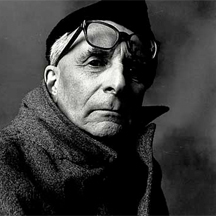
claudeReading over today’s obituary of that looming figure of the twentieth- (and twentieth-first-) century who seemed to watch over every discipline of critical theory, Claude Lévi-Strauss, I couldn’t help but apply my dusty knowledge of his structuralism to the hegemonic culture of wine today. After all, in some ways similar to Freud, Lévi-Strauss, who transpired over the weekend, will be remembered as much for his contribution to literary theory and epistemology as he is for his unapologetic transformation of the field of anthropology.

His fear of and subsequent predictions of a western behemoth “monoculture,” as it came to be known, have certainly taken shape in the evermore homologated contemporary world of wine today. The west, he wrote with words that seem to speak directly to the modern vs. traditional debate in European wine today, could destroy itself by “allowing itself to forget or destroy its own heritage.”

Lévi-Strauss wrote famously about wine: his treatment of the wine culture in southern France in his study The Elementary Structure of Kinship is often cited by scholars. (He also wrote about wine in The Origin of Table Manners.)

But wine, like bread, also held a special place in the lexicon of the great scholar and thinker. Like bread, wine represented for Lévi-Strauss a post-Neolithic technological transformation of the natural. Society (and the universal values that tie every expression of human experience together) is defined, according to Lévi-Strauss’s view, by a “rational” transformation of nature.

As Edward Rothstein wrote so ably in The New York Times today:

    Lévi-Strauss rejected Rousseau’s [historically romantic] idea that humankind’s problems derive from society’s distortions of nature. In Mr. Lévi-Strauss’s view, there is no alternative to such distortions. Each society must shape itself out of nature’s raw material, he believed, with law and reason as the essential tools.

Alas, we’ll never be able to ask Lévi-Strauss where he stands in the overarching dialectic of natural wine (and I can only imagine the ire this post will spark!). My own thought is that Lévi-Strauss and structuralism offer us a tool for understanding wine and its relationship to society. One can argue the finer points of ambient yeast, zero SO2, and minimal intervention vs. manipulation. But there is no denying that wine as an expression of society is shaped out of nature’s raw material by humankind — however minimal the intervention. Society by definition (and is there any wine that exists outside of society?) offers no alternative to the distortion of nature. Fermentation can occur spontaneously in nature. But the rational hand of humankind is what turns fermentation into wine.

What would Lévi-Strauss say? And who really cares? Probably no one but me.

What I can say for sure is that humankind has lost one of its greatest thinkers and one of the voices that helped to shape the very ideological dialectic from which the natural wine movement has culled its roots. If I only had a bottle of zero-SO2 Beaujolais for every night I spent cramming over the writings of Lévi-Strauss for my critical theory exams in grad school!

Lévi-Strauss, old man, you will be sorely missed…

Umami blogging (and Nebbiolo gone wild)

Above: I poured an awesome flight of Nebbiolo on Tuesday night at The Austin Wine Merchant for my class “The De Facto Cru System in Piedmont.”

They say that parenting blogs, so-called “mommy blogging,” are the most lucrative: evidently, folks who write about parenting have no troubles finding advertisers. Among wine bloggers, however, the term “mommy blogging” denotes a sub-genre of posts in which bloggers “write home to mom,” telling her all the great bottles that they have opened. Italian Wine Guy often accuses me of this and I must confess that my mom does read my blog (hi mom!).

Since I am about to indulge in some flagrant, unapologetic mommy blogging, I’d like to propose a new sub-genre of enoblogging for your consideration: “Umami Blogging.”

Umami is one of the “the five generally recognized basic tastes sensed by specialized receptor cells present on the human tongue” and in wine writing, we often use it to denote a class of “savory” descriptors.

Umami, meaty, brothy, savory flavors were on everyone’s palates Tuesday night when I poured 7 bottlings of Nebbiolo from Langa at my weekly Italian wine seminar at The Austin Wine Merchant. Man, what a flight of wines! The de facto cru system of Piedmont was the topic and participants tasted bottlings from the east and west sides of the Barolo-Alba road as well as a Barbaresco and a Langhe Nebbiolo sourced in Barbaresco, where many believe the proximity of the Tanaro river adds another dimension to the appellation’s macro-climate.

Highlights were as follows…

Bruno Giacosa 2001 Barolo Falletto

This wine, from a classic Langa vintage, showed stunningly on Tuesday. Still very tannic in its development but as it opened up over the course of the evening, it performed a symphony of earthy, mushroomy flavors. The Austin Wine Merchant is selling this wine at release price (RUN DON’T WALK).

Brovia 2004 Barolo Rocche

My first encounter with this vintage from traditional producer, Brovia, one of my favorites. Here wild berry fruit ultimately gave way to a wonderful eucalyptus note. The wine is still very tannic, of course, but was suprisingly approachable after just an hour of aeration. I loved the way the fruit and savory flavors played together like a meal in a glass. Great value for the quality of wine.

Marcarini 2005 Barolo Brunate

This wine had a bretty, barnyardy note on the nose that was a turn off for a lot of folks but guest sommelier June Rodil (the current top Texas sommelier title holder) and I really dug this wine, which weighs in at less than $60. I love the rough edges of this rustic style of Barolo and only wish that I had some bollito misto and mostarda to pair with its vegetal, sweaty horse flavors.

Produttori del Barbaresco 2005 Barbaresco

Tracie B, who joined at the end of the class, and I agreed that this wine is beginning to close up. It is entering a tannic phase of its development and its savoriness overpowers its fruit right now. That being said, it still represents the greatest value in Langa today, at under $40. If you read Do Bianchi, you know how much I love the wines of Produttori del Barbaresco: I would recommend opening this wine the morning of the dinner where you’d like to serve it. By the end of the night, the tannin had mellowed and the fruit began to emerge.

To reserve for my Wines of the Veneto class (Nov. 3, a seminar dear to my heart because of my personal connection to the Veneto) or my Italian Wine and Civilization Class (Nov. 10, my personal favorite), please call 512-499-0512‎. On Tuesday, Nov. 10, we’ll all head over to Trio after class for a glass of something great to celebrate. Thanks again, to everyone, for taking part and heartfelt thanks to The Austin Wine Merchant for giving me the opportunity to share my passion for Italian wines with Austin!

In other Nebbiolo news…

My buddy Mark Sayre is pouring Matteo Correggia 2006 Roero Nebbiolo by the glass at the Trio happy hour at the Four Seasons. European wine writers have been paying a lot of attention lately to the red wines of Roero (an appellation better known in this country for its aromatic white Arneis). There isn’t much red Roero available in the U.S. and I was thrilled to see this 100% Nebbiolo in the market. It’s showing beautifully right now and is my new favorite pairing for chef Todd’s fried pork belly — my compulsive obsession — a confit seasoned with the same ingredients used to make Coca Cola.

See, mom? You can sleep peacefully knowing that your son is drinking great Nebbiolo! ;-)

*****

Does anyone remember Tom Lehrer’s “So Long Mom, I’m Off To Drop a Bomb”?

Mr. Zaia goes to Washington (and lets Montalcino down)

smith1

It’s seems like it was just yesterday that I was posting a sigh of relief that the U.S. Alcohol, Tobacco, Tax, and Trade Bureau (TTB) was lifting its requirement of Italian government certification for Brunello di Montalcino imported to this country. Nearly every Italian news agency and feed (ANSA, Yahoo.it, etc.) had reposted agricultural minister Luca Zaia’s press release in which he announced — with cocksure nonchalance, I may add — that the requirement had been lifted following his successful meeting in Washington with TTB bureau head John Manfreda. Even Brunello producers association director Patrizio Cencioni issued a release praising minister Zaia and thanking him for a job well done. (You can read all of the press releases here.)

But it seems that minister Zaia was a little too quick to sing his own praises.

Late yesterday afternoon, another post hit the feed as the Italians were already sleeping: the TTB issued a press release in which stated plainly and clearly that the agricultural minister had falsely represented the agreement negotiated in the minister’s meeting with Manfreda last week. Despite claims otherwise, states the document, Italian government certification is still required. And it will continue to be required, according to the document, until the Italian government presents the Siena prosecutor’s final report on the investigation (the so-called “Operation Mixed Wine” inquiry into the suspected adulteration of Brunello and other Tuscan wines).

smith2

I spoke this morning to Brunello producer Fabrizio Bindocci of Il Poggione in Sant’Angelo in Colle and he told me that he and Il Poggione’s owner Leopoldo Franceschi were left dumbstruck when they read the news of the TTB’s clarification. “Maybe Zaia met with the doorman, not the TTB administrator,” Fabrizio wondered out loud with classic Tuscan wit. (Fabrizio’s son Alessandro has posted the entire series of press releases at his blog Montalcino Report.) “We feel that certification should be required and it should continue to be required,” said Fabrizio, whose wine has been certified by an independent Norwegian risk management firm since 2003, long before the controversy began.

smith3

In his post this morning, Franco published an image of Walt Disney’s Pinocchio and asked: “Just for the sake of clarity, can somebody — in Montalcino, Rome, or Treviso — help us to understand what’s going on?” (Minister Zaia hails from Treviso.) And making reference to Zaia’s bid to become governor of the Veneto (his home region), Franco asks rhetorically, “is it so hard to understand that it’s not possible and it makes no sense to run an electoral campaign in the Veneto using the supposed great success obtained in the [minister’s] campaign in Montalcino?”

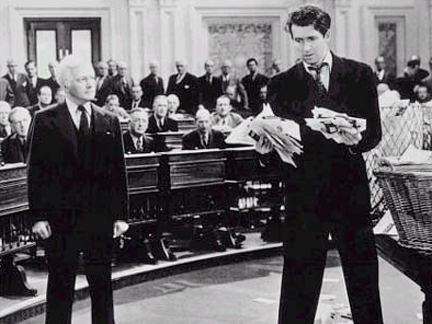
@Mr. Zaia you are no James Stewart: if you need an interpreter the next time you head to Washington, feel free to give me a call!

Looking back at Brunello

On Friday, Franco and I posted the news that the U.S. Alcohol, Tobacco, Tax, and Trade Bureau (TTB) has lifted the requirement of Italian government certification for Brunello di Montalcino imported to the U.S. The lift was agreed after Italian agricultural minister Luca Zaia met with bureau administrator John Manfreda last week.

I am happy to observe that despite the hail of the controversy (like the early-fall hail of 2008, that damaged but did not destroy the harvest; see above), Brunello and its producers — large and small — have emerged intact and healthy.

Looking back at the Brunello affair, in the glow of the Montalcino sunset, I am convinced of two things: that the controversy was a healthy wake-up call for producers (and that, ironically, it helped to raise positive awareness of the appellation abroad); and that, in many ways, it shed light on the importance and strength of the Italian appellation system.

At the same time, I believe the TTB’s response to the controversy was a trans-Atlantic misunderstanding: as the dearly departed Teobaldo Cappellano pointed out in the Brunello debate a year ago, the DOC/G system was created to protect the producers and the territory, not the consumer. And as much as I loath the thought of a Brunello producer “cutting” his Sangiovese with another grape variety, the transgression is a victimless crime as it relates to the consumer. If the consumer likes the wine and is satisfied with the perceived price-quality ratio, s/he is not molested by this misdeed.

The real victims were those producers who remained and continue to remain true to the territory and the territory itself. If unscrupulous enologists and calculating landowners did indeed adulterate their wines, and in doing so, co-opted and misappropriated an appellation tied to the land and the people who created it, therein lies the injury inflicted on their compatriots.

The saddest legacy of the Brunello controversy is the ill will it has created in the microcosm of Italian wine. On the same day that the Italian agricultural ministry issued a statement announcing the requirement for certification had been lifted, Franco (above, right; mentor, friend, and my partner in VinoWire) posted about a “cease and desist” letter he received from a lawyer representing a commercial winery. (For the record, Franco expunged any reference to the winery and wine in his post and I am merely speculating that the winery in question produces Brunello.) But the letter did not refer to something Franco had written: it referred to comments made by his readers! In one of the comments in question, a reader had made a remark about the unusual dark color of the wine by said winery. Has it really come to this? Do behemoth, commercial producers of Brunello really feel so threatened by a comment thread on a blog? Has it really come to this? Must a blogger feel threatened for merely allowing his readers to express their opinions in the comment thread of a blog?

Today, few who reside beyond Montalcino remember that Montalcino and its environs were one of the Germans’s last battlegrounds as they retreated in the face of the Allied advance in the last year of the Second World War. Even before the war, Montalcino and Tuscany were centers of the “red” resistance to fascist rule. Looking back on the whole Brunello affair, I was reminded of a little red book given to me by the mother of three brothers in Montalcino, whom I’ve known well since 1989. The locally published tome is by political activist, later partisan, and then local politician Carlo Sorbellini (above): Le mie memorie (My Memories). His descriptions of the years leading up to the war and the sacrifices made by him and his compatriot partisans during the German occupation are among the most humbly written and most moving narratives I have ever read. Many people shed their blood and gave their lives to protect this unique place: the same mountainous geography that made it a German stronghold also made it a great place to make fine wine after the war. And this Unesco-protected valley is among the most beautiful places in the world.

One thing I know to be true: I heart Brunello and I heart the people that lived, loved, and died to make it what it is today.

Lucky to be alive and a lot to live for

The rain just didn’t want to stop falling as Étienne, John, and I made our way from Austin to Dallas yesterday for business meetings and a tasting of Étienne’s family’s wines. My friends and family know that I am a very cautious, prudent driver, even to the point that some will tease me. It was one of those bad Texas rain storms, a “white-knuckle” tempest as some would say, and so I maintained a pretty steady 60 mph as we headed north on I-35. It wasn’t long after my habitual pit-stop at Italy, Texas, about 30 minutes outside of Dallas, that a gold Mercedes spun out of control about 150 yards ahead of us, bouncing off the median divider and sliding lengthwise across the highway directly in our path. I swear, and John, who was in the front passenger seat, told me that he had the same experience: everything seemed to appear in slow motion, despite the celerity with which events unfolded. I didn’t want to break too hard because the road was wet. We were in the middle of three lanes. My instinct told me to swerve right to avoid the oncoming car but I glanced in my right-side mirror and saw there was an 18-wheeler behind me in the far-right lane. It seemed that we were going to collide with the Mercedes head-on.

In that moment, I thought I was going to die.

But then a miracle happened: the Mercedes seemed to bounce off of the front bumper of my Hyundai, like a billiard ball, and it kept moving, colliding with the truck that had passed me on the right. It then flew back across the freeway in front of us and finally stopped moving when it hit the median divider. By this point, I had managed to stop my car.

We were lucky to be alive. The driver of the Mercedes was alive and conscious and the emergency team arrived swiftly and took him away.

The right side of my bumper had been dislodged but a tap put it back into place. There’s barely a scratch on my car. A miracle.

Beyond the adrenaline rush, Étienne, John, and I were 100% fine.

Later, that night, following long meetings and a tasting, Alfonso hosted us all for dinner at his house. We paired his chipotle-chili-marinated, grill-fired pork and baked potatoes with the Étienne’s Domaine de Montille 2006 Volnay 1er cru Les Mitans and a Produttori del Barbaresco 2001 Barbaresco Pora. Étienne told me with a big smile, “you can write on your blog that I love Barbaresco!”

We were lucky to be alive.

We got back to our hotel around 10 p.m. and retired and I was finally able to call Tracie B, who shared the wonderful news that her childhood friend Jennifer had posted our engagement photos on her blog. (Click the photo above to see them all, if you like.)

I don’t know that everything happens for a reason, and even though I believe in God, I’m not sure there is a divine plan. I do know that I love Tracie B with all my heart and all my soul and the joy that she has brought into my life is the greatest miracle anyone could wish for. To imagine my life without her is to imagine a life without meaning, direction, or purpose. I can’t say that “my life passed before my eyes” in the moment of the crash. All I could think about was how I’ve finally arrived at this moment after a life that has certainly been interesting but never entirely fulfilled: I have the love of the sweetest, most beautiful woman I’ve ever known, I have my health and my mind, both of our families are with us and healthy and soon will share the joy of our union. And there was even one of Tracie B’s savory oatmeal cookies left in my wine bag for breakfast this morning…

The whole worlds speaks (indigenous) Italian

montille

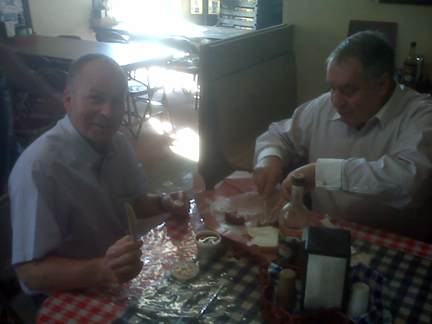
Above: Where does one take one of the greatest winemakers of Burgundy for lunch? City Meat Market in Giddings, Texas, of course! That’s Étienne de Montille (left) and John Winthrop owner of Veritas Imports enjoying some smoked sausage in Giddings yesterday. It’s been fascinating traveling with Étienne and hearing him talk about his wines, biodynamic farming, sexual confusion, and whole cluster fermentation. More on that later…

It seems the whole world speaks indigenous Italian these days: check out this article published yesterday by Bloomberg on the growing interest for indigenous Italian grape varieties in the U.S. (with a quote from you-know-who).

Seems a lot of folks have San Francisco and its love of European wines on their minds: check out Eric’s post here and SF native John Bonné’s post, where he asks “do our wine lists ignore California?”

I’ve got to hit the road again today with Étienne but stay tuned…

Quintarelli’s putative son

luca fedrigo

After a year in Texas, you’d think that I wouldn’t be surprised by the vinous talent that comes out to see us. On Saturday, I had the opportunity to chat with Luca Fedrigo, above, owner of L’Arco in Santa Maria di Negrar, whose wines I’d never tasted. “After I started making wines in the late 1990s,” he told me, “my first sale in the U.S. was here in Austin.” The Texas market’s loyalty to his wine has brought him back ever since.

Just as Texas holds a special place in Luca’s heart for the sweet memory of that first sale, so do the wines of Valpolicella in mine: I first tasted great wines from “the valley of alluvial deposits” when I went to study at Padua in the late 1980s.

Franco has written about the regrettable “Amaronization” of Valpolicella that has taken place over the last decade: the region is sadly over-cropped and too many producers are making Amaronized expressions of fruit that would be better destined for Valpolicella Classico.

Luca is part of a small but determined movement of winemakers who remain true to the origins of the appellation. I really dug his traditional-style Valpolicella and Amarone, classic expressions of the appellation, aged in large old casks. I even liked his Cabernet Franc/Cabernet Sauvignon blend, which showed great minerality and acidity (I think I’m going to use this wine for my Veneto class on November 3 as an example of the tradition of Bordeaux varieties long present on Veneto soil).

As it turns out, thirty-something Luca left school at the age of 14 and went to work for the “father of Valpolicella,” Giuseppe Quintarelli, who, in turn, became his putative father (I won’t go into the personal details, but let’s just say that Luca is practically a member of the family). For years, Luca studied winemaking with the great master of the appellation and ultimately became his vineyard manager. Quintarelli, he told me, helped him (and many others) to branch out on his own and create the Arco label. A gift that keeps on giving: thank goodness for Luca and the preservation of the traditions of this truly great appellation. “Valpolicella without Quintarelli,” Luca said, “is like a family without a father.”

The wines are available at The Austin Wine Merchant.

In other news… a savory oatmeal cookie…

oatmeal

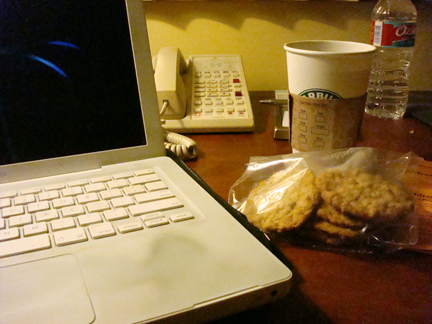
After three months of scraping by on writing and teaching gigs, I’m thankfully back to hawking wine. This early morning finds me in a hotel in Houston, where I “showed” wine all day on a “ride with,” as we say in the biz, with a famous French winemaker. It’s only my first day back out on the road and I already miss her terribly. But like manna from heaven, her savory oatmeal cookies somehow found their way into my wine bag and made for an excellent breakfast with my coffee.

Proust had his madeleine…

On the Wine Trail in Italy named “best local Italian wine blog”

From the “we tease him a lot ’cause we got him on the spot” department…

alfonso

Above: Alfonso Cevola aka Italian Wine Guy grows hoja santa in his backyard. The Mozzarella Company in Dallas uses the leaves for its excellent goat cheese.

Tracie B and I were thrilled to hear that one of our favorite blogs, authored by our very own Alfonso, was named “best local Italian wine blog” by the Dallas Observer. Alfonso is a generous and loving friend and a mentor to both of us and he’s the reason we met… well, his blog is the reason: we both discovered each other’s blog in the comment section of Alfonso’s blog. He’s going to be the best man at our wedding next year. :-)

Here’s what the Dallas Observer had to say:

    On the Wine Trail is local in the sense that blog-master, Alfonso Cevola, lives in Dallas and mentions local themes and places once in a while. But Cevola is also something of an international authority. A lifelong wine seller whose mom’s mom came from Calabria at the toe of the Italian boot, just across from Sicily, Cevola can tell you all about things like the tension within the Calabrian wine world over strictly regional tastes versus a more international mix of grapes. If you were real lucky, you could get this kind of stuff from him in person any Saturday morning when he might happen to drop into Jimmy’s Market in East Dallas for some wine schmoozing. But the blog is the more reliable place. A salesman for Glazer’s Wholesale Distribution in Dallas, Cevola has watched Dallas’ wine palate develop over 30 years. Asked what the big new thing is in these times, he said, “Wine under $15.” He’s got the skinny.

Congratulations, Alfonso! We love you, man…

Thanks for reading, everyone.

Buon weekend!