I felt a great disturbance in the Pour, as if millions of voices suddenly cried out in terror and were suddenly silenced. I fear something terrible has happened.
You are a Jedi Master among wine bloggers: the Pour was what gives a Jedi wine blogger his power. It was an energy field created by all vinous things. It surrounded us and penetrated us. It bound the galaxy together.
The Pour will be with you, always.
Credit where credit is due: I owe the above punny title to Alfonso. In exchange I offered free use of “mishegas impossible.”
The Latin expression ante litteram means literally before the letter, in other words, before the written word. I’ve recently had the opportunity to taste what I consider (and others are free to disagree) an “an orange wine ante litteram, id est, an orange wine that was created before the expression or notion of “orange wine” existed: the 1999 Trebbiano d’Abruzzo by Edoardo Valentini. We opened a bottle on Monday at the Orange Wine dinner at Vino Vino in Austin. This wine, made by Valentini himself (as my colleague John Paine pointed out), was fresh and bright, with youthful, powerful tannic structure, nuanced floral notes on the nose, and rich fruit flavor in the mouth. A wine, we agreed, still has many years ahead of it. Truly one of the greatest white wines I’ve ever tasted…
I wasn’t the only one who dug the Valentini and the other wines on Monday night: so did Michael Barnes, social columnist for the Austin American Statesman, who weighed in with this ambrosial post…
well, not really… but he’d like to be arrested… read on…
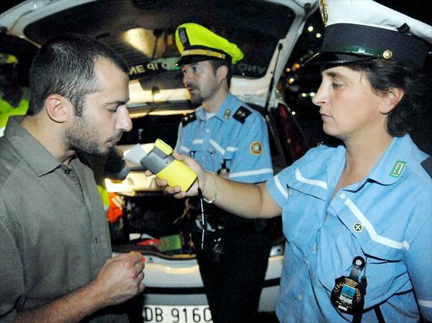
Above: Unidentified man is subjected to a random breathalyzer test somewhere in the Province of Como. Photo courtesy of La Provincia di Como.
According to a blog post published Sunday by Italy’s preeminent wine blogger and re-posted by numerous wine websites and blogs, including the LaVINIum blog and InternetGourmet, said blogger Mr. Franco Ziliani wants to be arrested for drunk driving. More precisely, he wants his alcohol blood content to be tested as he leaves the gates of the annual Italian wine fair — along with that of thousands of other attendees — before he ever gets behind the wheel of his car.
At issue is Italy’s newly instated (quasi-)zero tolerance drunk driving law, enacted in August 2009, whereby a .05-gram-per-liter-of-blood alcohol level is considered intoxication by police. (I found the most up-to-date text of the new Italian legislation at this breathalyzer sales site and for background and for general info on the legal limits allowed across the world, see the Wiki. Most states in the U.S. consider .08 grams the legal limit.)
The legislation was intended to curb excessive alcohol consumption and a rash of drunk driving incidents, mainly involving young people leaving discotheques on Friday and Saturday nights. The new laws require local police to set up random check points and subject drivers to breathalyzer tests, even when said drivers exhibit no outward signs of intoxication.
As a result (and I’ve heard of myriad cases of this during my recent trips to Italy), a number of individuals have lost their driver’s licenses even after only moderate alcohol consumption.
The bottom line: even one glass of wine at dinner can put you over the legal limit, depending on the wine and your body weight at mass etc.
The new laws have been widely criticized — even by Italy’s now former agriculture minister, Luca Zaia — as excessive. Many, including respected wine journalists, have called them a form of neo-prohibition and even neo-fascism applied through the use of unreliable devices by unprepared law officers. The legislation was intended to curb drunk driving among young discotheque-goers, not wine professionals attending tastings or average folks enjoying a bottle of wine at a country trattoria.
Here’s where it gets really interesting: Italy’s annual wine trade fair, Vinitaly, begins Thursday in Verona. If you’ve ever been to the fair, you can see what’s coming: of the thousands of people who attend each day, most are wine and restaurant professionals who taste in moderation, spitting, but tasting (as I do) up to 80 wines a day. This is the first Vinitaly since the new legislation has been enacted.
Mr. Ziliani is asking like-minded attendees to gather — in the thousands, he hopes — and march (or be bussed) down to the local police station, where he and his followers will “turn themselves in” and ask to have their alcohol blood levels tested without ever getting behind the wheel. He hopes that the overwhelming number of tests to be administered will demonstrate the absurdity and infeasibility of the law.
Mr. Ziliani’s protest may have “arrived a little too late,” notes the author of the LaVINIum post. But you can email Ziliani here to get protest details.
The U.S. Alcohol, Tobacco, Tax, and Trade Bureau (TTB) has officially lifted its requirement that importers of Brunello obtain an Italian government declaration stating that the wine has been made in accordance with appellation regulations.
As a self-anointed semiotician, I can’t help but note what an interesting instance of wine writing this document represents. A close reading of the text reveals that that the TTB will ultimately be remembered as the author who “wrote the book,” so to speak, on the Brunello controversy. A winery, as of this week not yet implicated, also emerges in the document.
It’s at once the grimmest form of wine writing and the happiest: I hope it truly marks the end of the controversy known as Brunellopoli (Brunellogate).
I believe that Mr. Franco Ziliani was the first to publish the news in Italian and my friend Ale, author of Montalcino Report, was the first to publish the story in English.
Above: Giovanna Rizzolio is a delightful woman, wholly committed to terroir-expression wines and the traditions of her beloved Barbaresco. She presents her wines every April as part of the Vini Veri tasting.
The inestimable Italian wine raconteur Mr. Franco Ziliani certainly never promised me a rose garden but he most definitely delivered a bunch of roses when he o so generously introduced Tracie P and me to his dear, dear friend Giovanna Rizzolio (above), who runs a wonderful bed and breakfast on the cozy Cascina della Rose (literally, rose farm) estate, owned by her family for two generations, atop one of my favorite vineyards in the world, Rio Sordo, with a view upon Rabajà and Asili (the latter two considered by many the greatest expressions of Barbaresco).
Mr. Ziliani (arguably one of Italy’s greatest wine experts) is a huge fan of Giovanna and her wines and an even bigger fan of her estate, where we all stayed the night of our tasting and dinner, as Giovanna and her significant other Italo’s guests.
Above: I just had to take this photo. It’s the view from the bathroom of the guest room where Tracie P and I stayed, looking northward (Rabajà and Asili to the right, out of frame). One of the coolest things about being in Langa with snow on the ground is that you can see where the “snow melts first.” In the olden days, everyone will tell you, grape growers planted Nebbiolo where “the snow melts first” because the melting of the snow reveals the growing sites with the best exposure.
A home-grown Piedmontese, Giovanna is as true to her land as her wines are: she makes some Barbera and Dolcetto but her best rows, situated at the top of the Rio Sordo cru, are devoted to her beloved Nebbiolo (even before she made wine, when she was still working in the schmatta trade, she told me, she drank Barbaresco almost exclusively).
Above: One of the coolest things about tasting with Giovanna in her cellar is seeing the exposed subsoil, a cross-section as it were, where you can see the white calcareous marl that makes Barbaresco and Rio Sordo such unique expressions of Nebbiolo.
The top of the Rio Sordo vineyard, which literally means deaf or silent river, runs parallel to the Tanaro river (just to the northwest). It’s essentially an underground river: as they search for the water below, the roots of the vines are forced to dig through the calcareous marl and in turn render the rich fruit necessary to make fine wine.
Above: Giovanna showed me this tear drop, a product of the silent underground river. Photo by Tracie P.
The wines of Rio Sordo are softer than the more potent wines on the northside of the valley. Rio Sordo doesn’t enjoy the ideal exposure of Rabajà and Asili. But it’s for this very reason that I have always loved this cru: the wines don’t take as long to “come around,” as we say. As with Pora, the fruit emerges at an earlier moment in the wines development and what gorgeous fruit it is! I thought Giovanna’s wines were great, especially the 2006 Barbaresco Rio Sordo.
Above: Giovanna loves cats, as is evidenced by the image on her label.
But the thing I love the most about Giovanna is her attitude toward wine and life in Piedmont. Whether it was tales of dealing with unscrupulous wine pundits or the INCREDIBLE spinach casserole she served at dinner, she speaks with an honesty and integrity uncommon in the supremely competitive world of Langa wines. Her house atop Rio Sordo came to her long before the renaissance of Italian wine began and her love of Langa shines through in her personality and her wines.
Above: Giovanna’s wines are available in a few American markets.
I’m not the only one who digs Giovanna and her farmhouse bed and breakfast. Doug Cook, of AbleGrape.com, and his wife Rachel are frequent visitors. I highly recommend staying there: I can’t think of a better way to be in touch with Langa and the folks who live and make wine there.
Giovanna, you can cry me a river, anytime you like, honey! Thanks again for a wonderful stay and tasting…
Here’s Diana Krall singing “Cry Me a River” with our friend Anthony on guitar….
Above: The dearly departed Baldo Cappellano (right), one of the founders of the Vini Veri movement, with his son Augusto, who now manages their family’s historic winery.
My good friend Marisa Huff, one of the organizers of this year’s event, has graciously shared the recently published link.
I wish I could be there: it is my favorite tasting of the season. But I’ve just been on the road too much already this year and there are more travels ahead.
Above: Tracie P and I tasted with Aldo Vajra at his winery in early February. You can taste Aldo’s excellent 2005 Barolo Albe with me today, Sunday, at Jaynes Gastropub in San Diego, 5-7 p.m.
When revered Italian wine scribbler Mr. Franco Ziliani asked Tracie P and me if we would mind tasting with Aldo Vajra in Barolo before we headed out to meet and taste with his dear friend Giovanna Rizzolio at Cascina delle Rose, we were thrilled, of course. Mr. Ziliani was interested in tasting Vajra’s first bottling of 2005 Baudana: Aldo’s newly inaugurated stewardship has preserved the legacy of the famous Luigi Baudana estate.
I won’t go into a history of Vajra here. Ubi major, minor cessat: no one has written more eloquently about Vajra and its wines than a wine writer I truly admire — both for his generosity of spirit and his deft hand at the keyboard — David McDuff. I will say that wines we tasted that day were awesome, across the board. As I peruse my notes from our visit, I am reminded that highlights were:
Vajra 2008 Dolcetto Coste & Fossati
Earthiness that balances the fruit beautifully.
Vajra 2007 Barbera d’Alba
Fantastic! Nebbioleggia!
Vajra 2006 Freisa Kyè
OUR kinda wine, tannic, and earthy, with nice fruit and great acidity.
Best Moscato d’Asti I’ve ever had. Unctuous in the mouth, gorgeous fruit, simply stunning expression of this wine.
But the wine that intrigued me the most, in part because of Aldo’s keenness for it, was his 2008 Langhe Bianco, made from 100% Riesling, clone 49, to be precise, taken from Alsatian rootstock.
Very little white wine has been produced historically in Langa and even less of it would be considered aristocratic in nature. Aldo spoke to us about his quest to make a truly noble white wine in Barolo: his first vintage of this planting was 1989 and until 1995, when the Langhe Bianco DOC was created, it had to be labeled as a vino da tavola or table wine. Labeling regulations still forbid him from writing the grape variety on the label. He believes that he was the first to plant Reisling in Barolo and I loved the way he described it, as a moglie per il Barolo, a spouse for Barolo. The wine was bright, with elegant white fruit flavors and lip-smacking acidity. I thought it was fantastic and would love to see how it ages. A truly noble white wine. If you can find this wine in your market, I highly recommend it…
Aldo is such a gracious man and I really love his wines. The 2007s and the 2005s are some of the best I’ve ever tasted from him winery. Really great stuff… and highly recommended… When he found out that we were recently married, he gave us a beautiful coffee-table encyclopedia of Italian cheeses. You can tell from the way he shakes your hand that he’s the type of person who gives a gift without expecting anything in return. But then again, a gift isn’t really a gift if its given with the expectation of something in return, is it?
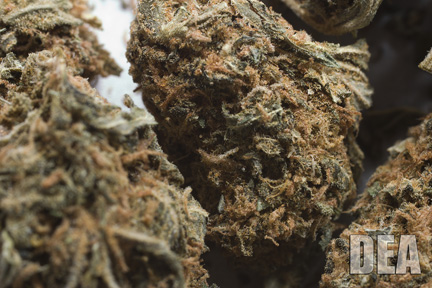
It’s hard to believe that this is happening in my lifetime but it’s true. I had to pull over to the side of the road the other as I was driving home and heard a radio story on American Public Media Marketplace: the spokesperson for NORMAL was talking about the recent initiative to legalize recreational marijuana use in California and — get this! — turn Humboldt and Mendocino into Napa Valley-inspired marijuana tourism destinations.
I’m certainly not the only or the first to write about this is in the enoblogosphere: check out this post by Wolfgang, who asks wryly, “have I smoked too much Cabernet?”
As I head out (tomorrow) to my homestate of California, to speak about Piedmontese wines at Jaynes Gastropub on Saturday Sunday and to celebrate the Passover with my family on Monday night, I have to admit that I never thought legalized pot would happen in my lifetime (even though pot is woven deeply into the cultural fabric of my beloved California). But is weed the new wine? Humboldt County tasting rooms? Unbelievable!
In other news…
Above: I love the raw pork sausage that you typically eat as an appetizer in Piedmont. You eat it just like that, completely raw. We were served this excellent victual when we dined in the home of Giovanna Rizzolio.
I been showered by numerous requests to hurry up and post about the amazing private tastings that were organized for Tracie P and me by venerable Italian wine pundit Mr. Franzo Ziliani in Barolo and Barbaresco during our February trip there. One zealous fan of my blog writes of his “burning disappointment” that I still haven’t posted on our tastings at Vajra, G. Rinaldi, G. Mascarello, and Cascina delle Rose, “our lady of the deaf river,” as I will call the inimitable Giovanna Rizzolio, producer of one of Mr. Ziliani’s favorite Barbarescos and his close friend.
Frankly, I’m flattered by all the messages I’ve received and I promise to devote next week’s posts to my notes and impressions of these amazing wines and the truly amazing people who make them. And I can only reiterate my heartfelt thanks to Mr. Ziliani, as I wrote on Valentine’s day, in a post published not long after Tracie P and I returned from Italy: noble is the host… (the line comes from a stanza of an ode by 18th-century Italian poet Parini that I translated and dedicated to Mr. Ziliani).
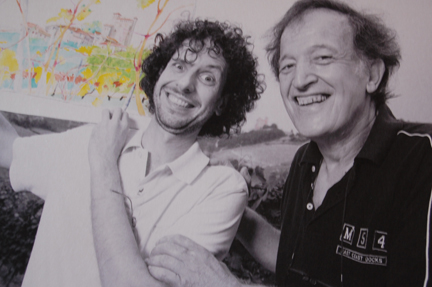
Above: Ignazio Giovine (center), owner and winemaker at L’armangia (Canelli), was one of the most interesting and nicest persons I met (and spoke to at length) in Asti earlier this month. As the interpreter that day, I wasn’t able to take photos and so I lifted this photo from the website of a Danish wine seller (left), Carsten Rex, who reports detailed tasting notes in English for Ignazio’s wines.
One of the disadvantages I faced on my recent trip to Asti for Barbera Meeting was that I simultaneously juggled the roles of meta-blogger, wrangler, and interpreter. As a result, there were many instances I wasn’t able to take photos and notes for my own blog. Another odd — surreal in certain cases — was that as interpreter for the group and for many of the winemakers we visited, I was not only gagged but also forced to be the literal mouthpiece verbatim for nearly all of the winemakers and enologists we visited. At one point, after a exhausting session of translating a heated debate during one of the conferences, Jon said to me, “wow, man, that was surreal: there you were, speaking to the crowd, saying things I know that you completely disagree with.”
My job there was to convey, transmit, relay the message, without any editorializing (for the record, I was trained formally as an interpreter when I worked for the Italian Mission to the United Nations back in 2003 and served as the Italian foreign minister’s personal interpreter; during that time, I translated for Kofi Annan and Colin Powell, just to name a few).
I wish I would have been able to spend more time with winemaker Ignazio Giovine (above) of L’armangia. I can’t say that I’m the biggest fan of his wines but I can say that I’m a personal fan of the man. Following our visit, he and I had a chance to chat at the evening tasting, where we had a fascinating conversation about wine, partisans (both his and his wife’s parents opposed the fascists), and the current state of Italian politics today. His wines are very well made, although they do not appeal to me personally. But I am a big believer that the objective quality of a wine is also derived from the people who make it (above and beyond my personal tastes). Ignazio’s radical opposition to the use of native yeast stirred some controversy between him and the group. (And my now good friend Thor, whose writing I admire greatly, wrote an interesting and polemical piece on our visit with Ignazio.) I think I did a fine job of translating for Ignazio but I wish I could have been a participant and observer that day instead of interpreter.
According to a report that I recently synopiszed over at VinoWire, the German and Swiss markets grew or remained stable for the sale of Italian wines in 2009, while Britain and the U.S. dropped significantly (not in volume but in gross sales).
Ignazio makes his wines almost exclusively for the “Nordic” market, as it were, like the Dane above, who is a big fan of Ignazio’s wines. Wasn’t it Sheryl Crow who said, “if it makes you happy, it can’t be that bad…”
If Ignazio makes wines that his customers like, is that so wrong? Let me play the devil’s advocate and say: de gustibus non est disputandum. In other words, if it makes you happy…









 Do Bianchi

