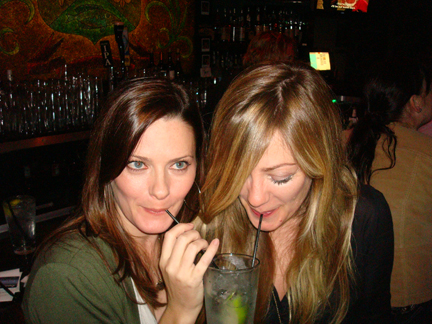
Tracie P and our friend Austin jazzer Liz Morphis got their smoked-pork-chop-on-a-stick on at the behemoth 50th annual Wurstfest 2010 in New Braunfels, Texas yesterday night. Entirely delicious with a cold lager beer on the side…
I knew that Central Texans were proud of their German heritage… but, sheesh, these folks dig them some Teutonic party time…
The music tents were packed and pumping the oom pah pah. And the musicians were smoking hot… You could hear some of the traces of what helped to shape the Tex Mex sound of the 1970s, a fusion of German music with Spanish instrumentation, the tuba meets the 6-string (Doug Sahm would have been right at home here).
Got sauerkraut?
Where I grew up we called them potato latkes.
The great hall of the Comal County Fairgrounds was a sight to see, and the folks, however sloshed, were super polite and well-behaved… only good times here…
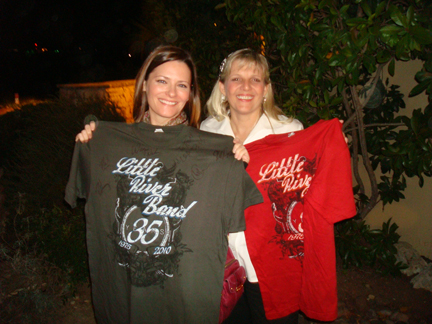
Reminiscing… Tracie P and I went on a super fun double-date last night with aunt Holly and uncle Terry… Cocktails, Mexican food, and then the Little River Band at the intimate One World Theatre (Austin).
The boys got the girls t-shirts and the girls got their t-shirts signed by the band…
You see, not only does my baby love her some Little River Band… “Reminiscing” (1978) was the song that made it all happen for aunt Holly and uncle Terry when they were high school sweethearts back in Orange, Texas… uh huh…
Come on… you know you love it, too (here, sung by Australian super star John Farnham)…
What does the Little River Band have to do with wine? The band took its name from the town of Little River in Victoria, Australia. I’ve been told they make wine not far from there…
I hope ya’ll are having fun today. Tracie P and I are headed to Wurstfest in New Braunfels, home to early German settlers and our good friends Seana and Josh… and you just know we’re going to find something blogilicious… stay tuned…
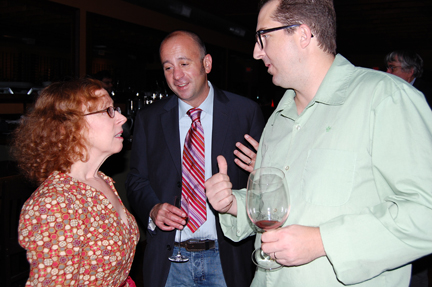
Above: My super good friend Joe Pat Clayton (right) was as geeked as me and Tracie P to taste natural Spanish wines last night with Alice Feiring (right).
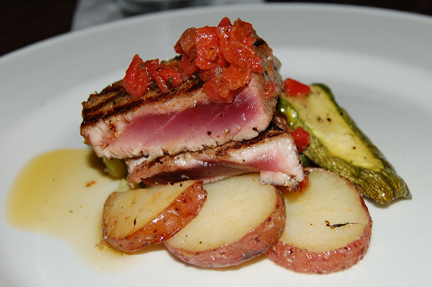
Alice Feiring hit the Groover’s Paradise like a Texas tornado. The few days she spent her with us were filled with honkytonking, two-stepping, great parties and great friends and lovers of natural wine, and a superb fish dinner prepared by Chef Esteban Escobar paired with a flight of Spanish natural wines last night at Vino Vino (the best little wine bar in Texas).
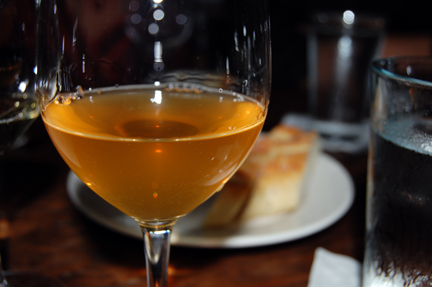
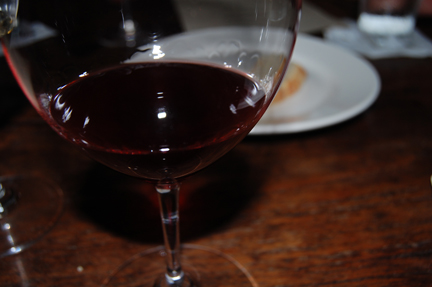
The two wines that impressed me the most were the Laureano Serres 2009 Abeurador Macabeo (above, 100% Macabeo grown in clay soils, vinified with 2 days of skin contact, no added sulfite [note by importer José Pastor]) and the Els Jelipins 2004 Sumoll (Sumoll with a small amount of Garnacha, grown in clay and limestone soils, whole-cluster fermentation in open-topped barrels, no added sulfite).
The Macabeo was rich and unctuous, tannic and chewy in the mouth and unbelievably delicious.
The Jelipins 2004 Sumoll was mind-boggling good. Impenetrably inky and viscous on the palate, a stilnovo sonnet with alternating rhymes of earth and fruit.
Chef Esteban’s excellent cooking has been reaching new heights lately but last night he took it over the top (especially considering the Herculean effort necessary to create a wine dinner using only Kosher fish and vegetables).
Kim and SO Alfonso also came down from Dallas expressly for the event.
Above, from left: Alice, Lewis Dickson (Texas Hill Country natural winemaker), Tracie P, Jeff Courington (owner Vino Vino), and Russ Kane (author of Vintage Texas, the top Texas wine blog).
And so this morning we took Alice to the airport (she stayed with us, of course). It was a great visit and we were sad to see her go. She certainly made a profound impression on the Texans she met. And I’d like to think that they also impressed her with the Texas-sized welcome they gave her.
We’ll miss her but somehow I think she’ll back sooner than later. Once you’ve danced to the rhythms of Dale Watson at Ginny’s Little Longhorn Saloon, there’s no turning back…
N.B.: Jaynes Gastropub does allow corkage, for a reasonable fee, for wines not offered on their wine list.
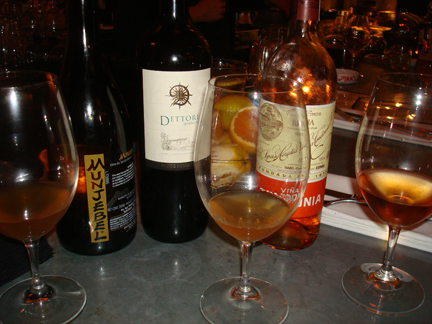
Chrissa, her husband Dan, Rikkers, and I opened a memorable flight of indisputably Natural wines last night at Jaynes Gastropub in San Diego. I write “indisputably Natural” with a capital N because any mention of Natural wine these days seems to spark the ire of some of the more cranky among us here in the enoblogsphere. But there’s no doubt in my mind that the community of wine bloggers who have laid claim to this precious and widely coveted epithet would agree that the three wines in question fulfill the criteria prescribed by even the most rigorous enforcers of Natural wine doctrine and dogma.
Perhaps nowhere has more been written about the wines of Frank Cornelissen than at Saignee and, ubi major minor cessat, I will defer to Cory’s excellent blog for a treatment of Cornelissen and the cult that has taken shape around him.
The wines, raised on the slopes of Mt. Etna, are not easy to come by in this country and I was thrilled to finally get my hands on some. Together, we tasted the 2007 Munjebel Bianco (native yeast, skin contact, no SO2, no filtration). Munjebel is dialectal toponym for Mt. Etna, btw (akin the Sicilian Muncibeddu or the Italian Mongibello, meaning monte bello or beautiful mountain).
The synthetic cork bulged out slightly from the lip of the bottle’s neck and the shoulder was very high. I believe this was due to a second fermentation in the bottle and the wine had a slight spritz to it.
I don’t have time today to go into the epistemological implications of this wine, which I find fascinating (the wine and the implications). But I can report that I thoroughly enjoyed it (bright acidity, bright citrus fruit, balanced alcohol). I believe the wine has not yet stabilized (it had rested for about a week in my wine locker in San Diego before we opened it last night). I’m looking forward to opening the other bottles in my allocation: this wine is alive, IT’S ALIVE, as Dr. Frankenstein might say.
The 2006 Bianco by Dettori? This was simply one of the best wines I’ve ever had in my life. Not a great vintage for Dettori but sure to be a 20+ in its cellar life. Tannic and rich, bright bright acidity and a crunchy mouthfeel. It took some time for this wine to open up but it was purely sublime.
We also ordered the 1998 López de Heridia Tondonia Rosado from Jayne’s list. The oxidative wine was a perfect closer after the thought-provoking, intense whites (orange wines, really), and was a fantastic pairing for my schnitzel and spaetzle (recommended by Jayne). Anyone who visits Do Bianchi regularly knows just how much Tracie P and I love LdH — anytime, anywhere.
After dinner we went to a new club on El Cajon Blvd. to see Jon’s band the Fairmounts play their blend of 60s soul.
That’s A.J. Croce (yes, Jim Croce’s son!) on keyboards… how cool is that? They completely rocked the house…
Wrapping up this quick San Diego trip (to ship and deliver wine for my wine club 2Bianchi.com), I just had to share this photo of my awesome nephews Abner and Oscar (brother Micah and sister-in-law Marguerite’s children).
Abner is holding a photo of his great-great-grandparents, mama Judy’s grandparents. It’s so remarkable to think about how far we’ve come from Russia, Poland, and Austria. And how radically the world has changed since then.
Would they have ever imagined that their progeny would be drinking unyeasted wines from the slopes of Mt. Etna on the far-flung shores of California?
Do Bianchi is by no means a “rant blog” so let me put this as gently as possible.
PLEASE DO NOT SAY “Baby Brunello” (or “Baby Barbaresco” or “Baby Barolo”)!
(And while we’re at it, please do not say “Super Tuscan” either!)
Baby Brunello: I recently heard this abominable lemma uttered by a colleague, whom I admire greatly for both his palate and his experience in the field, and I felt obligated to speak up against this oft repeated aberration.
Although fruit intended for Brunello di Montalcino often ends up in Rosso di Montalcino, the latter undergoes an entirely different vinification process (generally shorter maceration times) and is primarily made from younger vines and fruit grown in sites not suited for Brunello di Montalcino.
Rosso di Montalcino is intended for drinking its youth and is generally less tannic and more approachable early on. There are exceptions, like Poggio di Sotto’s 2002 Rosso di Montalcino, where Palmucci reclassified his entire harvest as Rosso. But why did he do that? Because the juice, however lip-smackingly delicious, was not worthy of the epithet “Brunello.” (Please note my use of the term in its etymological sense, Lat. epitheton.)
So, please folks, be Brunello and be proud or be Rosso and be proud but don’t use the [ugh] “baby” word!
Tracie P calls me “baby” but she don’t call no Brunello “baby”! ;-)
In other news…
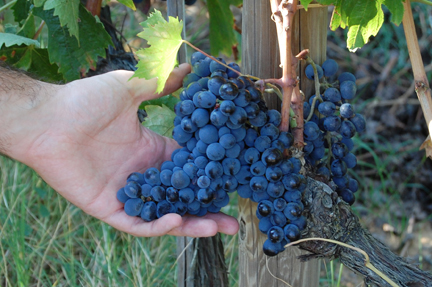
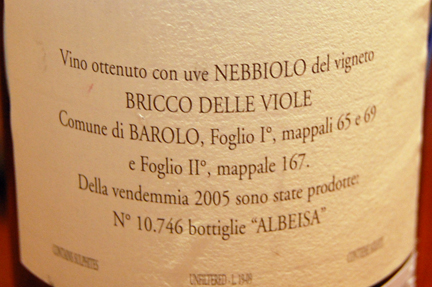
Some wonderful hypertextual blog love has been happening this week. After our friend Giuseppe Vaira sent me and McDuff a stunning photo of sunrise over the Bricco delle Viole in Barolo, McDuff posted this fantastic topographical survey of the growing site and croosadabilia wrote a lovely ode to Piedmont over at ‘na cica de vino. (If you don’t know croosadabilia’s blog, check it out!)
I love (and am fascinated by) the way the blogging medium generates hypertext.
In my case, I quoted a Neil Young lyric, McDuff went the technical contemplative route, and croosadabilia waxed epigrammatic.
The world is such a grand, beautiful place, isn’t it? But it’s a small world after all…
Yesterday, trading emails about this and that, my friend Giuseppe Vaira of G.D. Vajra in Barolo sent me and McDuff this amazing photo of sunrise in Barolo (click image for full effect).
“Moon Nebbia Dawn on Bricco delle Viole. View of the western slope. October 5, 2010, 6:35 a.m., two days to the new moon.”
Barolo, I’m still in love with you… On this harvest moon…
Come a little bit closer
Hear what I have to say
Just like children sleepin’
We could dream this night away.
But there’s a full moon risin’
Let’s go dancin’ in the light
We know where the music’s playin’
Let’s go out and feel the night.
Because I’m still in love with you
I want to see you dance again
Because I’m still in love with you
On this harvest moon.
When we were strangers
I watched you from afar
When we were lovers
I loved you with all my heart.
But now it’s gettin’ late
And the moon is climbin’ high
I want to celebrate
See it shinin’ in your eye.
Above: “Anyone who says we can’t feed the world is talking b… s…,” said Glen Boudreaux yesterday. What a great family and what interesting folks! I was fascinated by what he had to say and his take on humane, wholesome farming and “pasture-based” ranching.
There’s so much to tell since the last post… a couple of truly outstanding meals and more than one exceptional bottle of wine. But all that will have to wait.
Yesterday, I had a fascinating conversation with the gentleman above, Glen Boudreaux, who (together with his lovely wife Honi, pronounced honey) has owned and managed a ranch in beautiful Brenham, Texas for more than 20 years — the Jolie Vue Farms. Glen and Honi hosted a farm-to-table dinner last night and I covered the event for one of my clients (one of the underwriters). You can see my post (together with some of my git’ fiddle picking) here.
Above: Mustard greens and blue corn grits, sourced locally and prepared by chef Paul Lewis who came in from Houston for the event.
Glen advocates a no-nonsense approach to farming and is a proponent of humane and wholesome, “pasture-based” ranching. Over the last two decades, he has revived a ranch that had been devastated by cotton farming and left to the weeds. Merely by encouraging and enabling the revival of native grasses, he is literally able to raise twice as many cattle per acre as the Texas department of agriculture believes possible. And he is convinced that his philosophy — if embraced by the world — would allow the global farming community to stamp out hunger. And frankly, when you shake this man’s hand and he looks you in the eye with a warmth and humanity not uncommon in the Texas farmland, you believe him.
Above: More than 200 persons sat down for dinner together at one continuous table last night. The event was organized by artist Jim Denevan and his company Outstanding in the Field.
Among the more fascinating topics of conversation with Glen: the parallels he sees between Jewish dietary law and his approach to ranching and butchering (the butchering, he explains, is as important as the farming and he carefully and “mercilessly” screens his clients, he told me); he loathes anyone who uses the word “natural” or “organic” in their packaging or labeling (see this fantastic post on his blog, What’s it all mean? Natural terminology can be confusing…); his admiration for “sissy” (Joel’s word) and “rebel” (Glen’s word) farmer Joel Salatin (check out this video I found this morning).
Above: Tracie P and I really loved this couple, Clay and Julia Theeck, who help the Boudreaux family manage their ranch. You wouldn’t think that it’s fascinating to hear someone talk about native grass until you talk to Clay and Julia. Their knowledge of the local plant life is incredible. Clay and Glen haven’t done anything to treat the soil on the Jolie Vue ranch. All they do is help the native grasses flourish.
Glen and Honi sell most of their cattle and pigs to locally based individuals who want to feed their children wholesome food. They also sell to the occasional restaurant, like Cullen’s in Houston, who also underwrote the dinner.
Ultimately, they believe that their livestock should be happy, that happy pigs and cattle make for the healthiest nutrition. Although chef Lewis may have had something to do with the delicious factor yesterday, it was the materia prima that played the starring role.
Above: “Jews may not have believed in the afterlife the way that we do,” said Glen. “But when you read [the dietary laws in] the Old Testament, you can tell that they were doing what they were doing because they knew that it was the right thing to do on earth.”
My life in Texas continues to inspire me on many levels. This state — this Republic! — is home to a wide spectrum of folks, from the love-happy, guitar-strumming, pot-toking hippies of our beloved Austin to the generous-of-spirit, G-d-fearing, gun-toting ranchers of the immensely beautiful plains. Somehow, beyond the stereo- and archetypes, no matter the gulf of difference between them, there seem to be a humanity and a gentleness that pervade their willfully shared ethos.
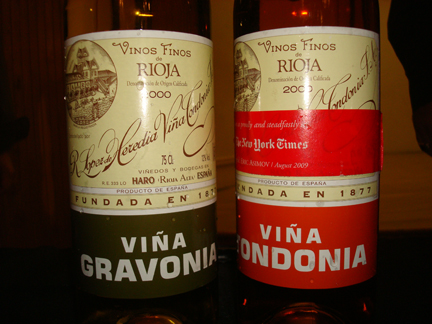
Making the rounds of yesterday’s trade tastings in the Groover’s Paradise (aka Austin, Texas), I was extremely fortunate to get to taste the current releases from one of our favorite wineries in the world, López de Heredia, Viña Gravonia blanco and Viña Tondonia rosado 2000. Ten-year-old white and rosé wines. I was impressed by how bright the fruit is in these bottlings, unusual (to tell the truth) for this house, where savory and salty notes always seem to dominate. Can’t wait to crack these with Tracie P, ideally over some ceviche and tacos al pastor at Fonda San Miguel.
It was great to catch up with everyone after being away for so long, like wine professionals April Collins, Jeff Courington, and Lolly Thompson.
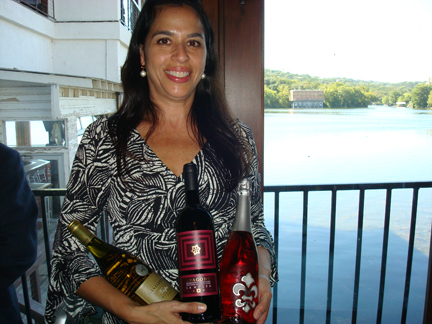
Wine broker extraordinaireSusana Partida was rocking the Bastianich.
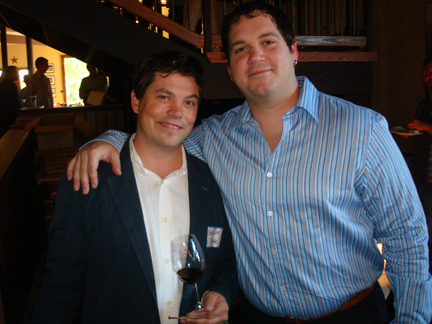
When I see these two dudes, Craig Collins and Mark Sayre, I always “smile like a fool,” as my friend Thompson likes to say.
Rob was in fine Forman: SO MANY killer Italian wines in his book (Inama, Marchesi di Gresy, Selvapiana, Tenuta Sant’Antonio) from Dalla Terra.
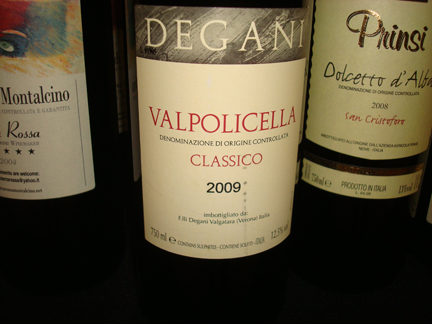
This Valpolicella from Degani is a welcomed new arrival in my Groover’s Paradise. It was fresh and bright, juicy and delicious, the way I like it. And it should weigh in well under $20 retail according to importer Enotec.
How does the song go, Flaco?
the guacamole queen is there
oh Lawd she’ll really curl your hair.
enchiladas and BBQ
oh baby whatch gonna do
come over here beside me
tell me baby how you been
I get through laying it on you
well you know that I’m back again
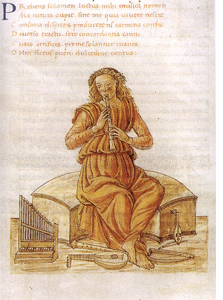
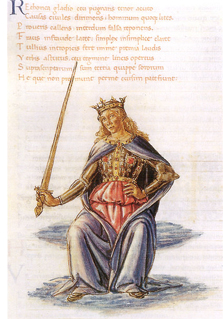
Yesterday on the Twitter, Alfonso asked me about the origins of the enonym Sangiovese. (I bet you’re wondering about the significance of the “allegory of music” from an illuminated Renaissance manuscript to the left but more on that below.)
First off, in all of my readings, I have found no one and nowhere that point to sangue di Giove (blood of Jupiter [Zeus]) as a philologically tenable origin of the grape name. This is what philologists call a folkloric etymology, most likely due to the quasi-homonymic (and Romantic) rapport between the enonym and purported etymon (the literal sense of a word according to its origin). While divine blood plays a central role in Christian myth and liturgy (another element that most likely contributes to the folkloric etymology), it is not found in the Roman or Italian cults that honored Jupiter during the vinaliae (wine festivals) of late antiquity. (For the record, blood does play a role in the myth of Zeus, when the “blood from the birth of Zeus begins to boil up” in a “sacred cave of bees… said to be found on Crete.” See this profile of Rhea, who gave birth to the deity.)
Most scholars believe the most plausible etymon to be sangiovannina, a term which denotes an early ripening grape in the dialect of Sarzana, a township that lies on the border of Liguria and Tuscany in northwestern Tuscany. (Hohnerleien-Buchinger, 1996, cited in Vitigni d’Italia, eds. A. Scienza et alia).
It’s also possible that Sangiovese comes from sangiovannese, an ethnonym denoting an inhabitant of San Giovanni Valdarno, a town in the province of Arezzo. (I actually think this is the most likely answer to the conundrum; here’s a link to the Sangiovannese soccer team website.)
Others yet point to the etymon jugalis (Latin yoke), giogo in Italian, possibly derived from a vine training system. (There is a precedent in the enonym Schiava but I believe this an unlikely linguistic kinship.)
In my research last night (conducted in the golden hour, when the day’s toil is through, and Tracie P and I relax before dinner), I came across a wonderful journal devoted to Romagnolo (the dialect of Romagna). It’s called Ludla (click to download the edition I found), or spark in Romagnolo. In it, I found an article on the origin of Sanzves, the Romagnolo inflection of Sangiovese. Here’s where it gets really interesting…
It’s important to remember that the enonym appears for the first time in Tuscany in the 16th century as Sangiogheto (Soderini, 1590) and today, most ampelographers concur that Sangiovgheto or Sangioveto are geographically aligned with Tuscany while Sangiovese is more closely related to Romagna (on the other side of the Apennines).
The author of the Ludla article proposes that Sanzves might be derived (however remotely) from Mons Jovis, a site near the town of Savignano (where the Romagnoli believe the grape to have originated, another possible linguistic kinship), today known as Giovedìa, where Jupiter (Giove, in Italian) was worshiped in late antiquity.
The bottom line? It’s very likely that we will never know the true origin of the enonym. But that’s not important.
The images that adorn this post (allegories of musica and rehtorica) are culled from a Renaissance codex of De Nuptiis Philologiae et Mercurii (On the Marriage of Philology and Mercury) by Martianus Capella, a pagan writer of late antiquity whose work formed the basis for the study of the liberal arts in western civilization. Philology is literally the love of words and Mercury is the mythical embodiment of commerce or intelligent pursuit.
While we may never know the etymon of the enonym, the journey of discovery by the way offers rewards all the more satisfying to our intellectual curiosity, emboldening our knowledge and awareness of the world around us.
When we marry the love of words and intelligent pursuit, only good things are bound to happen. The same thing happens when we pair a great bottle of Brunello with a bistecca alla fiorentina (something I hope to do later this week).
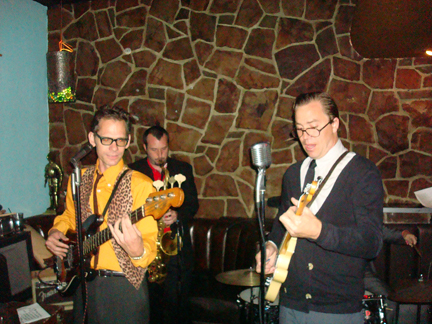
Tracie P and I capped off our holiday weekend in San Diego with a drive out to La Mesa (quite-a-place-a) to the Riviera Supper Club for some excellent old-school rhythm and blues by the Fairmounts (above).
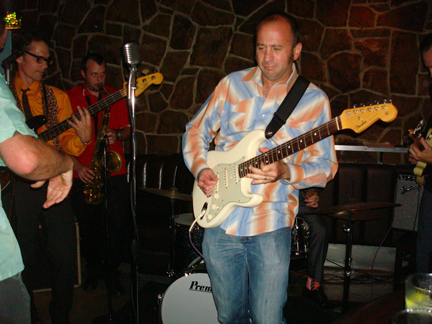
Really groovy stuff with Jon from Jaynes Gastropub on guitar… Bass player Tom and I figured out that we actually played a bunch of shows together when I was living in NYC and playing with the [CANNOT BE MENTIONED FOR LEGAL REASONS] old French band (remember them?) and he was playing with the Dansettes.
It can be painful to play the blues but I sat in on a number. SO MUCH fun to be playing music again…
John Yelenosky’s birthday is tomorrow. I love that dude… so many good times and great wines opened together, so many great memories from high school… happy birthday Yele!










 Yesterday on the Twitter,
  It’s also possible that Sangiovese comes from sangiovannese, an ethnonym denoting an inhabitant of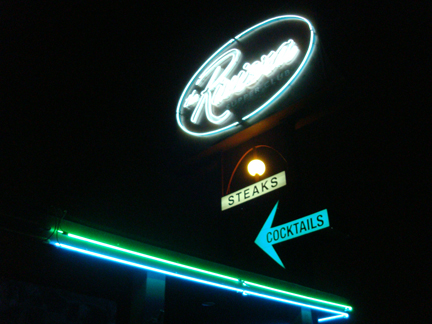
 Do Bianchi