One last note on Produttori del Barbaresco current release (and Tracie P’s fried green tomatoes)

On Friday, Tracie P brought home an open bottle of Produttori del Barbaresco 2008 Langhe Nebbiolo that she had been showing to her accounts that day. The wine had been open for the better part of the afternoon in her wine bag.

As much I have enjoyed drinking this vintage (2008, not nearly as great as 07 for this wine) since its release, I think the wine has entered a period of particular grace.

When we drank it at our wedding in January, it was light and bright, with happy black and red berry fruit.

But I got a taste of what was to come when I drank a glass at Jaynes Gastropub in San Diego last month (where they serve it by the glass): on Friday, the gentle savory notes I enjoyed in July had evolved into rich, earthy, muddy flavors, balancing the bright fruit in a lover’s embrace. I think that in the arc of its evolution, this wine has reached its moment of plenary expression (read: complete and utter yummyness).

In other news…

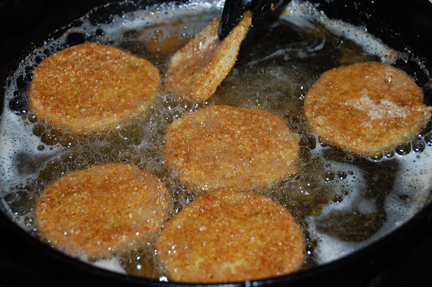
I just had to share this photo of Tracie P’s fried green tomatoes (from Sunday night), which she makes in her grandmother’s cast iron skillet. They were like savory candy: salty on the outside and sweet, tart and gelatinous on the inside. Paired resplendently with a bottle of Laurent Tribut 2008 Chablis (12.5% alcohol! yes!) and the 2010 vintage of True Blood.

Ain’t you glad we ain’t all California girls
Ain’t you glad there’s still a few of us left,
who know how to rock your world
Ain’t afraid to eat fried chicken and dirty dance to Merle
Ain’t you glad we ain’t all California girls

In other other news…

Seems I’m not the only one with Langhe Nebbiolo and summer tomatoes on the brain: Gary, watch out for that cucuzz’!

Barolo confessions

It was delicious…

Above: I was cold, I was hungry, I was tired… and, yes, damn it, I sat in my lonely hotel room on a damp, cold evening in Asti and watched TV, ate takeout pizza, and drank a bottle of 2005 Barolo Ravera by Elvio Cogno.

Forgive me, readers, for I have sinned. I can already hear the E-Bobs and WineBerserkers wailing, “infanticide!” It was a very lonely evening for me in the heart of winter in Piedmont: the Barbera 7 had abandoned me in my hotel, just as Jeremiah’s lovers had “forgotten him.”

My only companion was a bottle of 2005 Barolo Ravera given to me by Valter Fissore of Elvio Cogno. I was cold, I was hungry, I was tired. So I ordered takeout pizza, popped the cork, and watched TV.

I don’t know where food maven Arthur Schwartz said this, but Italian cookery queen Michele Scicolone often repeats his chiasmatic adage regarding pizza: if you can’t be with the pizza you love, love the pizza you’re with. Well, honey, I loved me some pizza and Barolo that night and I lived to tell about it!

Thanks for letting me get this off my chest… Buon weekend, ya’ll!

The basil of Salerno and Lisabetta’s tears

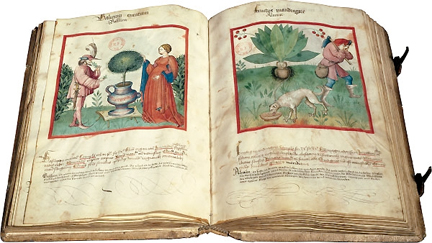
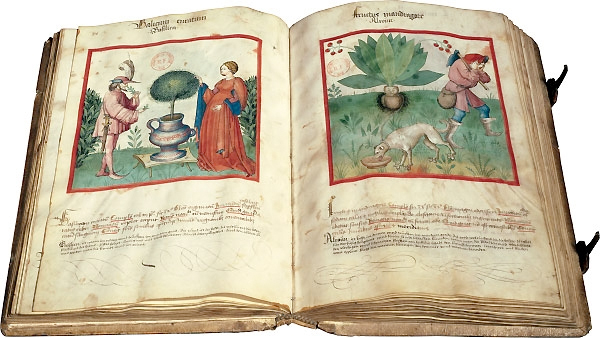
Above: Basil was prized for its healing properties for external wounds in the Middle Ages. The image of basil (note the presence of a woman and man) on the verso (left) is taken from the Tacuinum Sanitatis, in this case Codex Latinus 9333 from the Bibliothèque de France in Paris (click here to view a larger version). It was also a symbol of hate (read on).

I never imagined that my post the other day on Fake Pesto would lead to such a long comment thread here at the blog and over in the Facebook feed.

Here at the blog, Hande pointed out rightly that pesto, literally pestle, denotes the dressing for pasta made of ground basil, cheese, pine nuts, garlic, and olive oil. I was surprised to learn that the Genoese Pesto Consortium’s officially sanctioned recipe allows for walnuts (as a substitute for pine nuts) and Parmigiano Reggiano along with (the more traditional, in my view) Pecorino. As per Hande’s comment, when I wrote that pesto is traditionally served with boiled potatoes and green beans, I should have noted that the dish is properly called pesto avvantaggiato, literally, enriched pesto, whereby trenette or trofie (noodles) are tossed with the pesto, the boiled potatoes and green beans, and some of the cooking water from the vegetables. Thanks again, Hande, for keeping me on my toes!

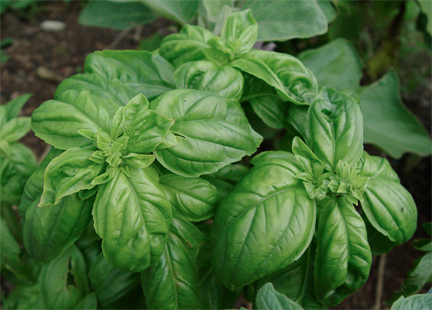
Image via SchoolGardenWeekly.

But when friend Leslie noted (over in the Facebook thread of the post) that basil is an anti-depressant, I began to think about one of my favorite novelle from Boccaccio’s Decameron, the Tale of Lisabetta da Messina.

    Lisabetta’s brothers slay her lover: he appears to her in a dream, and shews her where he is buried: she privily disinters the head, and sets it in a pot of basil, whereon she daily weeps a great while. The pot being taken from her by her brothers, she dies not long after.

    And so, saddest of women, knowing that she might not bewail him there, she would gladly, if she could, have carried away the body and given it more honourable sepulture elsewhere; but as she might not so do, she took a knife, and, as best she could, severed the head from the trunk, and wrapped it in a napkin and laid it in the lap of her maid; and having covered the rest of the corpse with earth, she left the spot, having been seen by none, and went home. There she shut herself up in her room with the head, and kissed it a thousand times in every part, and wept long and bitterly over it, till she had bathed it in her tears. She then wrapped it in a piece of fine cloth, and set it in a large and beautiful pot of the sort in which marjoram or basil is planted, and covered it with earth, and therein planted some roots of the goodliest basil of Salerno, and drenched them only with her tears, or water perfumed with roses or orange-blossoms. And ’twas her wont ever to sit beside this pot, and, all her soul one yearning, to pore upon it, as that which enshrined her Lorenzo, and when long time she had so done, she would bend over it, and weep a great while, until the basil was quite bathed in her tears.

    Fostered with such constant, unremitting care, and nourished by the richness given to the soil by the decaying head that lay therein, the basil burgeoned out in exceeding great beauty and fragrance.

There is so much I’d love to share about this truly fascinating (at least to me) story and the role that basil plays in it. Boccaccio’s Decameron has so many wonderful references to food and wine in it. (Read the entire tale in English here.) But, ahimè, professional duties call… I hope you enjoy it as much as I do.

In the meantime, here’s a scene from Pasolini’s version of the tale:

This man can COOK! Dinner with Bill and Patricia

Photos by Tracie P.

Just had to share some images from last night’s dinner in the home of our good friends Patricia and Bill.

Tracie P and I met Bill last year at a Valpolicella tasting and we’ve been friends ever since. Dinner began last night with jumbo shrimp wrapped in bacon and grilled (below). Only after I recited Artusi’s open letter to meatloaf did Bill acquiesce and agree to let us try his meatloaf from the night before.

“Signor polpettone venite avanti, non vi peritate,” wrote Pellegrino Artusi in La scienza in cucina e l’arte di mangiar bene (Science in the Kitchen and the Art of Eating Well, first published in 1881). “…lo so bene che siete modesto e umile…”

“Please step forward Signor Meatloaf and please don’t be shy… I know that you are modest and humble.”

He cubed it for us and we ate it cold. It was delicious.

It’s hard to describe how much sheer, pure fun we have when visiting with Patricia and Bill. Patricia is an interior designer by trade and their lovely Mediterranean-style home above Pease Park in Austin is a happy labyrinth of wonderful artifacts, paintings, and beautiful objects.

From his tales of working with the Israeli army to his anecdotes of Charlie Wilson and his time working in Washington, D.C., there’s never a dull moment in Bill’s presence. And the man can COOK. Bill made an unusual pasta shape, lanterne, dressed with a vodka-tomato sauce inspired by the Trattoria alla Vecchia Bettola in Florence. We paired with a bottle of 2008 SP68 by Occhipinti (which just came into the market here in Austin, available at the Austin Wine Merchant).

Next came involtini di vitello, veal rolls stuffed with mozzarella and accompanied by roast potatoes. We paired with a superb bottle of 2007 Bourgueil Cuvée Alouettes by Domaine de la Chanteleuserie (not sure where Bill picked that up, but I would imagine the Austin Wine Merchant). A supremely delicious pairing however you sliced it.

Customarily, one dines in the dining room when attending a dinner party chez Patricia and Bill. But on this special night it was just the four of us and so we ate in Tracie P’s favorite room in their house, the cappella. My lady loves her a turret!

Thanks again Patricia and Bill, for an excellent meal and a fantastic evening. We mustn’t let so much time pass between our visits again!

Txakolina, Txakolina, Txakolina!

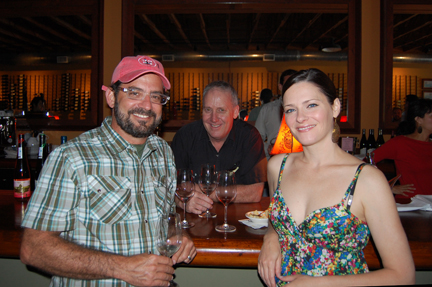
Above, from left: Importer of Basque, Spanish, and French wines André Tamers, Vino Vino owner Jeff Courington, and Tracie P at a Txakolina tasting in Austin on Saturday.

When I moved back to California from New York, a lot of concerned friends asked me, “what will you blog about? what will drink in California?” When I decided to move to Texas nearly two years ago, people admonished: “there won’t be anything interesting for you to drink there!”

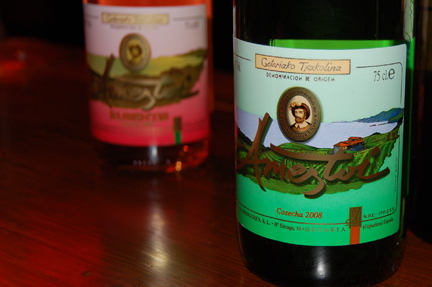
Above: My favorite in the flight was the Ameztoi Txakolina, so bright and fresh in the glass, with white fruit and spice on the nose and in the mouth. Low alcohol and gentle spritz. At under $20, the wine quickly shot up the charts to reach a top-five slot in my favorite wines of summer.

Well, folks, I’m here to tell you: I’m alive and well in Texas and drinking good juice!

Over the weekend, Tracie P and I attended a fantastic Txakolina tasting, hosted by André Tamers (the wine’s main proponent and Svengali in this country) and Jeff Courington, my client and friend, owner of the best little wine bar in Austin, Vino Vino.

Like manna from heaven, my sheer enjoyment of reading Eric the Red’s recent article on Txakolina was redoubled with a flight of the wines, poured personally for us by the dude who is making the synonymous Txakoli and Txakolina (pronounced CHAHK-oh-lee, CHAHK-oh-LEE-nah) household words here in the U.S.

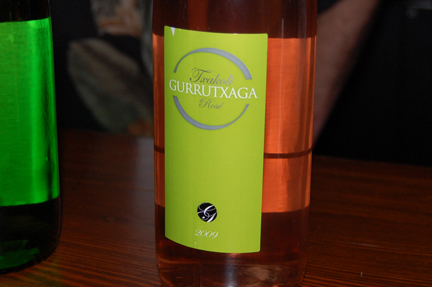
Above: I also really loved this rosé by Gurrutxaga. It had a crazy spicy note on the nose and was wholly sexy in the mouth. A truly and utterly “original” wine on my palate.

The world of wine is encyclopedic in breadth and I am constantly reminded that, beyond my love affair with Italian wine, there are so many fantastic wines to learn about, to taste, to pair with… now, more than ever, thanks to small importers like André, who launched his company more than 10 years ago when he was living with his wife and painting (oil on canvas) in Spain.

Txakolina is a truly “original” wine, to borrow a phrase I once heard Angelo Gaja use in a speech. Like Nebbiolo from Langa or Chardonnay from Chablis, it could be made in no other place in the world. It tastes of the place where it is raised and the people who make it. (Again, please see Eric the Red’s recent article on Txakolina for a great profile of the region, the people, and the wines.)

Being the self-appointed philologist of the enoblogosphere, I couldn’t help but nose around the interwebs in a search for the meaning and origins of the name Txakoli (Chacoli in Spanish, also spelled Sakoli). The lemma txak seems to denote small or little from what I can find in Basque language dictionaries available online. The editors of the Diccionario vasco-español-francés (Alfred Mame et Fils, Tour, 2 vol., 1905-1906) often translate the term (which appears in numerous instances in the two tomes) as vinaza (Spanish) or petit vin (French), literally, little wine, akin to the Italian vinello, an easy-drinking, light-bodied wine. According to the dictionary, the term also is used to denote wine must used to obtain distillate.

Above: Tracie P and I munched down an entire plate of Chef Esteban’s excellent fresh Manchego, dressed with basil, roast peppers, and olive oil. A sublime pairing with the Txakolina.

Beyond the great music and people here, the Texan lifestyle and the fact that the love of my life loves this town, Austin is such a great city because it attracts some of the brightest and best people I’ve ever met. Txakolina is sold in 26 states. Texas is one of them. When I asked André why he flies here especially to attend the tasting (now in its second year), he told me “because Jeff [owner of the venue] is a friend.”

The whole world may be talking about the wines of the Basque country these days. But here in Austin, we’re drinking it!

Fake pesto, real good

pesto

Summertime means fresh basil and pesto chez Parzen. Last night, before me and Tracie P cozied up on the couch for a Saturday movie and some Lini Lambrusco, I whipped up some “fake” pesto with some beautiful basil we found at the Central Market on Lamar.

True pesto is made with Pecorino, pine nuts, boiled potatoes and green beans, and extra-virgin olive oil, ideally from Liguria.

Pan-Italian pesto is generally made with Parmigiano Reggiano and omits the potatoes and green beans. And while true pesto should be milled by hand, using a mortar and pestle, fake pesto is super easy to make: just combine the ingredients in a food processor and pulse until you obtain the desired consistency.

Here’s how I made my “fake” pesto:

Pan-Italian Pesto

serves 4

1 handful pine nuts
1 heaping handful cubed Parmigiano Reggiano
(avoid pre-grated cheese!)
2 small bunches fresh basil (or 1 large bunch)
2 medium-sized cloves garlic, peeled
pinch of kosher salt
¼ extra-virgin olive oil (I love Sardinian San Giuliano)

Combine all the ingredients in a food processor and mill using short pulses. Add the olive oil as needed to obtain the desired consistency.

In the meantime, in a large pot, cook the pasta (long noodles, no short pasta!) in generously salted water until slightly undercooked. Before straining, add a few tablespoons of the cooking water to a large mixing bowl. Strain the pasta and transfer to the mixing bowl. Fold in the pesto, reserving a dollop per serving to top the pasta.

Et voilà!

And remember: the chalice from the palace has the brew that’s true! NOT the vessel with the pestle!

Sophie’s Choice: 06 Produttori del Barbaresco

This wine may be my favorite bottling yet, but not for the reason you think…

barbaresco

Above: Summertime isn’t exactly ideal for Nebbiolo but, after so much talk of this wine, I couldn’t resist opening a bottle of 2006 Barbaresco by Produttori del Barbaresco last night. Can you blame me? Dinner last night chez Parzen was cannellini dressed with extra-virgin olive oil, salt, pepper, and a kiss of red wine vinegar, wilted spinach and boiled potatoes also dressed with evoo, and some fresh feta.

Between Bruno Giacosa’s controversial decision not to bottle his 2006 vintage in Barolo and Barbaresco and Produttori del Barbaresco’s much misunderstood decision not to bottle its 2006 single-vineyard designated wines, the 2006 vintage may very well be one of the most talked-about vintages in Langa in recent years.

Let’s get one thing straight: most folks agree that 2006 was a classic, solid vintage, with a relatively balanced growing season (if not for rains in September). It wasn’t GREAT (in all caps) but it was good to very good. And while Giacosa’s decision appears outwardly based on the personal setbacks Bruno suffered that year, the decisions by Giacosa and Produttori del Barbaresco were probably based on economic reasoning: in a tough market, it’s easier to sell a more reasonably priced wine. In fact, Aldo Vacca (winemaker at Produttori del Barbaresco) said as much in a comment he left on Do Bianchi.

I tasted the 06 for the first time in New York in the spring: it was a ringer in one of the blind Greek tastings. But last night, after reading one too many blog posts about the 2006 Produttori del Barbaresco (which is now in the market), the mimetic desire kicked in and I caved and opened a bottle.

While I continue to kick myself for not cellaring more 2004 (especially) and 2005, my negligence has been rewarded by this amazing bottle of wine, which is a cuvée of all the Produttori del Barbareso crus.

barbaresco

Above: I tasted all of the 2005 single-vineyard (cru) designated wines in March at the winery with Aldo. I’ll post my notes on these, which have also just hit the market, next week.

I have always been a bigger fan of the cuvée, i.e., the classic Barbaresco blended mostly from the Ovello cru, with smaller amounts of other crus depending on the vintage. But the 2006 classic blended Barbaresco is something truly special.

Antonio Galloni, one of the top 3 palates for Nebbiolo in the world IMHO, was a fan of the otherwise “average” vintage when he tasted the first bottling of the 06 (before the decision was made not to bottle the crus): “If the regular Barbaresco holds this much power,” he wrote, “I can only wonder what the Riservas might have in store. Simply put, this is a marvelous effort.”

The wine we tasted last night was fantastic, with all the earth and all the red fruit I dream for, extremely powerful and rich, more so than other classic vintages like the winery’s 99, 01, 04, and 05.

My only misgiving about this wine is that it’s one of the few instances where I will tell you to let it age in your cellar for a few years before approaching it. I believe that with the addition of grapes from crus like Montestefano and Montefico (the most tannic), the wine has a tannic power that will only reward the patient collector.

It’s not that this wine is “better” because “better” fruit went into it, as many sales people are however earnestly but erroneously saying. The crus are not “better.” They are just different among one another.

What’s special about this wine is how it shows that terroir is also about people and where and how they decide to grow and raise things. This wine is a true collector’s item from Produttori del Barbaresco: it’s an anomaly, a rare occasion where Aldo had a better vintage than many, but decided not to bottle single-vineyard wines.

In some ways, this wine is the best bottling of my enosentient lifetime. Keep in mind that the cru system began in the late 1960s (and 1967, the year of my birth, to be exact), when Gaja, Vietti, and Produttori del Barbaresco were inspired by the French cru system to bottle single-vineyard designated wines. Ultimately, whether it’s Aldo’s cru vs. cuvée or Vajra’s Barolo Bricco delle Viole vs. Barolo Albe, or even Gaja’s Sorì-designated wines vs. its Barbaresco (to use three different stylistic examples), I always find that it’s the classic, blended wines (like Bartolo Mascarello, who has never made a cru) that keep calling me back. They don’t express a growing site: they express a vintage, an appellation, and a way of life.

So in a way, the 2006 Barbaresco by Produttori del Barbaresco is the financial crisis’s little gift to us: a wine that harks back to an era before the advent of Barbaresco’s Francophilia.

In essence, for survival’s sake (and the sake of all those who depend on him), winemaker Aldo had to make a “Sophie’s choice.” I’m glad that he chose well.

Veraison wireless in Montalcino

My friend Ale at Il Poggione (Sant’Angelo in Colle, Montalcino) is not the only one who’s been posting about the 2010 vintage on his blog.

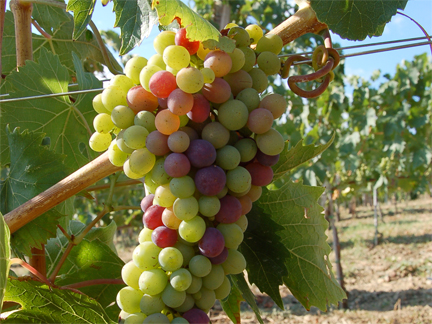
Another good friend, Laura, has been doing some amazing posts at the blog she authors for Il Palazzone. The photo above comes from a wonderful post she did showing the different ripening times in different growing zones of the winery’s estate.

One of things I’ve been enjoying about following Laura and Ale’s respective blogs is how it illustrates the subtle (and sometimes not so subtle) differences in the various subzones of the appellation.

In the case of Ale in the southwest subzone, the rate of ripening has accelerated slightly (80% of the grapes have changed color, he writes, catching up to the average) while Laura’s grapes are still about a week behind schedule. I love how she writes: “The ripening seems to be more than a week behind schedule, if it is appropriate to apply such concepts to nature.”

Check out Laura’s most recent post and Ale’s thread on the 2010 harvest in Montalcino.

In other news…

Another Brunello has been born with the 2010 vintage…

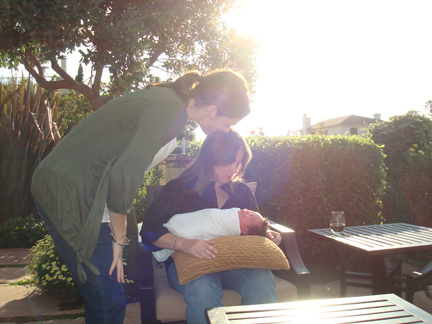
Over the weekend, Tracie P and I got to visit with our good friends Melanie and Noah, who have just welcomed Bruno into the world. Don’t they look angelic?

Noah and I grew up together (even attending Hebrew School together!) and luckily their stay in La Jolla overlapped with ours. Melanie has taken to calling the little one “Brunello.”

I still haven’t had a chance to pick up my copy but Melanie’s new book Eating for Beginners is now available.

Mazel tov, Melanie, Noah, and Bruno!

@Bruno I’ll be sure to put away some 2010 Brunello to drink with you when you turn 21!

Scenes from a Boda Mexicana and the best breakfast in Tijuana

boda mexicana

Above: Sandro and Julia were wed in a Saturday evening mass at the Iglesia de la Divina Providencia in Tijuana this weekend. What a beautiful wedding, what a gorgeous couple! When Julia knelt before the image of the Virgin Mary in the cathedral’s chapel and the soprano sang Schubert’s “Ave Maria,” both Tracie P and I had tears in our eyes.

The Castro and Parzen families have been closely related and intertwined for nearly four decades. The marriage of Julia this weekend to her beloved Sandro marked a milestone that none of us will ever forget. They were married in the same cathedral where brother Micah and I were ring-bearers (he nine years old, I eleven) in 1978 at the wedding of Teresa and Felix, Julia’s parents.

boda mexicana

And so mama Judy, brother Micah and sister-in-law Marguerite, Tracie P, and I drove to Tijuana on Saturday afternoon for the night.

boda mexicana

The reception was held in the Salón de Eventos of what many consider to be the best restaurant in Tijuana these days, Cien Años, in the Zona Río shopping district (my favorite part of the city).

The main course of our dinner was a wonderful mole blanco (a mole sauce made with white as opposed to dark chocolate) with a roast potato au gratin and a julienne of fresh squash.

boda mexicana

Before heading to the wedding, we had a cocktail at our hotel next door to the event space (the Hotel Real del Río, a moderately priced, full-service hotel, highly recommended).

cien anos

The next morning, we had a fantastic breakfast at Cien Años, which opens every day at 8 a.m., btw. The main dining salon there is one of those magical rooms.

cien anos

I envied Tracie P’s crepas (crêpes) drowning in a mango and habanero sauce…

cien anos

…and stuffed with zucchini blossoms, mushrooms, and serrano peppers. Amazingly good… We used to dine regularly in Tijuana when during my college and grad years at UCLA. There are so many great places to eat there.

cien anos

Chelsea Clinton may have had the wedding of the year, but Julia and Sandro had the wedding of a lifetime! :-)

Muchisimas felicidades!

One more from California (WARNING: CONTAINS EXTREME FIG CONTENT)

wedding cakes

Just had to add these photos quickly before we head out for the next adventure: we had a great lunch at Michele Coulon Dessertier, who created our wedding cake earlier this year. Most people think of her café purely for dessert, but her savory menu is FANTASTIC. All of her ingredients sourced for local growers, like the salad above, most of which came from San Diego’s famed Chino Farms.

wedding cakes

We try to eat at Michele’s every time we’re in La Jolla.

wedding cakes

Every time we visit Michele, it brings back such a great memory of our wedding cake! :-)

Now it’s time to get dressed up and head south…