Hemingway’s Valpolicella and the Quintarelli Legacy

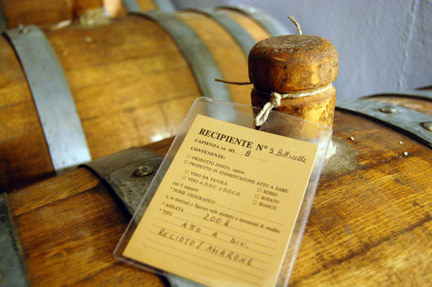
Except for the cover of Hemingway’s novel below, all the images here were captured when we tasted at the winery in January 2011.

In 1949, as he lay dying (or convinced that he was about to die as the result of hunting accident) in Venice, Ernest Hemingway famously drank Valpolicella. His brush with death and his love of the wines of the Valpolicella are fictionalized in Across the River and into the Trees (Scribner 1950), a novel he thought would be his last. The main character, Colonel Cantwell (a lightly veiled autobiographical figure), always seems to have a bottle of Valpolicella at hand’s reach, even though the Colonel believes “that the Valpolicella is better when it is newer. It is not a grand vin and bottling it and putting years on it only adds sediment.”

Some 25 years later, in the landmark Vino al Vino, the great Italian wine writer Mario Soldati reluctantly called Quintarelli’s wine the “closest” to the wine that Hemingway loved, adding “I’m not saying it’s the best Valpolicella on the market” (Soldati’s preferred “artisanal” Valpolicella — yes, artisanal, that’s the term he used in 1975 — was Galtarossa).

Both texts open a window onto how Valpolicella and its wines were perceived in the post-war era — in Italy and abroad (in his 1950 review of Hemingway’s novel in The New Yorker, Alfred Kazin wrote, paraphrasing the novelist, that “Valpolicella is better poured from flasks than from bottles; it gets too dreggy in bottles”).

Giuseppe “Bepi” Quintarelli — the son of the man who made the wines that Soldati tasted — was born on March 16 19, 1927 and died yesterday at home in Negrar after succumbing to a long battle with Parkinson’s disease.* It wasn’t until the 1980s that he began to experiment in his family’s vineyards and cellar, ultimately creating some of the world’s most coveted, collected, and expensive wines.

“Bepi was a deeply religious man,” said winemaker Luca Fedrigo, 33, who spoke to me early this morning from Santa Maria di Negrar in the Valpolicella. Luca worked side-by-side with the maestro for 10 years, from age 17 to 27, from 1992 until 2002.

“All of his vacations were religious [in nature]: Rome to see pope Pius XII; Lourdes; and the Holy Land. But in the 1980s he also made a trip to Burgundy, where he discovered that the soils there were similar to the [Morainic] soils of the Valpolicella. That’s when he began to believe that we could make great wines here.”

“He was self-taught,” said Luca, “He learned early on that the priest of the village and the bishop of Verona were willing to pay well for quality wines. Priests always like the finest things in life. He was always experimenting, in the vineyard and the cellar, constantly looking for ways to make better wines.”

Leafing through the many tomes on Italian wine that inhabit our shelves at home, I discovered that Anderson (Vino, 1980) and Wasserman (Italy’s Noble Red Wines, 1985) both parsimoniously cite Quintarelli as one of the best “traditional” producers but do not give him the praise that Belfrage would later bestow in 1999 in Barolo to Valpolicella.

“One realizes in his presence,” wrote Belfrage, “as he draws samples from this barrel and that, intently studying your expression and your words as you taste and comment, that it is this attention to every detail which constitutes the difference between the great and the good in artisanal winemaking.” (Note the quasi-apologetic use of artisanal.)

Today, Quintarelli’s Amarone and Recioto, as well as half bottles of his rare white Amabile “Bandito”, command upward of $300 a bottle retail in the U.S.
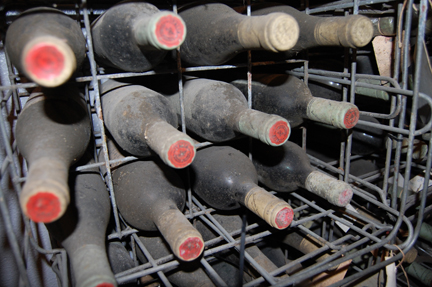
In Negrar, Quintarelli was no mere artisan but rather a maestro and a patron saint and protector.

“Bepi departed with the same discretion with which he lived,” said Luca.

“He was one of the most generous persons in Valpolicella,” he recounted. “His gave generously to help children in Africa and he never hesitated to help people from the village who needed help. And he was always happy to share the secrets of his winemaking. For him, there were no secrets.”

Luca, who at Bepi’s encouragement launched his own winery some years ago and continues to make wines in the same style, was one of Bepi’s students. The other was Romano Dal Forno, considered by many the father of modern-style Valpolicella.

“Whatever the style, Bepi taught us how to reach for quality in winemaking. And as generous as he was, he could also be severe” in his criticism. “We both learned from him.”

“I think of him as the nonno dell’Amarone,” the grandfather of Amarone. “When [his daughter] Silvana called me yesterday to tell me that he had passed way, I had a long cry. I couldn’t help it,” said Luca, whose emotion was palpable over the intercontinental connection.

It’s been amazing to see the internet reaction to Quintarelli’s passing. Knowing the focus, beauty, and spiritual clarity that Bepi sought in his life on earth (and in his wines as an expression of that earth), it’s not surprising…
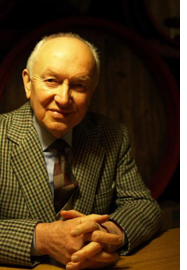
Giuseppe Quintarelli has died…

If you’ve landed here, please see today’s post on Quintarelli with remembrances by his student Luca Fedrigo.

Italy’s top wine blogger Franco Ziliani has just posted the news that the great master of Valpolicella — one of the greatest winemakers of our lifetime — Giuseppe Quintarelli has died (photo via Wineries Wine).

I never had the chance to meet Quintarelli but I interviewed him on three occasions by phone. He was always very gracious, gentle, and jocular and he seemed to take great pleasure in speaking with the “American with the Veneto cadence.”

His passing comes after a long and debilitating battle with Parkinson’s disease.

Here’s my post on our visit to the winery last year (and here’s the thread of all my posts on Quintarelli and the wines).

And see also Elisabetta Tosi’s excellent post for Palate Press here.

I can remember every one of his wines that I’ve had the great pleasure to taste (like a 1993 Recioto della Valpolicella in magnum that I tasted in New York in 2005, one of the best wines I’ve ever had).

As he passes from this world to a better one, I know that his legacy will live on in his wines and a generation whose sensibilities were shaped by them… We are lucky to have had him — and the wines — here among us…

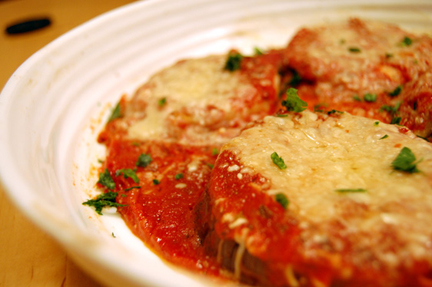
Melanzane alla parmigiana (Eggplant alla Parmigiana) my recipe

From my post today for the Houston Press

Slice one medium-sized black beauty aubergine into ¼-inch rounds (I know that you Solanaceae geeks out there would cringe if I called a western variety eggplant). Arrange in a colander and sprinkle with kosher salt. Set aside for 30 minutes to purge its bitter liquid.

Pre-heat the oven to 350° Fahrenheit.

In the meantime, make the tomato sauce by sautéeing 1 or 2 peeled whole cloves of garlic, 2 tbsp. finely minced onion and 1 tbsp. finely chopped well washed flat-leaf parsley in extra virgin olive oil (reserve a tbsp. of flat-leaf parsley to finish the dish). Add your favorite tomato purée (ideally unseasoned; my favorite is the Central Market brand in bottle). Season with 1 bay leaf, and salt, pepper, and chili flakes to taste. Once the tomato has begun to simmer, add ½ cup of white wine. By the time the eggplant has entirely purged its liquid, the sauce will be ready.

Grease a medium-size, oven-ready, deep casserole dish with unsalted butter. Distribute the aubergine rounds in the bottom of the dish and sprinkle generously with freshly grated domestic cow’s milk mozzarella. Pour the sauce into the dish, making sure to cover the aubergine completely. Top generously with freshly grated Parmigiano Reggiano and bake until the Parmigiano Reggiano begins to brown.

Serve hot sprinkled with finely chopped flat-leaf parsley.

In summer, when locally grown fresh basil is available, use the basil instead of the flat-leaf parsley. This dish is best if you can prepare it beforehand and let it cool, reheating it immediately before you serve it.

Friuli meets Japan @UchikoAustin

It’s not everyday that you dine at one of the top Japanese restaurants in the country with the woman who wrote its cookbook. Last night I finally caught up with Jessica Dupuy and executive (and celebrity) chef Tyson Cole who took time out to talk about some of his dishes and his approach to cooking at Uchiko with me and travel and wine writer, my friend Bruce Schoenfeld who was in town on business.

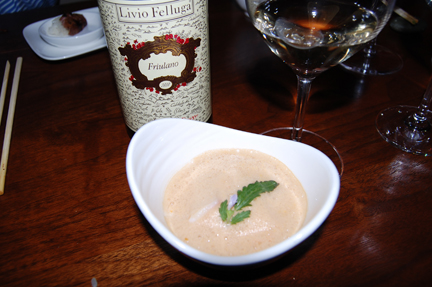
Bruce suggested we pair the [Tocai] Friulano by Livio Felluga with a dish of uni, cuttlefish, and lemongrass (above). The minerality and grassy aromatic character of the wine worked gorgeously with Tyson’s creations. I’ll let the food do the talking…

Nantucket bay scallop with nasturtium blossoms, cantaloupe sorbet, and sherry vinegar.

Buri sashimi with pickeled hakurei turnip, saikyo miso, and crème fraiche.

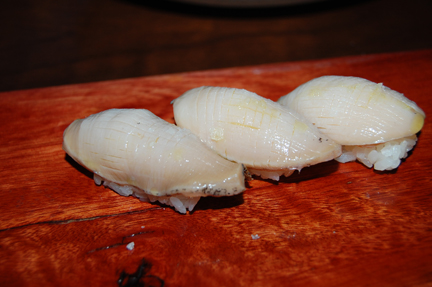
Abalone nigiri with lemon, maldon, and garlic.

Yokai berry with Atlantic salmon, dinosaur kale, Asian pear, and yuzu.

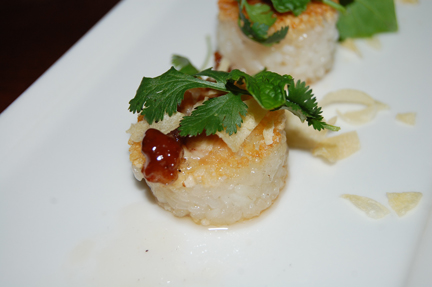
Dewberry Hills farm chicken, short grain sweet rice, banana leaf, and Thai chili vinegar.

Prosecco, lies, and videotape: the real story behind the new wave Prosecco

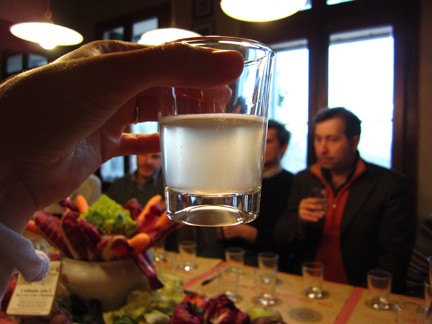
Above: Until the 1970s, before pressurized “autoclave” tanks were introduced into the appellation, most Prosecco was double-fermented in bottle “on its lees.” The resulting wine was gently sparkling, cloudy, and still had the “fondo” (sediment) in the bottom of the bottle. Even when I lived and worked in the Veneto in the 1990s, it was a lot easier to find Prosecco “col fondo” (with sediment) than it is today. The traditional glass for Prosecco is the one pictured above.

Alan Tardi is one of the great wine writers and restaurant professionals of our generation. I had the chance to meet him a few times when I lived and worked in New York and I’ve greatly appreciated and admired his work (especially this wonderful 2006 article on Asprinio).

But he gets it wrong in today’s New York Times article on Prosecco and its (relatively new) DOCG, “Prosecco Growers Act to Guard Its Pedigree.”

Maybe it was not Alan but his editor at the Dining section who hand-crafted the title (a “pedigree” for Prosecco?). But it was certainly Alan who wrote the oxymoron “sophisticated prosecco.”

The Italian wine writers scratched their head incredulously when then-agriculture minister and native of Treviso where Prosecco is made, Luca Zaia, effortlessly pushed through legislation creating the Prosecco DOCG.

Does a humble wine like Prosecco — and by its very nature, Prosecco should be a humble wine — deserve to be elevated to the status of wines like Barolo and Brunello di Montalcino? asked pundits like Italy’s top wine blogger, Franco Ziliani.

Yes, it’s true, as Alan notes, that the new DOCG (which went into effect in April 2010) gives the wines raised in Conegliano and Valdobbiadene a bureaucratic distinction that sets it apart from Prosecco grown in Friuli, Piedmont (yes, Piedmont), and Australia. But this DOCG was just one of many that were created before Common Market Organization reforms went into in 2009, shifting the power to create new designations from Rome to Brussels. It’s one of the many examples of political spoils that Zaia lavished on his hometown before his boss Berlusconi was forced out by the international community.

And yes, it’s true that the biggest names in commercial Prosecco — Adami and Ruggeri are among those that Alan tasted for the piece — are making “heirloom” vintage-dated and vineyard-designated wines, as well as low-sulfur and even lees-fermented wines.

But these products are the result of attempts by the Prosecco industrial complex to appeal to the hipster sommelier crowd.

In fact, excellent col fondo Prosecco has been produced for many years now by an ever expanding group of small growers (see this post on our col fondo tasting last year). This is the bona fide new wave of Prosecco.

Costadilà is one of those wines and has been available in the U.S. for a few years how. And Coste Piane, which has also been available here for many years, has been making and marketing true Prosecco for as long as anyone can remember. More recently, col fondo producer Bele Casel has shipped its wines to North American shores.

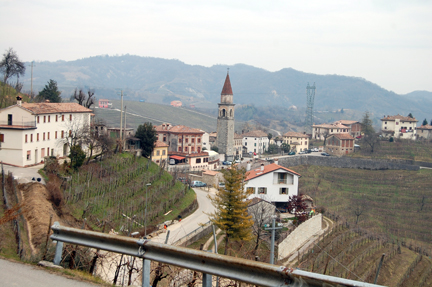
Above: The village of Rolle (not Passo Rolle, the mountain pass, btw) lies at the epicenter of the Prosecco appellation. Nearly equidistant from Conegliano and Valdobbiadene. Most locals would argue that Conegliano is where Prosecco was born as an appellation, even though Valdobbiadene has eclipsed its sister village.

And on a technical note, in Italian and Veneto dialect (including the dialect of Treviso), rive is the plural of riva, which does indeed denote hillside or slope (analogous to costa in Prosecco parlance). The rive system doesn’t denote a single growing site, as Alan implies: it denotes a series of slopes set apart for their topographical designation.

While I’m not a fan of Ruggeri, there’s nothing wrong with a glass of any of Adami’s wines. But they don’t represent real Prosecco. They are an expression of the consumerist hegemony that has choked my beloved trevigiano since the 1990s when Prosecco became a brand in the U.S.

I know I’m splitting hairs here and I remain Alan’s loyal admirer.

His oversights are harmless in the big (commercial) scheme of things and not nearly as bad as those in a Times piece this week in which Eric Pfanner ingenuously believes that a Paris wine shop owner is affected by Robert Parker’s “downgrade” of a 1998 Châteauneuf-du-Pape.

    I have no intention of second-guessing Mr. Parker, who has been tasting, and championing, the wines of Châteauneuf-du-Pape for decades. But the change in his score for the 1998 Beaucastel highlights the challenges of encapsulating something as complex, subtle and capricious as a fine wine in a single number.

The moment of truth has arrived: it’s high time that we begin questioning the wisdom of Robert Parker’s rating system! It’s enough to make you think that the editors at the Times Dining section only recently discovered bread and butter…

O, Eric the Red, where art thou? O, Solomon among wine writers!

Sexy girls and sommeliers: an Italian recipe for controversy

Anyone who has ever been to Italy (and especially anyone who’s ever watched an Italian primetime variety show) knows that sexy girls often appear there in the strangest places.
The models are called veline (a word that doesn’t come from velo or veil but rather the French vélin, akin to vellum, i.e. fine parchment obtained from calves’s skins; it was first used in its current meaning in the late 80s on the show Striscia la notizia where, by metonym, it was used to denote the models who presented cue cards, called veline in Italian editorial parlance, to the show’s stars).

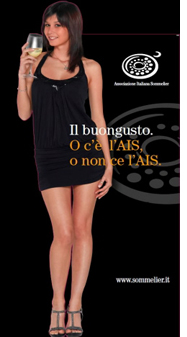
The Italian Sommelier Association’s (AIS) use of a velina (left) in one of its promotional campaigns stirred controversy late last year (December 27) when one of Italy’s top wine bloggers, Alessandro Morichetti, pointed out that the model is holding her glass incorrectly. The story was picked up on Monday of last week by Luciano Ferraro, a blogger for one of Italy’s leading newspapers, the Corriere della Sera. “The veline sommeliers have arrived,” he wrote.

Later in the day, in a post entitled “AIS, Good Taste, and Blow-Up Dolls,” Laura Rangoni, blogger for one of Italy’s leading glossy magazines, L’Espresso, wrote that she was offended by the campaign’s sexual and body-image implications, saying that she was going to cancel her membership in the body (no pun intended). The “good taste” of the association had sunk to new lows, she wrote, especially when the campaign centered around the slogan: good taste: either you have it or you don’t (playing on the assonance between the second personal singular of the verb avere, hai, and the association’s acronym AIS).

By Thursday, a spokesperson for the AIS issued a press release in which he reproached Morichetti for posting false information and Rangoni and Ferraro for alleged sloppy journalism.

It’s enough to drive you to drink!

Another AIS controversy unfolded late last year when the body ended its longstanding relationship with top Italian wine blogger Franco Ziliani, who, for more than three years, curated a recurring “WineWebNews” column for the association’s site, a monthly round up of wine blogging from Italy and around the world. It enjoyed a wide following in the Italian enoblogosphere, in part because it offered readers a view beyond Italy (Franco synopsized and translated salient quotes from English-language blogs). As southern Italian wine blogger Luciano Pignataro observed, the move came after the AIS hired ex-Gambero Rosso editor Daniele Cernilli as its head of marketing. (De gustibus non est disputandum.)

“An Aristotelian syllogism could be applicable in this case,” wrote Luciano. “Cernilli is named as director of marketing. Cernilli detests Franco Ziliani. Cernilli rubs out Franco Ziliani.”

Inspired by a tide of appeals from readers, Franco has relaunched the column on his own blog.

My goodness… It’s enough to drive you to drink… and blog…

Pasolini’s Lagoon @GiampaoloVenica

From my good friend @GiampaoloVenica:

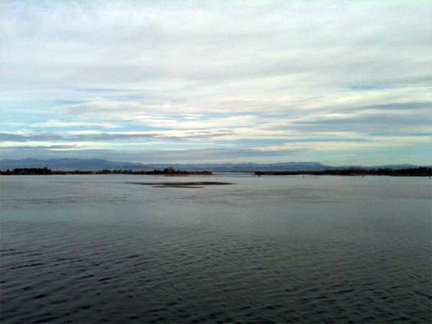
    Winter view from Grado island lagoon now I understand Pasolini inspiration coming out from.

    For you Jeremy pic.twitter.com/9s5G7qgx

I’m in love for the first time…

I’m in love for the first time
don’t you know it’s gonna last
it’s a love that’ll last forever
it’s a love that has no past

The Saint of Sangiovese Gambelli

Yesterday, I received yet another round of remembrances of the great Giulio Gambelli (who passed away a few days ago), including one by my good friend Francesco Bonfio, president of Vinarius, the association of Italian wine shops.

    He was an exquisite, deeply humble person whose humility was rivaled only by his extraordinary knowledge of Montalcino and especially Chianti Classico. Every time I saw him at the presentations of new vintages he would whisper to me the names of two or three wines that I should taste. But he didn’t just say the name of the farm: he noted the vintage, category, and often the vineyard, specifying this one, yes and this one, no. And they were all his wines. But at the same time, being the great gentleman that he was, he would also point out wines from wineries that he had just tasted — wines, although not his own, that had piqued his interest. Honestly, I’d have to say that he was more apt to praise these than his own creations.

For all the bitter discord that inhabits Montalcino and Chianti Classic and the continuing acidic debate over the inclusion of international grape varieties in Montalcino and Chianti Classico, the hagiography of Gambelli has united the entire spectrum of Tuscan grape growers, winemakers, wine writers, and lovers.

If, in vita (in life), this man championed Sangiovese in purezza (in purity) as Tuscany’s greatest and ultimate vinous expression, let us hope that in morte (in death) his legacy will continue to inspire all of us to transcend our earthly weakness.

Sit tibi terra [tuscolana] levis Juli.