Way to GO brother Micah! Brilliant, simply brilliant… :-)

Lots of reasons for smiles in the Parzen family these days. :-)

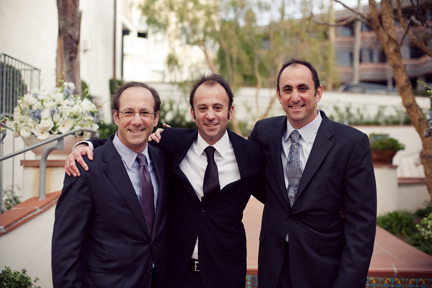
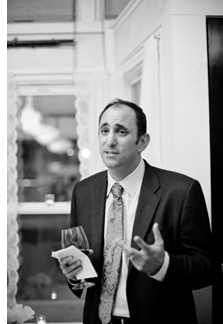
I’ve known for a week or so but had to keep a lid on it: brother Micah (right, giving a toast at our wedding) has landed what might just be his dream job, the Executive Directorship of San Diego’s Museum of Man.

Here’s what he had to say on his Facebook:

Micah David Parzen is OVER THE MOON to announce that, beginning August 9, he will be the new Executive Director of the San Diego Museum of Man in Balboa Park! Stay tuned–and jump on board–for great things facebook friends! I can use all the support I can get!

(Check out this link to an article in the San Diego paper of record, The Union-Tribune.)

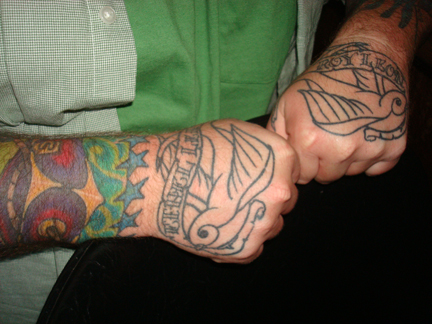
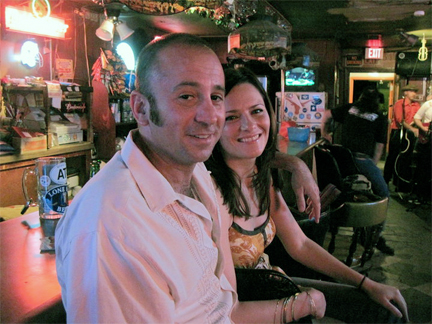
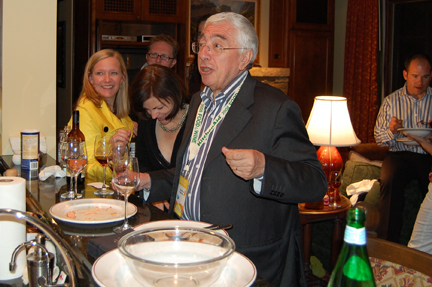
Above: The brothers Parzen: Tad, me, and Micah. We sure clean up nicely, don’t we? ;-)

You see, brother Micah isn’t just a partner in one of San Diego’s top law firms. He also has a Ph.D. in anthropology. He filed his dissertation “‘Culturally Appropriate’ Mental Health Care: Wilderness Therapy for Navajo Youth” in 2000 at Case Western.

Dude, we are so stoked for you… Congratulations and double mazel! It’s simply brilliant. :-)

Maybe it’s the way she grates her cheese: Tracie P’s rice balls

Maybe it’s the way she grates her cheese…

Above: When Tracie P asked me what I wanted for my Sunday night birthday dinner, I told her I would love her fantastic ragù. It was great as always, but she surprised me with RICE BALLS. Unbelievably good…

Whether its Faicco’s in the City or the Focacceria di Ferdinando in Brooklyn, Tracie P knows that I love me some Sicilian rice balls. On Sunday she made me one of my favorite dishes of hers, her ragù, but she surprised me with fried rice balls: stuffed with Brooklyn-style domestic mozzarella, using some leftover risotto alla parmigiana that I had made with Arborio earlier in the week for supper.

Or just the freckles on her knees…

Above: Did I mention that the GIRL CAN COOK?

She ALSO surprised me with a bottle of 2004 Sagrantino di Montefalco by Paolo Bea. This wine, at once extremely tannic and ethereal in the mouth, achieves that magic balance of simultaneous power and lightness in the mouth. It showed stunningly well last night and was such a great pairing for Tracie P’s stellar ragù alla bolognese (via Marcella Hazan).

Maybe it’s the scallions…

Above: Our favorite dried (pastasciutta) egg tagliatelle are made by Rustichella d’Abruzzo. Isn’t funny how Tracie P and I agree on the important things in life? ;-)

My good friend Charles Scicolone is not the only one “blessed” by his wife’s amazing cooking!

Maybe she’s Italian…

blueberry pie

Above: She also made me a DELICIOUS fresh blueberry crostata, a tradition for my birthday started by mama Judy.

My goodness, Tracie P, what a wonderful birthday week (I’ll have to hope my birthday falls in the middle of the week again next year!). I love you so… :-)

The lady sticks to me like white on rice…. She never cooks the same way twice…*

Above: We’ve been having so much fun with our new Polaroid 300 instant camera.

Rev. and Mrs. B and the B family gave me a power drill for my birthday over the weekend when we visited with them on Canyon Lake in the Texas Hill Country. We SO NEEDED it for our little home and the new library I’ve been setting up. :-)

Thanks, so much Rev. and Mrs. B and B family!

Birthdays used to be a nagging reminder of all the things I haven’t done yet in life. Now they remind me how lucky I am to be surrounded by wonderful folks who share such rich love and warm joy for living with me. Thanks again, also, to everyone for all the warm birthday wishes this week on Facebook, Twitter, and here at the blog… I’ve got so much to be thankful for this year… The words of support mean so much…

* “Eggplant” 1975 (same vintage as Tracie P!) by Michael Franks (my fellow La Jollan)

In other news…

Everyone in Italy is reading BrooklynGuy’s excellent post on old vintages of Vallana Spanna. Be sure to check out Alfonso’s comments to the post as well.

Ginny appreciation week at the Little Longhorn Saloon: No Cussin’, No Fussin’, No Hasslin’, No Wrasslin’!

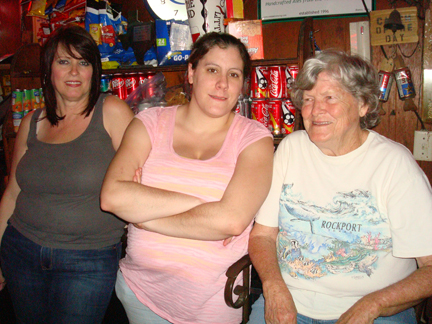
Above, from right: three generations of Ginny, Ginny Kalmbach, her granddaughter, and her daughter. All three manage this national treasure.

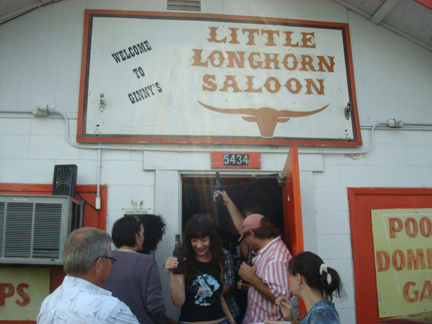
On Friday night, Austin music icon Dale Watson emceed “Ginny Appreciation Night” at the Little Long Horn Saloon in Austin, Texas (on Burnet Road, on the north side of town, not far from where Tracie P and me live).

ginny's little longhorn saloon

Above: I’ve been to many great honky-tonks across our fine nation but Ginny’s — let me tell you, people — is something special (and I say this in a town famous for its honky tonks).

We were at Canyon Lake (in the Texas Hill Country) with family on Friday night but we took friends Brenna and Jason, who were in town from Orange, Texas there last night: no night on the town in Austin would be complete without a stop at Ginny’s.

Above: Ginny showed us her new Lone Star hat, which she had made especially for her.

Ginnny’s real fond of Tracie P (can you blame her?) and every time we visit, she and her daughters ask to see her wedding ring. There’s a sign up at Ginny’s that reads: “No Cussin’, No Fussin’, No Hasslin’, No Wrasslin’!”

jww and the prospectors

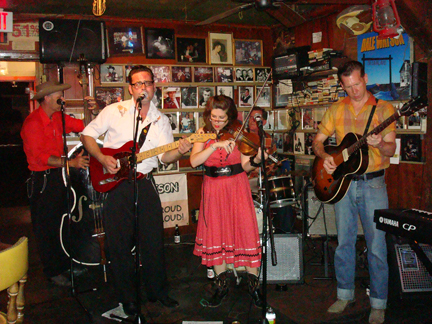
Above: Last night, JWW and the Prospectors were playing. You really can’t go wrong at Ginny’s. I’ve been blown away by the caliber of musicianship we’ve seen there.

Folks like Ginny rarely win Kennedy Center Honors or Congressional Medals but, man, she and her saloon are true national treasures, if only for the traditions and music that she fosters and if not for the immense joy that she brings into so many folks’s lives with her bright spirit and motherly affections.

Above: You’d expect Jason to get your back in a bar fight but you wouldn’t expect him to turn to his lovely wife Brenna and say, “damn, it honey! I forgot to cook that beautiful asparagus we have in the fridge.” Jason is an amazing cook and writes a food blog via Facebook. He and I also share an obsession and fascination with Doug Sahm. But more on that later.

Ginny’s was one of the first places Tracie P took me when I started coming out to Austin to visit her. Whether it’s with friends visiting from out-of-town on a Saturday night or just getting our honky tonk on on a Tuesday, we try to get there as often as we can.

Above: If you ever meet a woman who loves country music and knows how to play Chicken Shit Bingo and speaks Italian and cooks a mean ragù, thank your LUCKY STARS!

Ginny, we can’t imagine a world without you.

My first (and last) gulf oyster

Above: You had me at hello… The oven-roasted gulf oysters at Cochon in New Orleans, in February 2009.

Reading The New York Times this morning as I munched my quesadilla (topped with “casera” salsa by Herdez, which, btw, you must look for in a can as opposed to jar, because it just tastes SO much better), I found myself entirely mesmerized by the “domino effect of lives touched” described in this article and I couldn’t help but remember my first gulf oyster (above), masticated in New Orleans not long after I moved to Texas, back in February 2009.

Will it be my last?

Above: Before the BP oil spill, it was common to serve endless raw gulf oysters at crawfish boils and other summer gatherings. This year, it’s not.

Gulf oysters are in short supply these days in the wake of the oil spill and subsequent catastrophe but I trust and hope they will rebound. Check out the Times article. It’s fascinating… My favorite passage:

    And yes, the captain eats oysters. Using a short knife, he pops the seal of a just-harvested oyster with safecracker élan, makes a cut, and slurps the wild goop down.

Buon weekend, ya’ll!

The James Suckling era ends (and what we ate and drank for my birthday)

poggione

Above: We treated ourselves to a bottle of 2004 Il Poggione Brunello di Montalcino and porterhouse steak last night in celebration of my birthday. When we planned this classic Tuscan meal, I had no idea that my birthday would also deliver the news that James Suckling had left the Wine Spectator.

Yesterday, as we were preparing for birthday and Bastille Day celebrations chez Parzen, the following news arrived via email from a colleague and friend:

    James Suckling, who joined Wine Spectator in 1981 and has served as European bureau chief since 1988, has retired from the company.

    Suckling’s tasting responsibilities have been reassigned. The wines will be reviewed in our standard blind-tastings in the company’s New York office.

    Senior editor and tasting director Bruce Sanderson will oversee coverage of Italy. Sanderson, who has been with the magazine for 18 years, currently reviews the wines of Burgundy, Champagne and Germany.

fiorentina

Above: To make a proper “bistecca alla fiorentina” at our house, we season the porterhouse generously with kosher salt, rubbing the salt into the meat, and then we char the T-bone, with the steak upright.

Neither Tracie P nor I could ignore the uncanny coincidence that we had decided to open a bottle of 2004 Brunello di Montalcino by Il Poggione, a traditional-style wine made by a family who has vehemently and vociferously opposed the modernization of its appellation. There’s no two ways about it: during James Suckling’s tenure at the Wine Spectator, the scores he gave to modern-style Brunello — with Casanova di Neri as its poster child — helped to eclipse the sale of traditional-style wines, like those made by Il Poggione. (In all fairness, Suckling also gave good scores to Il Poggione but his historic preference for dark, concentrated, oaky Brunello with higher alcohol levels, indisputably skewed his evaluations toward modernism.)

fiorentina

Above: Then you cook the steak on either side, very quickly at high heat. By cooking the steak upright first, the meat “heats through” entirely.

Another layer of irony was cast upon the news and our Brunello by the fact that Mr. Franco Ziliani — at times Mr. Suckling’s detractor — had suspended publication on his wine blog Vino al Vino, the leading Italian-language wine blog, a few days earlier. (Mr. Ziliani’s relationship with Mr. Suckling is even referenced by the author of the Wiki entry on the Italian wine writer.) “A pause for reflection,” wrote Mr. Ziliani on Monday, a search for “clarity” in his life and for a sense of purpose for the blog, he explained. “To blog or not to blog,” he asked rhetorically.

fiorentina

Above: High heat is the key to searing and caramelizing the fat on the outside of the steak while leaving the meat in the center tender and nearly raw.

The two events are certainly unrelated but their confluence is rich with meaning. We often forget that that the current economic crisis has affected both the wine industry and the publishing industry. Hawking wine is no easy tasks these days (especially when it comes to high-end, luxury wine like Brunello) and hawking newspapers and magazine is even harder.

fiorentina

Above: Traditional style Brunello and steak, one of the great gastronomic pairings in the Western Canon. (Honestly, I wish I would have used a slightly shorter cooking time. I prefer my steak “black and blue,” charred on the outside, blood rare on the inside. But it was delicious nonetheless!)

While I’ve been a devoted fan of Mr. Ziliani’s blog since I first discovered his writing more than 5 years ago, I can’t say that I’ve been such an admirer of Mr. Suckling’s take on Italian wine. In fact, I think that Suckling historically ignored and omitted the great icons of Italian wine from the canon of the Spectator’s “top wines of the world” because he was looking for wines that appealed to his idiosyncratic sensibility without viewing them in a broader scope and without consideration for the wines that Italians consider to be indicative of their winemaking tradition. At the same rate, looking back on Suckling’s legacy (however skewed) as an arbiter of Italian wine, I feel compelled to acknowledge his contribution to the world’s awareness of the overarching greatness of Italian wines.

fiorentina

Above: Potatoes, spinach, grilled onions, and steak, all dressed simply with kosher salt and extra-virgin olive oil.

And so we raised a glass of 2004 Brunello di Montalcino by Il Poggione last night, to both Mr. Suckling and Mr. Ziliani, polar opposites in their approach to Italian wine, leading voices of antithetically positioned vinous philosophies. I hope and trust that both will continue to share their impressions and palates, using whatever media they see fit, with a world ever-thirsty for Italy’s unique wines.

Rewind: The origins of sugo alla puttanesca?

Taking a break today and reposting something from the days when Do Bianchi was just getting started. One of my favorite posts. Little did I know at the time that I would meet and marry a wonderful, beautiful lady who had lived on the island of Ischia and who makes the best puttanesca I’ve ever tasted… Thanks for reading! And happy Bastille Day!

Above: spaghetti alla puttanesca. There’s one thing we can all agree on: “sugo alla puttanesca” (literally “whoreish sauce”) is made with tomatoes, olives, capers, salt-cured anchovies, garlic, and chili flakes (give or take an ingredient or two). There’s no questioning that it tastes good.

In the wake of my post-new-year’s eve post “Taittinger alla puttanesca”, fellow bloger Marco wrote me, collegially questioning my belief that “sugo alla puttanesca” should not be attributed to prostitutes or their culinary preferences. I promised Marco that I would do some more research and another post. Here’s what I found:

1) the earliest text to reference pasta “alla puttanesca” cited by the Grande dizionario della lingua italiana (edited by Salvatore Battaglia) is Raffaele La Capria’s 1961 novel Ferito a morte (translated as The Mortal Wound, 1962).

2) according to a study commissioned by the Unione Industriali Pastai Italiani (Italian Pasta-Makers Union), pasta “alla puttanesca” first became popular in Italy during the 1960s.

3) a search in The New York Times electronic archive revealed that the first mention of “puttanesca” sauce in the paper was made on January 28, 1972 by restaurant reviewer Jean Hewitt in her review of Trattoria da Alfredo (then located at 90 Bank street): “spaghetti Puttanesca [sic], which has a tantalizing tomato, garlic, anchovy and black olive sauce.”

4) in her landmark tome on Neapoitan cuisine, La cucina napoletana (1977), Jeanne Carola Francesconi attributes the creation of sugo alla puttanesca to Ischian painter Eduardo Maria Colucci (1900-1975) who — according to Francesconi — concocted “vermicelli alla puttanesca” as an adaptation of alla marinara or “seaside-style” sauce.

But the definitive albeit anecdotal answer to this conundrum may lie in an article published by Annarita Cuomo in the Ischia daily, Il golfo, in February, 2005: “Il sugo ‘alla puttanesca’ nacque per caso ad Ischia, dall’estro culinario di Sandro Petti,” “Puttanesca sauce was born by accident in Ischia, the child of Sandro Petti’s culinary flair.”

According to Cuomo, sugo alla puttanesca was invented in the 1950s by Ischian jet-setter Sandro Petti, co-owner of Ischia’s famed restaurant and nightspot, the “Rancio Fellone.”* When asked by his friends to cook for them one evening, Petti found his pantry bare. When he told his friends that he had nothing to cook for them, they responded by saying “just make us a ‘puttanata qualsiasi,'” in other words, “just make us whatever crap” you have (see my original post for a definition of the Italian puttanata).

“All I had was four tomatoes, a couple of capers, and some olives,” Petti told Cuomo. “So I used them to make the sauce for the spaghetti.” Petti then decided to include the dish on the menu at the Rancio Fellone but “spaghetti alla puttanata didn’t sound right. So I called it [spaghetti] alla puttanesca.”**

Petti’s anecdote is probably tenable but is by no means exhaustive (from a philological point of view). To make matters worse, Colucci was Petti’s uncle and it’s unclear why Francesconi attributes the dish to the painter. But philology is an inexact science: the origin of sugo alla puttanesca probably lies some where between the isle of Ischia and the Amalfitan coast, where tomatoes, capers, olives, anchovies, and garlic are ingredients of choice. It’s clear that the dish emerged sometime after World War II when tomato-based sauces grew in popularity among the Italian middle class. My philological sensibility leads me to favor the “puttanata/puttanesca” theory over any other and there is no evidence — at least that I can find — that points to prostitution as the origin of the dish.***

There’s one thing we can all agree on: sugo alla puttanesca tastes good.

* A rancio fellone is a sea spider or spiny crab, a common ingredient in Mediterranean cuisine.

** Like the French à la, the Italian expression “alla” (the preposition a + the definite article la) denotes “in the style of” or “after the fashion of” and is always followed by an adjective (not a noun); alla puttanesca sounded better to Petti because puttanesca is an adjective (while puttanata is a noun).

*** In his Naples at Table (1998), the otherwise venerable but hardly philologically minded Arthur Schwartz reports a number of apocryphal etymologies whereby Neapolitan prostitutes are indicated — in one way or another — as the originators of this dish. He even goes as far as to write that a seemingly celebrated nineteenth-century courtesan, Yvette “La Francese” (Yvette the French [prostitute]), a native of Provence, may have created the dish to assuage her homesickness. The fact that the dish emerged during the 1950s would seem to dispel any romantic notions of pasta alla puttanesca in nineteenth-century Neapolitan bordellos. Brothels were outlawed in Italy in 1958.

A correction on white Musar and a Tracie P[olaroid] moment

Above: I met Serge Hochar, owner of Musar, a few years ago at a food and wine festival. Super nice guy and a lot of fun to be around. I’m not sure where he wrote or said this, but Georgios Hadjistylianou in Cyprus quotes him, “the harmony of nature is better than anything we could ever create. I believe it should be a priority to seek to drink what is ‘true’ rather than what is ‘good.'”

Reader Georgios Hadjistylianou in Cyprus was entirely right to write me, pointing out that Musar white is, in fact, made from Obeideh and Merwah, grapes indigenous to Mount Lebanon. (See a fact sheet on the wine here.)

He was writing me in reference to yesterday’s post on the super restaurant Marouch in Los Angeles. The restaurant listed the wine under “Chardonnay” but the other wine professionals with whom I dined were under the impression (as was I) that it was made from Sémillon.

Thanks, Georgios for the correction! :-) I can tell you — for certain — that the wine was delicious. ;-)
Obeideh and Merwah didn’t make it into Eric the Red’s (Eric the Green’s?) excellent post today on “a dozen obscure grapes that are the foundation of some wonderful wines and will reward intrepid explorers.” But I highly recomment both the wine (Musar) and Eric’s post to you.

In other news…

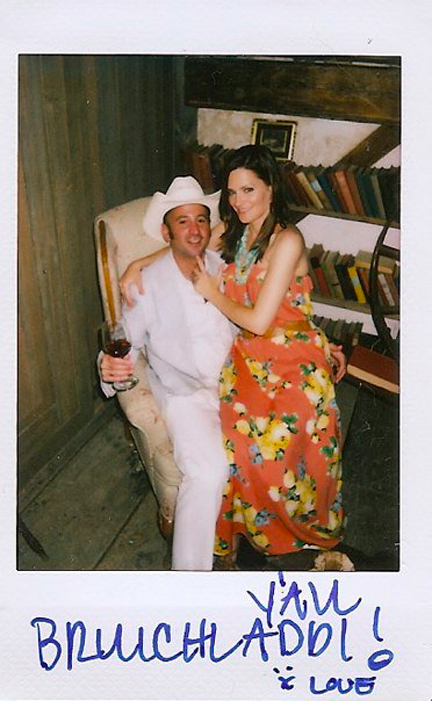
Couldn’t resist sharing this Polaroid moment from Kate and Dan’s wedding over the weekend. Among other fun activities, they had set up a Polaroid studio where you could take photos with some of the western artifacts lying around the Figueroa Mountain Farmhouse.

O my goodness, my Tracie P, you are the most mellifluous melody this singing cowboy has ever heard! I love you so! :-)

Wines I drank with Russian spies in LA at Marouch

Above: The 2000 Chateau Musar white (Sémillon) was FANTASTIC at Lebanese/Armenian restaurant Marouch in Los Angeles last night. At 10 years out, this wine is just coming into its own: oxidative and richly aromatic, with gorgeous nutty and stone fruit flavors.

Strained diplomatic relations between the two countries and the delicate nature of my mission as cultural attaché do not allow me to reveal the names of the persons with whom I dined last night. Let it suffice to say that they were all ethnic-Russian Jews who — at some point in their lives — have harbored sympathy for the Communist Party and/or own or have at one time owned a copy of Chairman Mao’s “Little Red Book.”

Above: Not to be missed at Marouch, the fried sardines. Serge, a wonderfully convivial host who came to this country more than 30 years ago, allows corkage in his fine establishment, which I cannot recommend enough.

Owner Serge Brady blew our communist party away with his superb cooking. I can’t believe I’ve almost reached 43 years of age without knowing about his restaurant. Amazing… While I was waiting for my friends, I sipped the Musar and noshed on turnips pickled in vinegar and red wine and cured olives. Perfection… simple and utterly undeniable and inconfutable perfection…

Above: My decoder ring was embedded in the Fattouch (Lebanese Salad).

Among other bottles opened last night, it was the Pascal Janvier 2009 Coteaux du Loir Rouge “Rosier,” made from Pineau d’Aunis, that captivated our senses more than any other. Some of my companions preferred it chilled, but espionage, my friends, is a dish best served température ambiante. Lip-smacking delicious wine. [PHOTO UNAVAILABLE FOR SECURITY REASONS!]

Above: Secret messages where imprinted in the Bastourma (Armenian Salami), which melted in your mouth after the for-your-tongue-only information was decoded.

But as if to prove the axiom that the signifier precedes the signified, it was another bottle brought by Comrade H, its contents now defunct, that contained the logogriphic dispatch with our orders.

Need I say more?

Get to Marouch AS QUICK AS YOU CAN!

In other news…

Readers of Do Bianchi have asked for it and here it is. A short video of The Grapes debut performance last week by the lovely Gross sisters (with whom I attended La Jolla High School). Enjoy!

Congratulations Kate and Dan! Mazel Tov ya’ll!

What a beautiful setting and gorgeous wedding in the Santa Ynez Valley!

This is just one of the amazing sunset photos that Tracie P took with our trusty Nikon.

Among other wedding duties, musical and otherwise, Dan enlisted me to play the hora.

I think it’s safe to say that I got the job done. ;-)

It was so great to see so many old friends, from NYC and LA, and to meet Kate’s family from Scotland.

Mazel tov, ya’ll!

It never rains in Southern California and “Italian wine from local vineyards”

Tracie P and I headed north from Los Angeles yesterday afternoon up the Pacific Coast Hwy 1. We stopped for a light dinner at one of my favorite college-days haunts, the Reel Inn. Inexpensive, family-friendly, fresh grilled fish, casual and classic beach comber setting. Love it. Right next to the Topanga Canyon Inn. Get the picture?

We found that “golden hour” driving up the coastal highway, some Willie and Merle on our juke box. Snapped that photo about 40 minutes south of Oxnard. Simply gorgeous…

Woke up in Solvang and had breakfast with Eileen and Greg, who are also heading to Dan and Kate’s wedding this afternoon. Looking forward to celebrating with them (and I gotta sing at the wedding!) and seeing so many good friends from LA (where the couple lives now) and NYC (where Dan and I and Greg played in NN+ for all those years.

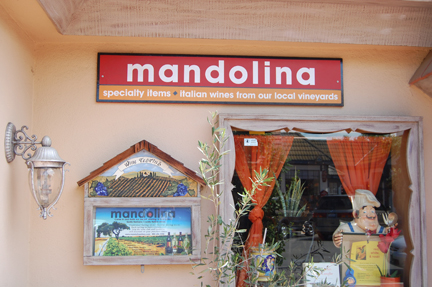
Even tasted some “Italian wine from local vineyards” in one of the many tasting rooms that pepper downtown Solvang. Honestly, the wines — made from Italian grape varieties — weren’t bad. Oaky (a big turnoff for me and Tracie P) but the Nebbiolo smelled like Nebbiolo. In other words, the wines were true to the variety. They just didn’t really excite me. I was a little nonplussed by the presence of Freisa in a “Super Tuscan.”

Gotta run: need to practice the hora (oy, the hora!) before we head up to the farmhouse in Los Olivos for the shindig… It’s bound to be a blast… Stay tuned… and thanks for reading…

O, and, btw, Alfonso on Calabria today at 32 Days of Natural Wine, not to be missed!