Harvest has begun in Tuscany and I’m heading to Montalcino

Catching up today in the wake of the holiday weekend, I read that harvest has begun in Montalcino.

I’ll be heading to Montalcino later this week: I’ll be visting and tasting with winemakers in Montalcino and Bolgheri starting this weekend and then, if all goes according to plan, I’ll be heading north for some interesting visits… but more on that later…

While in Montalcino, I’ll put my ear to the ground and try to find out what’s in store for Brunello. I’ll also be talking to winemaker Fabrizio Bindocci of Il Poggione about his role as the technical adviser to the Brunello producers association and his hopes for preserving traditional winemaking there.

And hopefully I’ll get an invite to dinner in the Bindocci’s home: remember the meal of pork glands and chestnut-flour polenta that signora Bindocci made for me and Tracie P in February?

Stay tuned…

Veraison wireless in Montalcino

My friend Ale at Il Poggione (Sant’Angelo in Colle, Montalcino) is not the only one who’s been posting about the 2010 vintage on his blog.

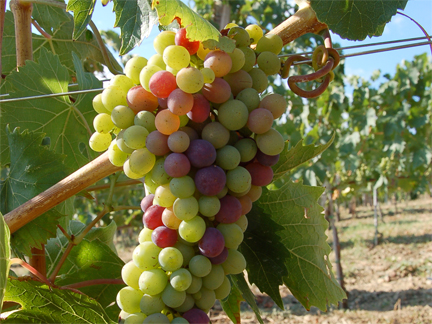
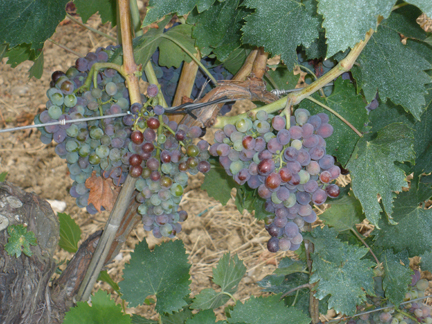
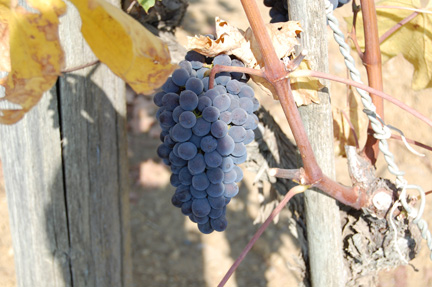
Another good friend, Laura, has been doing some amazing posts at the blog she authors for Il Palazzone. The photo above comes from a wonderful post she did showing the different ripening times in different growing zones of the winery’s estate.

One of things I’ve been enjoying about following Laura and Ale’s respective blogs is how it illustrates the subtle (and sometimes not so subtle) differences in the various subzones of the appellation.

In the case of Ale in the southwest subzone, the rate of ripening has accelerated slightly (80% of the grapes have changed color, he writes, catching up to the average) while Laura’s grapes are still about a week behind schedule. I love how she writes: “The ripening seems to be more than a week behind schedule, if it is appropriate to apply such concepts to nature.”

Check out Laura’s most recent post and Ale’s thread on the 2010 harvest in Montalcino.

In other news…

Another Brunello has been born with the 2010 vintage…

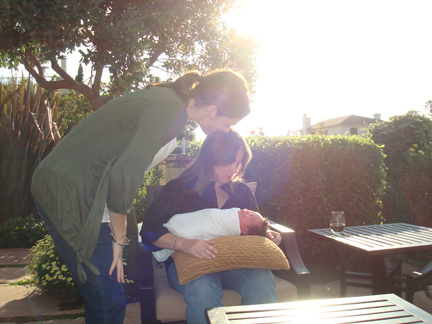
Over the weekend, Tracie P and I got to visit with our good friends Melanie and Noah, who have just welcomed Bruno into the world. Don’t they look angelic?

Noah and I grew up together (even attending Hebrew School together!) and luckily their stay in La Jolla overlapped with ours. Melanie has taken to calling the little one “Brunello.”

I still haven’t had a chance to pick up my copy but Melanie’s new book Eating for Beginners is now available.

Mazel tov, Melanie, Noah, and Bruno!

@Bruno I’ll be sure to put away some 2010 Brunello to drink with you when you turn 21!

Rivella, barbarian at the gate: the Brunello debate goes mainstream (WARNING: POST CONTAINS POETRY)

Above: The grapes are ripening about a week late in Montalcino but conditions are excellent, says Alessandro Bindocci (Fabrizio Bindocci’s son) in his blog Montalcino Report. Alessandro has been updating the blog regularly with harvest and weather reports.

Yesterday a friend emailed me this article in Reuters online, “Battle of Brunello exposes row over purity vs blends,” by top wine writer Robert Whitley, my fellow San Diegan. In it he summarized the events that led up to Ezio Rivella’s controversial election as Brunello producers association president and Fabrizio Bindocci’s passionate if unsuccessful bid to stop Rivella’s march of progress. (For a more detailed account of what happened in recent months in Montalcino, you can scroll and leaf through this thread here at Do Bianchi.)

    The controversy over the election has put the spotlight on growing divisions in the wine world as some producers take a more global approach to their craft while others stick to tradition.

    Opponents such as Bindocci are passionate defenders of the status quo and are convinced that the 77-year-old Rivella as the modern face of Brunello could put the soul of Brunello at stake.

Has Montalcino become the frontline in the global battle (“growing divisions of the wine world”) of modernism vs. traditionalism?

In a “why didn’t I think of that” moment, I thoroughly enjoyed Robert’s superb allusion to the great poem “Waiting for the Barbarians” by Greek poet Cavafy wherein he implied that Rivella is a “barbarian at the gate.” It’s probably more a propos than Robert bargained for, especially in the light of the uncanny parallels. Poetry lovers read on…

    What are we waiting for, assembled in the forum?

    The barbarians are due here today.

    Why isn’t anything happening in the senate?
    Why do the senators sit there without legislating?

    Because the barbarians are coming today.
    What laws can the senators make now?
    Once the barbarians are here, they’ll do the legislating.

    Why did our emperor get up so early,
    and why is he sitting at the city’s main gate
    on his throne, in state, wearing the crown?

    Because the barbarians are coming today
    and the emperor is waiting to receive their leader.
    He has even prepared a scroll to give him,
    replete with titles, with imposing names.

    Why have our two consuls and praetors come out today
    wearing their embroidered, their scarlet togas?
    Why have they put on bracelets with so many amethysts,
    and rings sparkling with magnificent emeralds?
    Why are they carrying elegant canes
    beautifully worked in silver and gold?

    Because the barbarians are coming today
    and things like that dazzle the barbarians.

    Why don’t our distinguished orators come forward as usual
    to make their speeches, say what they have to say?

    Because the barbarians are coming today
    and they’re bored by rhetoric and public speaking.

    Why this sudden restlessness, this confusion?
    (How serious people’s faces have become.)
    Why are the streets and squares emptying so rapidly,
    everyone going home so lost in thought?

    Because night has fallen and the barbarians have not come.
    And some who have just returned from the border say
    there are no barbarians any longer.

    And now, what’s going to happen to us without barbarians?
    They were, those people, a kind of solution.

And some who have just returned from the border say/there are no barbarians any longer.

I’ll be visiting Montalcino in September and will try to catch up with Fabrizio (a friend) then (although I know he’ll be very busy with the harvest). Who knows? Maybe Rivella will grant me an appointment, too… Stay tuned and thanks for reading!

Ezio Rivella: “80% of Brunello was not pure Sangiovese.”

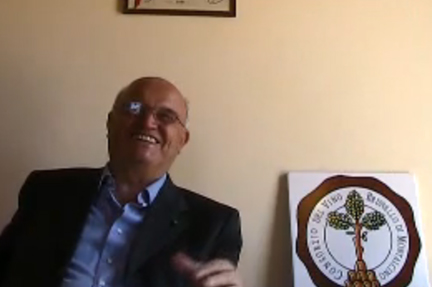
Above: I hope that Tuscan wine writer and internet-based interviewer Carlo Macchi doesn’t quit his day job. I certainly wouldn’t call him the next Antonioni. Although he might give Dario Argento a run for his money. Last week, the newly elected president of the Brunello producers association, Ezio Rivella, told Macchi that “80% of Brunello was not pure Sangiovese.”

You can imagine my utter and profound astonishment when I watched a recently taped interview with the new president of the Brunello producers association in which he stated the following: at least up until the time of the Brunello controversy that broke in March 2008, “80 of Brunello was not pure Sangiovese” and that the practice of adding “3-5% of grapes other than Sangiovese” was “widespread” and “commonly accepted” among the 250 or so bottlers of Brunello di Montalcino. (The interview was filmed in two parts: the above statements were made in the second segment, and here’s a link to the first.)

The interviews were conducted last week by Italian (Tuscan) wine writer Carlo Macchi, editor of the online wine magazine WineSurf. The videos came to my attention via the weekly web news roundup published on the Italian Sommelier Association website by Mr. Franco Ziliani (who, btw, is not currently blogging right now).

I’m only partly astonished by the figure. In fact, most people whom I’ve spoken to on the ground would arrive at the same figure more or less through guesstimation. As Gian Franco Soldera told me when I visited with him in September 2008 (at the height of the crisis), “the tanker trucks come in weighted down, their load riding low to the ground, and they leave riding high.”

No, what amazed me was the nonchalance with which Rivella brandished this astounding figure. But at the same rate, considering the fact that he spent four decades (the majority of those at the helm) at the largest producer in the appellation (you don’t need me to tell you who that is), I’m not surprised that he would so unabashedly utter these words. And in all fairness and in honesty, I must applaud Rivella for sharing this insight (so often spoken sotto voce, under one’s breath in Montalcino) in a public forum.

What alarmed me was the fact that Rivella also told his interviewer that “for the moment were not going to be talking about changing the appellation to allow for grapes other than Sangiovese.” The law states that the producers get to decide the rules, he explains, and the producers have voted for 100% Sangiovese. But — ugh and here it comes — “we will discuss changing it in future because it needs to be changed.”

When asked the wine figure that impressed him the most, he replied Robert Mondavi. Are you surprised?

I translated and paraphrased some other highlights (?) here at VinoWire.

The James Suckling era ends (and what we ate and drank for my birthday)

poggione

Above: We treated ourselves to a bottle of 2004 Il Poggione Brunello di Montalcino and porterhouse steak last night in celebration of my birthday. When we planned this classic Tuscan meal, I had no idea that my birthday would also deliver the news that James Suckling had left the Wine Spectator.

Yesterday, as we were preparing for birthday and Bastille Day celebrations chez Parzen, the following news arrived via email from a colleague and friend:

    James Suckling, who joined Wine Spectator in 1981 and has served as European bureau chief since 1988, has retired from the company.

    Suckling’s tasting responsibilities have been reassigned. The wines will be reviewed in our standard blind-tastings in the company’s New York office.

    Senior editor and tasting director Bruce Sanderson will oversee coverage of Italy. Sanderson, who has been with the magazine for 18 years, currently reviews the wines of Burgundy, Champagne and Germany.

fiorentina

Above: To make a proper “bistecca alla fiorentina” at our house, we season the porterhouse generously with kosher salt, rubbing the salt into the meat, and then we char the T-bone, with the steak upright.

Neither Tracie P nor I could ignore the uncanny coincidence that we had decided to open a bottle of 2004 Brunello di Montalcino by Il Poggione, a traditional-style wine made by a family who has vehemently and vociferously opposed the modernization of its appellation. There’s no two ways about it: during James Suckling’s tenure at the Wine Spectator, the scores he gave to modern-style Brunello — with Casanova di Neri as its poster child — helped to eclipse the sale of traditional-style wines, like those made by Il Poggione. (In all fairness, Suckling also gave good scores to Il Poggione but his historic preference for dark, concentrated, oaky Brunello with higher alcohol levels, indisputably skewed his evaluations toward modernism.)

fiorentina

Above: Then you cook the steak on either side, very quickly at high heat. By cooking the steak upright first, the meat “heats through” entirely.

Another layer of irony was cast upon the news and our Brunello by the fact that Mr. Franco Ziliani — at times Mr. Suckling’s detractor — had suspended publication on his wine blog Vino al Vino, the leading Italian-language wine blog, a few days earlier. (Mr. Ziliani’s relationship with Mr. Suckling is even referenced by the author of the Wiki entry on the Italian wine writer.) “A pause for reflection,” wrote Mr. Ziliani on Monday, a search for “clarity” in his life and for a sense of purpose for the blog, he explained. “To blog or not to blog,” he asked rhetorically.

fiorentina

Above: High heat is the key to searing and caramelizing the fat on the outside of the steak while leaving the meat in the center tender and nearly raw.

The two events are certainly unrelated but their confluence is rich with meaning. We often forget that that the current economic crisis has affected both the wine industry and the publishing industry. Hawking wine is no easy tasks these days (especially when it comes to high-end, luxury wine like Brunello) and hawking newspapers and magazine is even harder.

fiorentina

Above: Traditional style Brunello and steak, one of the great gastronomic pairings in the Western Canon. (Honestly, I wish I would have used a slightly shorter cooking time. I prefer my steak “black and blue,” charred on the outside, blood rare on the inside. But it was delicious nonetheless!)

While I’ve been a devoted fan of Mr. Ziliani’s blog since I first discovered his writing more than 5 years ago, I can’t say that I’ve been such an admirer of Mr. Suckling’s take on Italian wine. In fact, I think that Suckling historically ignored and omitted the great icons of Italian wine from the canon of the Spectator’s “top wines of the world” because he was looking for wines that appealed to his idiosyncratic sensibility without viewing them in a broader scope and without consideration for the wines that Italians consider to be indicative of their winemaking tradition. At the same rate, looking back on Suckling’s legacy (however skewed) as an arbiter of Italian wine, I feel compelled to acknowledge his contribution to the world’s awareness of the overarching greatness of Italian wines.

fiorentina

Above: Potatoes, spinach, grilled onions, and steak, all dressed simply with kosher salt and extra-virgin olive oil.

And so we raised a glass of 2004 Brunello di Montalcino by Il Poggione last night, to both Mr. Suckling and Mr. Ziliani, polar opposites in their approach to Italian wine, leading voices of antithetically positioned vinous philosophies. I hope and trust that both will continue to share their impressions and palates, using whatever media they see fit, with a world ever-thirsty for Italy’s unique wines.

Jancis Robinson: “Syrah di Montalcino”

From Jancis Robinson’s blog, yesterday, “Montalcino votes for modernism”:

“After dramatic last-minute machinations, it has just been revealed that the secret ballot to elect the new president of the Brunello di Montalcino consortium revealed that arch-modernist Ezio Rivella of Banfi garnered most votes and will now direct the fortunes of this controversial wine.

Until very recently it looked as though the most prominent woman in Montalcino, Donatello Cinelli Colombini, would win, but at the eleventh hour, in a move that took many by surprise, she withdrew her candidacy and threw her weight behind Rivella. Concerned that this would be the final nail in the Brunello coffin, and that Piemonte-born Rivella would encourage the use of grape varieties other than Brunello (Sangiovese), veteran winemaker Fabrizio Bindocci of the respected estate Il Poggione declared his own bid for the presidency yesterday. …

It seems as though the juggernaut rolling towards the likes of Syrah di Montalcino is unstoppable.”

Maginot lines in Montalcino

Above: Tracie P and I took this photo, facing southeast toward Mt. Amiata, in February on Strada Statale 64 (State Hwy 64) heading north from the village of Paganico toward Sant’Angelo in Colle on the south side of the Montalcino appellation. It’s just a matter of time before Asti-born Ezio Rivella will be making “Brunello” just northeast of there, in a partnership launched with Veneto behemoth Masi in 2007.

And so, just as the Germans flanked the Maginot Line, invaded Belgium and then France, Ezio Rivella — the self-proclaimed “prince of wine” — has been elected as the new president of the Brunello consortium. He has vowed not to change appellation regulations so that they would allow for international grapes, as he previously advocated. But the thought of an Piedmont-born enotechnician at the helm of an appellation situated in the heart of a UNESCO-protected territory sends shivers down the spines of many — myself included. It’s a dark, dark day in Montalcino.

Above: “Hunting forbidden.” Facing southeast, gazing out on Masi’s Bello Ovile vineyards. Taken in February 2010. Today the sun shines in the early summer heat but it’s a dark, dark day in Montalcino.

Chatting with a friend, a wine professional I admire very much, late last night, he pointed out that this battle was lost a long time ago: anyone familiar with European history and iconography is acquainted with the metaphor allegory of the Maginot Lines.

If you’re not tired of my posts on Montalcino and what has transpired there, please revisit this post on the Brunello debates where Rivella and the sorely missed Teobaldo “Baldo” Cappellano sparred over the future of Montalcino and the Brunello appellation.

I promise to write something fun and entertaining (to cheer myself up) tomorrow but today — the day after the commemoration of the founding of the Italian republic, freed from fascist tyranny — I plan to mourn. Sorry to be a bummer…

Nightmare in Montalcino: Fabrizio is our only hope!

I just saw a retweet in my Twitter feed and am literally feeling ill after what I just read over at Montalcino Report: Donatella Cinelli Colombini has “stepped aside” and is giving her support to Ezio Rivella in his bid to become president of the Brunello producers association (if you haven’t been following events there, just scroll down on my blog to my most recent posts).
A nightmare is unfolding in Montalcino and Fabrizio Bindocci (left, in a photo I took probably 6 years ago) is our only hope. Fabrizio had not officially announced his candidacy for the presidency but Cinelli’s “abdication” has led him to speak out finally. He did so today in an open letter he wrote to Italy’s top wine blogger Mr. Franco Ziliani. Fabrizio’s son Alessandro has published an English translation at Montalcino Report.

In it, his father writes:

    It is, however, with a certain dismay that I have learned — in a meeting that we held yesterday with some of the councillors — that Donatella Cinelli Colombini wishes to give way (and to give the presidency) to the very person, in my opinion (and in accordance with my own sense of propriety), who is the farthest from my land and the wine that we steadfastly wish to continue to produce (perhaps by improving our tradition but certainly not by bastardizing it). He is the farthest from it in his actions, his feelings, and his interests.

    I am referring to Cavalier Rivella, whom I have known since his earliest days in Montalcino and whose bluntness I appreciate.

    Therefore, I believe that it is my duty, on the eve of this most delicate of appointments, to ask all of my fellow councillors and all of those who hold dear the reputation (and success) of this wine to banish from our behaviour any interest that does not correspond to that of the producer Consortium members.

    This — and only this — is what I would wish to do if I were to be President!

However distant this election may appear, it is the front line in the battle to save traditionalism and indigenous winemaking in Italy. I know Fabrizio well and as outspoken as he is (in the true Tuscan tradition), he is also a very humble man who would not have taken such a brazen stance if the situation were not grave.

Keeping my fingers crossed (and hoping you are, too)… thanks for reading…

A ray of hope in Montalcino (election results expected tomorrow)

Above: I photographed this pristine bunch of Sangiovese grapes in the southwestern subzone of the Brunello appellation in September 2008, just a few days before harvest began.

So many amazing bottles of wine (Italian and otherwise) have been opened for me and Tracie P over the last few weeks and I have a lot to post about, but today Montalcino is on my mind: tomorrow Thursday, if all goes as expected, the Brunello producers association will announce the name of its new president.

The good news is that presidential front-runner Ezio Rivella, who previously proposed a change in appellation regulations that would allow for grapes other than Sangiovese to be used, has publicly pledged NOT to change the rules.

My colleague Mr. Franco Ziliani, author of Italy’s most popular wine blog, Vino al Vino, reported the story last week, and this morning, he and I have posted my translation of Rivella’s interview with the Corriere di Siena over at VinoWire.

Above: Neither my friend Ben Shapiro (in the photo), who accompanied me on the trip, nor I will forget that beautiful fall day in Montalcino, our last in the appellation before we headed over to Maremma.

His words come as a relief, to me and to many observers of Montalcino and actors on the ground. The thought of Brunello with even just 5% of Syrah in it… well… makes me want to heave…

I imagine that the backroom compromise went something like this: after being elected to the consortium’s advisory council (who in turn will elect a president, to be announced tomorrow), Rivella vowed not to change appellation regulations to allow grapes other than Sangiovese in exchange for support for his presidency and a willingness to revise the Rosso di Montalcino and Sant’Antimo appellations to allow higher percentages of international grape varieties.

The fact is that most producers — at least from what I hear directly — want Brunello to continue to be produced using 100% Sangiovese grapes.

Fyi, Rivella has teamed with viticultural giant Masi to produce Brunello on the Pian di Rota estate in Castiglione d’Orcia (not far from the estate where Masi is growing grapes for its Bello Ovile project). To my knowledge, no Brunello has been produced there yet…

Stay tuned…

“Xinomavro is a punch in the face to globalisation. We don’t need Cabernet in Greece!”

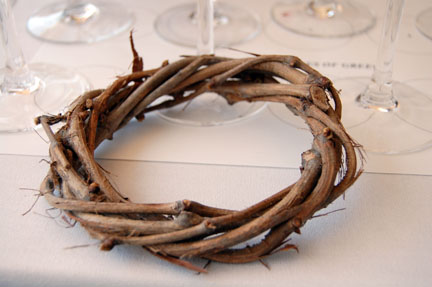
No, it’s not a crown of grape vines. It’s a sample of basket-trained vines from Santorini that was passed around at the New Wines of Greece seminar I attended this morning in New York.

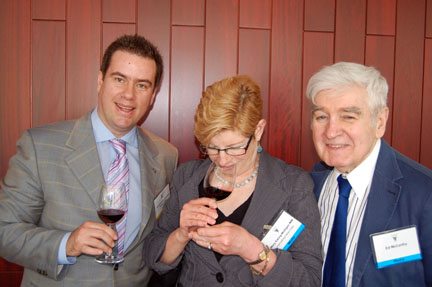
The highlight of the tasting came for me at the end of the morning seminar when Master of Wine Kostantinos Lazarkis (below, left) told the crowd of wine professionals, referring to the “diva” indigenous red grape of Greece, as he called it, “”Xinomavro is a punch in the face to globalisation. We don’t need Cabernet in Greece!”

Now, THAT’S MY KINDA LANGUAGE! If only MONTALCINO WERE LISTENING!!!

Getting to chat and taste with Kostantinos was a wonderful treat and it’s always great to taste with two of my favorite people in the wine writing world — who make ANY room feel glamorous — Master of Wine Mary Ewing-Mulligan and the inimitable Ed McCarthy (with Kostantinos, above). In the Xinomavro flight, Ed picked the two ringers blind: Nebbiolo from Piedmont and Sangiovese from Montalcino. There’s no two ways about it: the dude is a stud.

I’ve only been in New York for a morning and I’ve already tasted some amazing wines and met some amazingly interesting people. And the day is young!

Stay tuned…