
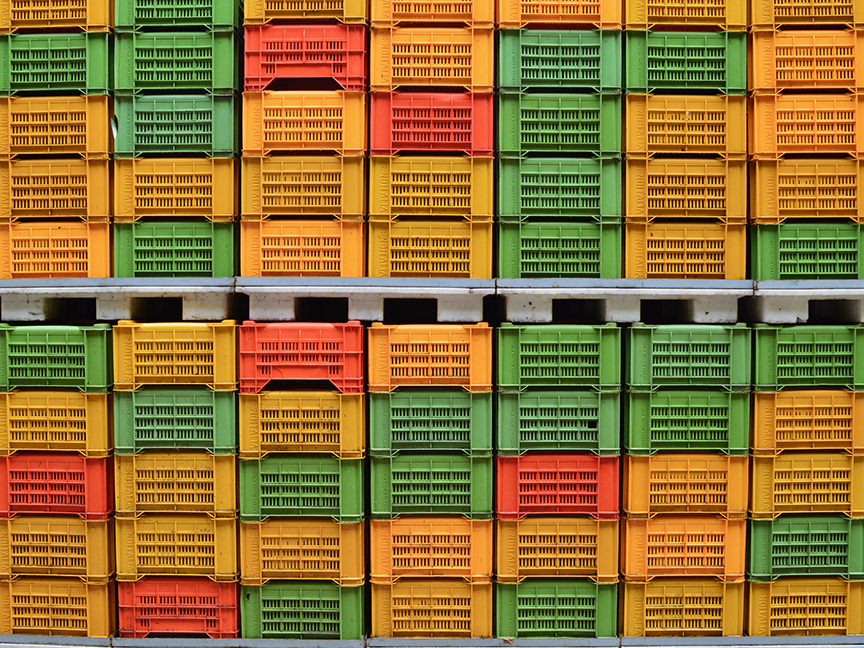
 Above: empty picking crates waiting to be filled with grapes at harvest.
No two people could be more diametrically opposed in their sentiments and approaches to Italian wine than Ceri Smith, one of our nation’s leading wine retailers and tastemakers, and James Suckling, one of our nation’s leading wine critics and tastemakers.
But this week, the unlikely pair sent messages to their supporters in which their views seamlessly aligned: in urgent tones, both are asking their followers to register their dismay at the thought of 100 percent tariffs on Italian wines and other European agro products currently being considered by the Trump administration.
Read Ceri’s here (on Facebook) and James’ here.
“Proposed higher tariffs on expanded list of European wines could devastate business, say importers and retailers,” according to a piece published earlier this week by the popular wine trade-focused blog SevenFifty.
Michael Skurnik, a leading importer of Italian wines in the U.S., was quoted in the article: “If enacted, these tariffs could have the effect of essentially crippling the importation and sale of European wine in the U.S. This would mean a devastating loss of revenues, jobs, and taxes to many sectors of the U.S. economy.”
Trade wars like this are nothing new to the U.S. nor the global economy. Few in the wine industry are old enough to remember the Banana Wars of the 1990s. During that decade, the U.S. “imposed a retaliatory range of 100 per cent import duties on European products, encompassing everything from Scottish cashmere to French cheese” (the Guardian).
At the time, the U.S. was retaliating for an EU quota on bananas grown in Latin America but sold by north American companies. Today, the U.S. is retaliating for Airbus subsidies illegally doled out to European interests and for a proposed European “digital service tax.”
What do bananas have to do with cashmere and cheese? What do wine and cheese have to do with airplanes and online advertising? That’s how trade wars work.
Earlier this week, I spoke to one of the top sales agents in California for the largest distributor of fine wines and spirits in the U.S. Even his Trump-supporter colleagues share his fear that said tariffs would decimate their business, not to mention many of their suppliers’ and clients’ businesses. He told me that even his boss, an avid “Trumper,” recognized that many of his employees would have to be dismissed if the tariffs were implemented.
Think of your average Italian restaurant in the U.S., he said, where the wine programs are designed around Italian wines that land at “by the glass” prices. The industry rule of thumb calls for wines by-the-glass to be sold at the same price as the wholesale cost of the of the bottle. An $8-9 by-the-glass wine would now cost $16-18.
Would you pay $18 for a glass of Sangiovese that cost $9 the previous day?
The reasoning is oversimplified here for sake of argument but you get the picture.
According to some estimates, 70 percent of the wine grown in Italy is shipped to the U.S. In many cases, Italian wineries sell nearly 100 percent of their products to the U.S. If the Trump administration implements the tariffs, the entire industry would be disrupted — from top to bottom. The people in the middle would devastated as well (including me and my marketing consulting business).
Ceri and James included the following links where Americans can send messages to their representatives in congress and the U.S. Trade Representative to stop these tariffs from taking effect.
To your senators (via the National Association of Wine Retailers):
https://account.votility.com/enterprise/NAWR/ec/697
To your congressperson (via the National Association of Wine Retailers):
https://account.votility.com/enterprise/NAWR/ec/698
To the United States Trade Representative:
https://www.regulations.gov/comment?D=USTR-2019-0003-2518
If you love Italian wine and the people who grow, make, and sell it, I encourage you to join Ceri, James, and me in taking action.








 Do Bianchi