As Italy prepares for harvest, climate change is on everyone’s minds.

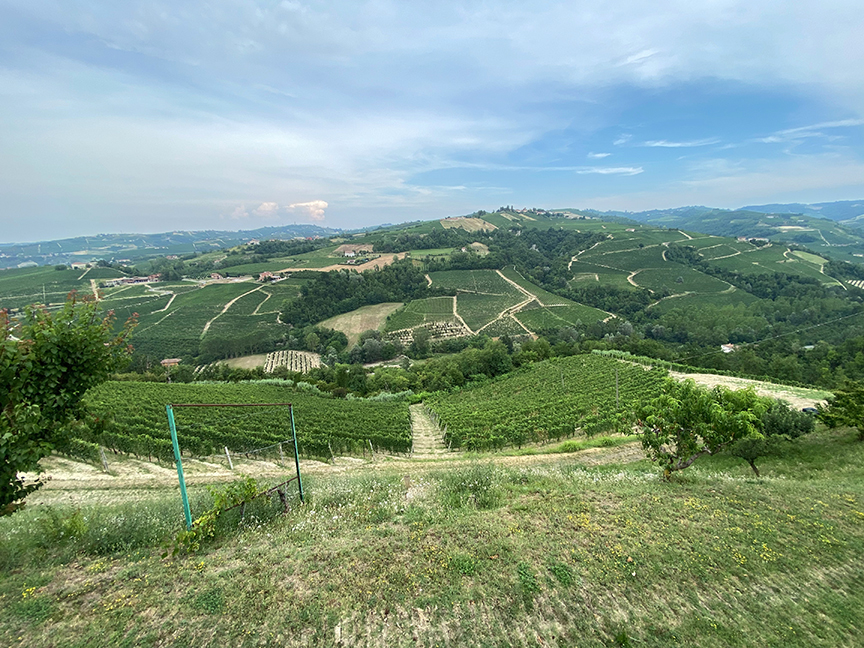
Above: if you were in Piedmont, Italy or Southeast Texas, you might think that was a rice field or a crawfish farm. In fact, it’s a flooded vineyard. A heat wave, massive rains, and severe hailstorms dominated the three weeks I was in northern Italy during the second half of July and the first week of August.

Climate change is always a sticky subject to cover when you’re a wine professional leading a guided tasting in Houston. It’s nothing less than inevitable that there will be some oil and gas professionals among the tasters. And especially when it comes to the older (and monied) petroleum crowd, some of those guests will reliably grumble, however amicably, when the topic comes up.

As a rule, I always begin my spiel by saying, we may not agree on its causes, but if you ask a grape grower, even the most conservative grape grower (and grape farmers tend to land on the conservative side, like most farmers), they will invariably tell you that they have observed clearcut shifts in climate over the last 30-40 years and beyond.

To this I always add: Whether or not it’s caused by human activity is a question for another time and place. But there’s no denying that it’s happening. Just ask any grape grower and they will tell you that 1) they harvest their crop much earlier than their grandparents did; and 2) extreme weather events, like violent rainstorms and intense hailstorms, are more frequent and more harmful than they were for past generations.

While I was in Italy teaching at the Slow Food University of Gastronomic Sciences during the last two weeks of July and the first week of August, it would have been challenging to find anyone who denied the devastating effects of climate change — or its causes. During the roughly 21 days I was in the country, there were a seemingly never ending heat wave; numerous hailstorms that literally destroyed cars across northern Italy; and concentrated bouts of rain that caused widespread flooding — even in areas, like Como township and lake, where flooding rarely if ever happens.
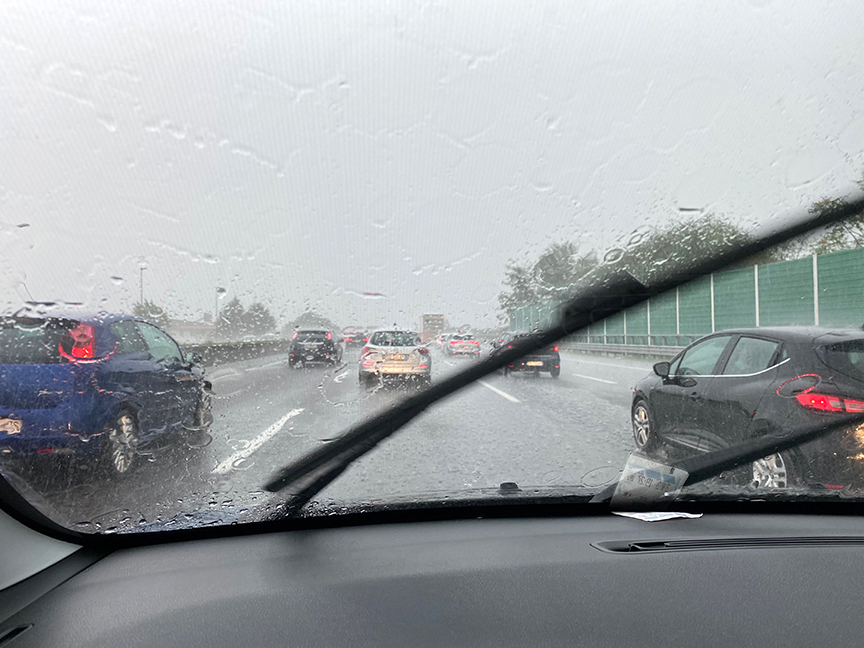
During my recent visit to Italy, my first in more than a year and a half, I took every opportunity I could to travel across wine country. Every day, it seemed, was punctuated by a major weather event that brought traffic to a standstill.

The hailstorms were so intense and the car damage so widespread that drivers on the freeway would pull over and vie for cover under overpasses. In the more than 30 years I’ve been traveling to Italy, I had never seen anything like it.

In the days that followed rainfall, the smell of sulfur being sprayed on the vines was often intense. There was one day when I abandoned my daily run because a grape grower warned me that the fumes could be harmful. (Farmers, even on certified organic farms, use sulfur to contain the spread of vine disease after intense humidity events like heavy rainfall.)

In Lombardy (northern Italy), where some grape farmers have already begun picking fruit for their classic method (sparkling) wines, the regional office of the Italian national farmers union, Coldiretti, has already predicted a 15 percent drop in production for the 2021 vintage. That estimate is surely a conservative one.

As Italy prepares for the general harvest to begin next month, climate change — whatever its causes — is on everyone’s mind.
Houston Chronicle features my new wine director gig at Roma.

Above: I was teaching at the Slow Food University of Gastronomic Sciences in Pollenzo, Italy last month when Houston Chronicle wine writer Dale Robertson called me up and said, “hey, I’m going to drive over from France and take you out to dinner… I want to write a story about your new gig at Roma” (photo by Marcello Marengo for the Università di Scienze Gastronomiche).

Tracie and I couldn’t have been more thrilled to see Houston Chronicle wine columnist Dale Roberton’s article about my new wine director gig in the paper (“Meet Jeremy Parzen, the new wine director at Roma in Rice Village,” August 10).

Our heartfelt thanks goes out to Dale and his editor: beyond the story of how I became the wine director at Roma restaurant, it also traces the arc of our romance, engagement, and family life here in Houston, a city that I’ve loved since I first moved to Texas to be with Tracie in 2008.

Even though I’ve run a wine program or two in the past (including Sotto in Los Angeles, where I served as wine director for nearly eight years), Roma owner Shanon had never considered having me help out with the list until I began hosting virtual wine dinners for the restaurant during the lockdowns (I’ve also been Roma’s media manager for more than three years).

It was in May of this year that we decided it was time for me to step up, roll up my sleeves, and do inventory — that odious chore of any wine director.

And from there, things just blossomed. Not only do I manage the list. But I also host wine tastings, in-person wine dinners, and virtual wine dinners where guests pick up the food and wine and then head home where we all connect on Zoom.

Honestly, we never imagined that the virtual events would continue after the lockdowns ended. But people really seem to enjoy them. And while we don’t have the 80-90 people that we used to host back in late 2020 and early 2021, we still get up to 40 guests on the calls. It’s been an immensely rewarding experience, both professionally and personally thanks to the many lasting friendships Tracie and I have forged through the Zoom meetings.

I was teaching at the Slow Food University of Gastronomic Sciences in Pollenzo, Italy last month when Dale called me up and said, “hey, I’m going to drive over from France and take you out to dinner… I want to write a story about your new gig at Roma.” He treated me to a fantastic dinner at La Piola in the town of Alba — the heart of Piedmont wine country, our shared “spiritual homeland,” as I like to call it. And it was there that he interviewed me for the piece.

The rest is history, as they say. Or should I say, our story.

Again, our heartfelt thanks goes out to Dale and his editor; to the amazing and wonderful Marcello Marengo who did the photography; to the director of the grad program where I teach, Michele Fino, who offered me the teaching gig more than six years ago and who orchestrated the photo shoot on the spur of the moment; to Shanon who has always believed in me and who lovingly gave me a shot “up at bat”; and to all our friends and family who have shared our myriad blessings during our seven years in Houston.

And dulcis in fundo, I want to thank Tracie for believing in all my crazy ideas and always being by my side… in thick and thin, for better and worse. I love you, piccina. We’ve come a long way, haven’t we? I wouldn’t have made it without you. I love you.

Taste with me tonight, tomorrow, and Thursday at Roma in Houston!

Houston wine friends: I’m back in Texas and will be pouring at Roma in Rice Village TONIGHT (FREE tasting), TOMRROW (in-person wine dinner, including black truffles shaved tableside), and THURSDAY (for our weekly virtual wine dinner via Zoom).

Click here for details.

Please come on down or log on and say hello!

I’m looking forward to sharing tales from my Italy trip and opening some bottles of Italian wine with you!

Tonight, I pour at our free tasting at 6. And then I’ll be working the floor of the restaurant all night. Please come by and say hello! Thanks for the support.

Getting your covid test in Italy before returning to the U.S. Notes from both sides of the Atlantic.

PLEASE NOTE THAT COVID REQUIREMENTS ON BOTH SIDES OF THE ATLANTIC CONTINUE TO CHANGE. CHECK THE U.S. EMBASSY IN ROME WEBSITE FOR LATEST UPDATES. THAT’S THE BEST RESOURCE IN MY EXPERIENCE. (UPDATED THURSDAY SEPTEMBER 30 2021)

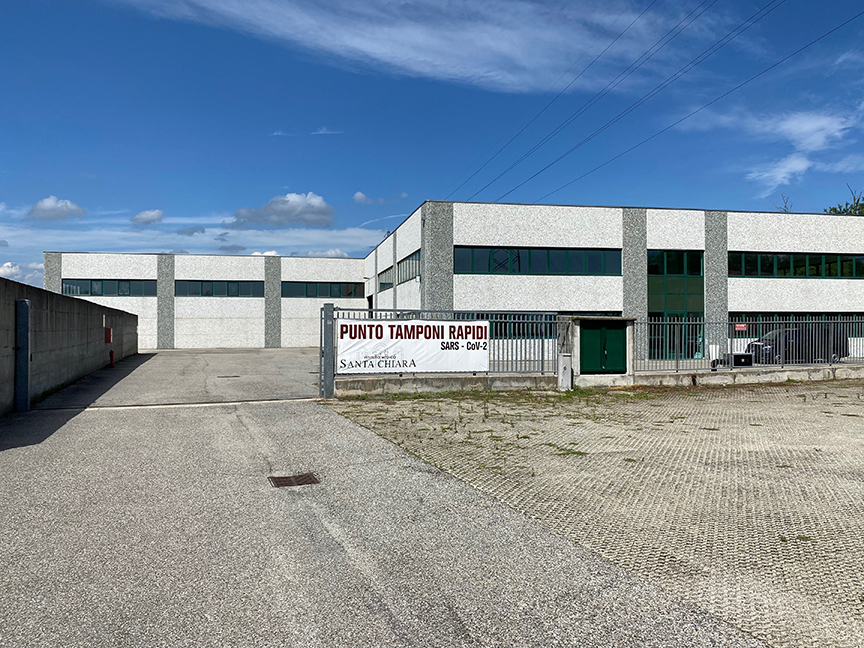
The covid testing kiosk in the arrivals area at Malpensa airport in Milan.

As soon as friends and colleagues started to notice that I was heading back to Italy, I started to receive messages about covid travel protocols here in the U.S. and on the other side of the Atlantic.

Here’s what I can tell you about my recent experience during my July 18-August 6 trip (my first in more than eighteen months, a long stretch for someone who regularly makes six or more trips to his spiritual homeland each year).

Nota bene: this is not professional advice or official information on what is required. I highly recommend visiting the U.S. Rome embassy website’s covid page for authoritative information. I also recommend signing up for the embassy’s newsletter and reading their updates before and during your trip.

Before leaving in July, it wasn’t clear to me whether I just needed my CDC vaccine card (I’m fully vaccinated, for the record) or whether a covid negative test result was required as well. I used the United Airlines “travel center” to upload both a negative test result and my CDC card. The covid test had to be administered no sooner than 72 hours before my departure. I did mine the day before.

When I arrived at Malpensa airport in Milan, all non-EU passengers were asked to share the documentation with officials before we got to the passport control. As soon as I pulled my CDC card out of its case, he waved me on. He didn’t ask for identification nor did he examine my documentation. That was it. Next stop was the passport control and after an official stamped mine, I was on my way to the rental car pick up.

I got my pre-flight covid test at a drive-in (not drive-through) outpost not far from the airport.

Again, this is not official information or professional advice. Please look at the Centers for Disease Control and Prevention travel requirement page. Here’s what it says: “If you plan to travel internationally, you will need to get tested no more than 3 days before you travel by air into the United States (US) and show your negative result to the airline before you board your flight.”

It’s my understanding that even vaccinated travelers need to show a negative result. There are some exceptions. See the CDC site for details.

According to my UniSG students — I was teaching at the University of Gastronomic Sciences in Pollenzo, Piedmont — there was easy-access testing in Bra, the nearby city where most of the students and visiting professors like me stay. And from what I observed while in Italy, there are plenty of options for testing, although it seemed that you in many cases, you either had to call (which might be a problem for travelers who don’t speak Italian) or visit in person to get an appointment.

I was planning on staying at a hotel at the airport the night before my departure. It was easy to find multiple testing “drive-through” testing sites in the area where you could register online. I got my test at the one in the photo above. I had registered online a few days before and was able to print out all the required documents.

It wasn’t a “drive-through” in the American sense but rather a “drive-in” where you parked and someone came out to your car to administer the test. I waited for about 15 minutes before they brought me the result. The health professional who gave me the test had lived in the U.S. and he spoke English to me as soon as he saw my passport. He created a English-language version of my test results (which was super cool of him).

As soon as I arrived at the airport, I uploaded my result using the United Airlines app on my phone (via their Travel Center). I received a text about 10 minutes later informing me that it was approved. And that was it.

At the airport, there were at least two options for getting tested on the spot. One was in the arrivals area (the first photo in this post). The other was in the lobby of the Sheraton hotel (above).

I checked online to see available for the one located in the arrivals area. At roughly 7 a.m., it showed the first availability at 8:33 a.m. As I was walking by the kiosk, a young American asked, in English, what time they opened. 8:30 a.m., said the health professional who was preparing to open the testing spot.

I didn’t look at availability for the other testing center.

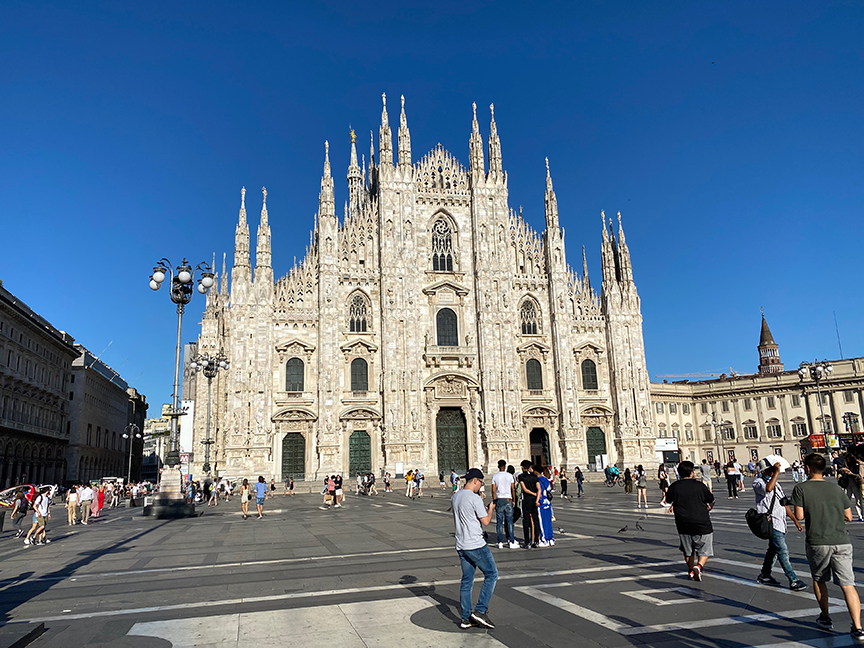
The Duomo in Milan on Friday, August 6, the day before I left Italy and returned the U.S.

If you don’t speak English, I highly recommend checking with the front desk or concierge at your hotel. From what I observed, there was no shortage of options. And I imagine that many hospitality professionals can point you English-friendly testing spots.

Traveling, especially right now, can be stressful when you don’t speak the home country’s language. From what I saw and heard from other travelers, there were myriad options. Getting a test was relatively easy for everyone I spoke to.

Get vaccinated, wear a mask, and travel safe!

At the Slow Food University, the meglio gioventù. A last dispatch from Piedmont.

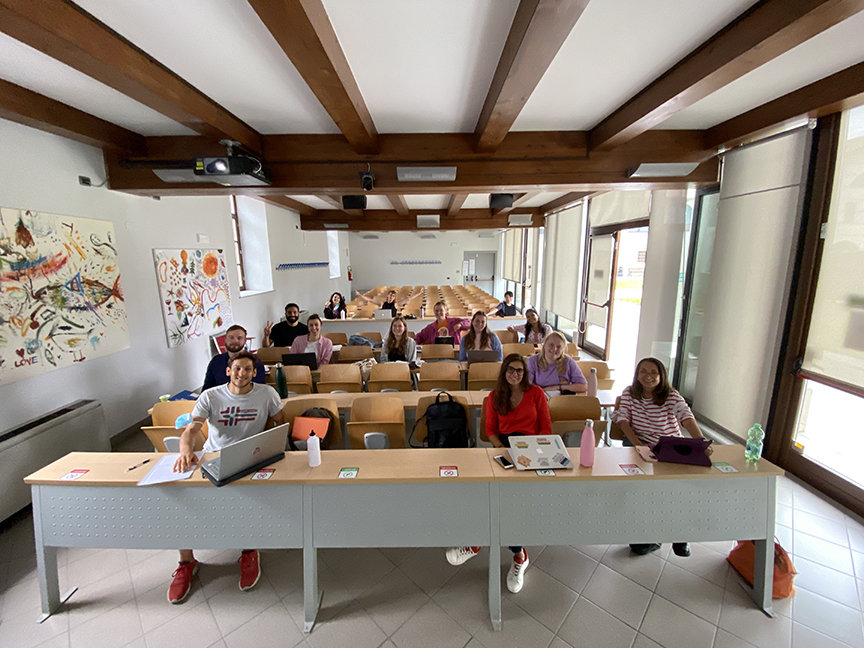
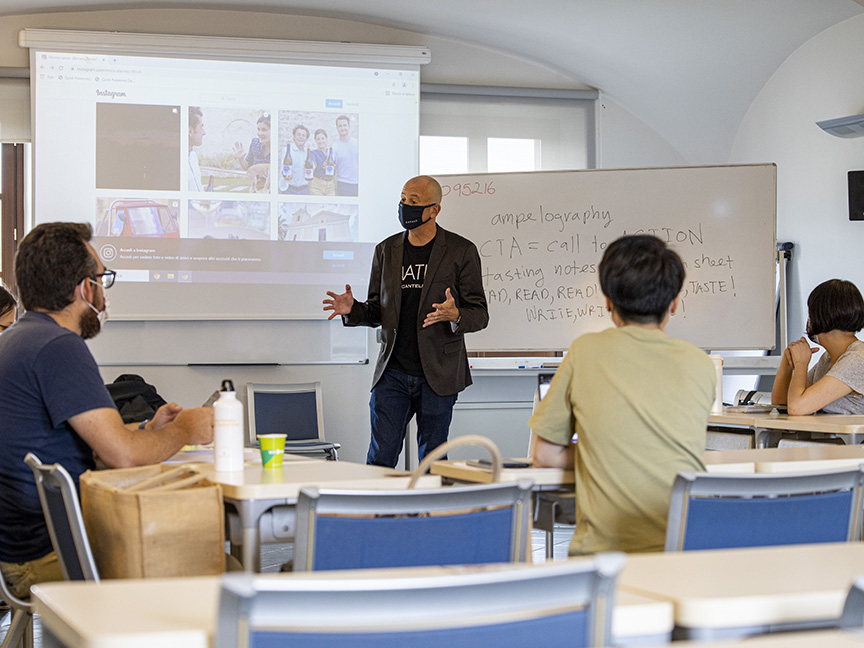
Above: some of the 2021 wine communications and food communications students in the graduate program at the Slow Food University of Gastronomic Sciences in Piedmont, Italy.

Things are a little different here in Pollenzo in Piedmont, Italy, where I’ve been a communications instructor in the graduate program for the last six years. Of course, they didn’t bring me over last year for reasons that we all know all too well.

This year, for the first time since I began teaching here in 2016, in-person attendance is no longer required and many of my 30+ students follow from home. The photo above was snapped yesterday in one of the largest classrooms on campus: the extra space allows the students to distance if they prefer.

Masks are mandatory for the staff like me. I wear mine religiously. The students, nearly all of them fully vaccinated as far as I know, generally do not wear them. (I’m fully vaccinated as well, for the record.) After teaching for nearly three weeks with mask on, I have even more respect for teachers in the U.S. and everywhere: in ways I didn’t expect, it’s extremely challenging to lecture for three hours straight with a mask on. Luckily, every classroom is outfitted with a microphone and a public address system that mitigates the need for volume.

Despite all the new-normals of campus life, the experience has reminded me of why we do this in the first place: the students and their journey in discovering and exploring what they want to do when they grow up. For all the homesickness and the hassles of being away from Houston for such a long stretch, the immense reward is the bright light that appears in their eyes as their curiosity is sparked and sometimes satiated.

I wish that everyone could have been in the classroom when my wine communications students and I re-watched some of our wine industry colleagues’ powerful Instagram videos from 2020 calling for social changes in our trade. It was our last hour of class together (although they also attend my food communications lectures).

The discussion that followed not only gave me hope that our work will make the world a better place to eat, as one of my students put it during my first year teaching here in Roero. It also filled me with joy to remember that the students always seem to have an innate sense that compels them to infuse their professional lives with activism — whether combatting climate change, food inequality, or discrimination.

Like Pasolini’s Casarsans, they are the meglio gioventù — the best of youth. And they are what makes this whole crazy world of food and wine all worthwhile.

Your part has ended in light
and I have no darkness in me
to hold your shadow.

Pier Paolo Pasolini
1954

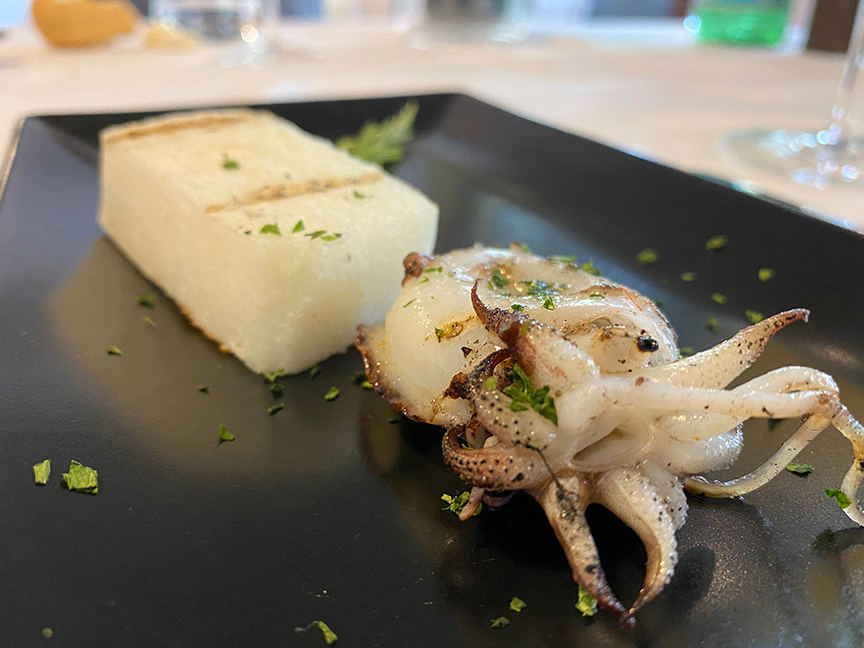
A unicorn (yes, we found one) and impossibly delicate baby cuttlefish at Nalin in mainland Venice.

When Giovanni and I sat down at Trattoria Nalin in mainland Venice on Saturday at around 1:30 p.m., we basically just said please start bringing us crudo and please bring us the wine list.

The super professional staff at this historic seafood destination did just that. But at the end of the crudo flight, the owner offered also us an unusual and entirely unexpected delicacy: flash-grilled baby cuttlefish that only appear for a brief window during this time of year. They are called seppioline di porto or harbor baby cuttlefish because these little cephalopods tend to gravitate toward the banks of the port.

They were impossibly delicate and when you bit into them you were rewarded with a “pop” of their ink. It was undeniably the best thing I’ve eaten this year.

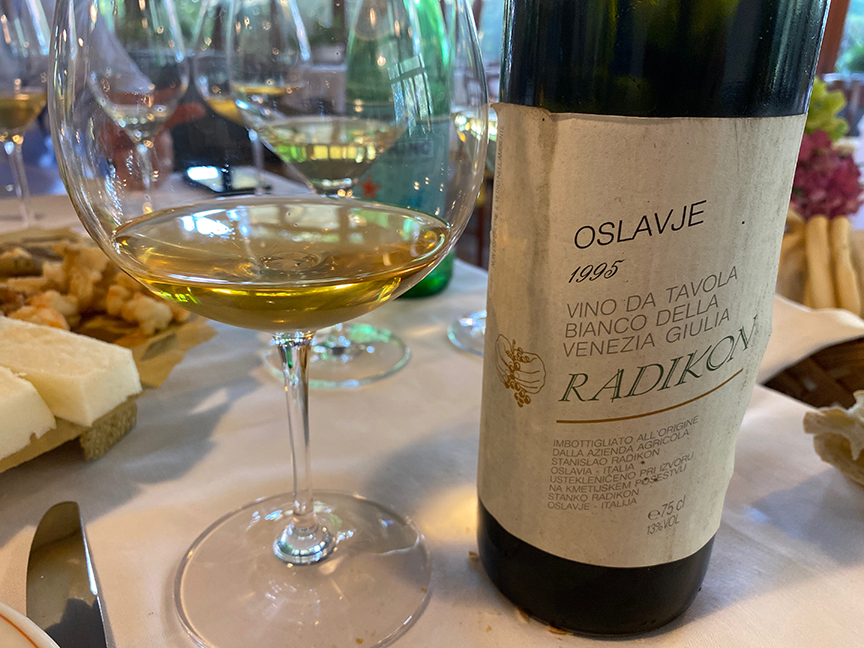
And of course it was only natural, after we ordered a couple of dream whites — a 2013 Friulano by Borgo del Tiglio and a 1999 Pinot Blanc from Vigne di Zamò (see below) — that the gracious and generous owner would reach deep into his cellar for a 1995 Radikon white blend.

Now, if that isn’t a unicorn, then I don’t know what is, folks!

Like a pre-CBS-era Fender amp, Radikon’s pre-maceration-era wines are intensely coveted among Friulian wine lovers. This wine was incredibly fresh, with only gentle notes of nutty oxidation and rich notes of dried stone fruit in the mouth. We lingered for at least an hour over this wine and it never lost its vibrant and very much “alive” character. The decade is young but this wine is going to set a high standard to follow! What an incredible wine.

Here are some snaps of the other things we ate and drank. The cuttlefish julienne and the langoustine (scampi) were highlights among the spectacular crudo lineup. The Pinot Blanc paired magically with the oysters.
Continue reading

Pinot Noir’s spiritual homeland in Italy: the extraordinary wines of Valeria Radici Odero’s Frecciarossa.

Like many American wine professionals, I had only ever tasted the classic method wines of Oltrepò Pavese pioneer Frecciarossa. But that all changed during the lockdowns thanks to a mid-sized importer of Italian wines in Texas.

I had called Doug Skopp, the owner of Dionysus Imports, to ask him if he had any wineries that would like to take part in the virtual wine dinner series I was moderating each week at Roma restaurant in Houston. He was eager to suggest “it kid” Italian flying winemaker Cristiano Garella and the wines of the legendary Oltrepò estate. But when I told him that we didn’t normally use sparkling wines for our weekly events, he was quick to point out that he imports only the winery’s still wines.

Not only was Cristiano one of the most compelling speakers in our series. But the wines, and in particular the Pinot Noir vinified off its skins (as a white wine), really impressed me with their depth, nuance, and originality.

After my first week of teaching at Slow Food U. in Bra, Piedmont (my first time back in Italy after more than a year and a half), I hopped in my rented Fiat 500L and made a beeline to the other side of the Po River in Lombardy (Oltrepò means literally on the other side of the Po [river]; Pavese is a toponym that denotes Pavia province).

Those are the some of the cows (above) that Valeria Radici Odero uses for compost on her organic farm (certified as of the 2020 vintage). She is the granddaughter of Giorgio Odero, the man who first begin making fine wines there. She is also one of the most brilliant winery owners I’ve ever met, a true wine professional with fantastic communications chops and a razor-sharp palate.

She had graciously squeezed me in with a group of young Piedmontese wine lovers who had reserved a tasting and tour with her that day (thank you again, Valeria, you are awesome!).

Her 2016 Pinot Nero dell’Oltrepò Pavese Giorgio Odero floored me with its rich flavor profile and lithe character. What a stunning wine, with great freshness on the nose and incredible lift in the mouth. It made me reflect on Italy’s wildly diverse mosaic of terroir: while I’ve tasted great still Pinot Noir from Trentino, Alto Adige, and Friuli, few wines have moved me the way this one did.

Frecciarossa’s wines remind me of why I keep doing what I do for a living: the endless viticultural adventures and discoveries that Italy shares with us as we explore the country’s myriad natural and human-made treasures.

Valeria, who speaks impeccable English, has promised me that Houston is going to be one of her first stops as soon as Italians are allowed to return to the U.S. I can’t wait to introduce her and share her wines with our guests back in Houston.

Join Paolo Cantele and me this Thursday for a virtual wine dinner in Houston.

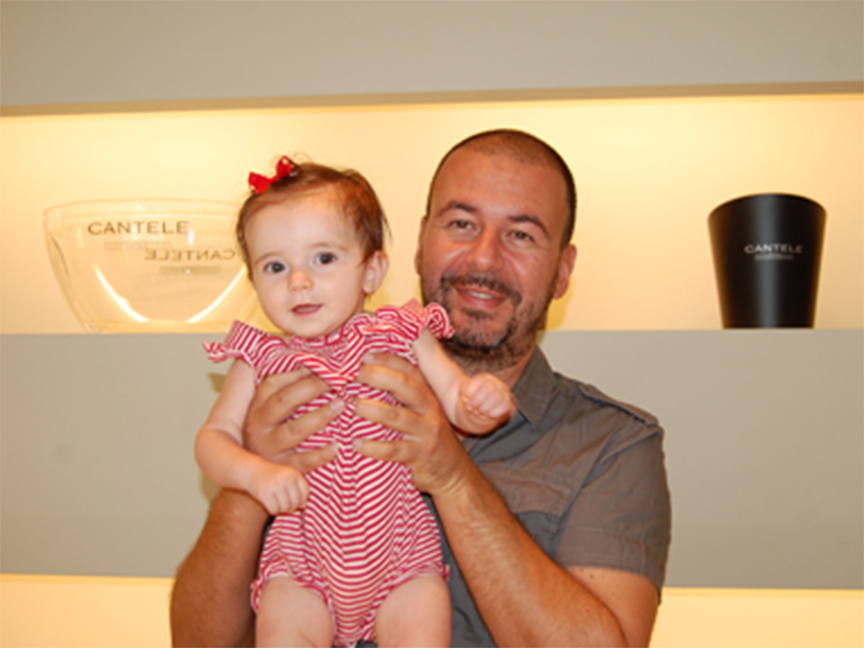
Georgia was about nine months old the first time we took her to Italy. That’s her with Paolo at the Cantele winery outside Lecce.

Paolo Cantele isn’t just one of my best friends in Italy.

He’s one of my best friends, period.

A “road warrior” like me, he and I went on what would turn out to be our last road trip of the year back in February, not long before our countries — his and mine — began to shut down.

We’ve traveled across Italy and the U.S. together, we’ve eaten in some of the best restaurants in the world together, we’ve discussed literature and film (our friendship began with his most amazing story about meeting Ninetto Davoli!), we share a love of music and culture.

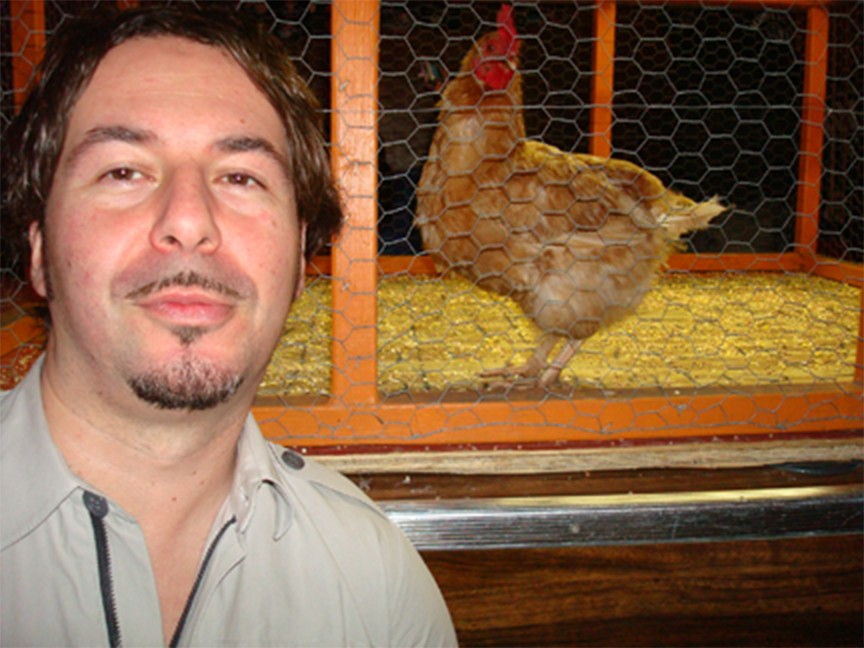
I’ll never forget taking Paolo honky tonking in Austin for the first time. That’s Paolo at Ginny’s Little Longhorn Saloon in 2010 (long before Dale Watson bought the place). We played chicken shit bingo — de rigueur!

In Oklahoma this year, we were even trolled together by a Trump supporter! No shit.

I just love the guy and we’ve had some truly unforgettable experiences together.

Paolo and I also work together: this Thursday he and I will be hosting a virtual wine dinner organized by one of my local clients, ROMA.

Owner Shanon Scott, chef Angelo Cuppone, and I have been doing these since late April and they’ve morphed into a de facto supper club. They are super fun and the regular crowd has developed a bonhomie that’s much needed in these days of attenuated socializing. Tracie and I look forward to them each week.

See the menu and details here. The couples price includes dinner for two and three bottles of wine. It’s a great deal and the week chef outdid himself with the perfect lineup for summer.

Please join us if you can: it’s a great way to support local businesses (including my own) and spend an evening with likeminded food and wine lovers. You won’t regret it.

Call (713) 664-7581 to reserve (these sell out fast so please be sure to snag your spot).

We left our hearts on Lake Iseo. A new favorite restaurant. #bromance

It wasn’t until day six of my first trip to Italy in more than a year and a half that I was finally able to sit down with my bromance Giovanni Arcari for a proper dinner.

We went to our favorite restaurant in Franciacorta, Dispensa Pani e Vini, where we literally laughed so hard that we cried. Man, it had been so long since that had happened. It felt great.

The next morning we headed up to Lake Iseo for an aperitivo before I headed back to Piedmont to teach the next day at Slow Food U.

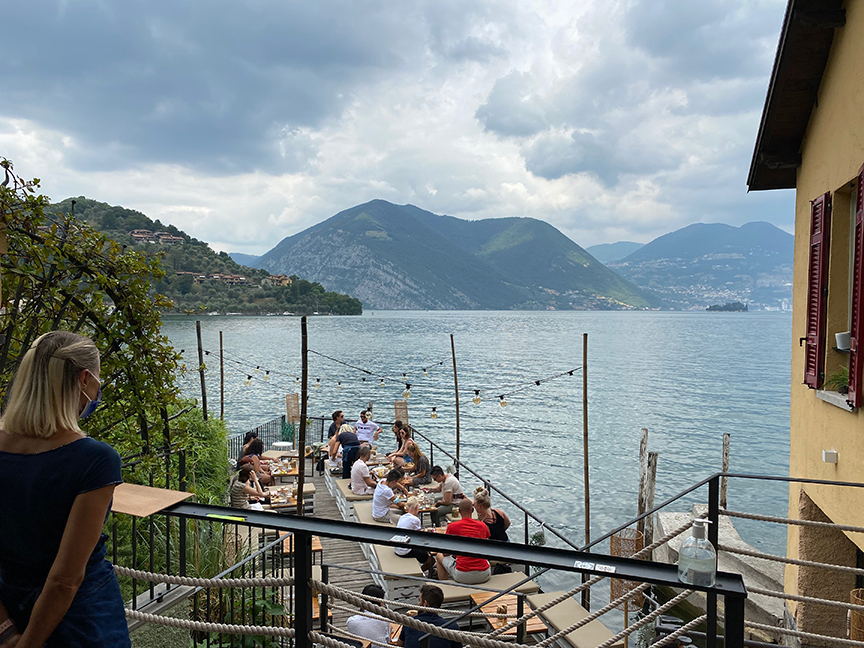
And it was there that Giovanni turned me on to one of his favorite spots: Darsena 21, a converted boathouse (darsena means dock in Italian).

What a magical spot!

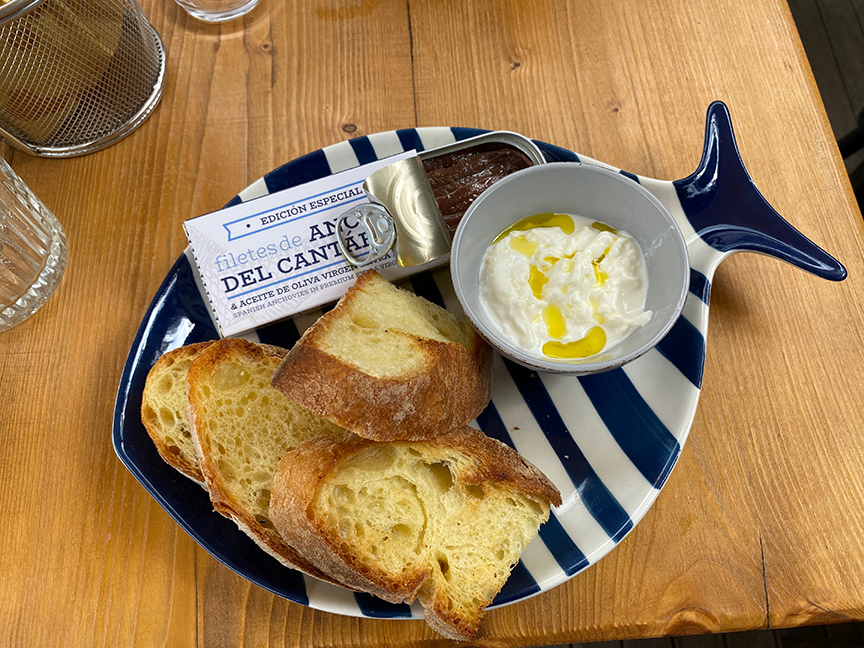
Those are anchovies from Cantabria, Spain. They are all the rage at the moment in Italy. Nearly every day I’ve been here, I’ve eaten them in one form or another.

Darsena 21 owner Daniele Scotti prides himself on using olive oil-cured Cantabrian anchovies. He said that most of the filets you get are cured in sunflower oil. I have to say that these were the best so far. He served these with a side of stracciatella di Andria, the chunky filling used for the famous burrata of Andria, Puglia. Wow… That dish was incredible.

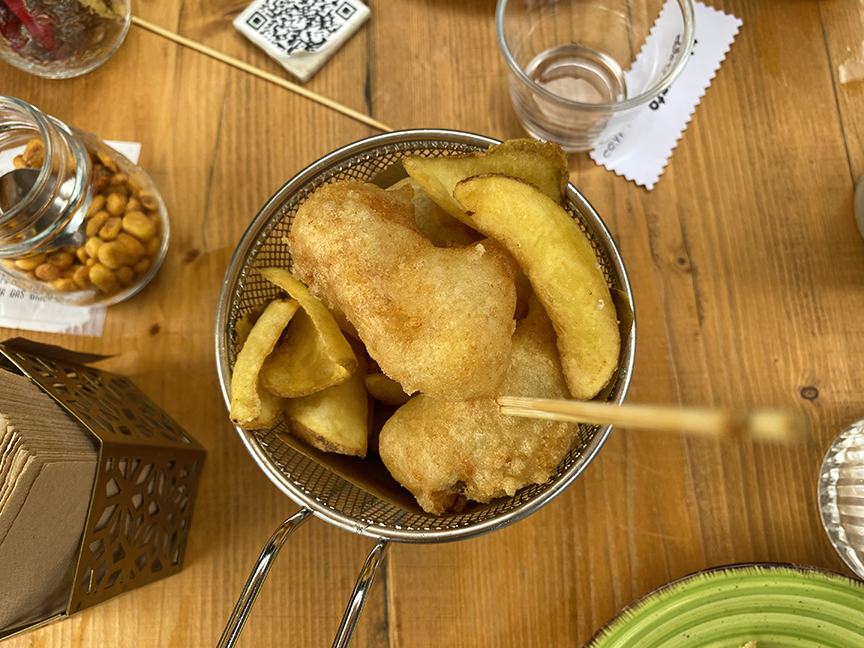
The “Pès and Chips” is made with fresh cod (pès is Brescia dialect for pesce or fish).

Super.

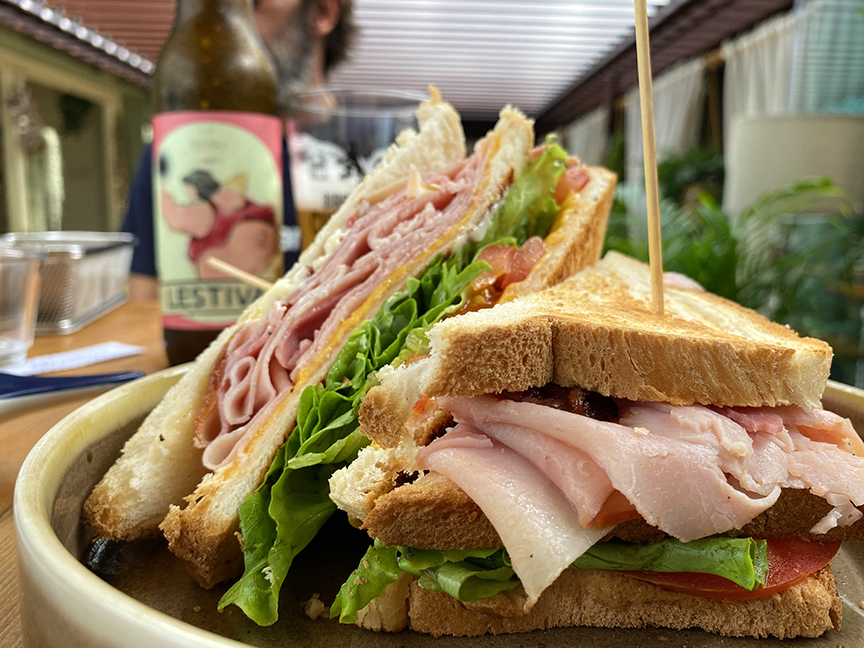
I’ll probably never be able to wrap my mind around the fact that the American club sandwich has become ubiquitous in northern Italy. The difference between theirs and ours is that they use much higher quality ingredients. The bread, bacon, and mayonnaise alone would be worth the price of admission!

Delicious. Great hangover comfort food (not that we were hungover!).

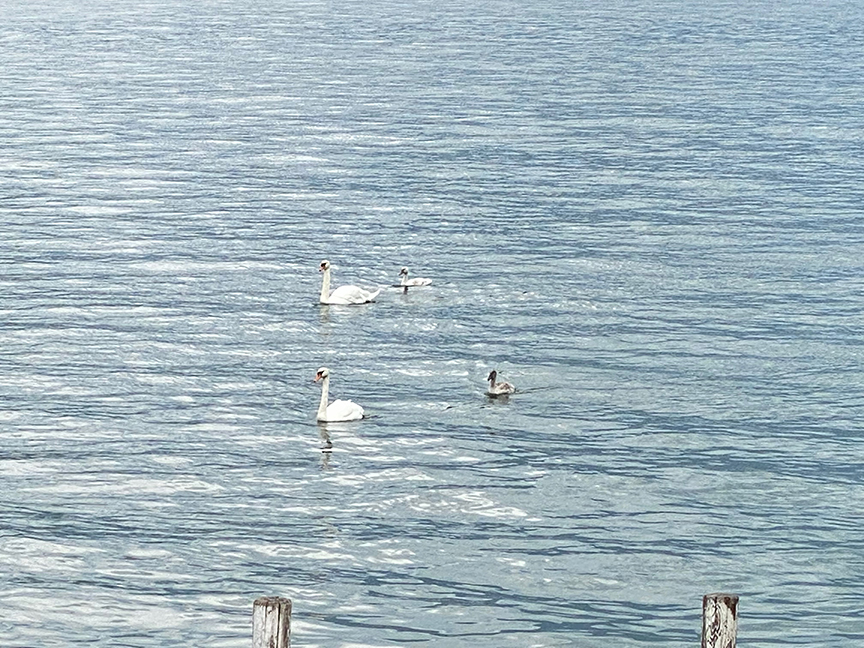
And dulcis in fundo, some geese stopped by to say hello and forage for a French fry or two.

Daniele is a legendary mixologist around those parts. The next I’m up that way, I plan to hit up the brunch and his Bloody Mary.

If and when you make it to Lake Iseo in Franciacorta (and I sincerely hope that you’ll make the trip because it’s worth it), check it out. You won’t regret it. Tell ’em I sent you!

Cascina Baricchi: the best Barbaresco you’ve never tasted.

Only a few savvy insiders in America know the wines raised by the amazing Natale Baricchi on his family’s farm, Cascina Baricchi, on the eastern edge of the Barbaresco appellation.

Partly because of wine but more so because of our shared passion for guitar (he’s got an amazing collection of handmade acoustic guitars, including some Spanish gems), Natale Simonetta, his wife Francesca, and I became good friends two years ago when I was teaching in Piedmont at the Slow Food University of Gastronomic Sciences in Bra.

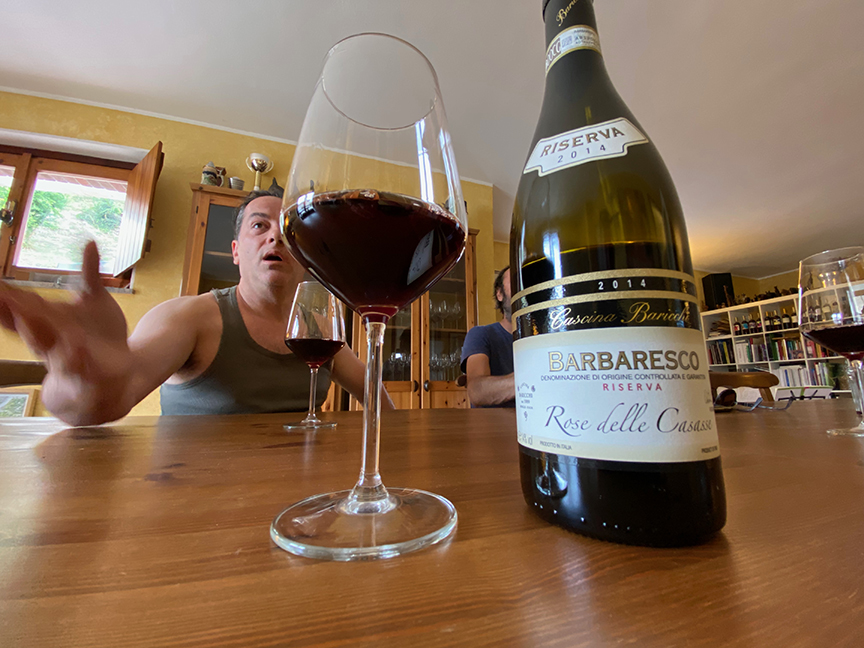
Yesterday, the couple hosted me and my Franciacorta bromances Nico Danesi and Giovanni Arcari for dinner and an informal tasting of their Cascina Baricchi Barbaresco (accompanied by guitar, of course!). That’s Nico, Franciacorta winemaker of acclaim, in the photo above.

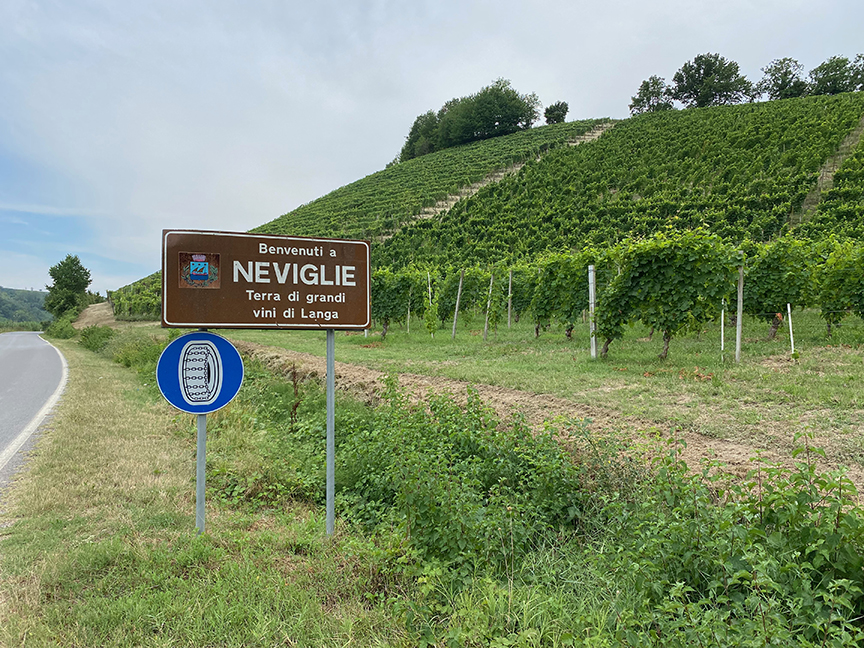
Francesca and Natale live in the commune of Neviglie, just to the east of the Barbaresco appellation. But their vineyards are in the Barbaresco DOCG. Because Natale’s father began making wine there decades ago, they are “grandparented” into the appellation (their case is an exception but for most producers the grapes have to be transformed into wine within the appellation borders). Natale’s dad was super tight buds with Angelo G., who helped him early on when he was first planting Nebbiolo there.

Natale likes to hold his wines back. His current release is Barbaresco 2014 (most producers have already released their 2016). We also tasted the 2004. Both wines were extraordinary. The 04 was one of the best wines I’ve tasted this year, nearly fully evolved and drinking gorgeously.

It was all accompanied by Francesca’s homemade vitello tonnato, a little bit of insalata russa, freshly cut tomatoes, a wedge of farinata, and a slice of crusty bread. Superb!

Natale and Francesca are in the processing of changing U.S. importers. I think a lot of people will be very happy with the results in terms of availability moving forward.

And when I see you in person, I’ll tell you a voce about some of their noteworthy clients. Once you taste the wines, you’ll understand why so many Nebbiolo greats collect these.

Man, it’s great to be back in Italy again. Seeing my friends, tasting new releases and vintages, and remembering what makes my world go around.

Thank you Natale and Francesca! I love you guys! (Thanks also for letting me play you the new song I wrote for Tracie! That meant the world to me.)