Another clarification on ripasso/ripassa

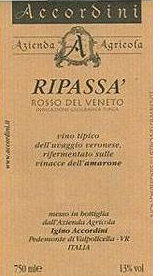
accordiniYesterday, I messaged the VinoWire group on Facebook, asking if anyone knew of a Valpolicella producer besides Zenato who used the term ripassa on its Valpolicella label. (Btw, if you’re not a member of the VinoWire FB group, please join!). Colleague, friend, and fellow blogger Tom Hyland weighed in with Accordini’s Ripassà (or Ripassa’ depending on whether your looking at the label or the winery’s website. Ripassa’ is a Veneto dialectal form of the Italian ripassato, literally passed again or refermented in this case. (I am reminded of Giacomo Leopardi’s famous observation that French is a language of terms while Italian is a language of paroles: like so many lemmae in the Italian lexicon, passare can assume a wide varieties of meanings depending on the context.) Thanks, Tom, for sharing the info and thanks also to Devon Broglie and Angelo Peretti who pointed out that Zenato’s “Ripassa” — without the accent grave or inverted comma — is indeed a trademarked proprietary name.

Has anyone tried the Accordini? Is it good?

In other news…

Just in the from the “unbelievable but true” department: Franco and James Suckling are in the midst of a cordial, collegial, and amiable exchange in a comment thread at James’s blog on the Wine Spectator site.

Here’s the link to the post and thread but since you have to subscribe (as I do) to view the blog, I’ve copied and pasted the exchange below.

User Name: James Suckling, Posted: 03:36 AM ET, May 28, 2009

    Guiseppe Mascarello & Figlio doesn’t send but we buy bottles normally for review. I find the wines very up and down. Some are amazing but others have flaws like volatile acidity.

User Name: Franco Ziliani, Italy Posted: 12:13 PM ET, May 29, 2009

    I know very well, and I’m a great fan, of Giuseppe (Mauro) Mascarello wines, but I confess that I don’t find any traces of “volatile acidity” that Mr. Suckling find…

User Name: James Suckling, Posted: 12:26 PM ET, May 29, 2009

    Franco. Some people have a high tolerance for VA. Have you ever been to their cellars? Anyway, it’s only been with a few wines. I generally like the wines as you do. Thanks for the comment.

User Name: Franco Ziliani, Italy Posted: 04:21 PM ET, May 29, 2009

    Mr. Suckling, apologies in advance for my poor English. I know very well the Giuseppe Mascarello cellars and I don’t think that is this kind of old, and very fresh in every season, cellar that create the problem of “volatile acidity” that you find in Giuseppe Mascarello wines. And I don’t think that a case of “high tolerance for VA” don’t allow me to find in Mascarello wines the “VA problem” that you find in few wines. Can you tell in what wines, Barolo, Barbera, Dolcetto (what vintages?) have you find VA “flaws like volatile acidity”? Thanks for your kind answer f.z.

We’ll have to wait for James’s next move!

Ain’t we glad that we got ’em: good times and Valpolicella

It really is the best of times and the worst of times. Across the board, wine sales are down, restaurateurs are suffering sharp declines, and many businesses are hanging on by the seats of their pants. In the same breath, I can also say that I feel lucky to have a good job and a happy life here in Texas, where I know I am truly fortunate to have such a wonderful lady in my life and such good people around me — personally, professionally, and virtually (a nod to all the friends whom I know through the blogosphere).

Just yesterday, I read a report that Italy saw a significant drop in U.S. exports in the first quarter of 2009 and anecdotally, I hear from my Italian wine colleagues, friends, and peers locally and on both coasts that things are tough all around.

Having said that, I believe wholeheartedly that Italian wine represents the greatest value for quality on the market and I was thrilled to see Eric’s article in the Times and subsequent post on Valpolicella and the value it offers the consumer.

As is often the case with Italian wine and regulations governing its production, there seems to be some confusion as to how Valpolicella is labeled — specifically with reference to the term ripasso meaning literally a passing again or refermentation. (The only instance of the term ripassa, with a feminine ending, that I have been able to find is for a Valpolicella produced by Zenato. But this seems to be an anomaly, an affected corruption of the sanctioned term.)

Basically, ripasso denotes the use of “residual grape pomace” in the refermentation or second fermentation of the wine (see below).

Some time back, Italian Wine Guy did this excellent post on three different techniques that can all be classified as ripasso.

Hoping to shed some light on the conundrum of ripasso this morning, I translated the following passage from article 5 of the appellation regulations for Valpolicella DOC.

    The use of residual grape pomace from the production of “Recioto della Valpolicella” and “Amarone della Valpolicella” is allowed in the regoverning [refermenting*] of the wine Valpolicella, in accordance with the ad hoc standards established by the Ministry for Agriculture and Forestry Policy and the territory office of the Central Inspectorate for the Repression of Fraud with respect to the standards of the European Union.

    Controlled Origin Designation (DOC) Valpolicella wines classified as “Valpolicella,” “Valpolicella” classico, “Valpolicella” superiore, “Valpolicella” classico superiore, “Valpolicella” Valpantena, and “Valpolicella” Valpantena superiore can be refermented on residual grape pomace from the production of the wines “Recioto della Valpolicella” and/or “Amarone della Valpolicella.”

    Wines obtained in this manner can utilize the added designation “ripasso.”

    * In Italian the term governo or governare retains its etymological meaning, steering or to steer, from the Greek kubernaô.

I also highly recommend that you read Franco’s Decanter article on Valpolicella and Amarone, downloadable here.

*****

I couldn’t find a good YouTube for this, but you get the idea…

Just lookin’ out of the window.
Watchin’ the asphalt grow.
Thinkin’ how it all looks hand-me-down.
Good Times, yeah, yeah Good Times

Keepin’ your head above water
Makin’ a wave when you can

Temporary lay offs. – Good Times.
Easy credit rip offs. – Good Times.
Ain’t we lucky we got ’em – Good Times.

Above: Actor Jimmie Walker in one of his most famous rolls always brings good times to the heart.

I have seen Franciacorta future and its name is…

…Giovanni Arcari.

Above: Giovanni Arcari, the Bruce Springsteen of Italian sparkling wine. This man is crazy and I thank goodness for him.

We first met in September of 2008, when he, Franco, and I visited Ca’ del Bosco together, where we tasted 1979 Franciacorta by Ca’ del Bosco (owner of Ca’ del Bosco, Maurizio Zanella, was just elected president of the Franciacorta consortium, btw).

We connected again at Vinitaly, where we got thrown out of the fair for hanging around his booth after hours, drinking Franciacorta and eating salame.

Above: In March, Giovanni led a tasting of artisanal “grower-producer” Franciacorta bottlings at Ceri Smith’s excellent wine shop in San Francisco, Biondivino.

The last time I saw him, he still hadn’t launched his new blog, Terra, Uomo, Cielo (Earth, Man, Sky), “a small man, on a small plot of land, under a small sky.” The blog is now live and so I felt it time to share my vision of the future with you: Giovanni has spearheaded an innovative winemaking program and agenda in Franciacorta, consulting with grape-growers who previously sold their fruit to the large commercial producers of Franciacorta. In doing so, he has helped to create a new genre of grower-producers who make excellent hand-crafted, artisanal expressions of Franciacorta.

Above: Ceri Smith (left) with Giovanni at their March tasting in San Francisco. One of the things I like the most about Giovanni is that he doesn’t just help the growers to make great wines. He also helps them to market the wines. There’s no point in writing a song that no one will ever hear and while there are plenty of reasons to make wines that will never make their way to the market, Giovanni’s wines are too good not to share with the world.

That day in Verona, we tasted a number of bottlings by Andrea Arici’s Colline della Stella and the Dario and Claudio Camossi’s Camossi di Camossi, each tasting better than the last. When sampling these terroir-driven wines, you cannot help but be impressed by their freshness and their structure. The secret, Giovanni will tell you, lies in when the wine is disgorged.

Chapeau bas, Giovanni!

The wines are not currently available in the U.S. but you can find them at Vittorio Fusari’s excellent restaurant and food and wine shop, Dispensa Pani e Vini in Torbiato di Adro in the province of Brescia (Lombardy). Even if you don’t read Italian, check out the photos is this review of legendary chef Vittorio’s new enterprise.

Poetry for Sunday: my favorite Pasolini (and Orson Welles)

The embedded video below is one of my all-time favorite movie clips. It’s from an episodic movie called RoGoPaG (1963), to which Pasolini contributed the segment La Ricotta. In Pasolini’s segment, Orson Welles plays an American director making a movie about the life of Christ in Rome.* It is simply brilliant, on so many levels (I love the music and the dancing). It is rivaled only by the sequence where Welles recreates Pontormo’s Deposition in the Church of Santa Felicita in Florence.

In the clip, Orson Welles reads a poem by Pasolini, “I am a force of the past.” In thinking about culinary tradition, pizza paired with wine, and the recent censoring of “ethnic” food in Italy, I realize that the poem is actually and entirely topical (even more so when considered in the context of the entire Welles sequence).

I am a force of the Past.
My love lies only in tradition.

Here’s an as-of-yet unpublished translation by the Italian translator I admire most, my friend Stephen Sartarelli, who has also translated the Montalbano detective series. I wrote to Stephen who graciously shared his excellent rendering.

I am a force of the Past.
My love lies only in tradition.
I come from the ruins, the churches,
the altarpieces, the villages
abandoned in the Appennines or foothills
of the Alps where my brothers once lived.
I wander like a madman down the Tuscolana,
down the Appia like a dog without a master.
Or I see the twilights, the mornings
over Rome, the Ciociaria, the world,
as the first acts of Posthistory
to which I bear witness, for the privilege
of recording them from the outer edge
of some buried age. Monstrous is the man
born of a dead woman’s womb.
And I, a fetus now grown, roam about
more modern than any modern man,
in search of brothers no longer alive.

Io sono una forza del Passato.
Solo nella tradizione è il mio amore.
Vengo dai ruderi, dalle chiese,
dalle pale d’altare, dai borghi
abbandonati sugli Appennini o le Prealpi,
dove sono vissuti i fratelli.
Giro per la Tuscolana come un pazzo,
per l’Appia come un cane senza padrone.
O guardo i crepuscoli, le mattine
su Roma, sulla Ciociaria, sul mondo,
come i primi atti della Dopostoria,
cui io assisto, per privilegio d’anagrafe,
dall’orlo estremo di qualche età
sepolta. Mostruoso è chi è nato
dalle viscere di una donna morta.
E io, feto adulto, mi aggiro
più moderno di ogni moderno
a cercare fratelli che non sono più.

A little Sunday poetry. Thanks for reading…

Buona domenica a tutti…

* Pasolini was a deeply religious man and he made a beautiful film about the life of Christ, Il vangelo secondo matteo (The Gospel According to St. Matthew, 1964).

Pizza, an Italian sine qua non (Alan Richman, please call me!)

Above: Doug Horn’s pizza at the aptly named Dough in San Antonio is among the best I’ve ever had — in Italy and the U.S. That’s his margherita: there is a lot of great Stateside pizza but Doug’s is the most authentically Neapolitan I’ve tasted.

Did it all began back in January when Dr. V asked me what vino I’d pair with pizza?

The tenor of the debate seemed to have reached fever pitch by the time I weighed in with my post Pizza, pairing, and Pasolini.

A Solomon of pizza lovers, Eric, the sage among us observed rightly that we don’t have to do it the way they do it Rome.

Above: Doug’s mushroom and caramelized red onion pizza is not the most traditional among his offering but, damn, is it good! I have deep respect for Alan Richman (who also happens to be one of the nicest food writers you’ll ever meet) but his omission of Dough in the top 25 pizzas in the U.S. is a glaring oversight.

But now one of our nation’s greatest food writers, Alan Richman, tells us that “Italians are wrong about pizza… Pizza isn’t as fundamental to Italy as it is to America. Over there, it plays a secondary role to pasta, risotto, and polenta. To be candid, I think they could do without it.” (Here’s the link to the GQ article on the top 25 pizzas in the U.S. but it is a major pain in the ass to navigate.)

Above: Doug also does a wonderful, traditional Neapolitan flatbread. This is probably a trace of the origins of pizza as we know it today. I’ve never met anyone as passionate about traditionalism in pizza as Doug.

Alan has impeccable and unquestionable taste and I agree with almost all of his top-25 selections (at least those I have tasted myself). Anyone who reads Do Bianchi knows that I — like most Italophile oenophiles — have an obsession with pizza and that Lucali in Brooklyn is one of my all-time favorites (a preference that Alan shares).

I know that Alan is just having fun when he says that Italians are “wrong about pizza.” And I agree that Americanized pizza is a wonderful and spontaneous mutation of the ingenious simplicity that the Italians have created — like so many things they’ve given the world.

Above: Doug also does some incredible fresh cheese and traditional Neapolitan cheese antipasti that he learned to make while studying to be a pizzaiolo in Naples.

But to say that “Pizza isn’t as fundamental to Italy as it is to America” is egregious hyperbolism. Pizza — like pasta, like the Italian national football team — is one of the few notions that truly binds the Italians together as a nation — nation in the etymological sense, i.e., a shared birth from the Latin natio. (I have a great deal to say on this but I’m literally running out the door to San Antonio as I write this.)

Alan, Eric, and Tyler, please come to San Antonio anytime: we have much to discuss and the pizza (and the Brunello) will be on me. I promise that the trip will be well worth it.

Just some of the reasons I’m so smitten…

From the “it’s Friday so just indulge me” department…

1. She just gets so giddy when you get some good Basque cheese in front of her and some stinky wine (and she’s knock-out gorgeous; to gaze at her makes me feel like Antonioni with Monica Vitti in his camera’s frame). That’s her last week at Terroir Natural Wine Merchant in San Francisco.

2. Her palate is as good as any I’ve ever tasted with and to hear her describe wine is like Petrarch to my ears (that’s her tasting barrel samples of Cabernet Franc and Petit Verdot in Yountville, CA).

3. She is a pro taster and nothing gets by her. She’s never afraid to ask the tough questions (that’s her tasting with Tadeo at Neyers).

4. She is just the coolest blogger and she will travel to the other side of the world for a wine that she loves (like this post she did about tasting in Savennières).

5. I just can’t imagine my life without her (that’s us in Sausalito).

Tell me, what is my life without your love
Tell me, who am I without you, by my side
Oh tell me, what is my life without your love
Tell me, who am I without you, by my side

What is Life, George Harrison

What Brunello does Dick Cheney drink?

From the “just for fun” department…

One of my guilty pleasures is reading Maureen Dowd’s op-eds. Yes, it’s true. I’m a sucker for her gossipy Cheney bashing and I find her over-the-top satire thoroughly entertaining. It seemed only appropriate that I check in with Maureen last night, on a drive home from Houston, where Dan and I worked in the market and he pointed out both the Enron and Haliburton buildings… or rather, the Enron and Haliburton industrial military complices (pun intended for the Latinate among us). (Dan drove, btw, and he and our ride-with were chatting in the front while I blog-surfed on my blackberry in the back seat.)

In her column published yesterday online, Ms. Dowd imagined Dick and Rummy having dinner at what must be one of our nation’s capital’s top insider dining spots, Cafè Milano.

“Rummy grins,” she writes, “taking a gulp of his brunello. Dick grunts, raising a fork of his Risotto Gucci with roasted free-range quail.” (It’s always bugged me, btw, how the Times style-sheet does not require grape varieties to be capitalized. In the case of Brunello, I feel capitalization is doubly important but we can get into that later and don’t get me started on montepulciano d’abruzzo, where there is no questioning that Abruzzo is a place name! [Addendum: Eric the Red pointed out rightly that the Times renders the grape name “montepulciano d’Abruzzo”; what I meant to write was Montepulciano is a place name and should be capitalized; see Eric the Red’s comment below].)

I couldn’t help but wonder, what Brunello would they drink? So, I went online (duh, I practically live online!) and looked up the wine list (there is actually a dish called Risotto Gucci: “roasted free range quail over a lemon and spumante wine risotto.” Free range quail? Those quail are about as free as the orange-jump-suited detainees in my antfarm!).

The obvious choice would be the Valdicava Brunello 2004, 95 points according to the Wine Spectator, at a meager $450:

    Displays complex aromas of blackberry and cherry, with a hint of licorice. Full-bodied, with silky tannins and a delicious finish of wonderful yet subtle fruit. Well-integrated and beautiful. Everything is in the right place. Best after 2011. 5,000 cases made. –JS

There are a handful of wines on Cafè Milano’s dick-wagging list that I could actually drink — Conti Costanti, Poggio Antico, Biondi Santi — but I can’t really afford them. (If Tracie B and I were forced to eat there, the virtual sommelier would recommend having the white label 2004 Carema by Ferrando, for $95, over-priced but within reach, although incorrectly listed with Barbaresco.)

But then it came to me in a flash. Cheney and Rummy would drink the 2003 Brunello by Argiano — on the list at a spit-take price of $185!!!

After all, it’s already declassified…

Red, white, and sparkling carpet at Kermit Lynch Tasting

Some of the cool people I got to taste with in San Francisco…

The pre-Kermit-Lynch-tasting evening began with an aperitif of stinky wine at Terroir Natural Wine Merchant where we hung with my new friend Guilhaume Gerard. Between him chasing off a would-be shoplifter, a discussion of the cutthroat nature of our trade, and some Django on vinyl (how cool is that?), we had a fantastic time. I’m really digging Guilhaume’s blog, Wine Digger, and highly recommend it. (Book editors: there’s a story there that hasn’t been told yet.)

The pre-tasting dinner was held at an excellent restaurant I’d never been to, Jardinière, with a very chic, glamorous art-deco ambiance and great food. The man himself, Kermit, took time out to chat music and pose for a photo-op with me and the lovely Tracie B.

Also got to taste with Gerard’s partners the next day at the portfolio tasting, Luc Ertoran and Dagan Ministero (to the left and right, respectively) and their friend Ian Becker of Arlequin Wine Merchant in SF.

The previous week, I tasted beer not wine with Clark Z. Terry, who came to see our band Nous Non Plus play in SF. In my view, Clark represents the future of wine marketing: he’s cool, he’s hip, he’s way-friggin-intelligent, and he’s dialing Kermit into the age of viral marketing. Check out the Kermit blog, authored by Clark.

Tracie B and I got to catch up with one of our favorite people in the natural wine business, the inimitable Lou Amdur of Lou on Vine. I don’t really miss living in Los Angeles but I sure miss cozying up to the bar at Lou on Vine and checking out what he has in his glass. Terroir in SF may be giving him a run for my money but Lou remains for me the best natural wine bar and best wine bar period in the U.S.

Representing Austin in the house was Monsieur Josh Loving (center), Austin’s top natural wine palate, classical guitar player, and one of the coolest dudes I know in Texas. We kinda went ape-shit over 1987 Terrebrune Bandol Rouge that we tasted together. Geoffrey Metheny (right), who pours wine at Fino in Austin, had his eye on some of those California natural wine girls.

Our friends Dan and Melinda Redman, who own the company I work for, were so way-super-cool and generous to bring me and Tracie B along for the ride and what a ride it was. Thanks again, guys! Tracie B and I had a blast.

I didn’t taste any wine with this funny bunny but I did take this picture of him in the Sonoma downtown square where he was hanging with some Lego Stormtroopers. Thanks for reading this far!

More on Maynard…

Above: From left, winemaker Eric Glomski, national sales manager Paula Woolsey, Mosaic Wine Group founder Dan Redman, winemaker (and, yes, rockstar) Maynard James Keenan, and me, myself, and I at the Enchantment Resort in Sedona, Arizona.

A lot of folks have commented and left comments asking for more info on Maynard’s wines. Check out this post by my friend Dan, whose company I work for in Austin.

Maynard was totally cool to hang out with and we nearly fell out of our chairs laughing at dinner that night. Eric is one of the coolest winemakers you’ll ever meet and I really dug his natural approach to winemaking. Paula owns and runs a fun restaurant in Jerome called The Asylum, a restaurant on the fringe, where she treated us to some great food and wine the night after our tasting and vineyard tour. Jerome, AZ is a pretty trippy hippy town with a headshop and a haunted hotel. The inhabitants of Jerome are called “Jeromans.” As I’ve always said, when in Jerome…

Check out Dan’s post for more about Maynard and Eric and their wines.

The trip to wine country Arizona and California gave me a lot to think about and I’ve received some interesting comments like this one from Seth P:

    With all due respect, I’d like to point out something about your recent entry. You say that “people who live in Napa and Sonoma […] favor big, oaky, concentrated, tannic Cabernet Sauvignon in their glass.” In my (reasonably extensive) experience in California, Napa and Sonoma are worlds apart. Granted, it would be hard to find a Sonoma Cabernet that could be mistaken for a Margaux, but then again Cabernet tends not to be the focus in Sonoma. Those wineries in Sonoma that do Cabernet or Cabernet blends tend to create wines that are restrained in alcohol and fairly authentic in fruit and spice. Yes, the Syrah, Petite Sirah and Zinfandel tend to be a little more powerful, but to my taste these are perfect matches to the food and culture of the region. If you’re looking for old-world, stop by Acorn for the “Medley” or Sunce for the Wild Hare Merlot and tell them I told you to visit :)

I’m still catching my breath from the last ten days and still wrapping my mind around what I saw and tasted. I will post more on “terroir delivered” (think “Jerusalem delivered” by Torquato Tasso) shortly… Thanks for reading!

Eating tripe with Baron Ricasoli

Above: From left, Francesco Ricasoli and his father Bettino Ricasoli, the great-great-grandson of Iron Baron Bettino Ricasoli (in the oil on canvas), an architect of Italian unification, Italy’s second prime minister, and winemaker who reshaped the history of Tuscan winemaking by replanting the vineyards of his Castello di Brolio estate with Sangiovese.

As I write this, the world of Italian wine mourns the loss of Baron Bettino Ricasoli, the namesake and steward of one of Italy’s most illustrious winemaking families. He was 87 and his funeral is being held today in the church of the Santa Trinita in Florence (the name of the church is pronounced TREE-nee-tah, btw, with the tonic accent on the first syllable, because the Florentines use Latinate pronunciation in this and similar instances, e.g., Santa Felicita pronounced feh-LEE-chee-tah).

Above: The library at the Castello di Brolio.

Six years ago I went to visit Baron Bettino, who was one of the nicest, most generous, and most gracious hosts who has ever received me. I wanted to browse the library at the Brolio Castle and leaf through the reprinted, bound collection of his great-great-grandfather’s letters and thanks to my connections in the wine trade, I was able to contact him. I visited in January when the castle was closed and he traveled expressly that day from Florence to spend the day with me. He, personally, led me on a tour of his family’s castle and then let me spend the afternoon in the library there. It was an amazing and truly unforgettable experience.

His ancestor and namesake, the Iron Baron Bettino Ricasoli, reshaped the history of Italian winemaking when he replanted his vineyards “exclusively” with native Italian varieties in the second half of the 19th century. Franco and I have published my translation of the famous letter in which he describes his experiments and his decision to replant at VinoWire.

Many uninformed wine writers claim that the Iron Baron composed a “recipe” or “formula” for Chianti with exact percentages. This is simply not true. What he did do was to establish that fine wine could be made in Tuscany using native Italian grape varieties (viz., Sangiovese or Sangioveto, Canaiolo, and Malvasia). He replanted his estate with those varieties (inspiring other winemaking estates to abandon international varieties), and he developed techniques (modeled after what he had seen in Bordeaux) for stabilizing his wines and thus making them suitable for shipping. The culmination of his efforts and achievements was that Tuscany and a newly unified Italy established themselves for the first time as a world-class producer of fine wine that could be shipped beyond its borders.

Here are a few anecdotes from the day I spent with Baron Bettino…

We ate stewed tripe in the Florentine style at a wonderful little trattoria called Carlino d’Oro near the Brolio Castle. I highly recommend it.

He told me a story of how the Iron Baron decided to leave Florence after another man asked his fiancée to dance at a ball. Evidently, the Iron Baron was prone to jealously and so he swept his betrothed away to the Brolio Castle and began his studies on winemaking. In the end, it was a woman behind the first renaissance of Italian winemaking!

I sat at the edge of my seat as he told me about the German occupation of the castle in the last years of the second world war. The German soldiers used its turrets as mounts for their artillery and Baron Bettino was among the Allied soldiers when they liberated his family’s castle. Because he knew the terrain so well, he was able to help mount their attack. How cool is that?

It was thanks to Baron Ricasoli that I met Darrell Corti, who became an unwitting mentor to me. But that’s another story…

To be continued…

In other news…

I’m picking up the pieces after ten days on the road and ten different cities between wine, one fine woman, and song. Starting a week ago last Thursday, I have visited and eaten meals in San Francisco (twice), San Jose, Los Angeles, Austin, San Antonio, Dallas, Sedona (AZ), Jerome (AZ), Napa Valley, and Sonoma.

It’s good to be home where I belong and I have lots to post about so please stay tuned…